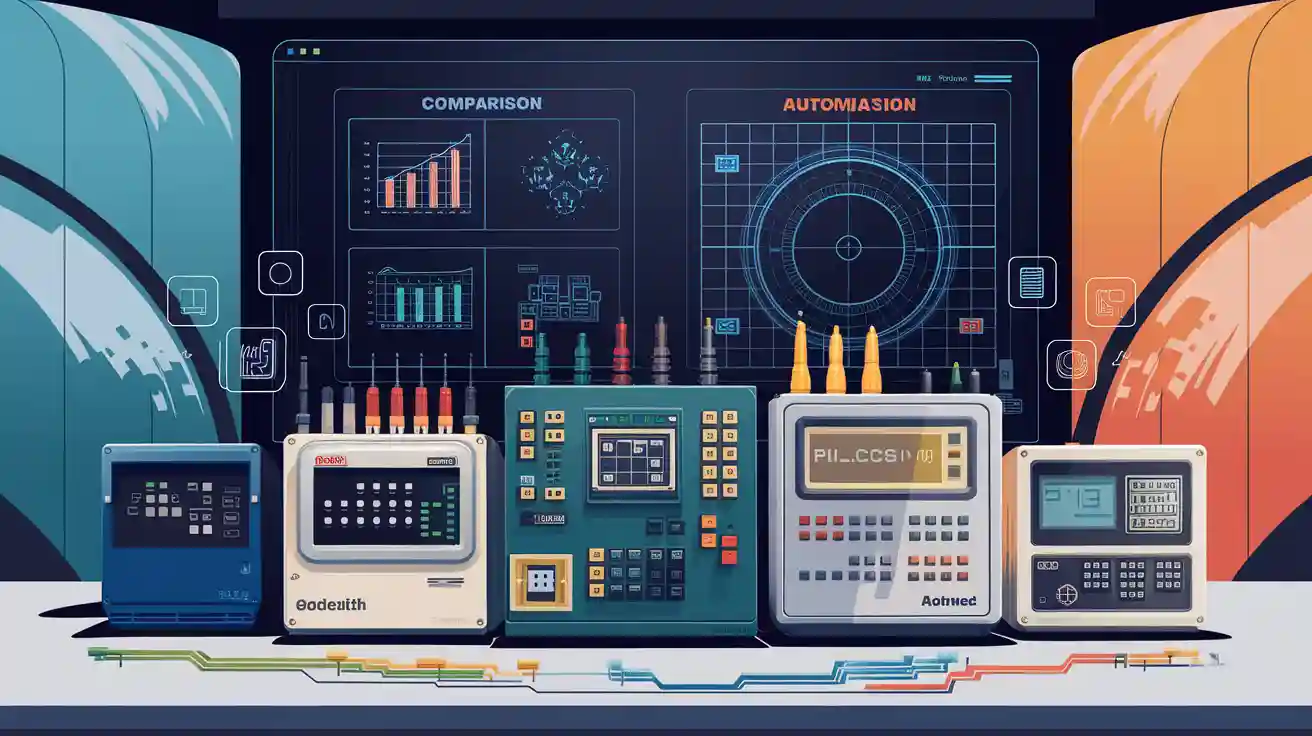
You want to pick the best PLC for your project in 2025. Siemens works well for big factories and can grow with your needs. Allen-Bradley gives very accurate control and connects easily for hard jobs. Mitsubishi Electric has cheaper choices that you can build up as needed. Schneider Electric saves energy and is ready for smart devices. ABB is strong and good for tough jobs in heavy industries. Omron makes small PLCs that work well with robots. The table below shows how these top PLC brands compare:
Brand | Key Features | Cost Range | Ideal For |
|---|---|---|---|
Siemens | High performance, scalability | $500 – $2,000+ | Large industrial plants |
Allen-Bradley | Premium precision, integration | $1,000 – $5,000+ | Complex, high-end applications |
Mitsubishi Electric | Affordable, modular designs | $300 – $1,500 | Small-to-medium enterprises |
Schneider Electric | Energy-efficient, IoT-ready | $400 – $2,000+ | Versatile industrial needs |
ABB | Robust for heavy industries | $800 – $3,000+ | Mining, oil & gas sectors |
Omron | Compact, robotics-ready | $200 – $1,000 | Small-scale automation |
New PLC models now use more edge computing and better connections. Looking at Siemens and Allen-Bradley helps you choose the right PLC for your job.
Top PLC Brands 2025
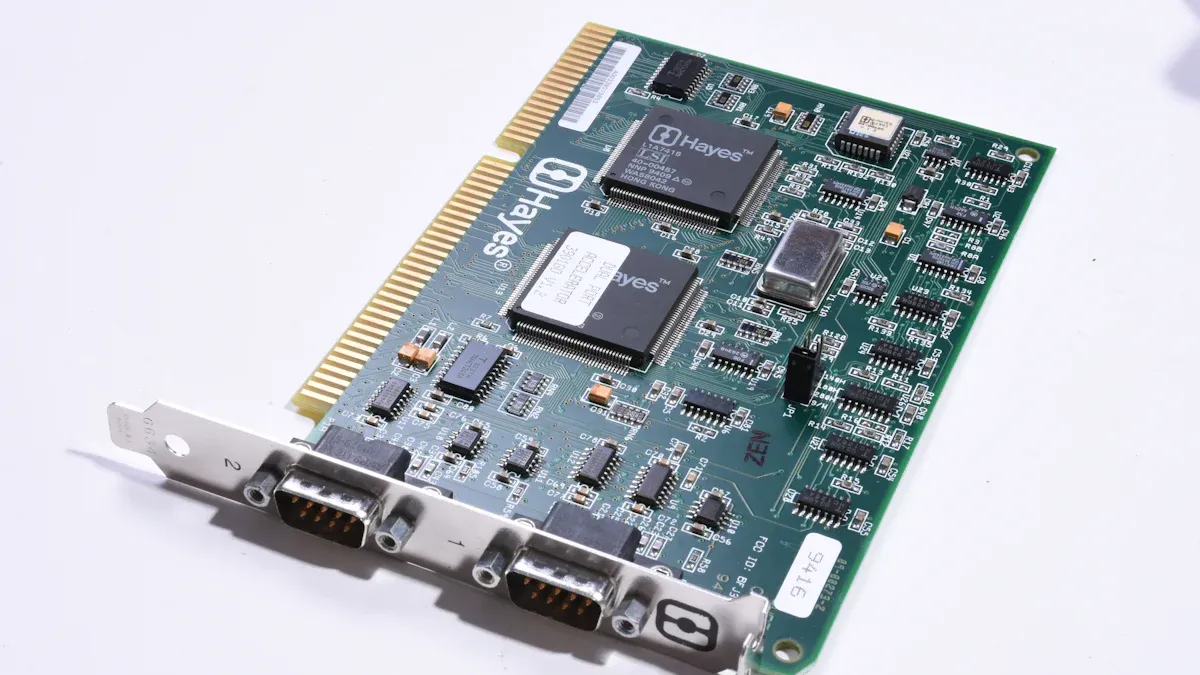
When you look for the best plc brands in 2025, six names are most popular. Each brand has something special for automation. People want to know how these brands do in speed, trust, and how easy they are to use. The table below shows what people check when picking a plc brand:
Criteria | Description |
|---|---|
Performance and Reliability | Speed, uptime, and durability. |
Ease of Programming | User-friendly interfaces and tools. |
Scalability | Ability to expand and connect with other systems. |
Technical Support | Quality customer service and resources. |
Cost | Purchase price and total cost of ownership. |
Siemens
You see Siemens in many factories and power plants. This brand is known for strong support and new ideas. Siemens plc models like S7-1200 and S7-1500 have fast processing and lots of memory. They are good for hard automation jobs. Siemens is used in Europe, Asia, and other places. You get help and products that follow world rules.
Tip: Siemens is a smart pick if you want to grow your system and work on big projects.
Allen Bradley
Allen Bradley is great for real-time control and easy setup. You get simple programming and strong safety for your data. Allen Bradley plc systems help you run machines and keep things safe. They use AI to fix problems before they happen. You can count on Allen Bradley for tough jobs.
Secure boot and encrypted communications
Role-based access control
Pattern recognition for quality control
Mitsubishi Electric
Mitsubishi Electric gives you plc choices that are not expensive and can be changed as you need. You can start small and add more later. Mitsubishi keeps making new products and growing. You get good performance and easy ways to upgrade.
Schneider Electric
Schneider Electric is a leader in saving energy and digital control. You find their plc products in many places like data centers and factories. Schneider helps you use less energy and work better. The company is growing and has a strong place in the market.
Digital automation for better control
ABB
ABB plc models are good for tough places. You get systems that can grow and tools to check for problems. ABB works for simple and hard automation jobs. Their products last long and can change as you need.
Note: ABB is a top choice for mining, oil, and gas work.
Omron
Omron works on smart maintenance and systems that can change. You get AI control and tools to fix things before they break. Omron works with others to make new ideas. Their plc products help you save energy and make better products.
Trend | Description |
|---|---|
Smarter Maintenance | Predictive maintenance reduces downtime and boosts efficiency. |
Adaptive Systems | AI-driven control adjusts to real-time data for better quality. |
Energy Efficiency | Advanced power conversion helps the environment. |
You can pick from these top plc brands for your automation needs. Each brand is strong in trust, speed, and help.
PLC Model Comparisons

Siemens S7-1500 vs Allen Bradley ControlLogix
You might wonder how Siemens S7-1500 and Allen Bradley ControlLogix compare. These PLCs are top choices in 2025. You see them in large factories and advanced projects. Both are reliable and work fast, but each has its own strengths.
Here is a hardware comparison table for these models:
Feature | Allen Bradley ControlLogix | Siemens S7-1500 |
|---|---|---|
Memory | 2MB to 20MB of user memory | Up to 32MB of work memory |
Communication | EtherNet/IP, ControlNet, DeviceNet | PROFIBUS, PROFINET, OPC UA, MQTT |
CPU Performance | Up to 0.1ms per 1000 Boolean instructions | Up to 0.04ms per 1000 instructions |
Siemens S7-1500 works faster. It has more memory and supports new protocols. Allen Bradley ControlLogix gives strong performance and connects well in North America.
Tip: Siemens S7-1500 is good for Industry 4.0 and edge computing. Allen Bradley ControlLogix is best for factory jobs and process control.
Here is a model comparison table for application suitability:
Feature | Siemens S7-1500 | Allen Bradley ControlLogix |
|---|---|---|
Performance | Optimized for complex algorithms and rapid response | Solid performance in discrete manufacturing |
Unified, user-friendly TIA Portal | Standardized programming environment (Studio 5000) | |
Scalability | Easily scalable across industries | Scalable, focused on North America |
Connectivity | PROFINET, PROFIBUS, OPC UA | EtherNet/IP, DeviceNet, ControlNet |
Cybersecurity | Secure boot, role-based access | Basic cybersecurity features |
Siemens S7-1500 is great for fast, complex automation. Allen Bradley ControlLogix fits factory automation and process control. Siemens makes programming easier with TIA Portal. Allen Bradley uses Studio 5000 for programming. Siemens has stronger cybersecurity to keep your system safe.
Mitsubishi MELSEC iQ-R vs Schneider Modicon M580
You may want a PLC that saves money and is flexible. Mitsubishi MELSEC iQ-R and Schneider Modicon M580 have modular designs and good software support. You can start small and add more as you need.
Feature | Mitsubishi MELSEC iQ-R | Schneider Modicon M580 |
|---|---|---|
Memory | Up to 16MB | Up to 32MB |
Communication | CC-Link IE, Ethernet/IP | Ethernet, Modbus TCP, OPC UA |
CPU Performance | Fast cycle times | Advanced processing with edge computing |
Mitsubishi MELSEC iQ-R lets you upgrade easily. Schneider Modicon M580 works with cloud and edge computing. Both help save energy and make systems more reliable.
Note: Mitsubishi MELSEC iQ-R is good for small and medium businesses. Schneider Modicon M580 is better for bigger and more flexible automation.
Schneider Modicon M580 leads in AI and cloud support. Mitsubishi MELSEC iQ-R is strong in modularity and saving costs.
ABB AC500 vs Omron NX1
You might need a PLC for tough jobs or small automation. ABB AC500 and Omron NX1 have different strengths. ABB AC500 is strong and works in heavy industries. Omron NX1 is small and ready for robots.
Feature | ABB AC500 | Omron NX1 |
|---|---|---|
Memory | Up to 8MB | Up to 4MB |
Communication | Ethernet, CAN, Modbus | EtherCAT, Ethernet/IP, OPC UA |
CPU Performance | Reliable in harsh environments | Fast response for robotics |
ABB AC500 is very reliable. Omron NX1 gives smart systems and helps fix things before they break. ABB AC500 is used in mining, oil, and gas. Omron NX1 is best for small automation and robots.
Tip: Pick ABB AC500 for hard jobs. Choose Omron NX1 if you want a small size and smart features.
Key Factors in Model Comparisons
When you compare PLC models in 2025, look at these important things:
Factor | Description |
|---|---|
AI Integration | PLCs use AI for predictive maintenance and quality control. |
Edge Computing | Most industrial data gets processed at the edge for fast response. |
Cloud Integration | PLCs connect to the cloud for real-time monitoring and control. |
Cybersecurity Measures | Advanced protocols protect your system from cyber threats. |
Software-Defined Architectures | Virtualized PLCs allow flexible control logic deployment. |
Interoperability Challenges | Integration issues can increase costs and slow down projects. |
Check performance, reliability, programming, and software support. Also think about hardware, scalability, and cybersecurity. These things help you pick the right PLC for your automation needs.
Key PLC Features 2025
Edge Computing Integration
Edge computing is changing how PLCs work in 2025. New PLC models process data right at the machine. This gives you faster results and less waiting time. You do not have to send all your data to a main server. Local dashboards let you watch and control your system nearby. Multi-core processors and SSDs inside PLCs help you run analytics fast. You can make decisions quickly with these new features.
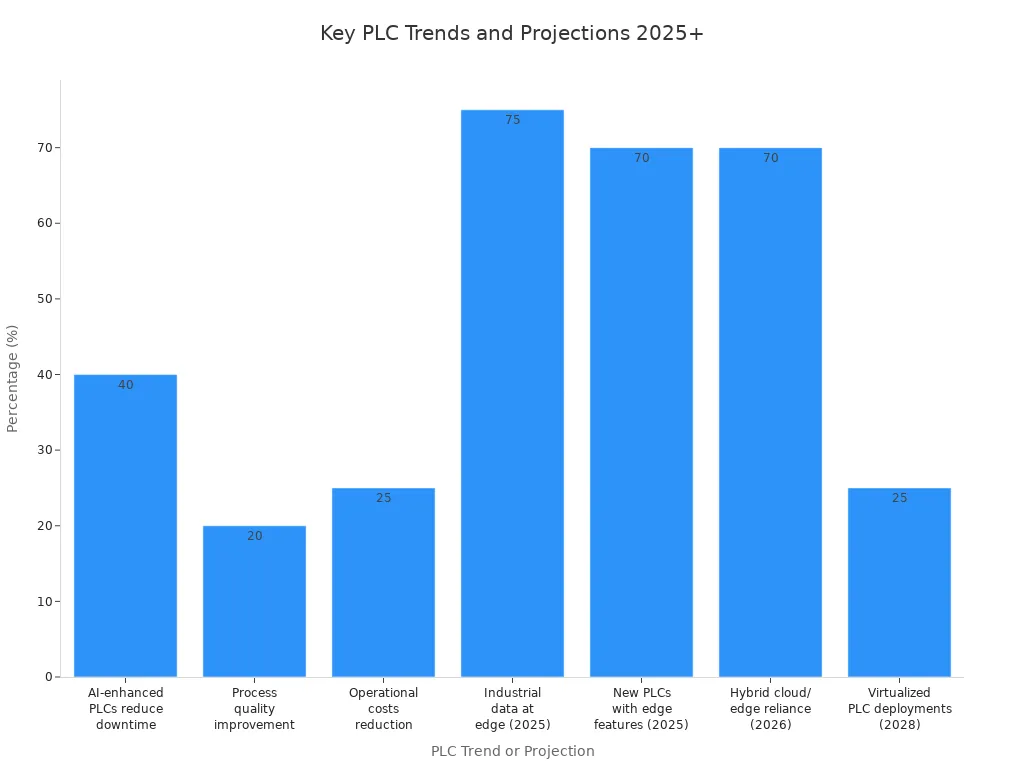
Did you know? By 2025, most industrial data will be processed at the edge. Many new PLCs will have edge computing built in.
Statistic | Description |
|---|---|
75% | Industrial data processed at the edge by 2025 |
70% | New PLC models with edge computing features |
N/A | Local dashboards and analytics without central SCADA |
N/A | Multi-core processors and SSDs boost edge computing |
Performance and Reliability
You want your automation system to be fast and reliable. Advanced PLCs use AI to find problems before they happen. This helps you fix things early and avoid downtime. Built-in cybersecurity keeps your system safe from attacks. You get secure boot, encryption, and global safety standards. These features make your system strong and dependable.
Feature | Description |
|---|---|
AI Integration | Predictive maintenance and quality control |
Built-In Cybersecurity | Secure boot, encryption, IEC 62443 compliance |
Software-Defined PLCs | Flexible and scalable control logic deployment |
Digital Twin Support | Simulation and optimization of PLC operations |
Application Flexibility
Modern PLCs work in many industries. They are used in factories, energy plants, and with robots. AI features help you cut downtime by almost half. Process quality gets better by up to 20%. You can save a lot on costs. Many companies use both cloud and edge solutions now. Virtual PLCs let you change control logic without new hardware.
Tip: Flexible PLCs help you grow and change your system. You get better results and save money.
PLC Pricing and Value
Cost Comparison
When you check PLC prices, look at more than the price tag. You pay for hardware, but also for training and support. Upgrades cost money too. Some costs are easy to spot. Others are harder to notice. You might need extra work to set up your system. Changing your process can add costs. If you switch brands, you may pay more. Special help from the vendor can cost extra.
Here is a table that shows the different types of costs you should think about during the life of a PLC:
Cost Type | Description |
|---|---|
Direct Costs | Initial purchase price, maintenance fees, hardware, training, support, upgrades |
Indirect Costs | Learning curve, integration effort, maintenance overhead, opportunity costs, risk factors |
Hidden Costs | Data migration, process changes, change management, compatibility issues, vendor lock-in |
ROI Factors | Productivity improvements, quality benefits, quantifiable metrics like time savings and resource efficiency |
Tip: Pick a PLC that fits your needs and works with your setup. This helps you save money over time.
Value for Different Applications
You want the best value for your money. The PLC market is growing quickly. By 2025, it will be worth over 12 billion dollars. More companies want automation, so new models have better features. Think about how often you will use the PLC. Also, think about what jobs it will do. Big factories pay more at first but save money later. They get better performance and less downtime. Small businesses may choose cheaper models that still work well.
Manufacturers and system integrators care about cost and return on investment. They want systems that help them work faster and smarter. Check if the PLC saves time and improves quality. See if it helps you use resources better. The right PLC gives good value and helps your business grow.
Note: Always look at the total cost and the benefits before you buy. A smart choice in automation can make your work easier and help you earn more.
Choosing the Right PLC
Application Suitability
You need a PLC that fits your project and budget. Every industry needs something different. Some factories want fast control and strong security. Others need systems that can grow with their business. Look for features like AI, edge computing, and cloud support. These features help you save money and make things work better.
Here is a table that shows what is important when picking a PLC for your job:
Criteria | Projected Impact/Feature |
|---|---|
AI Integration | Cuts downtime by up to 40%. Makes process quality better by 15-20%. Lowers costs by up to 25%. |
Edge Computing | By 2025, over 75% of industrial data will be handled at the edge. |
Cloud Capabilities | By 2026, more than 70% of manufacturers will use both cloud and edge for PLC data. |
Cybersecurity | PLCs will follow IEC 62443 rules and use strong security. |
Software-Defined Architectures | By 2028, at least 25% of new PLCs will be virtual, so they can change and grow easily. |
Tip: Pick a PLC with a modular design. You can upgrade parts when you need to. This helps you save money and not buy a whole new system.
When you look at brands, check their software and support. Siemens uses TIA Portal for hard automation jobs. Allen-Bradley works well in big factories. Mitsubishi gives fast control. Omron is good for robots. Schneider Electric helps save energy. ABB is strong for important infrastructure. Delta is a good choice for small jobs and saves money.
Think about scalability and adaptability.
Choose a PLC that fits your needs now and can grow later.
Future Trends
PLC technology will change a lot after 2025. AI will be a normal feature. Edge computing will handle most data close to the machines. Cloud integration will let you watch systems from anywhere. Software-defined PLCs will make control logic easier to change.
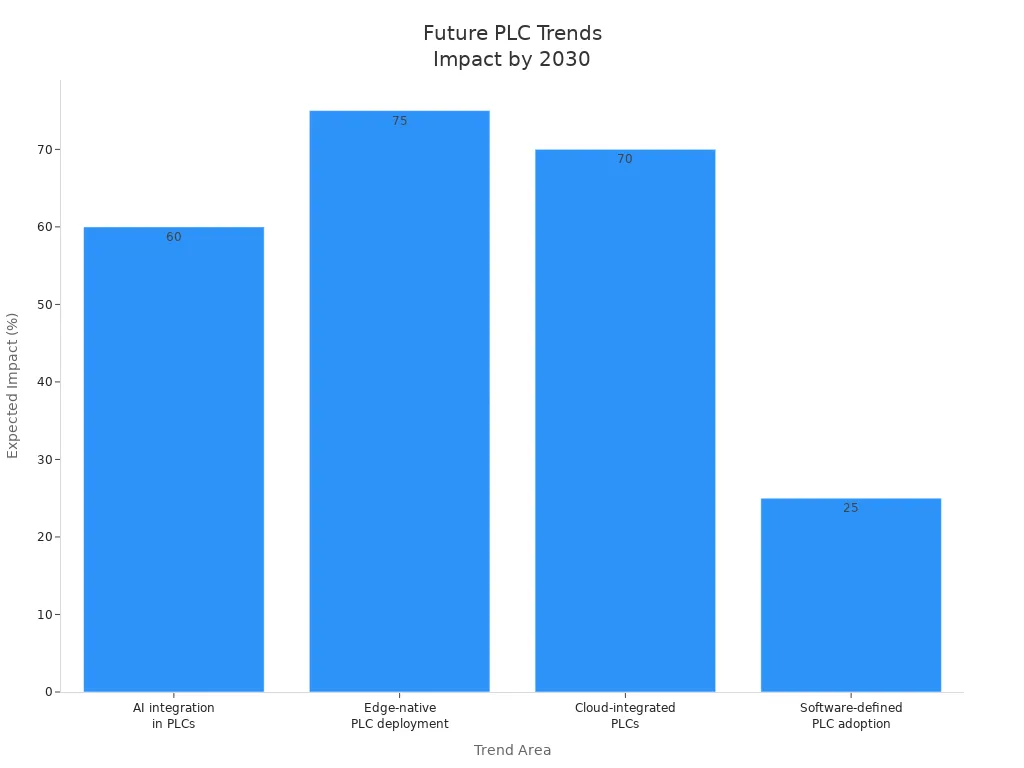
You should think about these changes when picking a PLC. AI systems can fix problems before they happen. Edge PLCs work faster and cut delays. Cloud setups help you manage sites all over the world. Virtual PLCs let you change control logic without buying new hardware.
Note: Pick a PLC that supports new technology. This helps your system stay strong and ready for new things.
You can look at the table below to see which brand works best for your needs. Siemens is good if you want strong performance. Allen-Bradley is best for jobs that need very exact control. Mitsubishi Electric is a good choice if you want to save money. Schneider Electric helps you use less energy. ABB is tough and works well in big industries. Omron is great for robots.
Brand | Best Use Case |
|---|---|
Siemens | Complex automation |
Allen-Bradley | High precision |
Mitsubishi Electric | Fast, affordable control |
Schneider Electric | Versatile, energy-saving |
ABB | Heavy industries |
Omron | Robotics |
Keep learning about new things like edge computing and AI. Talk to vendors, try out demos, and think about what your system needs next.
FAQ
What is a PLC and why do you need one?
A PLC is a computer that controls machines and processes. You use it to make your work safer and faster. PLCs help you run equipment in manufacturing and industrial automation.
How do you choose the right PLC brand?
You should look at your project size, budget, and future needs. Some brands work better for large factories. Others fit small jobs. Always check support and upgrade options.
Can PLCs connect to cloud systems?
Yes, many new PLCs connect to cloud systems. You can watch and control machines from anywhere. This helps you manage data and improve your process.
What is edge computing in PLCs?
Edge computing lets your PLC process data close to the machine. You get faster results and better control. This feature is important for modern industrial automation.