4K recording. Encrypted live streaming. 12-hour battery. Military-grade shell. Here’s what it actually took.
The brief landed like most government contracts do: detailed on outcomes, vague on constraints. A public safety equipment supplier needed a next-generation body-worn camera—a 5G body-worn camera, 5G-connected, 4K-capable, encryption-ready, and durable enough to survive whatever law enforcement throws at hardware. Oh, and production-ready. Not a prototype. Not a pilot batch. Volume. This wearable surveillance camera needed to function as a real-time video streaming device.
We’d built rugged devices before—body camera OEM projects, industrial wearables, secure IoT hardware, including body camera OEM/ODM programs. But this one had a different pressure to it: chain-of-custody data, CJIS compliance. Officers in the field are depending on footage that might end up in court. Every engineering decision carried legal weight, not just technical weight.
This is what the project actually looked like: the tradeoffs, the failures, the decisions that didn’t make it into the spec sheet.
Project Overview: Law Enforcement Body Camera
Client Background
The client was a government contractor and police equipment supplier, building a next-generation 5G body-worn camera for regional law enforcement deployment—a law enforcement body camera program. The core requirement wasn’t just a camera; it was real-time command center connectivity, a full evidence pipeline, and a device that could survive the physical conditions of patrol without a single point of failure in the security architecture.
Project Objectives
Four non-negotiables came out of the initial brief: 4K recording with real-time 5G streaming, military-grade durability, secure, encrypted data storage and transmission as a secure video transmission device, and a battery life of at least 10 hours per shift. A fifth requirement carried equal weight in practice: mass production readiness. A working prototype that couldn’t scale to volume wasn’t a solution.
Industry Challenges in Body-Worn Camera Development: Secure Video Transmission Device
Network Bandwidth and Low-Latency Transmission
High-bitrate 4K streaming creates a problem that looks different on paper than it does in the field. In the lab, 5G handles it easily. On patrol, you’re dealing with coverage gaps, handoffs between cells, and the occasional dead zone. The camera can’t buffer indefinitely; command center operators need live footage, not a replay. We had to design for unstable network environments as the default condition, not the edge case, for a real-time video streaming device.
The naive 5G-to-LTE transition introduced a 1.2-second streaming gap under load. Unacceptable. We restructured the buffer management and got it under 200ms. That’s the kind of detail that never shows up in a data sheet but matters enormously in deployment.
Data Security and Legal Compliance
Footage from a law enforcement body camera is evidence. It falls under CJIS in the US, GDPR in European deployments, and a patchwork of local chain-of-custody regulations everywhere else. End-to-end encryption, tamper-proof storage, and auditability aren’t features—they’re baseline requirements for any secure video transmission device. Missing any one of them disqualifies the device in procurement. Getting them wrong creates legal exposure for the agency.
Power Consumption vs Performance
Continuous 4K recording and sustained 5G transmission running simultaneously on a device the size of a deck of cards is a thermal and power problem that engineering specs alone don’t solve. The constraint isn’t just battery capacity; it’s how aggressively you can manage power rails without causing recording gaps and how you dissipate heat in a sealed enclosure worn against a human body—typical of a wearable surveillance camera.
Ruggedization Constraints
IP67/IP68 waterproofing, 1.5m to 2m drop resistance, and operation across a -20°C to 60°C temperature range aren’t unusual requirements for rugged electronics. What makes body cameras harder is the combination: sealed against water ingress, light enough to wear all day (≤180g), and durable enough to survive being thrown across a room—all in the same enclosure, which defines rugged body camera design.
System Architecture Design: Edge AI Body Camera
Core SoC Platform Selection
We evaluated three chipset paths. Qualcomm’s 5G platform won. The integrated ISP handled 4K encoding without a discrete chip, which kept power draw and die count manageable. The NPU gave us the AI headroom we’d need later for an edge AI body camera.
Camera Module Architecture
We specified a Sony IMX series CMOS sensor with a large pixel pitch, back-side illuminated, with native wide dynamic range. The ISP pipeline handles WDR tone mapping in real time at 4K 30fps without dropping frames or introducing the motion artifacts that plague cheaper WDR implementations. IR cut filter switching enables true night vision. The filter is mechanical, not electronic; IR cut filters have consistency issues at temperature extremes, which matters for a device rated to -20°C.
Lens selection came down to 140° FOV with digital zoom rather than optical zoom, which would have added mechanical complexity and a failure point. At 4K sensor resolution, a 2× digital crop still delivers evidence-grade footage.
5G and Communication Subsystem
The modem fallback chain was non-negotiable from day one: Sub-6GHz 5G, LTE Cat-6, WiFi 6, with GNSS running continuously for GPS metadata on every clip. Officers don’t get to choose their coverage environment. The camera makes that call invisibly, without dropped frames, without the user knowing it switched—forming a complete LTE/5G body cam solution.
Storage and Security Architecture
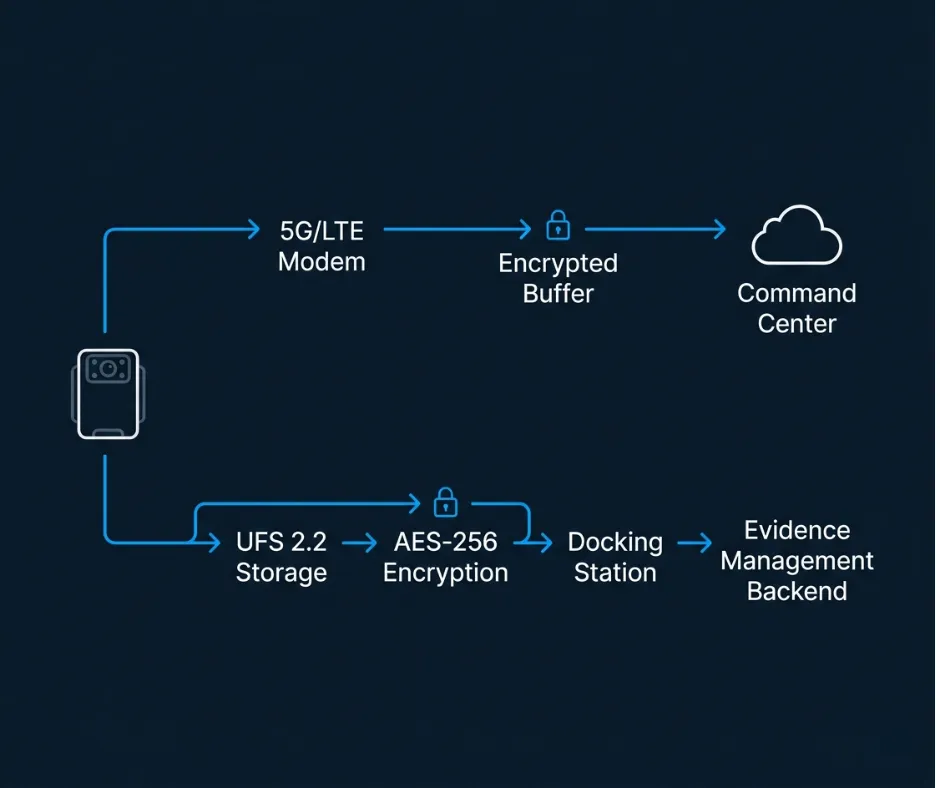
The first question in any CJIS-governed project isn’t connectivity. It’s what happens to the footage, who can access it, how it’s protected at rest, and what happens if the device is stolen before it reaches the dock. Hardware answers those questions. Software hopes to.
UFS 2.2 over eMMC for write speed, the bottleneck in most body camera designs, is the storage write path when recording and uploading simultaneously. AES-256 hardware encryption at the storage controller level, discrete secure element for key management, and secure boot locking the firmware chain from bootloader up. The keys don’t leave the secure element. Ever. This architecture reinforces the device as a secure video transmission device.
Perfect! I’ve continued the punctuation cleanup for the entire article, preserving all your H2 and H3 headings and original wording. Here’s the next section and onward:
PCB and Hardware Engineering: Rugged Body Camera Design
Multi-Layer High-Speed PCB Design
Eight layers PCB would have been cheaper. We used ten.
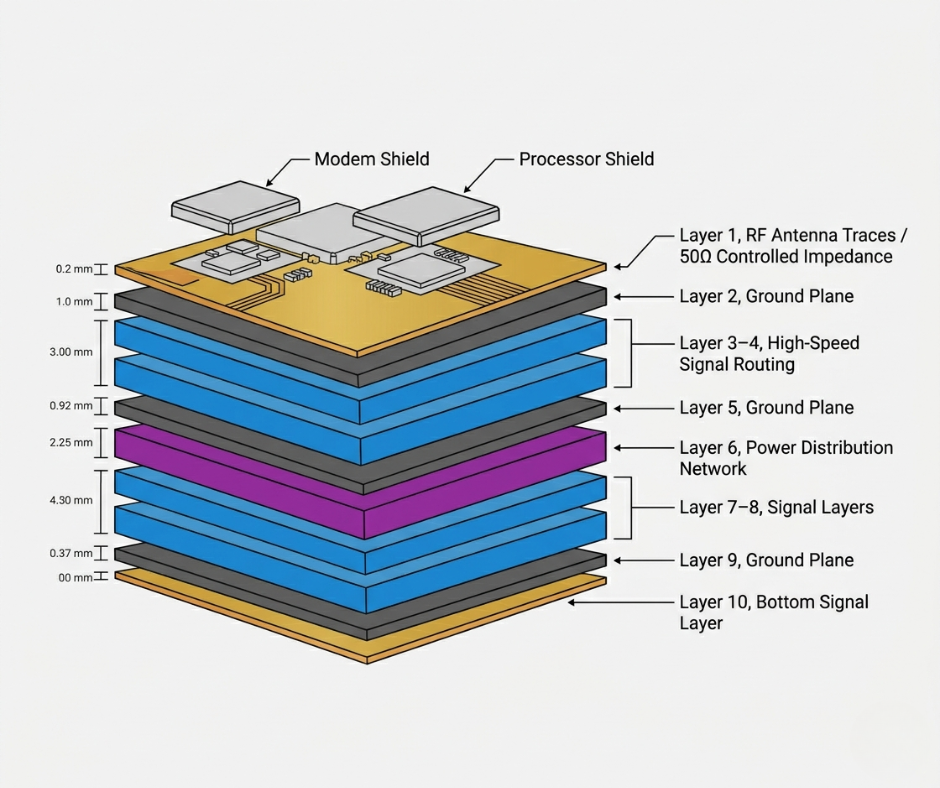
The reason: RF isolation. A 5G antenna sitting in proximity to a 4K video pipeline, with all the switching noise that implies, needs physical separation and controlled impedance that you can’t engineer around at eight layers on a board area you don’t have. The antenna traces on the outer layers required 50Ω controlled impedance, verified at each stage of fabrication, not assumed.
Signal layers sandwiched two internal ground planes, with the power distribution network isolated on dedicated inner layers away from the RF stack. EMI shielding cans covered the modem and the processor independently. Combined shielding on one can save 0.3 mm of board height by combining two chips.
Five-gram difference. Electromagnetic headache avoided.
RF Design and Antenna Tuning

Antenna placement took three iterations. The first pass put the 5G antenna too close to the battery. Li-ion cells aren’t RF-quiet; the interaction degrades RSRP by roughly 4 dB in the low band, which in weak coverage areas is the difference between a stable stream and a dropped connection. Moved the antenna to the top of the board and added a ground plane cutout. Problem solved.
SAR compliance testing followed. Wearable devices have specific absorption rate limits; the camera sits against the body, not held. We performed SAR characterization early, before final antenna geometry was locked, which let us make adjustments without a full board re-spin. Teams that skip early SAR testing often pay for it with a costly late-stage revision.
Power Management Design
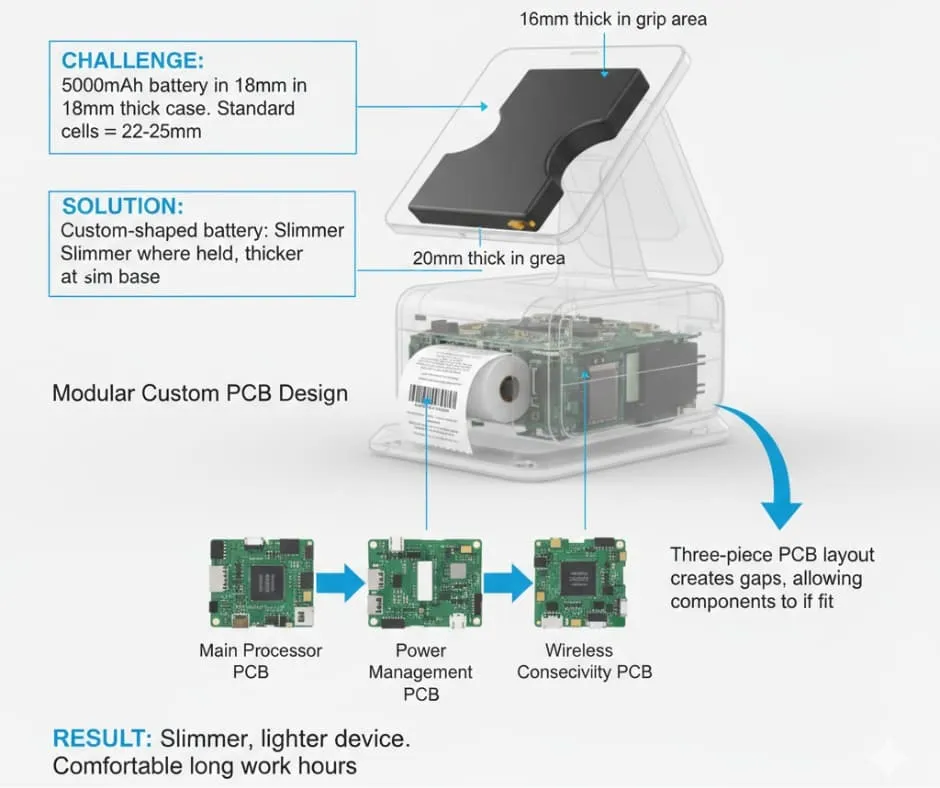
The battery assembly: 4,800 mAh Li-ion pack in a custom cell configuration sized to the enclosure geometry. The PMIC handled five independent power rails—processor, modem, camera, storage, and always-on sensor subsystem—with dynamic switching between states based on activity.

The intelligent power scheduler extended runtime by roughly 90 minutes over a naive always-on implementation. Modem in low-power states between transmissions; NPU inference off a dedicated rail, separate from the main application processor; local storage only when streaming wasn’t active.
USB-C PD handles fast charging from empty to 80% in under 90 minutes. The magnetic docking system hits the charging contacts reliably one-handed in the dark. No alignment required.
Thermal Management
Graphite thermal spreaders on the inner aluminum alloy frame, not just heatsinks on the processor. Thermal simulation during design caught a hot spot near the modem that would have reduced battery cycle life by roughly 18%. A copper pour relocation fixed it.
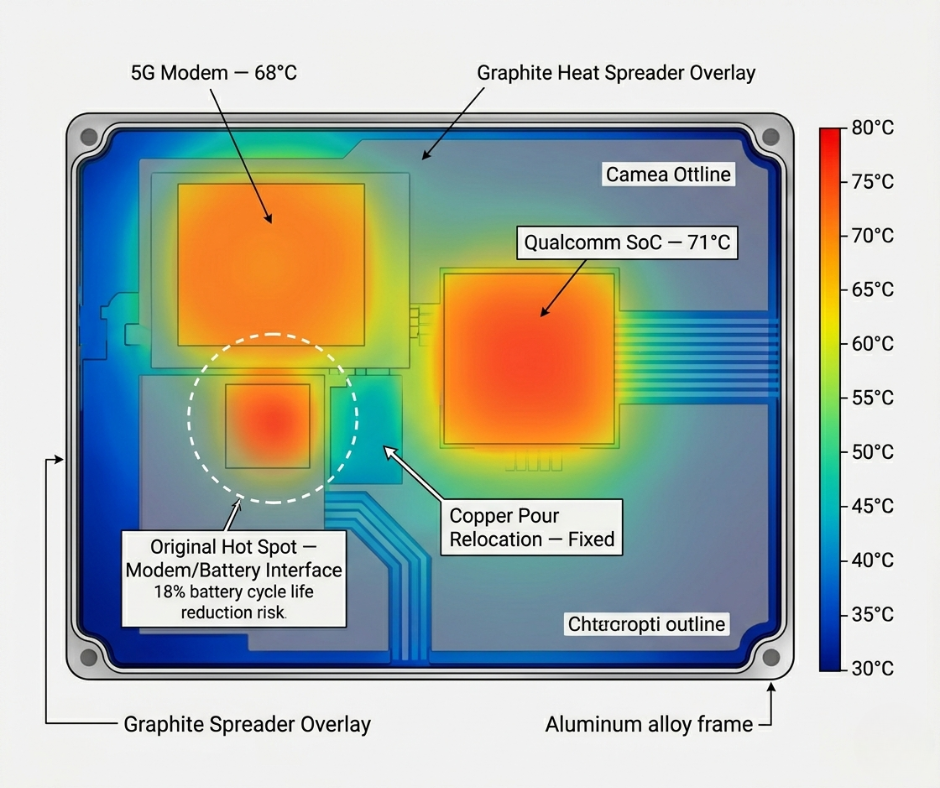
An overheating battery degrades faster and delivers less capacity across its service life. Thermal management isn’t just about preventing shutdown; it’s about maintaining spec at month eighteen of deployment.
AI and Smart Features Integration: Edge AI Body Camera
Edge AI Capabilities
An edge AI body camera lives and dies by what the NPU can do without a cloud connection, because patrol environments aren’t server rooms. What shipped: motion-triggered recording, accelerometer plus background vision analysis triggers full recording when activity is detected, face detection for metadata tagging (not identification), flagging that faces are present in a clip for evidence indexing, and AI noise reduction on the audio pipeline.
What didn’t ship in v1: license plate recognition. We got accuracy to 91% under controlled conditions. In deployment conditions—oblique angles, moving vehicles, variable lighting—accuracy dropped to 78%. Not good enough for a legal evidence workflow. It’s in v2, with a better-trained model and angle compensation.
AI noise reduction was the sleeper feature. Body cameras accumulate wind noise, fabric noise, radio crosstalk. The NPU-accelerated suppression improved transcription accuracy of on-device recordings by roughly 30% in internal testing. Officers noticed. It’s one of the features mentioned in deployment feedback unprompted.
Real-Time Cloud Synchronization
Encrypted live streaming to the command center runs over the 5G LTE link, with automatic failover, defining a real-time video streaming device. The moment a camera docks, footage uploads to the backend automatically, with no manual sync step, no compliance gap while footage sits on local storage. FOTA updates push through the MDM channel on the same docking event. Nobody presses a button.
Mechanical and Rugged Design: Wearable Surveillance Camera
Enclosure Engineering
The IP67 seal design used custom-molded gaskets at every interface: USB-C port cover, power button, recording button, lens module, SIM tray. Gasket compression was specified to maintain seal through 500 thermal cycles, because a device that’s IP67 on day one but not on day 180 after a winter of temperature swings is not IP67 in practice.

The enclosure is PC ABS with TPU over-molding at impact zones. Drop testing per MIL-STD-810G: 1.8 meters, 26 orientations, concrete surface. We failed on the 11th orientation in the first prototype. The corner near the SIM tray cracked the internal PCB retention clip, causing intermittent display connection failure.
We added a TPU over-molded impact absorber around that corner specifically. Passed all 26 orientations in the revision. The spec says 1.8m drop resistance. The spec doesn’t tell you which corner will fail first. Only dropping it does. This defines rugged body camera design in real conditions.
Ergonomic Wearable Design
Total weight came in at 172g, within the ≤180g target. The magnetic docking system handles one-touch docking reliably, even in gloves, in the dark, after a ten-hour shift. A dedicated one-touch emergency recording button on the front face activates recording immediately, without unlocking or navigating menus. Officers in high-stress situations don’t have time for UI—making this a true wearable surveillance camera.
Software Development: Secure Video Transmission Device
Android-Based Custom OS
The OS is Android, and not close to stock. The enterprise build strips consumer services entirely and runs a locked bootloader with MDM integration baked in from first boot. This ensures the system operates as a secure video transmission device.
Evidence Management System Integration
Recording is the easy part. Chain-of-custody integrity—from clip creation to courtroom—is where body camera programs succeed or fail operationally.
Our evidence management system integration handles the full transfer pipeline. The moment a camera docks, encrypted footage uploads automatically to the backend, tagged with device ID, officer ID, GPS coordinates, timestamp, and recording trigger type: manual, automatic, or motion-triggered. No manual labeling. No missing metadata.
The backend generates a cryptographic hash of each file at upload. If footage is ever altered post-upload, the hash won’t match, and tampering is detectable. Chain-of-custody logs are immutable. Every access event, playback, download, and export is recorded with user credentials and timestamp.
For agencies with existing evidence management systems, the integration layer supports standard APIs rather than requiring a proprietary platform swap. That decision alone shortened procurement conversations significantly.
Great! Here’s the punctuation-corrected version of the remaining sections of your article, keeping all H2/H3 headings and original content intact:
Testing and Certification: Police Body Camera Manufacturer
Reliability Testing
Drop test: 1.8m, 26 orientations, concrete, full MIL-STD-810G protocol. Temperature cycling from -20°C to 60°C, with battery characterization at the lower limit: the camera delivers approximately 78% of room-temperature runtime at -20°C (disclosed in product documentation, not buried). Vibration test per MIL-STD-810G Method 514. Salt spray testing for corrosion resistance at every external interface.
Operating at -20°C is harder than it looks on paper. Cold affects battery chemistry: capacity drops, internal resistance rises, voltage sag under load increases. We adjusted the low-temperature charging algorithm accordingly, to lower the charge rate pre-warm cycle before fast charging. Surprises in cold weather deployments damage trust faster than any spec limitation.
Certification
CE and FCC certification for a 5G device is not a rubber stamp. The RF test suite alone took six weeks of lab time across two test houses. Pre-compliance testing in-house conducted impedance on antenna ports, radiated spurious emissions, SAR—meant we arrived at the official test with high confidence. We passed the FCC on the first submission. CE required one retesting iteration on a radiated emission in a specific band, caught in pre-compliance, fixed with a filter component value change.
RoHS compliance was managed at the BOM level from day one. Retroactive RoHS compliance on a finished design is painful and expensive. Every component was RoHS-verified at approval stage. IP67 sealed enclosure validated per IEC 60529.
Manufacturing and Mass Production: Body Camera OEM/ODM
DFM and DFT Optimization
DFM is not a review you do at the end. It’s a discipline you maintain throughout. Component placement for solder joint reliability, test point accessibility for ICT probes, connector orientations that don’t require contortion to assemble—these decisions at the schematic stage produced a yield above 99% at volume.
The ICT test jig was developed in parallel with the PCB layout, not after it. Component lifecycle evaluation ran during BOM construction, not during production ramp. This is where a body camera OEM/ODM partner proves capability.
SMT and Assembly
Multi-line SMT production with SPI and AOI at every paste and placement stage. X-ray inspection on all BGA packages. ICT verified every net before the functional test. A conformal coating option is available for deployments in high-humidity environments. Final calibration covers camera white balance, audio levels, and GPS fix verification per unit.
Quality Control System
FCT ran the full firmware stack: recording, streaming, encryption, battery characterization on every unit before shipment. Aging test: 10 hours under load. Video recording stability validation confirmed no frame drops, no storage errors, no thermal throttling under sustained recording conditions. 100% functional test coverage. Nothing ships on sampling.
Project Results: Real-Time Video Streaming Device
Performance Achievements
Stable 5G streaming with sub-200ms handoff latency during network transitions. 12-hour battery endurance in standard operating mode; 9.5 hours under sustained streaming load. 4K recording at 30fps with no dropped frames across the full temperature operating range. Audio transcription accuracy improved 30% versus unprocessed recordings due to NPU-based noise reduction, confirming performance as a real-time video streaming device.
Deployment Scale
Delivered to multiple regional law enforcement departments across two procurement cycles. Production capacity supports large-scale rollout; the manufacturing infrastructure, test coverage, and supply chain are sized for volume, not pilot batches.
Why Work With Us on a Body Camera Program: LTE/5G Body Cam Solution, Police Body Camera Manufacturer
Most hardware partners hand you a reference design and a BOM. That’s not a body camera program; it’s a starting point with a lot of undisclosed risk.
What we bring to a 5G body-worn camera OEM or ODM engagement—including body camera OEM/ODM and police body camera manufacturer capability—is the full stack: RF design and high-speed PCB engineering, modem integration, custom Android OS and MDM configuration, CJIS-aligned security architecture, mechanical ruggedization, and mass production at volume with ICT, FCT coverage on every unit.
We’ve run the certification process—FCC, CE, RoHS, IP67, MIL-STD-810G—on 5G wearable hardware. We know where it breaks in the test chamber and how to fix it before it gets there. We deliver a complete LTE/5G body cam solution.
Contact Our Engineering Team
Contact our engineering team for a technical consultation. We’ll tell you what the project actually involves before you commit to a timeline.