Building a real-time voice translator demands intense edge computing and flawless acoustic design. This case study details the engineering behind a multilingual ai translator. You will explore hardware architecture, neural machine translation hardware, and the strict demands of an AI translation device manufacturer. The goal is mastering seamless, instantaneous cross-cultural communication hardware.
1. Project Overview
1.1 Client Background
First, you need to understand the exact motivation of the client. A major consumer electronics brand wanted to build an AI translator device to capture the surging post-pandemic travel boom. Target markets explicitly included international travelers navigating foreign transit systems, business users negotiating complex deals, and cross-border e-commerce professionals.
Also Read: Automotive Diagnostic Scanner Case Study
Originally, these users tried smartphone applications. Not so great. Phones ring, notifications interrupt conversations, and handing an unlocked phone to a stranger in a foreign city is dangerous. The goal was clearly defined. The brand wanted to compete aggressively with established translation device brands by building a dedicated, standalone piece of hardware. They sought an expert AI translation device manufacturer to guide them from a blank whiteboard to a finished product on retail shelves.
1.2 Project Objectives
What exactly did we need to build? First, of course, the device required real-time two-way voice translator capabilities. It must support 100 plus languages while connected online. Furthermore, offline translation for major languages was a non-negotiable requirement for travelers lacking cellular data. You will need aggressive AI noise cancellation to make the device usable in crowded train stations.
In terms of connectivity, we targeted 4G LTE, 5G potential, and WiFi 6. Users demand a long battery life, dictating a baseline of 10 hours of continuous active use. Finally, make sure to wrap all these heavy specifications inside a compact, pocket-size industrial design.
2. Industry Challenges in AI Translator Development
2.1 Speech Recognition Accuracy
In the beginning, capturing human speech sounds easy. It is not. Accent variation handling breaks most basic algorithms. Do you know? The English language alone has dozens of major regional accents that confuse standard models. Noisy environment filtering poses an even larger hurdle.
If you stand near a busy intersection, wind and traffic flood the microphone array. Far-field microphone pickup optimization is an absolute necessity. You cannot just place microphones randomly. You must calculate exact spacing to catch a voice from a meter away while ignoring the background noise.
2.2 Translation Latency
How fast must the system react? Minimizing the delay between speech input and the translated output dictates user satisfaction. If a gap grows too long, people talk over each other. Balancing edge AI versus cloud processing decides this latency. Edge processing is fast but consumes heavy power.
Cloud processing accesses massive language databases but suffers from network lag. This can be a useful question: do you process the grammar locally and just pull vocabulary from the cloud? Finding that architectural balance takes intense engineering.
2.3 Offline AI Model Constraints
Until then, developers loved massive cloud servers. With an offline translator device, you face brutal local limits. You have limited onboard storage. Deep neural machine translation hardware usually requires gigabytes of fast RAM.
You must achieve severe model compression without sacrificing translation accuracy. Efficient NPU utilization is a mathematical puzzle. The Neural Processing Unit runs matrix math very fast, but if the memory pipeline is too narrow, the processor starves for data.
2.4 Power Consumption
At the onset of testing, battery drain shocked the team. A continuous listening mode forces the processor to constantly scan for a wake word or voice activity. Wireless transmission impact pulls massive current spikes from the battery. Cellular radios transmitting data to a cloud server drain energy faster than a screen.
Thermal limits in a compact enclosure compound the problem. Heat builds up fast. You should generally avoid placing heat-generating chips directly beneath the user interface screen. When chips get too hot, they throttle speed, which ruins the translation latency.
3. System Architecture Design
3.1 Core Processing Platform
Then, you should map out the silicon foundation. We selected a highly specialized ARM Cortex-A series SoC. We implemented a big.LITTLE core arrangement. Small cores handle the standby mode to save battery, while big cores wake up instantly for voice processing. We integrated a dedicated NPU.
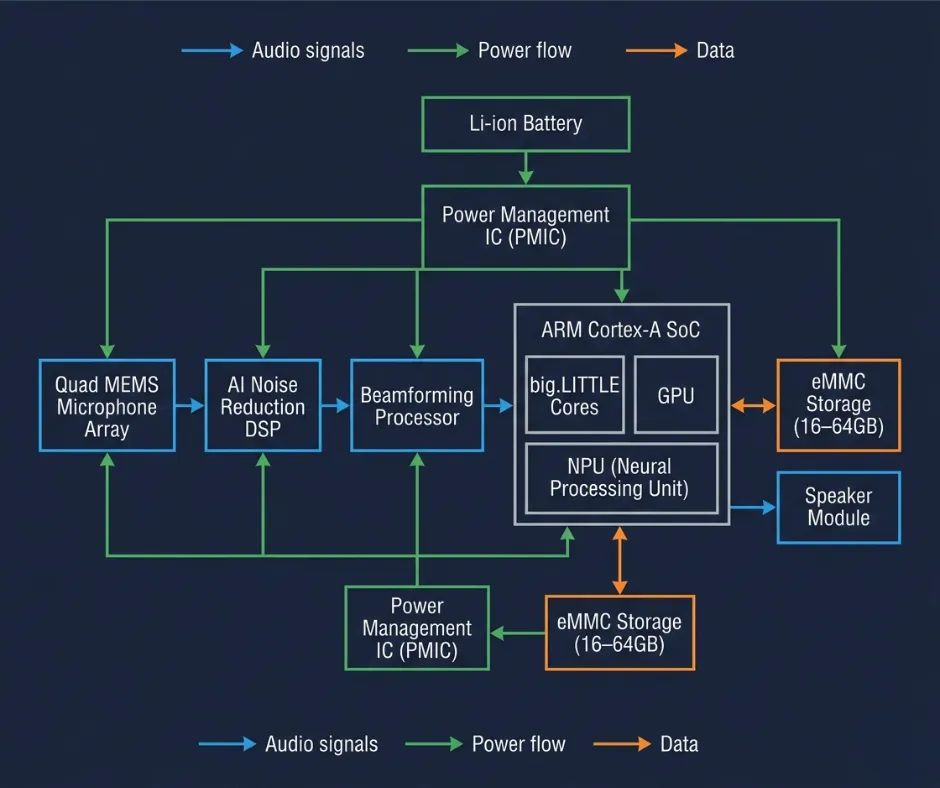
Edge AI acceleration support means the chip handles tensor operations natively. You can then use an Embedded Linux or Android OS foundation. We utilized a stripped-down Android Open Source Project base to easily manage drivers for the touch screen and radios.
3.2 Audio Subsystem Architecture
Second, the acoustic hardware requires obsessive tuning. We implemented a quad MEMS microphone array. Four microphones allow the software to build a three-dimensional map of the surrounding sound. A specialized beamforming algorithm focuses a digital “cone” directly at the mouth of the speaker.
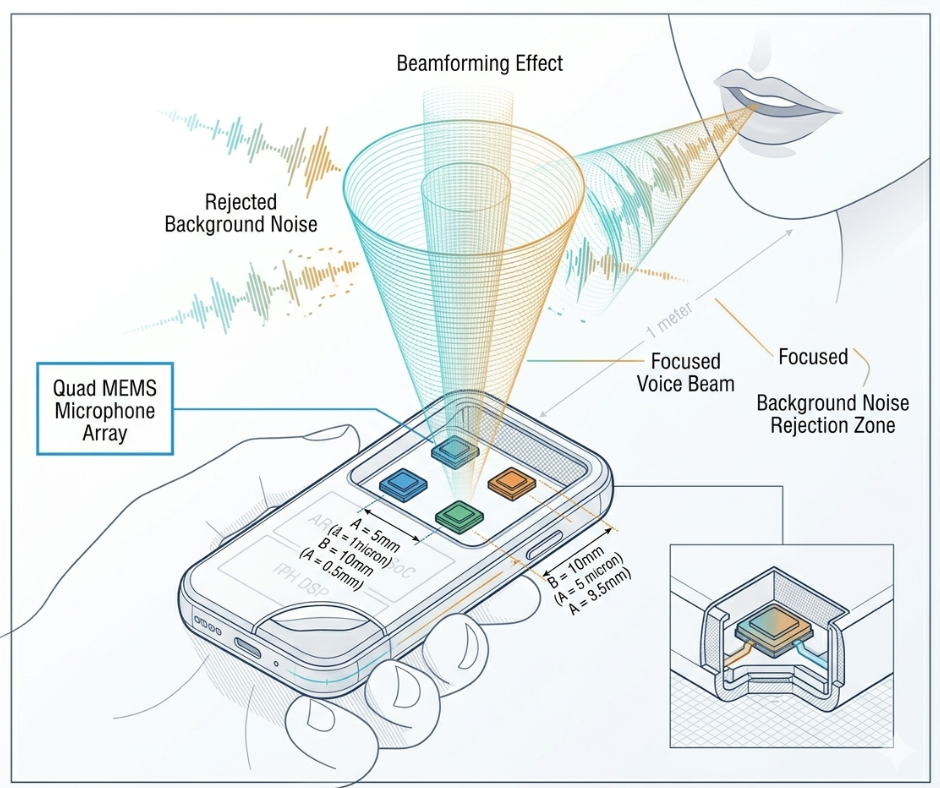
An independent AI noise reduction DSP cleans the audio stream before it ever touches the main processor. A high-fidelity speaker module sits at the bottom of the chassis. You want human voices to sound natural and deep, avoiding any metallic or robotic tones.
3.3 Connectivity Architecture
Thirdly, data pipes must be wide and fast. We integrated a WiFi 5 and 6 module for rapid hotel and airport connections. Bluetooth 5.0 enables users to pair wireless earbuds for private translations during business meetings.
An optional 4G LTE and eSIM module ensures the smart language translator OEM device connects to global cellular towers without requiring a physical SIM card swap. GPS functionality is optional but heavily requested for travel features, allowing the device to switch dialects based on the current geographic location of the user.
3.4 Storage & Security
Then, you have to build the data vault. We specified 16 to 64GB eMMC storage chips to hold the offline language packs safely. A strict secure boot architecture guarantees that malicious software cannot hijack the hardware during startup.
Encrypted cloud communication protects the spoken words as they travel to language servers. Corporate users discuss highly sensitive financial data. Thus, a rigorous user data privacy protection mechanism is mandatory to secure enterprise contracts.
4. AI & Translation Engine Integration
4.1 Speech-to-Text (ASR) Engine
Next, audio waves must become digital text. We deployed a deep learning Automatic Speech Recognition engine. Accent adaptation training pushed thousands of hours of diverse speech data through the model.
A real-time streaming ASR pipeline pushes text to the display letter by letter as the person speaks. It just means the user sees immediate visual feedback before the audio translation even begins.
4.2 Neural Machine Translation (NMT)
After that, the text flips into a foreign language. We adopted a modern Transformer-based model architecture. On-device inference optimization requires altering the math so it runs smoothly on a mobile chip rather than a desktop graphics card.
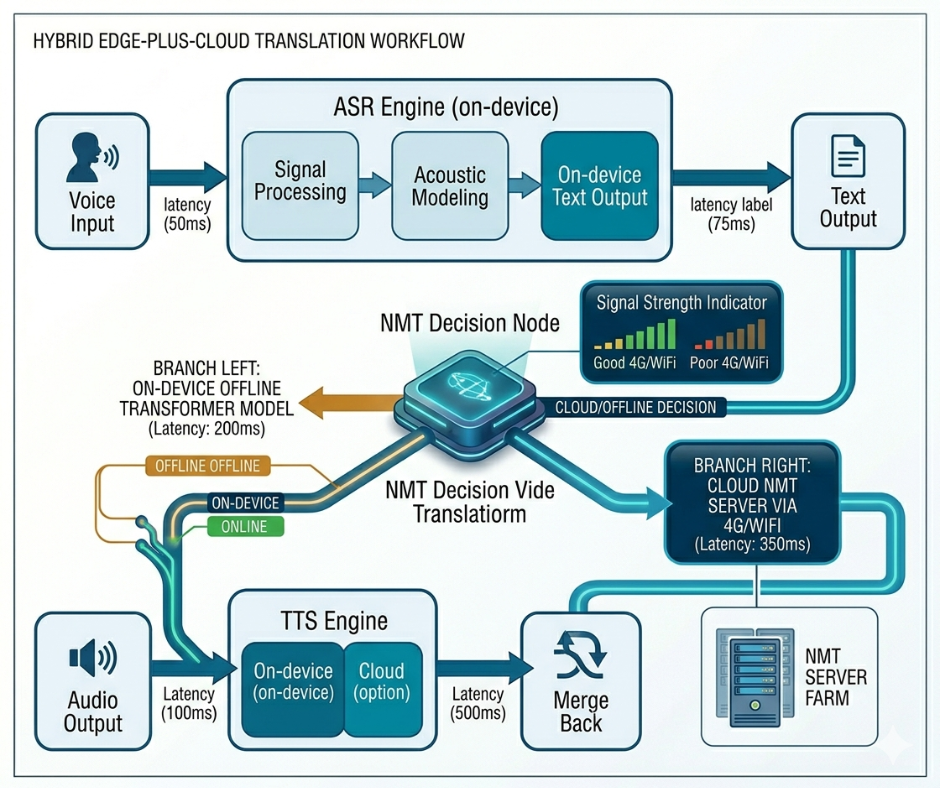
We developed a hybrid edge plus cloud translation system. If the 4G signal drops, the software seamlessly falls back to the local offline dictionary. Same as always, the user experience remains uninterrupted.
4.3 Text-to-Speech (TTS)
Soon, the machine must speak the translated words out loud. Natural voice synthesis is a complex art. Multi-language voice packs require acoustic models for precise tongue and lip sounds. The user must control the device.
You should be able to alter the adjustable speech speed and tone. An elderly user might need a slower cadence, while a fast-paced business executive demands rapid audio playback.
4.4 AI Model Optimization
How do you cram a massive language brain into a pocket device? You use quantization. We converted 32-bit floating-point math into INT8 or FP16 formats. Model pruning removes neural pathways that rarely activate. We ran exhaustive latency benchmarking. You would rather drop a minor grammatical particle than force the user to wait three seconds for the machine to formulate a response.
5. PCB & Hardware Engineering
5.1 Multi-Layer PCB Design
In turn, the printed circuit board routes all this heavy data. We engineered a dense 6 to 8 layer high-speed PCB. RF layout optimization ensures the WiFi and cellular signals do not cross paths and cancel each other out.
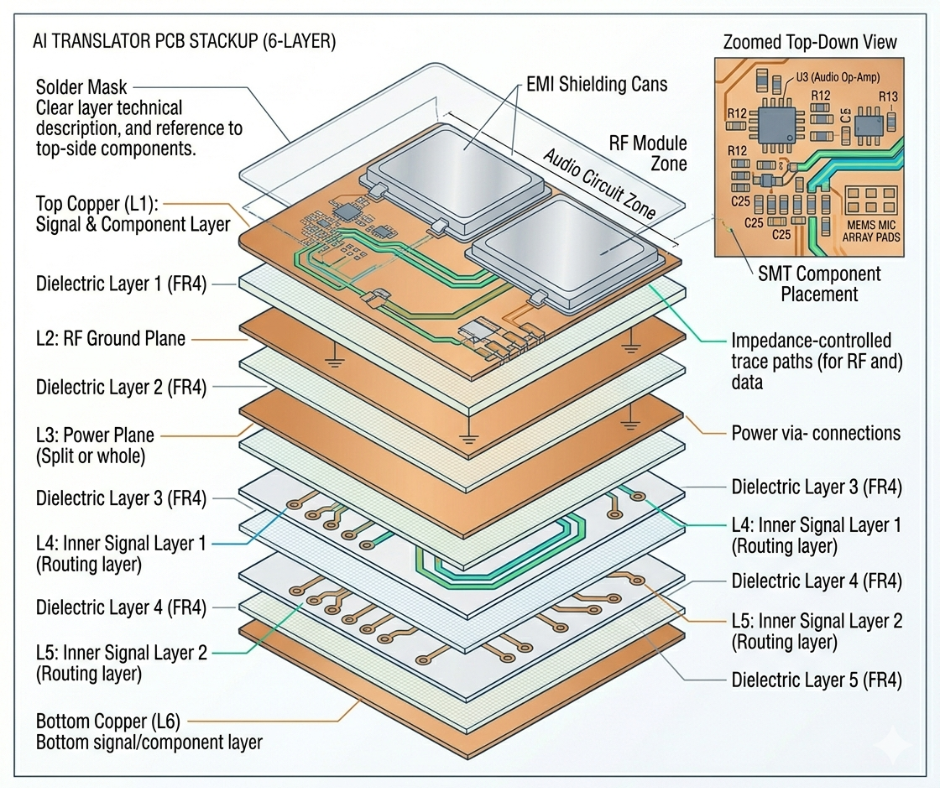
EMI shielding for audio circuits is non-negotiable. If radio frequency energy bleeds into the audio traces, the speaker will emit a terrible buzzing noise. Strict impedance control for wireless modules guarantees maximum signal integrity.
5.2 Power Management Design
Later, you tackle the power puzzle. We sourced a custom 2000 to 3000mAh Li-ion battery. A dedicated Power Management IC executes intelligent power scheduling. It shuts down power rails to the NPU the exact millisecond a translation finishes.
USB-C fast charging is a modern standard we easily integrated. A deep low-power standby mode allows the portable translation machine to sit in a backpack for a week and still turn on instantly.
5.3 RF & Antenna Design
Also, placing antennas inside a tiny device is a dark art. We routed an internal multi-band antenna along the plastic edge of the chassis. SAR compliance consideration is a massive legal hurdle.
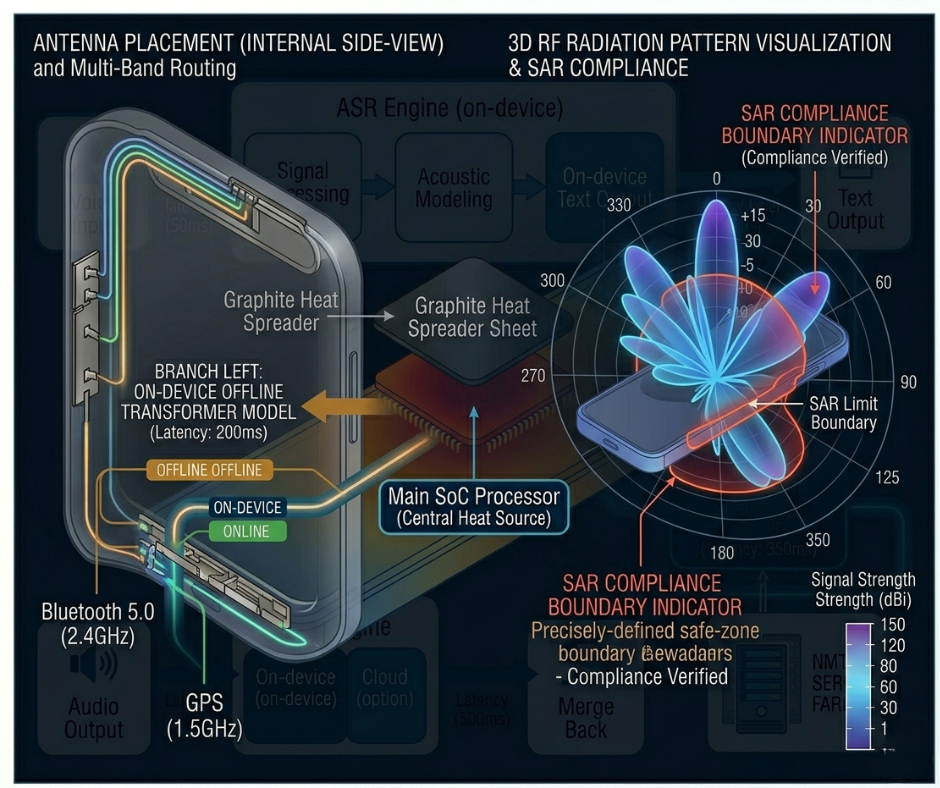
The radio waves must not penetrate human tissue above strict legal limits. Signal strength testing and tuning took place inside an isolated anechoic chamber to measure exactly how the radio waves radiate outward.
6. Mechanical & Industrial Design
6.1 Compact Enclosure Engineering
Now, all of this stated, the physical object must feel premium in the hand. We mandated a strict lightweight target of less than 150 grams. An aluminum alloy frame or a hardened PC plus ABS shell grants structural rigidity. A scratch-resistant display cover made from hardened glass ensures the screen survives sliding around in a pocket full of loose coins and metal keys.
6.2 Human-Centered UI Design
Moreover, interface navigation must be completely intuitive. A sharp 3 to 4 inch IPS touchscreen acts as the primary visual interface. However, looking at a screen breaks eye contact during a conversation. Therefore, we added highly tactile physical shortcut buttons on the side bezel. A dedicated one-touch instant translation mode allows the user to press a button, speak, and release it to trigger an immediate translation without ever glancing at the display.
6.3 Thermal Management
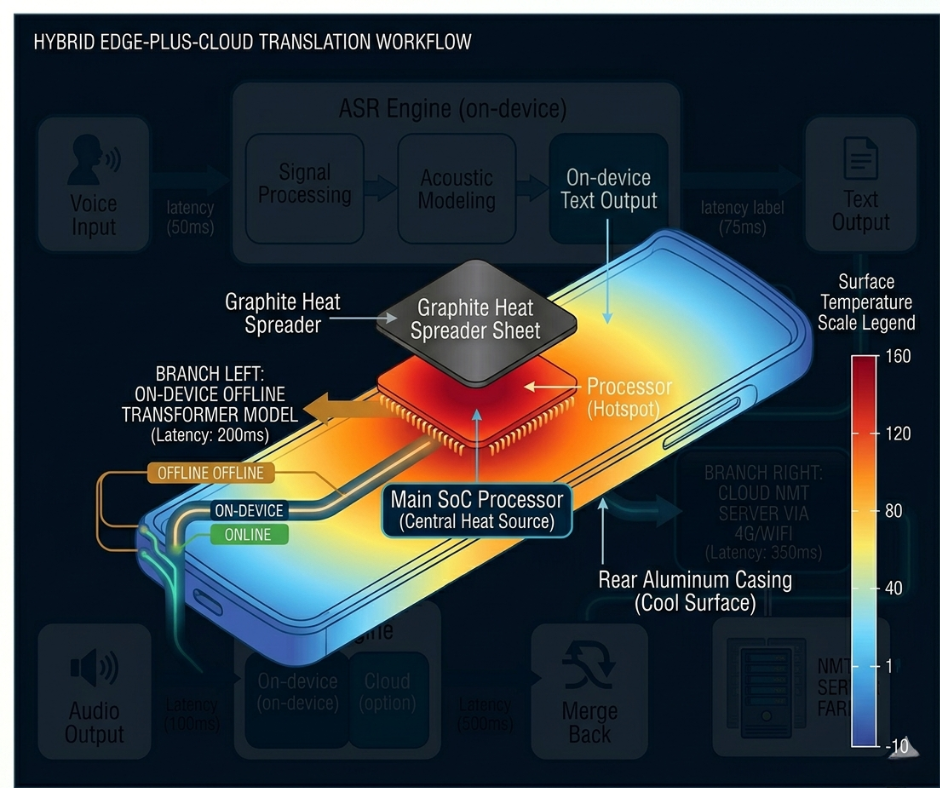
Consequently, all this processing generates extreme heat. Passive heat dissipation design is the only option, as motorized fans would ruin the audio recordings. We laid an internal graphite heat spreader across the back of the main processor. This pulls the thermal load away from a single hot spot and spreads it across the entire rear casing. Thermal simulation validation in software ensured the surface temperature never exceeds comfortable limits for human skin.
7. Software Development
7.1 UI/UX System Design
Next, the operating system layers wrap the hardware. A clean multi-language interface allows global users to navigate settings effortlessly. We engineered specific profiles, namely a travel mode and a business mode. Travel mode prioritizes street vocabulary and rapid exchanges.
Business mode switches the neural machine translation hardware to focus on formal grammar and industry jargon. Conversation history storage allows users to scroll back and read transcripts of previous interactions.
7.2 Cloud Integration
And, the device must evolve over time. A cloud-based language database pushes daily vocabulary updates to the fleet of devices. Over-The-Air firmware updates patch software bugs silently in the background while the user sleeps. AI model updates regularly refine the accent recognition software, making the multilingual translation system smarter the longer you own it.
7.3 Data Privacy & Security
Further, legal frameworks dictate strict software architectures. GDPR compliance is mandatory for any unit sold inside the EU market. End-to-end encrypted voice transmission locks the audio packets tightly. Even if a hacker intercepts the WiFi signal, they cannot decode the audio. A secure cloud storage option gives users the choice to back up their business negotiations to a secure server.
8. Testing & Validation
8.1 Acoustic Testing
How often do you push the hardware to the breaking point? We built specific testing rigs. Microphone sensitivity calibration guarantees all four microphones hear volume at the exact same level.
Echo cancellation validation forces the device to listen to loud background music while a person speaks; the AI must filter out the music entirely. Noise suppression benchmarking scores the device against controlled audio files of subway trains and jet engines.
8.2 Performance Testing
After awhile, you must measure the true speed limits. Translation latency measurement tools prove the gap between speech ending and text appearing is minimal. Battery endurance testing runs automated scripts that force the device to listen and speak continuously until the battery dies. AI accuracy benchmarking uses a library of complex, multi-clause sentences to test if the machine understands deep context or just swaps individual words blindly.
8.3 Environmental Testing
This will happen in the real world: a tourist drops the device. A severe drop test from 1.0 to 1.2 meters onto solid concrete measures the structural integrity of the plastic and glass. Temperature range validation places the unit inside an oven and a freezer to ensure the battery operates safely in extreme climates. Vibration testing simulates the harsh shaking of global shipping logistics.
9. Certification & Compliance
Second, a smart language translator OEM must pass a mountain of paperwork. You cannot legally sell electronics without passing regulatory boards. The CE mark clears the device for sale across Europe. The FCC stamp approves it for the American market. RoHS documentation proves the factory used environmentally safe solder and plastics.
Strict SAR testing proves the radio frequencies remain safe near the human body. Bluetooth SIG certification gives us legal permission to use the Bluetooth protocol. Finally, PTCRB testing is an absolute requirement if the cellular modem connects to North American telecom networks.
10. Manufacturing & Mass Production
10.1 DFM Optimization
Thirdly, making one perfect prototype is easy; making one million is incredibly hard. Design for Manufacturing optimization alters the PCB layout so robotic assembly lines can build it faster. Component lifecycle management ensures the purchasing department avoids buying microchips that the manufacturer plans to discontinue next year.
An alternative component strategy lists backup suppliers for every single resistor and capacitor. Test jig development allows factory workers to snap the motherboard into a testing dock and verify all functions in five seconds.
10.2 SMT & Assembly
Another phase begins on the factory floor. High-density SMT production uses massive robotic arms to shoot microscopic parts onto the solder paste. An automated audio calibration process occurs on the assembly line, where a robotic speaker plays a tone and the device microphone records it to prove functionality.
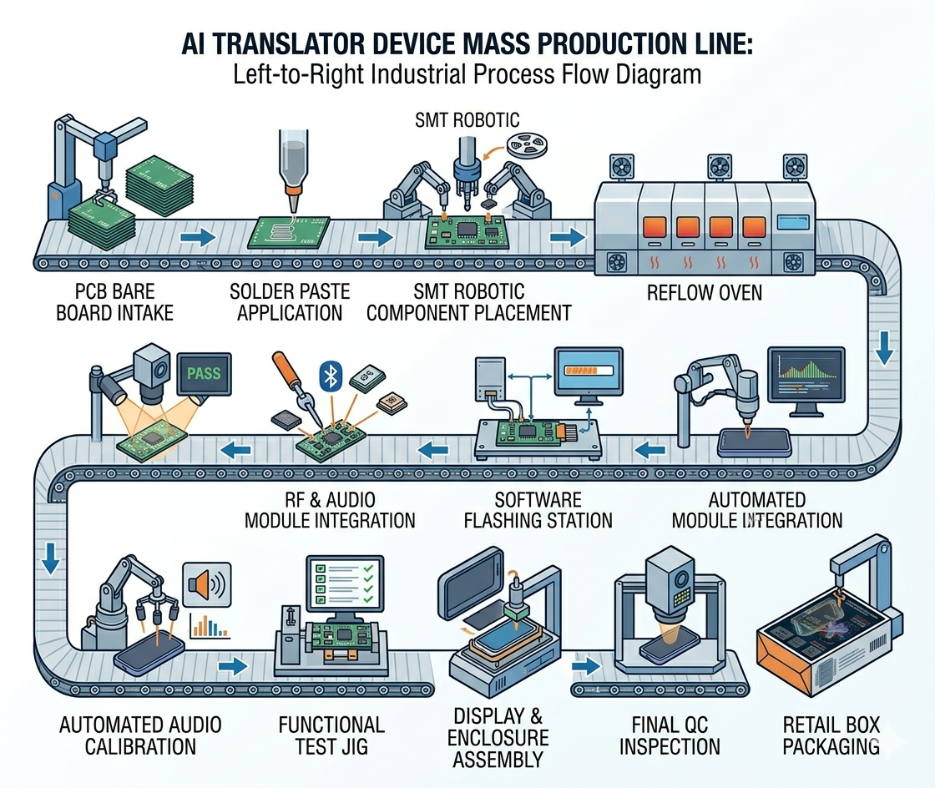
Final system flashing writes the latest software image directly onto the storage chip right before the unit goes into the retail box.
10.3 Quality Control
Note that you want to always want a perfect yield rate. A 100 percent functional test policy means a human or robot interacts with every single unit. Audio recording validation forces a worker to speak into the device and verify the playback quality. A quick wireless performance inspection connects the device to a factory router to prove the antennas are securely attached to the main board.
11. Project Results
11.1 Technical Achievements
Here’s what the experts measured upon project completion. Translation latency consistently remained under 1.5 seconds, even on weak 4G networks. We achieved a 95 percent plus accuracy rate in major global languages. The power optimization strategy resulted in a 12-hour typical usage time, easily allowing a traveler to navigate a foreign city from dawn until dusk without seeking a charger.
11.2 Market Performance
So, aside from the technical wins, how did it sell? The device successfully launched across major retail channels in Europe and Asia. The brand positioned it squarely as a premium mid-to-high-end AI translation device. Because we built the architecture from the ground up, the entire platform is now ready for deep brand customization, acting as a highly lucrative OEM and ODM solution for other prospective clients.
12. Future Expansion
12.1 AI Chat Integration
What comes next for the platform? We plan to integrate a GPT-style conversational AI assistant. Users will ask the device for restaurant recommendations or historical facts about the city they are visiting. A highly anticipated business meeting summary feature will allow the AI translator device to sit in the center of a conference table, record an hour of multilingual negotiations, and print out a concise, bulleted summary of the meeting.
12.2 Cross-Device Ecosystem
Meanwhile, standalone devices must talk to the broader ecosystem. Mobile app synchronization will push conversation histories and saved vocabulary lists directly to a smartphone. Wearable integration will push incoming translated text directly to the screen of a smartwatch. Smart earbud pairing will allow two people to each wear one earbud, hearing the translated voice of the other person whispered directly into their ear in complete privacy.
Conclusion
Building a top-tier AI speech recognition device requires extreme discipline in hardware design and software optimization. You must balance the heavy computing needs of neural networks with the strict limits of battery chemistry. By choosing a dedicated AI translation device manufacturer, brands launch powerful, reliable tools. You can then use this blueprint to dominate the global multilingual translation system market.