You use the on-board charger in your EV each time you charge it, so it needs to work well. PCB integration helps your charger work better. It uses special materials that can handle high heat. These materials stop heat from causing damage. Metal cores and thick copper help move heat away. This keeps the charger from getting too hot. These changes stop cracks and broken joints. Your electric vehicle can last longer because of this. New PCB technology makes charging stronger, safer, and last longer.
Key Takeaways
Advanced PCBs help EV chargers work well. They control heat and keep parts safe from harm.
New PCB designs make chargers smaller and safer. They also make chargers more reliable for daily use.
Thermal management keeps chargers cool. This helps them last longer and stops them from breaking.
Surge protection and safety features in PCBs lower the chance of shocks. They also protect against damage.
Future PCB technologies will make EV charging quicker and smarter. They will also help the environment.
PCB Impact on Reliability

Electrical Performance
You want your EV to charge fast and be safe. Advanced printed circuit boards help make this happen. High-Density Interconnect PCBs use tiny lines and small holes. They also have many layers. These features let the charger be smaller and stronger. You get better signals and less unwanted noise. This makes your charger work better and more often.
HDI PCBs let more wires fit in a small space.
Better signals mean fewer mistakes and better charging.
Less noise keeps your EV’s electronics working right.
New ways to make PCBs create tiny, exact paths for electricity. This stops problems and makes the charger last longer.
Your charger can also switch power faster. Wide bandgap semiconductors help change power quickly and save energy. PCB windings can take the place of old wires. This makes the charger smaller and easier to build. These changes help your EV charge faster and last longer.
Thermal Management
Heat can hurt your EV’s electronics if not handled well. New PCB designs use smart ways to keep your charger cool and safe. You see this in how parts are placed and how heat moves.
Thermal Management Technique | Description | Benefit |
|---|---|---|
Optimized component placement | Put hot parts in the middle and spread them out | Heat spreads out, fewer hot spots |
High thermal conductivity substrates | Use ceramic or metal PCBs instead of normal ones | Heat moves faster, parts last longer |
Thermal vias and copper blocks | Add copper holes and blocks under hot parts | More heat leaves important areas |
Thicker copper traces | Use more copper and thicker lines | Heat leaves parts more easily |
Thermal interface materials | Put pads or gels between parts and heat sinks | Less resistance, better heat flow |
Metal-core PCBs | Use metal bases with special covers | Heat spreads fast and safe |
Thermal-aware layout | Keep strong parts away from edges and weak spots | Fewer hot spots and less stress |
Active/passive cooling | Add heat sinks or fans | Extra cooling for hard jobs |
Thick PCBs with lots of copper act like heat sinks. They spread heat and stop hot spots. In high current times, these boards can lower top temperatures by up to 30°C. This helps your charger last longer and break less. Special materials like silicone fluids and gap fillers also keep out dust and water, giving more protection.
Surge Protection
Your EV can face sudden jumps in voltage. Surge protection in the PCB keeps your charger safe. These include fuses, surge protectors, overcurrent protection, and ground fault checks. Each part works together to stop damage from surges.
Type 5 Surge Protection Devices, like metal oxide varistors, are important. When voltage jumps, the MOV changes and sends extra energy to the ground. This keeps your EV’s electronics safe. Some chargers use EMI filters that block sudden voltages without only using MOVs. These filters use special materials to protect inside the charger.
You also get more safety because these surge parts are covered and shielded. This keeps them cool and lowers fire risk. Better EMI filtering cuts down on electrical noise, helping your charger last longer. Using these new protection methods means fewer problems and less need for repairs. Overvoltage and transient voltage protection are now normal in new EV chargers, so you can feel safe every time you charge.
Benefits of PCB On-Board Charger
Compact Design
You want your EV to be light and simple to use. Printed circuit boards help make this happen. They let more parts fit in a small space. Surface Mount Technology uses tiny parts close together. This makes your on-board charger smaller and lighter. Flexible PCBs can bend to fit tight places. Your EV can look sleek because of this. High-Density Interconnect technology puts more circuits in less space. You get more features without making your EV bigger. Using efficient on-board chargers saves space and boosts how well your EV works. Engineers use smart layouts and special materials to keep things cool and safe in small spaces.
Tip: Smaller chargers give you more room for batteries or other features in your EV.
Assembly Efficiency
You want your EV built fast and with few mistakes. Automated assembly lines use Surface Mount Technology to place parts quickly and accurately. This lowers mistakes and keeps quality high. Efficient on-board chargers use these ways to meet the need for more EVs. Automated assembly helps make many chargers at once. You get a reliable product every time. Using printed circuit boards helps make more chargers that all work the same. This keeps costs low and makes EVs cheaper for everyone.
Automated assembly makes sure each charger meets strict rules.
Fast machines put parts in the right place.
Good quality means fewer repairs and less downtime for your EV.
Safety Features
You need strong safety when charging your EV. Advanced printed circuit board designs add many safety features to your on-board charger. These include fuses, surge protectors, and ground-fault devices. Residual Current Devices can find problems and cut power fast. This lowers the chance of fire or electric shock. Good printed circuit board layouts spread heat and use special materials to stop overheating. Noise filters keep signals clear so your EV and charger can talk without mistakes. All these features work together to give you better safety every time you charge.
Safety Feature | How It Helps You |
|---|---|
Fuses & Surge Protectors | Stop damage from voltage spikes |
Ground-Fault Devices | Prevent electric shocks |
RCDs | Cut power quickly in emergencies |
Heat Management | Prevents overheating |
Noise Filters | Keep signals clear |
Researchers found these safety features lower the risk of accidents while charging. Early warning systems can find battery problems before they get worse. This means you get more safety and worry less about your EV. With efficient on-board chargers, you can trust your EV to stay safe and work well.
Advanced PCB Design in On-Board Charger
Multi-Layer Layout
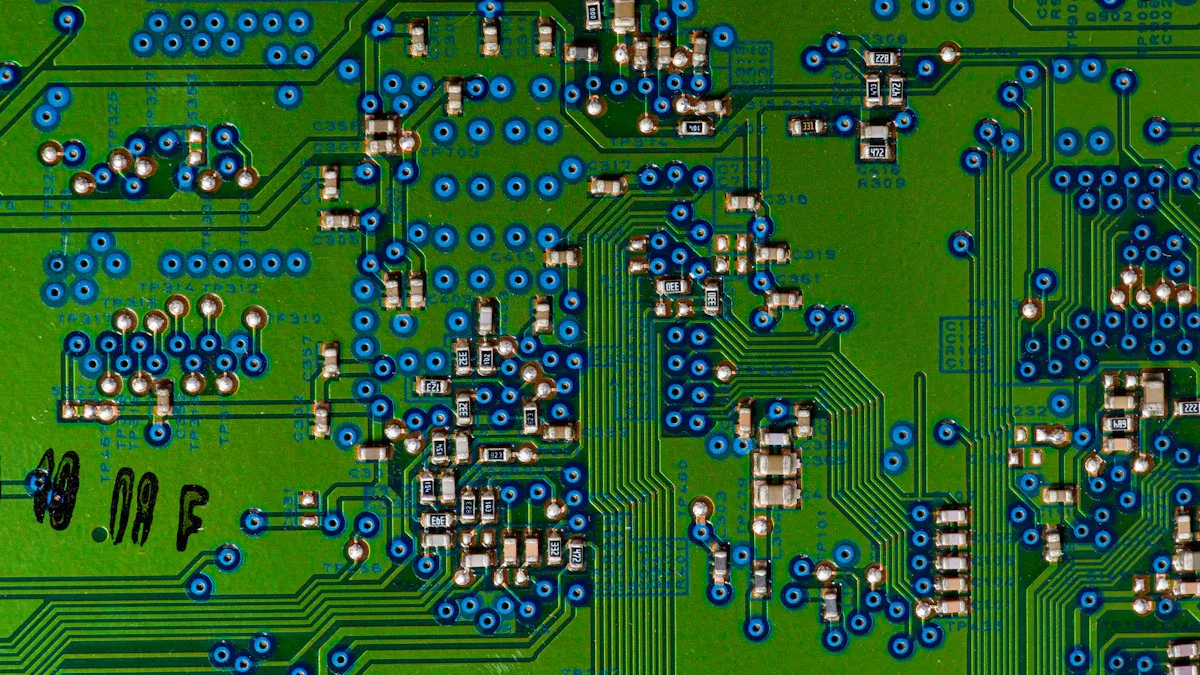
You want your EV to charge fast and stay safe. Multi-layer PCB layouts help with this. These boards have many layers stacked on top of each other. Each layer does something special. Some layers give power, and others carry signals. Putting ground and power layers close to signal layers helps stop interference. This also makes signals better. Your EV’s charger works well, even when charging quickly.
Multi-layer boards make signals stronger and cut down noise.
Thermal vias and special materials move heat away from hot spots.
Symmetrical stack-ups keep the board flat and tough.
Good layer order lowers resistance and keeps power steady.
DuPont says that new metallization and imaging make these boards last longer. Good plating and strong sticking help the board work in tough EV use. Engineers use simulation tools to design the best stack-up for your charger.
High-Frequency Considerations
Your EV uses high-frequency signals to control charging. These signals can make noise and bother other electronics. You need a PCB that handles these signals well. Engineers put parts in the right place and route paths carefully to keep signals clean. They also use shielding and controlled impedance to block unwanted noise.
Regulatory/Technical Aspect | Description | Relevance to High-Frequency Automotive On-Board Chargers |
|---|---|---|
ISO 26262 | Functional safety for automotive electronics | Keeps your EV safe during charging |
IATF 16949 | Quality management for suppliers | Ensures high-quality PCBs in your EV |
IPC-A-600 & IPC-6012 Class 3 | High-reliability PCB standards | Makes sure your charger lasts longer |
UL 94V-0 | Fire safety for PCB materials | Protects your EV from fire risks |
EMI/EMC Compliance | Controls signal noise and interference | Keeps your EV’s electronics working right |
You can trust that advanced on-board chargers follow these strict rules. This helps your EV stay safe and work well.
Automotive-Grade Materials
You want your EV to work in all weather and on rough roads. Automotive-grade materials make this possible. These materials handle heat, shaking, and wetness. For example, ceramic-filled PTFE and polyimide films keep the board steady when it gets hot. Aluminum cores and heavy copper laminates move heat away from power parts. Polyimide spacers stop arc faults in high-voltage areas.
Material | Key Properties | Application in On-Board Chargers and EV PCBs |
|---|---|---|
Ceramic-Filled PTFE | High thermal conductivity, up to 200°C | Used for thermal stability in charging ports |
Polyimide Films | Flexible, up to 260°C | Used in flexible circuits and battery monitors |
Aluminum Core | Good heat dissipation, cost-effective | Used in motor controllers and power PCBs |
Heavy Copper Laminates | Thick copper for durability | Used for high-voltage isolation |
Polyimide Spacers | High-voltage isolation | Prevents arc faults in high-voltage PCBs |
These materials help your EV last longer by fighting heat, water, and shaking. Special coatings and tough tests make sure your charger keeps working, even in hard places.
Reliability in EV Charging
Real-World Applications
You can see advanced PCB integration at real EV charging stations. Lincoln Electric’s Velion DC fast charger uses printed circuit boards with a clear epoxy coating. This coating protects against rain, dust, and very hot or cold weather. The charger has a modular design with two coated PCBs inside a metal case. This setup hides more electrical connections. The charger lasts longer and works well outside. Many EV companies now use these PCB technologies to make their chargers safer and more reliable.
PCB Technology | How It Improves Reliability in EVs |
|---|---|
Chip Embedding | Better heat transfer and higher reliability |
Heavy Copper PCBs | Handles high current and power loads |
Power Combi-board | Combines power and control for efficient charging |
Insulated Metal Substrate | Moves heat away and increases protection |
Inlay Technology | Improves current flow and thermal performance |
Comparison with Traditional Methods
You might wonder how new PCBs are different from old ones. Old chargers used single-layer boards and simple wires. These had more open parts and less protection. They could not handle lots of power or heat. This meant more breakdowns and shorter charger life. New EV chargers use multi-layer PCBs, heavy copper, and special coatings. These give better protection from heat, dust, and water. Now, you get fewer repairs and safer charging. High-performance chargers use these advanced boards for strong and long-lasting charging.
Future Trends
You will see even more changes in the next ten years. Engineers use flexible and multilayer PCBs to fit more features in small spaces. High-frequency PCBs help your EV charge faster and better. Companies use eco-friendly materials to make chargers safer for the earth. Artificial intelligence helps design better PCBs and find problems early. You will also see better cooling, with heat sinks and thermal vias keeping chargers cool. New materials and coatings protect against bad weather. Silicon carbide and advanced ceramics make chargers work better and last longer. These trends help your EV stay safe, reliable, and ready for what’s next.
You can see that PCB integration helps your on-board charger work better. Your EV charges faster, stays safe, and lasts a long time. Companies use new printed electronics and sensors to check battery health. This helps make charging safer and smarter. You get better battery care and safer charging every time you plug in your EV. The future of EV charging will have new batteries, faster charging, and smarter systems.
Power electronics and printed sensors let your EV charge fast and safe.
New battery types and smart systems help your EV last longer.
Printed films and heaters keep your EV’s sensors working in bad weather.
You can trust that advanced PCB design will lead the way for future EV charging.
FAQ
What does PCB stand for in electric vehicles?
PCB stands for Printed Circuit Board. You find PCBs inside your EV’s charger. They connect and control all the electronic parts. PCBs help your charger work safely and last longer.
How do PCBs make on-board chargers safer?
PCBs use special layouts and materials. These features stop overheating and protect against electric shocks. You get safer charging every time you plug in your EV.
Can PCB integration help my EV charge faster?
Yes! Advanced PCBs use smart designs and better materials. These changes let your charger handle more power. You can charge your EV faster and more efficiently.
Why do EV chargers need thermal management?
Heat can damage your charger’s parts. Good thermal management spreads heat away from important areas. This keeps your charger cool and working well.
Are modern PCBs better than old ones?
Modern PCBs use more layers, stronger materials, and better protection. You get fewer breakdowns and longer charger life. Your EV stays reliable with these new boards.