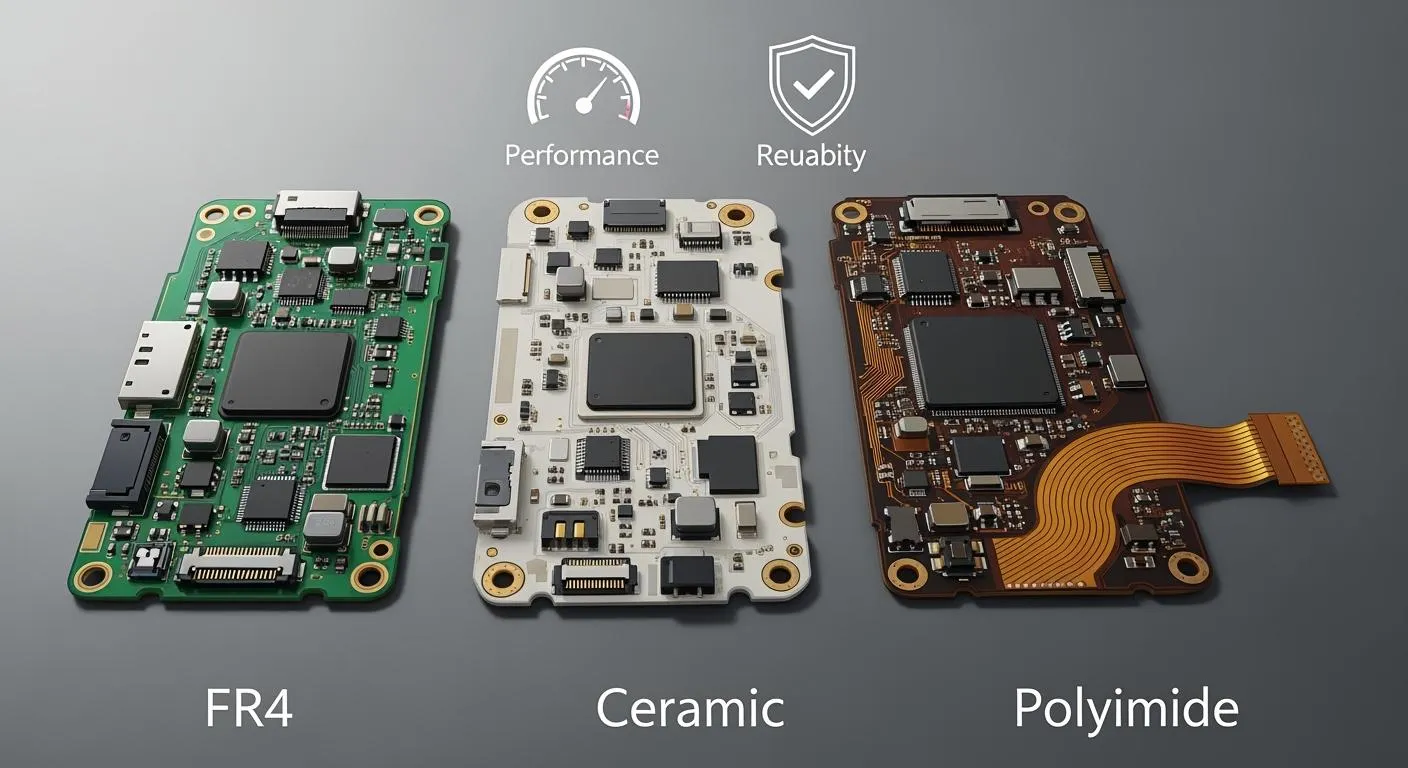
When you pick mobile pcb materials, Rogers and PTFE are top choices for good performance and reliability. The right material helps your phone last longer and work better. Rogers has a steady dielectric constant and stays stable with heat. PTFE has very low dielectric loss and is strong against heat and chemicals.
Material Type | Key Features | Applications |
|---|---|---|
Rogers PCB | Low dielectric loss, stable dielectric constant, thermal stability | Antennas, power amplifiers, filters |
PTFE PCB | Ultra-low dielectric loss, high thermal and chemical resistance | RF and microwave circuits, mobile phone antennas |
Rogers and PTFE are best for high-frequency designs.
Rogers is easy to use in making many designs.
PTFE helps lower signal loss in antennas.
Using both can help save money and keep good performance.
You can make better choices if you know these facts.
Key Takeaways
Pick Rogers or PTFE for high-frequency designs. These materials keep signals strong and reduce energy loss.
Think about heat properties when picking PCB materials. Good heat control makes your device last longer and work better.
Weigh cost and how well it works. Cheaper materials like FR-4 are fine for simple jobs, but better materials make devices more reliable and efficient.
Pick materials that fit what your device needs. Use polyimide for flexible devices. Choose ceramic for tough places.
Always look at the dielectric constant and dissipation factor. These things affect signal quality and how well your device works.
Why Material Choice Matters
Impact on Mobile Performance
You want your phone to be fast and work well. The PCB material you pick is important. Some materials have low dielectric constants. These help signals move faster and lose less energy. Your phone can process data quicker and use less battery. Using materials with low energy loss can make power use better by up to 10%. Phones with good materials have fewer delays and more accurate signals.
Performance Metric | Impact of PCB Material Selection |
|---|---|
Signal Accuracy and Speed | Low dielectric constants mean less signal loss and delay. |
Power Efficiency and Battery Life | Low energy loss materials boost power efficiency by 5-10%. |
Reliability Under Stress | High-Tg materials lower failure rates by 30% over 10 years. |
Reliability and Longevity
You want your phone to last a long time. Good mobile pcb materials help your phone survive drops, heat, and daily use. High-quality materials lower the chance of breaking, even in hard places. For example, in server rooms, the best parts fail only 0.164% of the time. In cars, the failure rate is higher, but good materials still do better than cheap ones.
If one Analog to Digital Converter breaks, failure rates go from 0.304% in server rooms to 1.406% in cars.
A Multi-Layer Ceramic Capacitor may fail at 0.166% in easy places but goes up to 1.160% in cars.
Chip resistors also fail more often in tough places.
Manufacturing and Cost Factors
You need to think about both cost and performance. Some PCB materials, like FR-4, are cheap and work for most things. Others, like Rogers, PTFE, or ceramic, cost more because they work better or have special features. What you choose depends on what your device needs and how much you can spend.
PCB Material | Cost Characteristics |
|---|---|
FR-4 | Made in large amounts and costs less |
Rogers | Costs much more for each panel |
PTFE | Costs more because of special properties |
Ceramic | Can cost much more than FR-4 |
Tip: Always pick materials that fit your device’s needs. This helps you get the best speed, reliability, and price.
Key Criteria for Mobile PCB Materials
Electrical Performance
You want your device to be fast and send signals well. Electrical performance is very important when picking mobile pcb materials. Materials with a low dielectric constant and low loss help signals move quickly. They also help stop mistakes in the signal. Rogers and PTFE are good because they keep signal loss low, even at high frequencies. This means your phone or tablet can handle more data. It also works better when many people use the network.
Thermal Conductivity
Heat can hurt your device if it builds up. You need materials that move heat away from important parts. Some mobile pcb materials, like aluminum nitride (AlN) and alumina, move heat well. This helps your device stay cool and last longer. Here is a quick look at how these materials compare:
Material | Thermal Conductivity (W/mK) |
|---|---|
AlN | 180 |
Alumina | 20 |
AlN moves heat much faster than alumina. If your device gets hot, you should pick materials with higher thermal conductivity.
Mechanical Strength and Flexibility
You want your phone or wearable to survive drops and bends. Mechanical strength and flexibility are very important. Polyimide and PTFE are great at handling heat and chemicals. Polyimide bends well and works in tough places. PTFE handles heat but does not bend easily. The table below shows how popular materials compare:
Performance Parameter | Polyimide (PI) | Polyester (PET) | Liquid Crystal Polymer (LCP) | Polytetrafluoroethylene (PTFE) |
|---|---|---|---|---|
Heat Resistance | Excellent (>200°C) | Moderate (≤150°C) | Good (180–220°C) | Outstanding (>250°C) |
Flexibility / Bend Durability | ideal for dynamic flexing | suitable for static use only | limited flexibility | not suitable for bending |
Dimensional Stability | High | Average | High | Moderate |
High-Frequency Electrical Performance | Good | Average | Excellent | Exceptional |
Moisture Resistance | Good | Poor | Excellent | Excellent |
Chemical Resistance | Excellent | Moderate | Good | Excellent |
Process Compatibility | Strong compatibility with lamination and assembly | Easy to process, suitable for volume production | Requires controlled processing | Difficult to process, needs specialized tools |
Cost Level | Medium | Low, cost-effective | High, used for premium applications | High, suited for high-frequency reliability |
Typical Applications | Aerospace, automotive, medical, military | LED strips, membrane switches, labels | 5G antennas, mobile RF modules, connectors | RF modules, microwave devices, satellites |
Cost Considerations
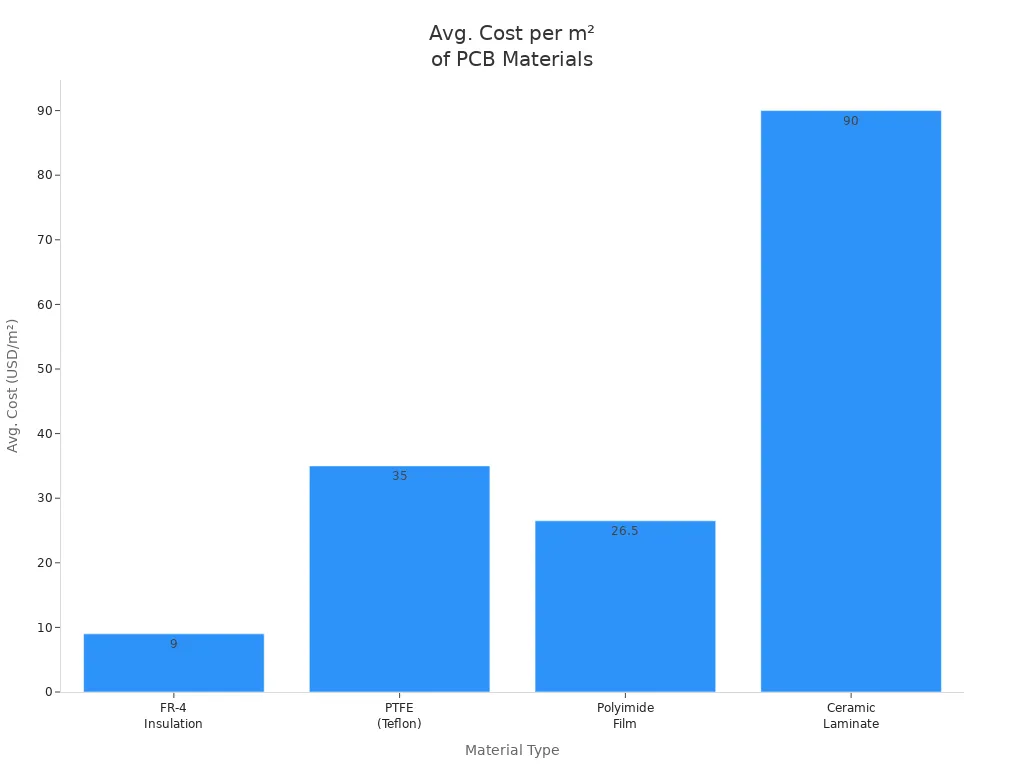
You need to balance what you spend with how well things work. Some mobile pcb materials cost much more than others. FR-4 is the cheapest and works for many simple devices. PTFE and ceramic laminates cost more but give better performance for special uses. Polyimide costs more than FR-4 but less than PTFE. It works well for flexible designs. Here is a chart that shows the average cost per square meter for each major material:
Tip: Always pick materials that fit your device and your budget. This helps you get the best value and performance.
Overview of Mobile PCB Materials
FR-4
Most mobile devices use fr-4. This material is made with glass fiber cloth and epoxy resin. It gives a strong and cheap base for your PCB. Fr-4 works in many electronics you use every day. The table below shows its main features:
Property/Characteristic | Description |
|---|---|
Composition | Made from woven glass fibre cloth impregnated with epoxy resin. |
Typical Properties | Dk ≈ 3.8–4.8, Df ≈ 0.009–0.02, Tg ≈ 130–180 °C. |
Advantages | Low cost, easy to process, mechanically strong, and widely available. |
Limitations | Signal loss increases at very high frequencies; glass weave can cause impedance variations in high-speed designs. |
Applications | Consumer electronics, industrial controls, and automotive modules. |
High-Tg Versions | Available for lead-free assembly and higher reliability under thermal stress. |
Fr-4 is a good choice for price and performance. You might see some signal loss if the frequency is high. But for most phones and tablets, fr-4 is good enough.
Rogers
Rogers materials are used for high-frequency needs. They have a steady dielectric constant and low signal loss. Rogers boards are easier to make than PTFE boards. You often find Rogers in antennas and RF modules. The table below compares Rogers and PTFE:
Criteria | Rogers PCB | PTFE PCB |
|---|---|---|
Dielectric Constant (Dk) | 2.2 – 10.2 | ~2.1 |
Dissipation Factor (Df at 10 GHz) | ~0.0013 | ~0.0009 |
Signal Attenuation | Low, suitable for up to 40 GHz | Very low, excellent for microwave frequencies |
Thermal Stability | High | Very high |
Manufacturing Ease | Easier to process | Softer, can be challenging |
Cost | Higher than standard materials | Often more expensive |
PTFE (Teflon)
PTFE, or Teflon, gives the lowest signal loss. You can use PTFE for microwave and RF circuits. This material stands up to heat and chemicals. PTFE is hard to work with, but it is best for antennas and fast data lines. You get great performance, but it costs more.
Polyimide and Flexible Materials
Some devices need to bend or flex. Polyimide lets devices bend and still work. This material handles heat and chemicals well. Polyimide is used in foldable phones and wearables. It keeps its shape in tough places. Flexible PCBs use polyimide or polyester. These materials help make thin, light, and bendy devices.
Ceramic (AlN, Al₂O₃)
Ceramic PCBs, like aluminum nitride and alumina, move heat away fast and lose little signal. You can use them for high-power or high-frequency circuits. The table below gives more details:
Material | Thermal Conductivity | Dielectric Constant | Max Temperature | Applications |
|---|---|---|---|---|
Aluminum Nitride | High | Low | >300°C | High-performance power electronics, military RF |
Alumina Ceramic | Moderate | Low | >300°C | High-power LEDs, RF power modules, high-temperature electronics |
Ceramics manage heat very well.
You can use ceramics in very hot places.
These materials keep their size and shape when hot.
Aluminum
Aluminum PCBs help move heat away from your device. They cool better than fr-4. Aluminum boards are used in LEDs and power supplies. The table below shows the difference:
Property | FR-4 PCB | Aluminum PCB |
|---|---|---|
Thermal Conductivity | Low (0.3 W/m·K) | High (1-2 W/m·K) |
Applications | General Electronics (phones, tablets) | Heat-Intensive Devices (LEDs, power supplies) |
Note: Use aluminum if your device needs to stay cool and strong.
High-Frequency PCB Materials
Rogers and PTFE for High-Frequency
If you need high-frequency pcb materials, Rogers and PTFE are great. These materials help your device send signals fast and clear. Rogers keeps its dielectric constant steady, even when it gets hot or cold. PTFE has very low dielectric loss, so signals stay strong and correct.
You can check the table below to see how Rogers and PTFE are different:
Feature | Rogers Materials | PTFE Materials |
|---|---|---|
Low Dielectric Loss | Dissipation factor as low as 0.0013 at 10 GHz | Dissipation factor around 0.0009 at 10 GHz |
Stable Dielectric Constant | Dk values from 2.2 to 10.2 | Dk typically around 2.1 |
Thermal Stability | Maintains performance across a wide temperature range | High thermal and chemical resistance |
Applications | Used in antennas, power amplifiers, and filters | Commonly used in RF and microwave circuits |
These high-frequency pcb materials help antennas and RF modules work better. Rogers is easier to make into different designs. PTFE is best if you want the lowest signal loss. Pick these high-frequency pcb materials if you want your device to move data fast and keep signals strong.
Tip: For very fast devices, choose high-frequency pcb materials like Rogers or PTFE.
Ceramic for Advanced Applications
Ceramic high-frequency pcb materials are strong and control heat well. You find ceramic PCBs in devices that work in hard places, like high-power circuits or military electronics. Ceramic materials help your device last longer because they do not break down easily.
Here is a table that shows what ceramic high-frequency pcb materials can do:
Performance Metric | Ceramic PCB Advantages | Challenges |
|---|---|---|
Durability | High mechanical strength leads to better performance over time, reducing aging. | Higher manufacturing costs. |
Insulation Performance | Excellent insulation in high-voltage environments, stable under temperature and humidity. | Manufacturing complexity. |
Thermal Conductivity | Superior thermal management, enhancing heat dissipation in high-power applications. | N/A |
Mechanical Strength | Robust support against mechanical stress and vibrations, improving durability. | N/A |
Use ceramic high-frequency pcb materials if your device faces heat, shaking, or high voltage. These materials keep your device safe and working for a long time. They cost more, but you get the best reliability and performance.
Note: Ceramic high-frequency pcb materials are best for advanced devices that need strong heat control and last a long time.
Comparison Table: Performance and Reliability
Electrical and Thermal Properties
It is important to know how each mobile PCB material deals with electricity and heat. These things change how well your device works and how long it lasts. Some materials keep signals strong. Others help your device stay cool when you use it a lot.
Material | Electrical Properties | Thermal Properties |
|---|---|---|
FR-4 PCB | Not great for high-frequency jobs because of higher dielectric loss. | Handles heat okay but does not move it away fast. |
Rogers PCB | Made for high-frequency use and keeps signals strong. | Great at handling heat, good for fast circuits. |
PTFE PCB | Very good at keeping signals clear at high speeds. | Stays stable in heat and fights off chemicals. |
Polyimide | Works well for moving signals and can bend. | Handles high heat, good for flexible devices. |
Ceramic PCB | Keeps signals safe even with high voltage. | Moves heat away very well, keeps things cool. |
Aluminum PCB | Not best for RF, but good for high-power and heat. | Moves heat away fast because of the metal core. |
Rogers and PTFE help keep signals strong when things move fast.
Ceramic and aluminum PCBs move heat away quickly and stop overheating.
Polyimide is good if you need a device that bends and handles heat.
Tip: If you want strong signals and good heat control, try Rogers, PTFE, or ceramic PCBs.
Durability and Environmental Resistance
Your phone or tablet faces things like water, heat changes, and shaking. The right PCB material helps your device survive these problems and keeps signals working well for a long time.
Environmental Stress Type | Description | Impact on PCB Performance |
|---|---|---|
Humidity | Water or wet air gets inside | Can cause rust and make connections fail |
Temperature Cycling | Big changes in hot and cold | Can make parts weak or break down |
Vibration | Shaking or bumps | Can break parts or make them come loose |
FR-4 is fine for normal use but not for very wet or hot places.
Rogers and PTFE fight off water and big temperature changes, so signals stay strong.
Polyimide can bend and handle heat, so it is good for wearables and foldable devices.
Ceramic PCBs are best at fighting heat and shaking, so use them in tough places.
Aluminum PCBs are good for heat but not as strong as ceramic for shaking.
Note: Always pick a PCB material that fits where your device will be used. This helps your device last longer and work better.
Choosing the Right Mobile PCB Material
Smartphones and Tablets
You use smartphones and tablets all the time. The right pcb board material helps your device work well and last longer. For mobile phone applications, you should think about these things:
Thermal properties help keep your device cool.
Electrical properties protect signals.
Signal integrity makes your device fast.
Mechanical strength keeps your device safe from drops.
Cost helps your device stay affordable.
Most phones use FR-4 for basic needs. Rogers and PTFE are better for fast circuits. Polyimide is good for flexible designs. Pick the pcb board material that matches your device’s needs.
Wearables and Foldable Devices
Wearables and foldable devices need special pcb board material. You want your watch or foldable phone to bend and stay strong. For these mobile phone applications, flexibility and durability are most important.
Material | Advantages | Disadvantages |
|---|---|---|
Polyimide | Very flexible, handles heat, and is light | Costs more, not stiff for hard circuits |
Rogers Material | Great electrical performance, low signal loss | Expensive, not as flexible as polyimide |
FR4 | Cheap, easy to find, good for stiff parts | Not bendy, heavier, not great for skin contact |
Liquid Crystal Polymer | Low signal loss, resists water, bends for wearables | Costs more, not used as much as polyimide |
Polyimide is best for mobile phone applications that need to bend. Rogers is good for parts that need strong signals.
Rugged and Industrial Devices
Rugged and industrial devices face tough places. You need pcb board material that can handle heat, chemicals, and shaking. For mobile phone applications in factories or outside, durability matters most.
Material Property | Importance |
|---|---|
Durability | Handles rough places and hard hits. |
Chemical Resistance | Stays strong when near chemicals. |
Thermal Stability | Works well when temperatures change. |
Vibration Tolerance | Stops damage and lasts long in places that shake. |
Ceramic and polyimide are good for these mobile phone applications. Pick materials that keep your device safe from harm.
Cost-Driven Applications
You want to save money but still get good results. For cost-driven mobile phone applications, balance price and reliability. Some pcb board material costs less but may not last as long.
Application Type | Material Used | Performance Requirements | Cost Considerations |
|---|---|---|---|
Consumer Electronics | Polyester, Polyimide | Good for simple circuits; handles heat for processors | Polyester is cheap; polyimide costs more but lasts longer |
Automotive | Polyimide | Handles heat and chemicals; keeps devices safe | Special additives raise costs |
Medical Devices | Biocompatible materials | Works with cleaning and sterilization methods | Treatments add to cost |
Aerospace and Defense | MIL-STD materials | Handles extreme temperatures and radiation | High cost for best performance |
Industrial Sensors | Chemical resistant materials | Stays accurate in tough places | Special builds cost more |
Pick the pcb board material that fits your budget and your mobile phone application’s needs. Always check if saving money will make your device not last as long.
Tip: Match the pcb board material to your device’s job. This helps your mobile phone applications work better and last longer.
Recommendations and Best Practices
Top Choices for Performance
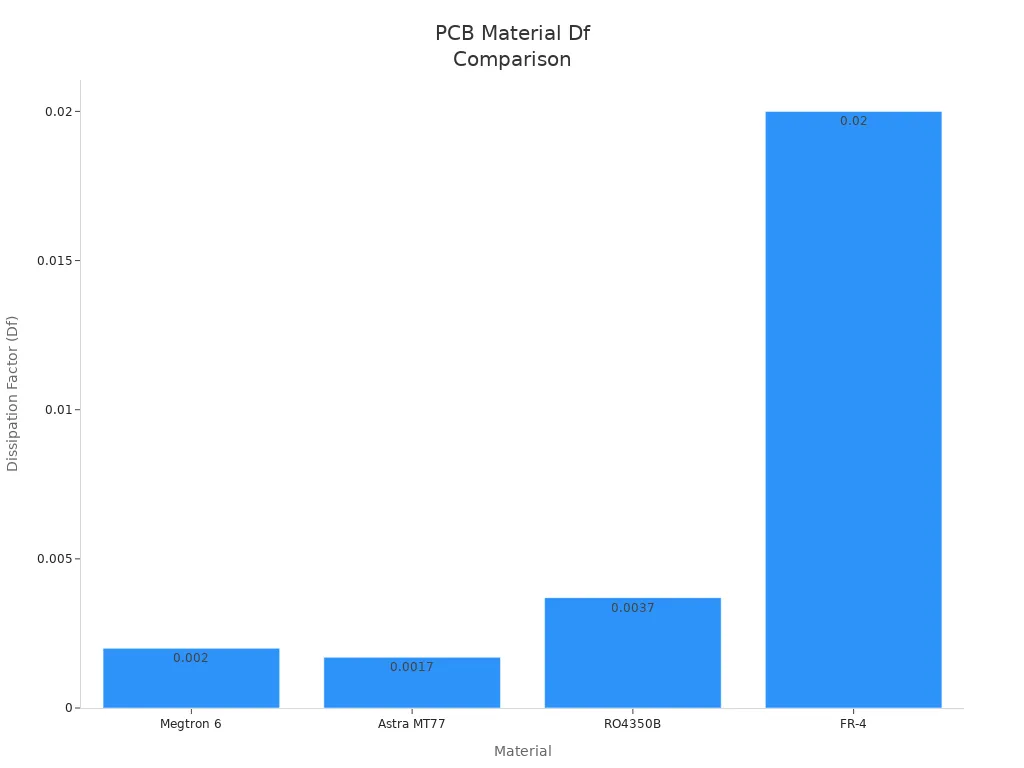
You want your phone to be fast and handle lots of data. Some PCB materials are better for this. These materials keep signals strong and work well at high speeds. The table below shows how they compare:
Material | Dissipation Factor (Df) | CTE (ppm/°C) | Best Use Case |
|---|---|---|---|
Megtron 6 | 0.002 | 14 | 5G sub-6 GHz layers |
Astra MT77 | 0.0017 | N/A | mmWave, 28 GHz phased arrays |
RO4350B | 0.0037 | N/A | Antenna substrates |
FR-4 | 0.020 | 3-4 | Baseband and power sections |
PTFE (Teflon) | N/A | N/A | High-frequency circuits |
Ceramic | N/A | N/A | High thermal conductivity needs |
Aluminum | N/A | N/A | Rapid heat dissipation |
Nelco | N/A | N/A | High-speed digital applications |
Tip: Always ask your PCB maker for proof the material is good. Lab tests from other companies help you trust the material.
Top Choices for Reliability
You want your device to last a long time, even in hard places. Some PCB materials are better for this. These materials can handle heat, stress, and bending without breaking. The table below shows the best choices:
Material Type | Key Features | Best Applications |
|---|---|---|
High Tg Laminates | Work in high heat (Tg 170°C+) | Automotive, industrial |
Low CTE Materials | Reduce thermal stress | Places with big temperature changes |
Polyimide | Great thermal stability and flexibility | Wearables, foldable devices |
Ceramic Substrates | High durability under stress | Demanding, high-reliability devices |
Note: Polyimide and ceramic PCBs are good for devices that get hot, shake, or need to bend.
Balancing All Factors
You need to think about cost, performance, and reliability. Here are some tips:
Use double-layer PCBs to save money and still get good results.
Make sure impedance matches what your project needs.
Pick FR-4 for simple devices to keep costs low.
Choose aluminum or ceramic if your device gets hot.
Match the power level to the right material. For example, use FR-4 for low power, aluminum for medium, and ceramic for high power.
Test your design early to find problems before building.
Always check if your material fights rust and works in your device’s environment.
Tip: Ask for IPC-A-600 lab tests to make sure your PCB material is right for your needs.
Picking the right PCB material helps your device work better and last longer. Each material, like FR-4, PTFE, or polyimide, has special strengths. These help with signals, heat, and making your device tough.
Always pick a material that matches your device’s job.
The finish on the surface can help your device last longer.
Experts say you should check how the material handles electricity, stress, and the environment before you choose.
Device Type | Best PCB Material Features |
|---|---|
Smartphones | Multi-layer HDI, high-speed, slim design |
Wearables | Flexible, lightweight, bendable |
Industrial | Durable, resistant to harsh environments |
If your project is complicated, talk to PCB experts. They can help you find the best material for your device.
FAQ
What is signal attenuation in mobile PCBs?
Signal attenuation means the signal gets weaker as it travels. You want to keep signal attenuation low for a fast device. PTFE and Rogers materials help stop signals from getting weak. This makes your phone work better and more reliably.
How do I choose a base material for my mobile PCB?
Pick a base material that fits what your device needs. Think about how much signal attenuation it has. Also, check if it can handle heat and how much it costs. For fast devices, use materials that keep signal attenuation low.
Why does signal attenuation matter for 5g technology?
5g technology needs signals that are fast and clear. If signal attenuation is high, your device can slow down. It may also make mistakes. Use materials that keep signal attenuation low for the best 5g results.
Which PCB materials help reduce signal attenuation the most?
PTFE and Rogers are the best at lowering signal attenuation. These materials keep signals strong and clear. Use them if you want less signal loss in your device.
Can signal attenuation affect my device’s battery life?
Yes, signal attenuation can make your device use more power. If signal attenuation is high, your device works harder to send signals. This can make your battery run out faster. Pick materials that lower signal attenuation to help your battery last longer.
Tip: Always check how much signal attenuation your PCB material has before you pick it.