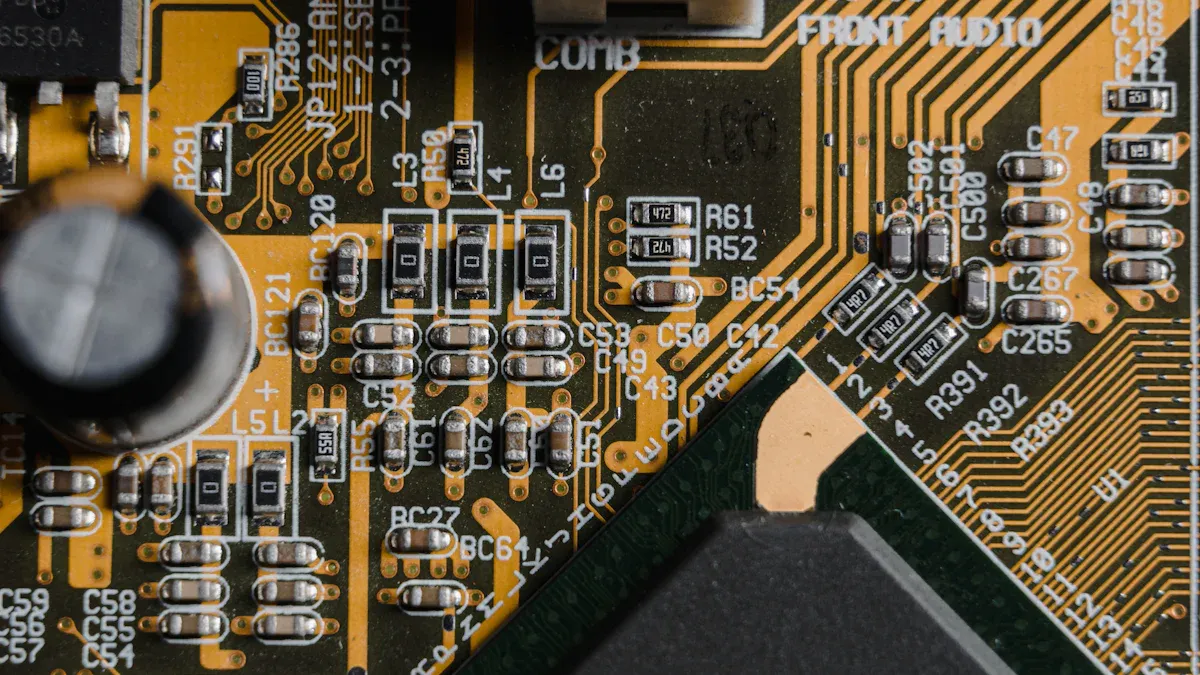
A 33k ohm resistor is a small but important part of electronic circuits. It helps control the flow of electricity, keeping devices safe and working well. The “33k ohm” value shows its resistance, which reduces the current passing through it.
These resistors are used in many ways, like:
Voltage divider circuits use 33k ohm resistors to set specific voltage levels for sensors or small computers.
Current limiting circuits use these resistors to stop too much current from damaging parts like LEDs.
Timing circuits use them to manage how fast capacitors charge, allowing accurate timing.
By controlling electricity, the 33k ohm resistor keeps electronic devices stable and reliable.
Key Takeaways
A 33k ohm resistor manages electric flow to prevent damage.
These resistors are important in circuits for splitting voltage or limiting current.
Knowing resistance levels and tolerances keeps circuits safe and working well.
Picking the right resistor, like carbon or metal film, is key for circuits.
Ohm’s Law helps you find current and check if circuits work right.
Understanding the Basics of a 33k Ohm Resistor
What is a Resistor?
A resistor is a basic part of electronics. It slows down electrical current by adding resistance, measured in ohms (Ω). By controlling current, resistors protect parts and help circuits work well. For example, they stop LEDs from getting too much current and burning out. Resistors also help keep voltage steady and shape signals in devices.
Resistors have changed a lot over time. Early scientists learned how materials block electricity, leading to modern resistors. In 1961, Otis Boykin made cheaper and more reliable resistors. This made them easier to use everywhere. Today, resistors are key to making circuits stable and efficient.
What Does “33k Ohms” Represent?
The term “33k ohms” shows the resistor’s resistance level. The “k” means kilo, or 1,000. So, a 33k ohm resistor has 33,000 ohms of resistance. This tells how much it slows down current. Higher resistance means less current flows, while lower resistance allows more.
Resistors like 33k ohms are picked based on what a circuit needs. For example, in audio devices, a 33k resistor helps process sound signals. Other factors like tolerance, power rating, and temperature changes also affect how it works. These details make sure the resistor works well in different situations.
Specification | Description | Typical Values for 33k Resistors | Importance |
|---|---|---|---|
Power Rating | The most power the resistor can handle safely. | 1/8W, 1/4W, 1/2W, 1W, 2W and more | Stops overheating and damage. |
Tolerance | How close the actual resistance is to the labeled value. | 5%, 1%, 0.1% or lower | Keeps circuits accurate and stable. |
Temperature Coefficient | How much resistance changes with temperature. | ±25 ppm/°C to ±200 ppm/°C | Ensures good performance in different temperatures. |
How Does a 33k Resistor Function in a Circuit?
A 33k resistor controls current and splits voltage in circuits. Using Ohm’s Law, current (I) is found with I = V / R. For example, if a 33k resistor is connected to a 5V power source and an LED with a 2V drop, the resistor gets 3V. Using the formula, the current is I = 3V / 33kΩ ≈ 0.09mA. This small current keeps the LED safe and cool.
33k resistors are also used in timing, bias, and filter circuits. In timing circuits, they work with capacitors to control charging times. In bias circuits, they set conditions for transistors or amplifiers. In filter circuits, they adjust frequencies and block unwanted signals. These uses show how useful 33k resistors are in electronics.
Application Type | Explanation |
|---|---|
Timing Circuits | 33k resistors help control how fast capacitors charge or discharge. |
Bias Circuits | They set the right conditions for transistors or amplifiers to work well. |
Filter Networks | Used with capacitors to block unwanted signals and adjust frequencies. |
Sensor Interface Circuits | Help divide voltage or provide bias for sensors, improving accuracy and stability. |
Specifications and Types of 33k Ohm Resistors
Resistance Value and Tolerance
A 33k resistor has a resistance of 33,000 ohms. This fixed value helps control the current in circuits. Tolerance shows how much the actual resistance can differ from the label. For instance, a 1% tolerance means the resistance can range from 32.67k to 33.33k ohms. A tighter tolerance, like 0.1%, gives more accuracy, ranging from 32.97k to 33.03k ohms. The needed tolerance depends on how exact the circuit must be.
Tolerance | Resistance Range (Ohms) |
|---|---|
1% | 32.67k – 33.33k |
0.1% | 32.97k – 33.03k |
Power Rating and Temperature Coefficient
The power rating shows how much power a resistor can handle safely. For 33k resistors, common ratings are 1/8W, 1/4W, and 1/2W. Going over this limit can damage the resistor and other parts. The temperature coefficient tells how resistance changes with heat. For example, a 40°C rise might cause a 1% resistance change in some resistors. Choosing a low temperature coefficient keeps performance steady in different temperatures.
Evidence Description | Explanation |
|---|---|
Exceeding power rating can cause permanent damage | If a resistor’s power limit is exceeded, it may break or harm nearby parts. |
Temperature coefficient affects resistance | Heat changes resistance; a 40°C rise can cause a 1% change in some resistors. |
Types of Resistors
Carbon Film Resistors
Carbon film resistors have a thin carbon layer on a ceramic base. They are cheap and used for general purposes. These resistors usually have a 5% tolerance and power ratings from 1/8W to 1/2W. They work well in circuits that don’t need high precision.
Metal Film Resistors
Metal film resistors use a thin metal layer on a ceramic base. They are more accurate, with tolerances as low as 0.1%. Their power ratings range from 1/8W to 1W. These resistors are great for precise circuits, like audio or measuring devices.
Wirewound Resistors
Wirewound resistors are made by wrapping wire around a ceramic core. They handle high power, with ratings over 10W. These resistors have very low temperature changes, making them good for high-power and precise uses like current sensing.
Resistor Type | Construction | Typical Tolerance | Power Rating | Temperature Coefficient | Applications | Mounting |
|---|---|---|---|---|---|---|
Carbon Film | Thin carbon layer on ceramic | 5% | 1/8W – 1/2W | Moderate | General use, low-cost circuits | Through-hole |
Metal Film | Thin metal layer on ceramic | 1%, 0.5%, 0.1% | 1/8W – 1W | Low | Precise circuits, audio, measuring devices | Through-hole & SMD |
Wire Wound | Wire wrapped on ceramic core | 1-5% | 1W-10W+ | Very low | High-power, current sensing | Through-hole |
Identifying a 33k Ohm Resistor

Resistor Color Code System
Most resistors, like a 33k ohms resistor, have color bands. These bands use a global color code system. Each color stands for a number, multiplier, or tolerance. This system makes it easy to find the resistor’s value without tools.
Resistors usually have four to six color bands. The first two or three bands show the main digits of the resistance. The next band is the multiplier, which adds zeros. The last band shows tolerance, or how much the actual resistance can differ.
For instance, a resistor with yellow, orange, and orange bands, plus a gold band, equals 33k ohms with 5% tolerance. This method is popular because it’s simple and works well.
How to Decode the Color Code for a 33k Resistor
To read the color code for a 33k ohms resistor, follow the band order. The first two bands are “3” and “3”. The third band, orange, means “×1,000”. Together, they make 33,000 ohms.
The fourth band shows tolerance. A gold band means ±5%. A silver band means ±10%. If there’s a fifth or sixth band, they show temperature or reliability.
Here’s a quick guide for a 33k ohms resistor:
Band Position | Color | Value | Meaning |
|---|---|---|---|
1st | Orange | 3 | First digit |
2nd | Orange | 3 | Second digit |
3rd | Orange | ×1,000 | Multiplier |
4th | Gold | ±5% | Tolerance |
Alternative Identification Methods
If the color bands are hard to see or missing, try other ways to identify a 33k ohms resistor. A digital multimeter is very accurate. Set it to resistance mode, connect the probes, and check the display for the value.
You can also look at the resistor’s packaging or datasheet. These give details like resistance, tolerance, and power rating. For surface-mount resistors, the value is often printed as a number code.
Tip: Always confirm your resistor’s value before using it. This helps your circuit work properly and avoids damage.
Uses of 33k Ohm Resistors in Electronics
Voltage Dividers
A 33k resistor is important in voltage divider circuits. These circuits lower voltage to a level other parts can use. By pairing a 33k resistor with another resistor, you create a voltage drop. This is helpful for sensors or small computers needing exact voltage.
For example, to turn 10V into 3.3V for a sensor, use a 33k and 16k resistor together. Accurate resistors are key for voltage dividers. If a resistor has high tolerance, it may cause voltage changes. This can harm the circuit’s performance. Also, heat can affect resistor stability. Picking a 33k resistor with low heat sensitivity ensures steady performance.
Limiting Current for LEDs
A 33k resistor protects LEDs by limiting current flow. Too much current can overheat or break LEDs. Adding a 33k resistor in series with the LED controls the current and keeps it safe.
For example, if an LED with 2V is powered by 5V, the resistor drops the extra 3V. Using Ohm’s Law (I = V / R), the current will be about 0.09mA. This small current keeps the LED bright and safe. The 33k resistor’s value balances safety and energy use, making it great for LED circuits.
Pull-Up and Pull-Down Resistors
In digital circuits, 33k resistors act as pull-up or pull-down resistors. These resistors keep a steady logic level when no signal is present. Without them, circuits may behave unpredictably.
A pull-up resistor links the input pin to high voltage (logic 1). A pull-down resistor connects it to ground (logic 0). The 33k resistor works well here because it avoids high current while keeping the input stable. This stability is vital for microcontrollers and other digital systems to work properly.
Signal Processing and Filtering
A 33k resistor is important in signal processing and filtering. It helps shape and improve electrical signals in circuits. When used with capacitors or inductors, it creates filters. These filters block unwanted frequencies or allow specific ones to pass. This makes them useful in audio systems and communication devices.
For example, in audio equipment, a 33k resistor and a capacitor can make a low-pass filter. This filter removes high-frequency noise, making the sound clearer. In radios, resistors help separate wanted signals from interference. By controlling current, they help circuits process signals correctly.
Active filters also use 33k resistors. These filters, found in amplifiers, depend on resistors to set cutoff frequencies. The cutoff frequency decides which sounds are amplified or reduced. Picking the right resistor value is key for good performance.
Tip: Check the resistor’s tolerance and temperature coefficient. These affect how stable and accurate your circuit will be.
Other Common Use Cases
The 33k resistor is used in many other circuits. It improves accuracy in sensor circuits. For example, it acts as a pull-up resistor in temperature or light sensors. This keeps readings steady.
In timing circuits, a 33k resistor works with capacitors to set time intervals. This is helpful in clocks and timers. Resistors also help in power supply circuits. They regulate voltage and protect parts from power surges.
Another use is in transistor biasing. A 33k resistor sets the working point of a transistor. This ensures it works well in amplifiers and switches. Choosing the right resistor improves circuit performance.
Note: Always match the resistor’s power rating to your circuit. This avoids overheating and keeps it reliable for a long time.
Tips for Picking the Right Resistor
Choosing the Correct Resistance Value
Picking the right resistance is key for your circuit. A 33k resistor is great for controlling current or splitting voltage. To find the right value, check your circuit’s needs first. Use Ohm’s Law (V = IR) to calculate resistance based on voltage and current.
If your circuit has LEDs, sensors, or timers, a 33k resistor often fits well. It keeps current safe and efficient. Always recheck your math to avoid mistakes that could harm your parts.
Checking Power Rating and Tolerance
The power rating shows how much power a resistor can handle safely. For most circuits, a 33k resistor with 1/4W or 1/2W works fine. If your circuit gets hotter, pick a higher power rating. Choose a resistor with a power rating above your circuit’s max power for safety.
Tolerance tells how close the actual resistance is to the label. A 33k resistor with 1% tolerance is more accurate than one with 5%. For precise circuits like audio devices, use a resistor with tighter tolerance.
Picking the Right Resistor Type
Different resistors work for different jobs. A 33k resistor can be carbon film, metal film, or wirewound. Carbon film resistors are cheap and good for general use. Metal film resistors are more accurate and stable, great for audio or signal circuits. Wirewound resistors handle high power and are durable.
Think about your circuit’s needs when choosing a resistor. For example, use a metal film 33k resistor for a voltage divider. For high-power circuits, pick a wirewound resistor. Matching the resistor type to your circuit ensures it works well.
A 33k ohm resistor is important in electronics. It controls how much current and voltage flow in circuits. Its features, like resistance, tolerance, and power rating, help it work well in different uses. These include voltage dividers, LED circuits, and signal filters. Always pick a resistor that fits your circuit’s needs. For accurate circuits, choose resistors with low tolerance. The right resistor makes your circuit last longer and work better.
FAQ
What does the “k” in 33k ohms mean?
The “k” means kilo, which equals 1,000. A 33k ohm resistor has 33,000 ohms of resistance. This number shows how much it slows down the flow of electricity in a circuit.
Can a 33k resistor replace another resistor?
You can replace a resistor if the new one matches the circuit’s needs. But using a 33k resistor instead of a different value might change how the circuit works. Always check or test before swapping resistors.
Tip: Use a multimeter to check the resistor’s value before replacing it.
How do you find the current through a 33k resistor?
Use Ohm’s Law: ( I = V / R ). Divide the voltage (V) by the resistance (R). For example, if 5V is across a 33k resistor, the current is ( I = 5V / 33,000Ω ≈ 0.15mA ).
Why does tolerance matter for a 33k resistor?
Tolerance shows how much the real resistance can differ from the label. A 33k resistor with 5% tolerance could range from 31.35k to 34.65k ohms. Lower tolerance means better accuracy, which is important for precise circuits like audio devices.
How can you identify a 33k resistor without color bands?
Use a digital multimeter to measure the resistance. Set it to resistance mode, touch the probes to the resistor, and read the value on the screen. This works if the color bands are faded or missing.
Note: Always confirm the resistor’s value to avoid problems in your circuit.