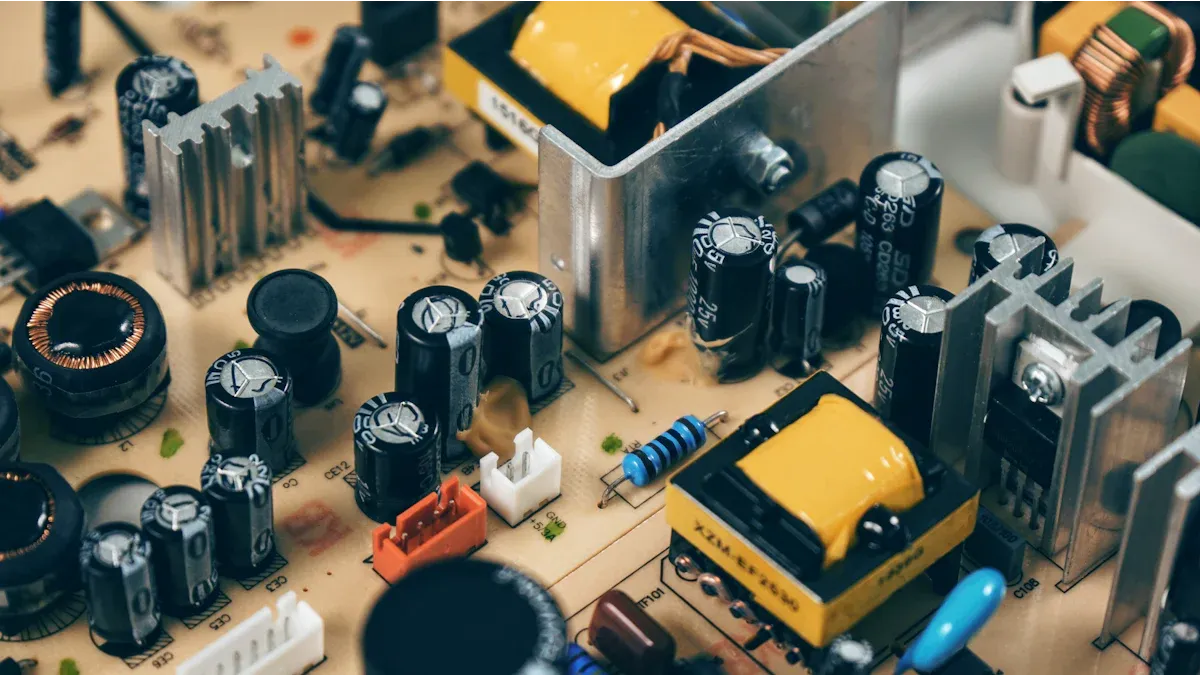
A resistor is a simple electrical part used in circuits. It manages how much current flows and changes voltage levels. This helps the circuit work safely and properly. For example, resistors in a voltage divider share the voltage. This lets different parts of the circuit work as they should. With delicate parts like LEDs, resistors lower the current. This stops overheating or damage. Without resistors, circuits can’t control power well. They are very important for making circuits work reliably.
Key Takeaways
Resistors manage how much electric current moves in circuits. They protect delicate parts like LEDs from harm.
There are different resistors, like fixed and variable ones. Each type has a special job in circuits, so picking the right one is important.
Ohm’s Law helps you find the right resistor value. This keeps your circuits safe and working well.
What is a Resistor and Its Functions
What is a resistor?
A resistor is a small but important part in electronics. It slows down electric current to protect other parts. This keeps sensitive components safe from too much current. Resistors also control voltage so each part gets the right power. For example, in LED circuits, resistors stop overheating by limiting current. Without resistors, circuits would not work properly or safely.
What do resistors do in circuits?
Resistors have many important jobs in circuits. They control current, adjust voltage, and share power evenly. In parallel circuits, they help current flow correctly through branches. Resistors also keep voltage steady for stable power. They can change how circuits respond, like in sound or signal systems. Resistors are used in voltage dividers to split voltage into smaller parts. They also reduce noise when used with capacitors or inductors.
Why are resistors important in circuits?
Resistors are very important for building circuits. They set tolerance levels, which affect how reliable a circuit is. Tolerance can range from ±20% to as exact as ±1%. Resistors also handle heat to keep circuits safe from overheating. They work well in tough places, like in cars, because they handle temperature changes. The color bands on resistors make them easy to identify. Whether in series or alone, resistors keep circuits stable and working well.
How Resistors Work

The principle of resistance and Ohm’s Law
Resistance slows down the flow of electric current. Think of it like a barrier that makes it harder for electrons to move in a circuit. Ohm’s Law is a key idea for understanding resistors. It shows how voltage, current, and resistance are connected. The formula is:V = I × R.
Here’s an example to explain:
Use a circuit with a resistor and power source.
Slowly increase the voltage from 0V to 10V.
Measure the current and graph the results.
The graph will show a straight line. This means current grows evenly with voltage if resistance stays the same. This rule helps predict how resistors act in circuits.
How resistors control current and voltage
Resistors help manage current and voltage in circuits. Adding a resistor can limit current to protect parts like LEDs. For instance, a 1kΩ resistor keeps an LED safe by controlling the current.
Resistors also split voltage in a circuit. In a voltage divider, two resistors share the voltage. This gives specific voltages to different parts. This is useful in devices like sensors needing exact voltage levels.
The relationship between resistance, current, and power dissipation
Resistance, current, and power dissipation are linked in circuits. Power dissipation happens when resistors turn electrical energy into heat. The formula is:P = V^2 / R.
For example, if a resistor has 10V and 20Ω resistance, it dissipates 5W of power. This heat must be controlled to avoid damage.
Resistance also affects current. Doubling resistance cuts current in half. Halving resistance doubles the current. Knowing these links helps design safe and efficient circuits.
Types of Resistors
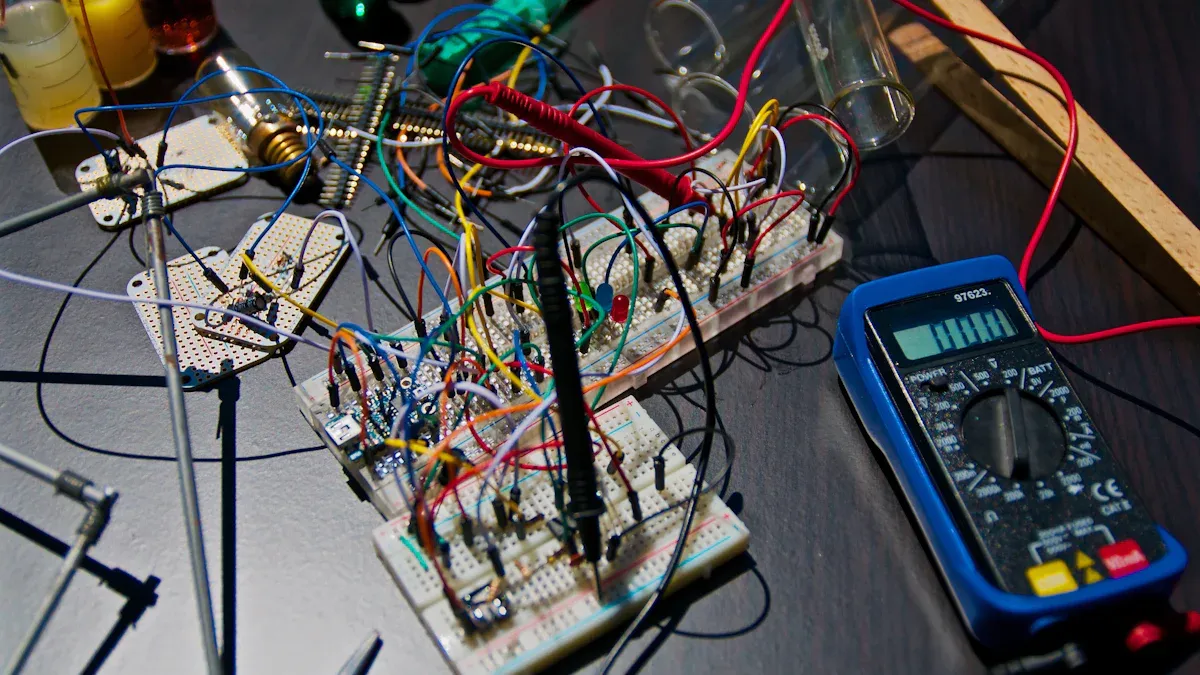
Resistors come in different types for specific circuit needs. Knowing these types helps you pick the right one.
Fixed resistors and their functions
Fixed resistors have a set resistance that doesn’t change. They are reliable for circuits needing steady resistance. Common types include carbon composition, wirewound, thin film, and thick film resistors. Carbon film resistors are used in audio devices. Wirewound resistors handle high power in industrial circuits. These resistors work well even with changing voltage or temperature.
Tip: Use fixed resistors for circuits needing stable resistance values.
Variable resistors and their uses
Variable resistors let you change the resistance when needed. They are found in radios and audio systems. Potentiometers adjust volume or tune circuits. Rheostats control current in motors. Multi-turn potentiometers allow precise adjustments. Trimpots help fine-tune circuits during calibration.
Variable resistors are great for adjusting voltage or improving circuit performance.
Linear vs. non-linear resistors
Linear resistors have a steady link between voltage and current. Non-linear resistors, like varistors, act differently. They lower resistance during voltage spikes to protect circuits. Linear resistors are good for steady tasks. Non-linear resistors are better for safety-critical uses.
Feature | Linear Resistors | Non-linear Resistors |
|---|---|---|
Response to Input | Predictable | Changes at certain points |
Input-Output Behavior | Steady scaling | Unsteady scaling |
Specialty resistors (e.g., thermistors, light-dependent resistors)
Specialty resistors react to changes in the environment. Thermistors change resistance with temperature, useful in thermostats. Light-dependent resistors (LDRs) adjust resistance based on light, ideal for automatic lights. These resistors are made for special circuit needs.
Specialty resistors are key for circuits needing flexible resistance.
Applications of Resistors in Electronics
Voltage dividers and their role in circuits
Voltage dividers are a common use for resistors. They split one voltage into smaller ones for circuits. For example, with a 24V supply, two resistors can make 12V or 5V. This is helpful for devices like sensors needing exact voltages.
Here’s how it works: two resistors in series share the voltage. The voltage drop depends on each resistor’s value. For instance, with a 20Ω and 40Ω resistor on a 12V supply, the first drops 4V, and the second drops 8V. This ensures each part gets the right voltage.
Current limiting in LED circuits
Resistors protect LEDs by controlling current flow. LEDs are delicate and need low current to work safely. Without a resistor, an LED could overheat and break. For example, a blue LED needs 3.2V at 20mA. If the power supply gives 12V, a resistor lowers the extra voltage. Using Ohm’s Law, you can find the right resistor value. A 470Ω resistor, for example, keeps the current at 18.7mA, protecting the LED.
Pull-up and pull-down resistors in digital circuits
Pull-up and pull-down resistors are key in digital circuits. They set input pins to a clear voltage when no signal is there. A pull-up resistor connects the pin to high voltage (logic 1). A pull-down resistor connects it to ground (logic 0). This stops floating inputs, which can cause errors. Choosing the right resistor value is important for stable signals and saving power.
Measuring current and voltage in circuits
Resistors help measure current and voltage in circuits. Using Ohm’s Law, you can find current or voltage if resistance and one value are known. In labs, resistors are used with ammeters and voltmeters to show this. For example, changing voltage across a resistor and measuring current confirms its resistance. This method is useful for designing and fixing circuits.
Resistors are important in circuits for managing current and voltage. They help parts work safely and correctly. There are different types, like fixed, variable, and specialty resistors. Each type is used for tasks like splitting voltage or limiting current.
To pick a resistor, follow these steps:
Find the resistance value you need.
Check tolerance for accuracy.
Look at power ratings to avoid overheating.
Review temperature stability.
Choose the right type for your circuit.
By knowing these steps, you can build circuits that work well and last long.
FAQ
What happens if you use the wrong resistor value in a circuit?
Using the wrong resistor can harm your circuit. It may cause overheating or give wrong voltage. This can damage parts. Always use Ohm’s Law to find the right value.
How do you identify a resistor’s value?
Resistors have color bands to show their value. Use a color code chart to read them. This helps you find the resistance easily.
Tip: Online tools make reading resistor values faster and easier.
Can resistors fail over time?
Yes, resistors can stop working. Overheating or damage can cause failure. Pick resistors with the right power rating and tolerance. This helps them last longer in your circuits.