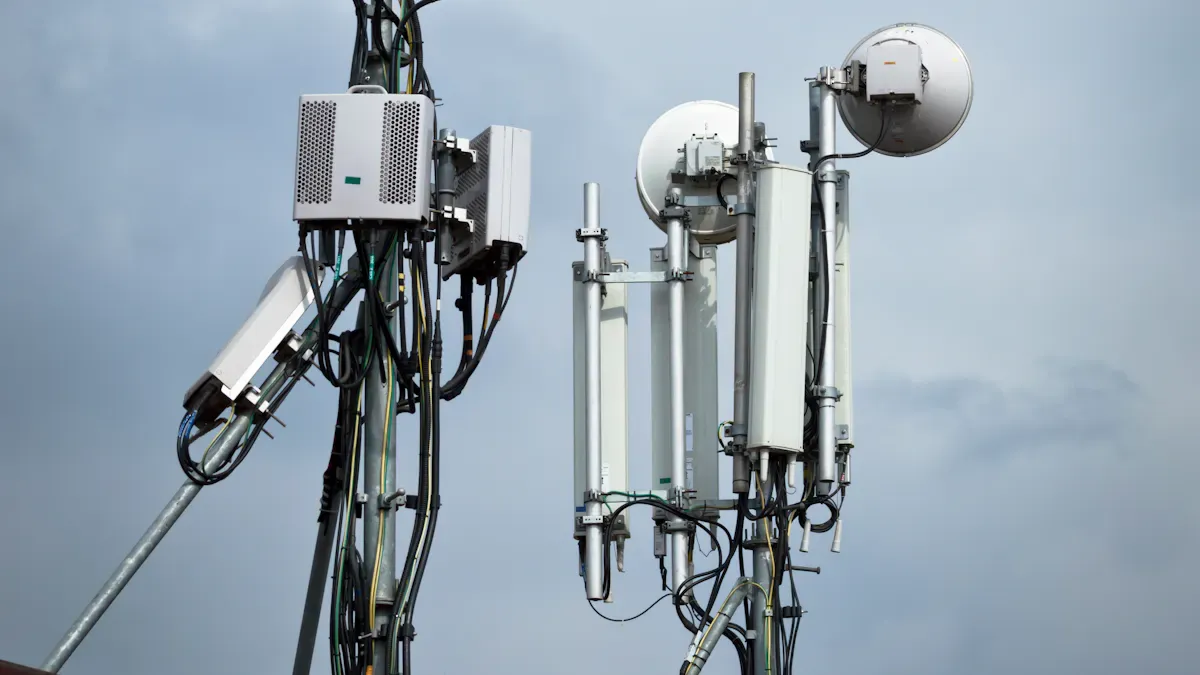
When you work on Mobile base station antenna controller design and manufacturing, you help wireless systems work better. Layered architecture is very important for this. Distributed RRUs near antennas lower feeder loss. They also cut latency by up to 35% in tall buildings. Putting RRUs with antennas cuts coaxial cable losses. This helps coverage and saves energy. Advanced MIMO setups are possible. These setups make spectral efficiency better in cities. High-gain and directional antenna arrays help support strong 5G and millimeter-wave signals. You also need to follow rules for control, monitoring, and installation.
Key Takeaways
Layered architecture helps mobile base stations work better. It manages signals well. It lowers delays and makes coverage better.
High-gain and directional antenna arrays make signals stronger. They also cut down on interference. These are important for strong 5G and millimeter-wave signals.
Picking the right materials for antenna controllers matters a lot. It affects how well they work and how long they last. Think about things like frequency and weather.
Testing and checking quality are very important before setting up. This makes sure everything works well and meets rules.
Planning for upgrades with modular designs is smart. Software-defined radios help your network change and get ready for new tech.
Antenna Controller Role and Requirements
Layered Architecture in Mobile Base Stations
Layered architecture is very important for mobile base stations. It uses antenna systems, RRUs, and BBUs to build a strong network. Antenna controllers help manage these layers. They let you change signals and send them where needed. Layered architecture makes signals better and keeps the network strong in many ways:
Beam management in 5G helps keep connections strong. The network and your device pick the best beam pairs. This stops interference from movement or changes around you.
Massive MIMO uses lots of antennas to send and get data at the same time. This gives you better signals. Beamforming sends signals right to users. It lowers interference.
Precoding in 5G lets the base station serve many users at once. You get higher spectral efficiency and less interference between users.
Performance and Reliability Criteria
You want your antenna controller to work well and be reliable. The controller must react fast to changes in signal demand. It should keep connections steady even when users move or weather changes. You need to make sure all parts of the base station work together. Controllers must handle high data rates and support advanced features like MIMO and beamforming. You should test the controller for uptime and error rates. Reliable controllers help stop dropped calls and slow data.
Standards for Control and Monitoring
You must follow standards for control and monitoring. These standards let you manage the antenna controller from far away. You can check how it works, update settings, and fix problems without going to the site. Standards like SNMP and TR-069 help you watch the controller and keep the network safe. You should use best practices for security and data protection. Following standards makes your mobile base station easier to manage and more reliable.
Mobile Base Station Antenna Controller Design
Antenna Synthesis and Steerable Arrays
Antenna synthesis helps shape how antennas send signals. It lets you design antennas to focus energy in certain directions. You can change the pattern by adjusting each antenna element’s phase and amplitude. This makes steerable arrays possible. Steerable arrays use beam steering to point signals where needed. You do not have to move the antenna. You only change the signal with electronics.
Recent studies show steerable arrays improve coverage and capacity. These arrays use phase shifting to direct the radiation pattern. You can focus coverage in one direction and cut interference in others. This means you get better capacity without extra hardware. Using antenna synthesis with steerable arrays makes your network smarter and more flexible.
Tip: Steerable arrays help boost coverage in busy places or send signals to users who move a lot.
High-Gain and Directional Array Design
High-gain and directional arrays are needed for strong 5G and millimeter-wave signals. These arrays help send signals farther and make them stronger. In mobile base station antenna controller design and manufacturing, you can use different designs to reach these goals.
The 8×8 antenna array uses 16 antennas with power dividers and a 50-Ω feed network.
You can change the spacing between elements for better performance. This creates more gain through constructive interference.
Important parameters are directivity, gain, radiation efficiency, and total efficiency. These show how well your antenna works for 5G and millimeter-wave systems.
You can use a low-profile, four-element series-fed dipole antenna. This design can reach a high gain of 11.2 dBi at 38 GHz. If you add a special MTM structure, you can boost the gain to 15.1 dBi at the same frequency. You can use a two-stage optimization method to fine-tune the antenna shape. This makes your design even better.
High-gain antenna arrays give you more than just strong signals. They also help reduce interference in cities. Here is how they help:
Diversity Gain (DG) improves signal reliability by using many antenna elements.
A higher DG value means you need less power for good signal quality, even when buildings block the signal.
Some MIMO arrays can reach a DG of about 9.99 dB, which is almost perfect. This means you get fewer dropped calls and better data speeds.
High-gain arrays can expand your signal coverage radius by 1.8 times compared to regular antennas.
They can increase penetration power threefold.
Directional designs can shrink the vertical beamwidth from 360° to 60°, focusing energy on the horizontal plane.
By coordinating the phase of four dipoles, you can create constructive interference in the main direction. This boosts signal strength.
Multi-band designs let you use both 2.4GHz and 5GHz bands. The 2.4GHz band works well in crowded areas, while the 5GHz band gives you faster data.
Frequency Band Optimization
You must pick the right frequency bands for your mobile base station antenna controller design and manufacturing. Each band has its own strengths. You need to match your antenna design to the band you want to use. For example, the 3.5 GHz band is popular for 5G because it balances coverage and speed.
Here is a table that shows important performance metrics for frequency band optimization:
Performance Metric | Description |
|---|---|
Bandwidth | The range of frequencies where the antenna works well. |
Gain | How well the antenna directs radio energy in one direction. |
Efficiency | The ratio of power sent out by the antenna to the total input power. |
Directivity | How focused the antenna’s radiation pattern is in one direction. |
You should check these metrics when you design your antennas. High bandwidth lets you support more users and services. High gain and directivity help you send signals farther and cut interference. Good efficiency means you waste less power.
When you focus on antenna synthesis, high-gain arrays, and the right frequency bands, you make your mobile base station antenna controller design and manufacturing much stronger. You give users better coverage, faster data, and more reliable connections.
Manufacturing and Assembly

Material Selection and Sourcing
You have to pick the right materials for your antenna controller. The material you choose changes how well your device works and how long it lasts. Here is a table that lists two common materials and what they are like:
Material | Advantages | Limitations |
|---|---|---|
FR4 | Cheap, strong, easy to get | Loses more energy, can change with heat, not as steady |
Rogers | Loses less energy, steady, works well with heat, good for high frequencies | Costs more, harder to use |
FR4 is good for many projects because it is strong and easy to find. Rogers works better for high frequencies, but it costs more and is harder to use. You should pick the material that fits your needs and how much you want to spend.
Assembly Workflow and Quality Assurance
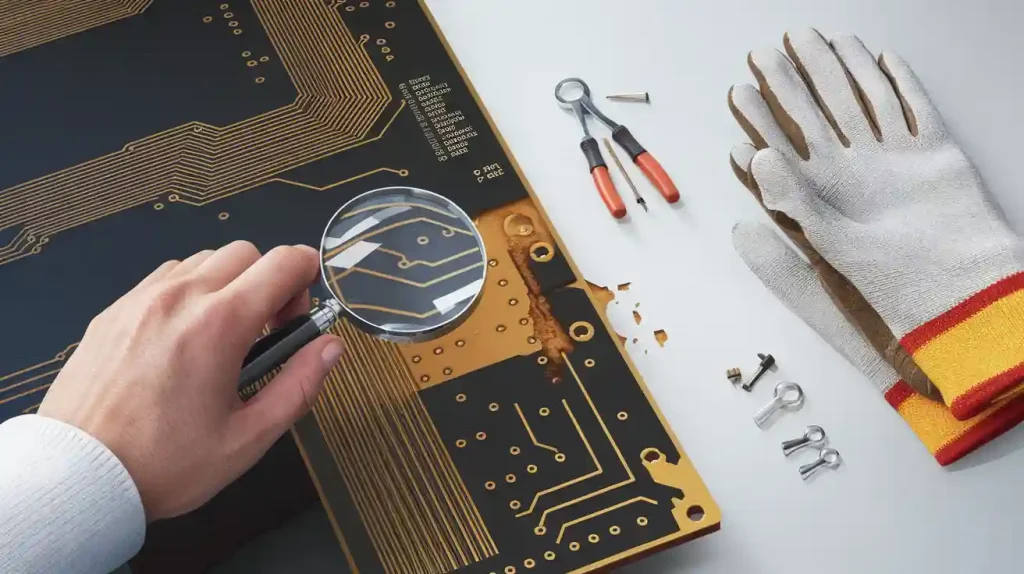
You need to follow clear steps when building your antenna controller. First, get all the parts and check for damage. Put together the circuit board, add connectors, and close the case. Use clean tools and keep your area neat. After you finish, check every part and connection. Quality assurance means you look for loose wires, bad solder, or missing screws. Careful work helps your base station last longer and work better.
Tip: Always use a checklist when you build. This helps you remember every step and makes sure each unit is built right.
Testing and Installation Guidelines
You must test your antenna controller before you install it. Check for signal loss and reflections. Use handheld analyzers to find cable problems and weak spots. Make sure your device passes all tests from 3GPP rules, like TS 38.141. These tests use special tools such as vector signal generators and spectrum analyzers.
Testing Procedure | Description |
|---|---|
Performance Check at Installation | Makes sure the antenna and cables do not lose too much signal or have too many reflections. |
Method for Verifying Performance | Uses handheld analyzers to check cable loss and find reflection spots, so you get the best setup. |
When you put up the antenna, place it at a medium height. Studies say about 1.6 meters works well in most places. This height gives you good data and fewer dropped signals. If you put the antenna higher in open spaces, you get better coverage and stronger signals. Do not put antennas too low or too high, or you might get more errors and lose data.
Challenges and Solutions
Design Pitfalls and Mitigation
You might run into some problems when making mobile base station antenna controllers. One big problem is weak signal coverage. This happens if you do not plan where to put antennas. You should test the area for coverage before you finish your design. Another problem is using parts that are not strong enough. Weather and temperature changes can break weak parts. You need to pick materials that last in tough weather. Sometimes, people forget to make upgrades easy. If you use a modular design, you can add new features later without starting from scratch.
Tip: Always use a checklist to review your design. This helps you find mistakes early.
Manufacturing Hurdles
Making antenna controllers has its own problems. You might have trouble with materials, space, or power. Some buildings use materials that block signals and cause dead spots. You can fix this by using Distributed Antenna Systems (DAS) to boost signals in hard places. Space is often small in 5G setups, and power can get high. You need to use small designs and smart cooling to keep things working well. Ruggedized parts help your device last in tough places.
Manufacturing Hurdles | Solutions |
|---|---|
Construction materials causing dead zones | Use Distributed Antenna Systems (DAS) to amplify signals |
Competing technologies affecting performance | Use specialized in-building wireless solutions |
Constrained space and power density in 5G | Use innovative thermal management for compact configurations |
You should make each part work as well as possible.
Always check if your parts can handle heat and rough use.
Ensuring Scalability and Upgradability
You want your antenna controller to grow with your network. Modular antennas let you add or change parts as tech gets better. Small, beam-steering antennas with built-in electronics make upgrades simple. You can use AI and automation to adjust settings from far away and help the network fix itself. Edge computing lets your system handle data nearby, which makes things faster.
Strategy Type | Description |
|---|---|
Modular Antennas | Mix macro and micro cells with upgradable antennas |
Compact Beam-Steering Antennas | Use small, flexible antennas with built-in electronics |
AI and Automation | Use predictive analytics and remote calibration for better performance |
Edge Computing Integration | Offload data processing to local edge devices for faster response |
Note: Planning for upgrades now saves you time and money later.
Wireless Network Enhancement
Performance Impact
You can make your wireless network work better with new antenna controller designs. Using massive MIMO and beamforming helps your network serve more people at once. These features send signals straight to each device. This means you get faster data and fewer dropped calls. You also get better coverage in busy places like stadiums or city centers.
Saving energy is important, too. New antenna designs use less power but still give strong signals. This saves money and helps the environment. You should always check your design to meet the latest rules for speed, reliability, and energy use.
Many networks now use AI and machine learning. These tools help change antenna settings right away. If the weather changes or more people use the network, your system can react fast. Open RAN makes it easier to use equipment from different companies. This gives you more choices and helps you build a flexible network.
Here is a table that shows some trends in antenna controller design:
Trend | Description |
|---|---|
More antennas for higher speed and capacity | |
Energy Efficiency and Sustainability | Lower power use for greener networks |
AI and Machine Learning Integration | Real-time adjustments for better performance |
Open RAN Architectures | Easier upgrades and more equipment choices |
Future-Proofing Solutions
You want your network to last a long time. To do this, you should plan for upgrades in the future. Pick hardware that works with software-defined radios. This lets you update your system for new standards like 5G NR or 6G without changing everything.
Carrier aggregation is also a good idea. You can use more than one frequency at once. This gives users faster speeds and a better experience. You should set up strong security rules. These keep hackers out and protect your data.
Tip: If you choose equipment that works with old and new technology, you will save time and money when you upgrade.
By following these steps, you make sure your wireless network stays strong, fast, and ready for the future.
You can make a strong mobile base station antenna controller if you use a complete design plan. Pick tough materials and check every part to make sure it works well. Try advanced antenna tricks like beamforming and sectorization to help your signal reach more places and serve more people. Always follow the rules for control and monitoring. To get the best results, remember these tips:
Pick materials that can handle bad weather and look at each part as you put it together.
Use safe coding and make sure your device does not waste power.
Put up antennas carefully so you get less interference and better signals.
Doing these things helps you build networks that work well, can grow bigger, and will last a long time.
FAQ
What does an antenna controller do in a mobile base station?
An antenna controller helps control signal direction and strength. It makes sure data goes to the right spot. You can change settings to get better coverage and less interference.
How do you choose the best material for antenna controllers?
You think about what frequency you need and how tough the material is. FR4 is good for simple setups. Rogers is better for high-frequency designs. You also look at price and how well it works before picking.
Why is testing important before installing an antenna controller?
Testing lets you find problems early. You check for signal loss and reflections. You make sure your device follows the rules. This step helps your network stay strong.
Can you upgrade your antenna controller later?
Yes, you can upgrade it. Modular designs let you add new things. You can use software updates to make it work better. Planning for upgrades saves time and money.