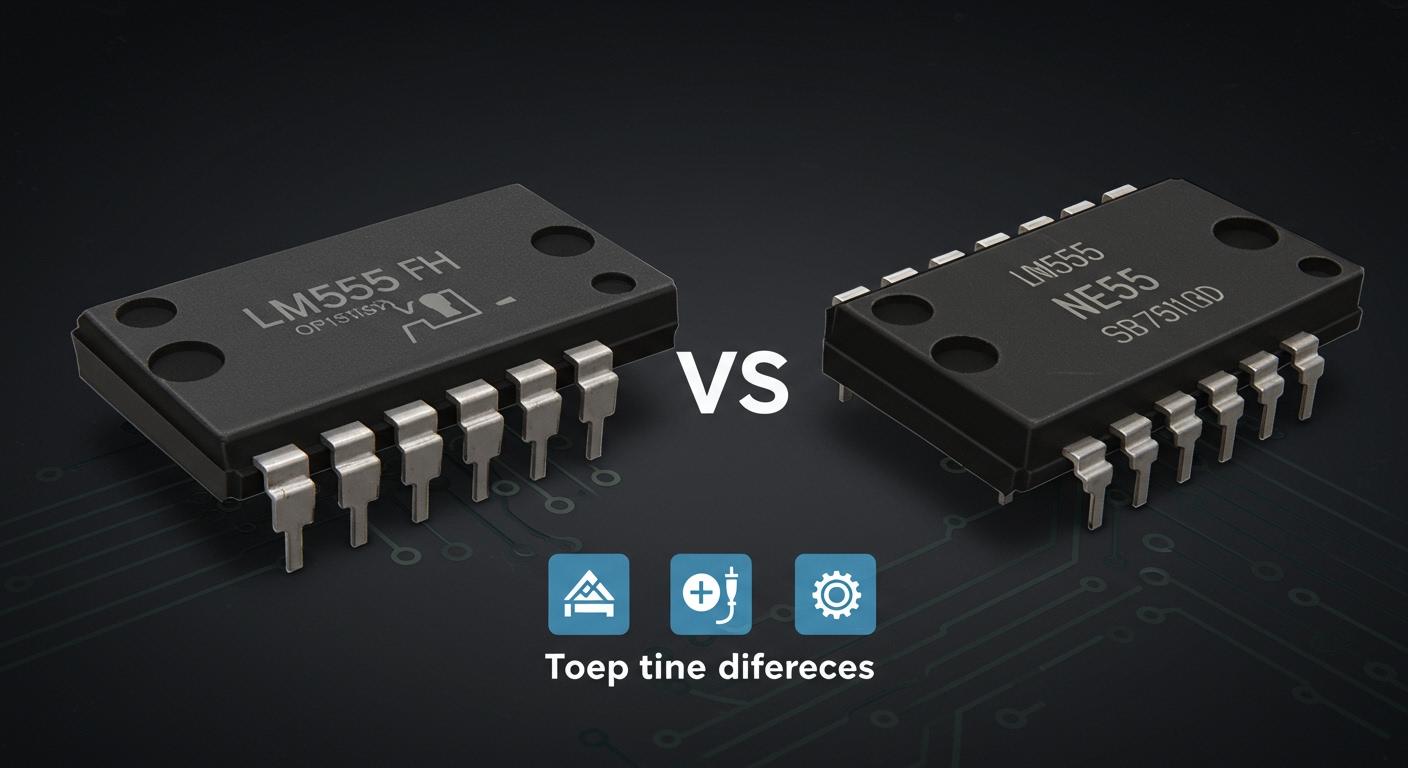
Key Differences Between LM555 and NE555
Explore the essential differences between LM555 and NE555 timer ICs.
Features | LM555 Timer IC | NE555 Timer IC |
|---|---|---|
Output Drive Capacity | Enhanced power for larger loads. | Standard power for typical applications. |
Temperature Stability | Superior performance in temperature extremes. | Basic stability under temperature changes. |
Power Usage | Lower energy consumption. | Higher energy consumption. |
Maximum Output Current | 5 mA to 50 mA output. | Up to 200 mA output. |
Noise Immunity | Better noise protection. | More susceptible to noise. |
Input Leakage | Lower input leakage. | Higher input leakage. |
Cost | Generally more expensive. | More affordable option. |
Common Applications | Used in precision timing circuits. | Popular in educational projects. |
You should learn the top three differences between LM555 vs NE555 timer ICs:
Output Drive Capacity: LM555 gives more power for bigger loads. NE555 has normal power for most uses.
Temperature Stability: LM555 works better when it gets hot or cold. NE555 stays steady but not as much.
Power Usage: LM555 needs less energy, so it saves battery life.
Look at the table below to see the main specs side by side.
Feature | LM555 | NE555 |
|---|---|---|
Output Drive Capacity | Enhanced | Standard |
Temperature Stability | Superior | Basic |
Power Usage | Lower | Higher |
Key Takeaways
LM555 uses less power, so it works well for battery projects. NE555 can give more output current, so it is good for bigger loads like relays and LEDs. LM555 keeps its timing steady even when the temperature changes, so it works well in tough places. You can find both ICs easily, but NE555 usually costs less and is used more in school projects. Always check the datasheets for both ICs to make sure you pick the best one for your project.
lm555 vs ne555 differences

When you look at lm555 and ne555, you find some big differences. These differences change how each ic works in your projects. Knowing these things helps you pick the right timer ic for your needs. Let’s look at the main points.
Electrical specs
First, check the electrical specs when you compare lm555 and ne555. Both timer ic chips can use a wide range of supply voltage. But their output drive and power needs are not the same. The ne555 can give up to 200 mA output current. This makes it good for bigger loads. The lm555 gives between 5 mA and 50 mA output current. So, it gives less current, but it uses less power.
Here’s a table to help you see the differences:
Component | Maximum Output Current | Voltage Swing Range |
|---|---|---|
NE555 | 200 mA | 5 V to 15 V |
LM555 | 5 mA to 50 mA | Limited |
The lm555 usually uses less power. This is better if you want to save battery or keep your circuit cool. These spec differences show why you should check what your project needs before you pick an ic.
Output and power
The output and power features are also different for lm555 and ne555. The ne555 gives a strong output drive. This is good for switching relays or powering LEDs. The lm555 does not give as much current. But it is more stable and uses less energy. If your circuit needs to run a long time on a battery, the lm555 helps save power.
Each ic has a different voltage swing. The ne555 can swing from 5 V to 15 V. This gives you more options for different loads. The lm555 has a smaller swing. You need to check if it fits your circuit.
Timing accuracy
Timing accuracy is another place where lm555 and ne555 are not the same. The lm555 has special design changes that help with trigger and threshold signals. For example, the lm555 uses a current mirror active load in its trigger comparator. This helps the ic stay accurate when the temperature changes. The threshold comparator in the lm555 also uses a current mirror and an emitter follower buffer. This makes it work better.
Here’s a table that shows the design changes in the lm555:
Design Change | Description |
|---|---|
Trigger Comparator | Current mirror active load replaces resistor load, enhancing performance over temperature. |
Threshold Comparator | Current mirror active load and emitter follower buffer added, improving functionality. |
Comparator Input Priority | Changes in input priority affect overall functionality, reversing behavior compared to NE555. |
These changes mean the lm555 gives better timing accuracy and stays stable. You will see this if you use the ic in projects where timing must be exact, even if it gets hot or cold. The ne555 works well for most things, but the lm555 is better when you need top performance.
Tip: Always look at the datasheet for each ic before you choose. The specs and design differences can change how your project works.
lm555 timer performance
Temperature stability
You want your 555 timer to work in hot and cold places. The lm555 timer has special changes inside. These changes help it keep good timing when it gets hot or cold. It uses a current mirror in its trigger and threshold parts. This helps the timing stay steady, even if the temperature goes up or down. The ne555 ic works in many places too, but it is not as steady with temperature. If you use a timer outside or where it gets very hot or cold, the lm555 timer keeps better time. Both chips can run for less than 4 hours with good timing. Things like voltage, capacitor quality, temperature, and leakage current affect both chips.
Timer Type | Maximum Reliable Time Interval | Influencing Factors |
|---|---|---|
LM555 | Less than 4 hours | Voltage, capacitor quality, temperature, leakage current |
NE555 | Less than 4 hours | Voltage, capacitor quality, temperature, leakage current |
Noise immunity
Noise can cause problems in your timer circuit. The lm555 ic has better noise protection because of its new design. You get fewer wrong triggers and a more steady output. The ne555 ic works well for most things, but it can pick up more noise. If you use the timer where there is a lot of interference, the lm555 timer gives a cleaner signal. You will see fewer problems with extra pulses or glitches.
Tip: Keep your ic away from strong power lines. Use good grounding to help both timer chips work better.
Input leakage
Input leakage changes how your timer reacts to signals. The lm555 ic has lower input leakage than the ne555 ic. This means your timer reacts better to trigger signals. You get better timing and fewer mistakes. The ne555 ic has higher input leakage, which can cause small timing errors in some circuits. If you need very good timing, the lm555 timer is the best choice.
Lower input leakage in lm555 ic means better timing.
Higher input leakage in ne555 ic can cause timing errors.
You should always check the datasheet for each ic before you start. The right 555 timer helps you get the best results for your project.
ne555 applications and cost
Manufacturer variations
Many companies make the ne555. The two main types are NE555N and NE555P. Both use the same 555 timer core, so they work almost the same. The biggest difference is the company that makes them. For example, STMicroelectronics makes the NE555N. Texas Instruments makes the NE555P. You can see more details in the table below:
Feature | NE555N | NE555P |
|---|---|---|
Manufacturer | STMicroelectronics | Texas Instruments |
Operating Voltage Range | Varies by manufacturer | Varies by manufacturer |
Power Consumption | Depends on model | Depends on model |
Temperature Stability | Varies | Varies |
Both types work well for most projects. You can pick either one based on what you can find or what your project needs. Most people do not notice a big difference between brands when using the ne555.
Use cases
The ne555 is used in lots of electronics projects. It is very popular in school kits. Teachers and students use it to make timers, pulse generators, and oscillators. These projects help you learn about electronics. The ne555 timer is simple to use. You can find it in alarms, light flashers, and sound circuits. It is also good for making delay circuits or blinking lights. Both beginners and experts like using the ne555.
Availability and price
You can buy the ne555 almost anywhere. It is one of the most common timer chips in the world. Many stores and online shops sell it. Most timer ics, like the ne555 and lm555, are made in Asia, mostly China. This means you have many choices.
The ne555 costs less than the lm555. Here is a quick price table:
Component | Price per Unit | Pack Size |
|---|---|---|
NE555 | ₹3.31 | 10 |
LM555 | ₹8.00 | 1 |
You save money if you buy the ne555, especially for big projects. This makes it a good choice for schools, hobbyists, and anyone who wants a cheap and reliable ic.
Design considerations in electronic circuits
PCB layout recommendations
You want your timer ic circuit to work well and stay reliable. Good PCB layout makes a big difference. Place timing components, like resistors and capacitors, as close to the ic as possible. This helps reduce noise and keeps your timing accurate. Keep all traces short and direct. Short traces lower the chance of interference. Use a solid ground plane under your ic. This gives a clean path for current and helps both LM555 and NE555 stay stable. Shield sensitive traces from noisy parts of your board. If you follow these steps, you get better results from either ic.
Place timing parts close to the ic.
Keep traces short and wide.
Use a ground plane for all ground pins.
Shield important traces from noise.
Power supply decoupling
Stable power is key for any timer ic. Both LM555 and NE555 need decoupling capacitors near their power pins. Put a small ceramic capacitor, like 0.01 µF, right next to the ic’s VCC and GND pins. This blocks high-frequency noise and keeps your ic running smoothly. Add a larger capacitor, such as 1 µF, nearby for extra filtering. These steps help prevent false triggering and timing errors. The LM555 may show better noise immunity, but both ic types benefit from good decoupling.
Tip: Always double-check capacitor placement before soldering your board.
Common circuit pitfalls
Many people make the same mistakes when using a timer ic. Long traces between the ic and timing parts can pick up noise. This causes your circuit to act strangely. Weak grounding leads to unstable output. Forgetting decoupling capacitors lets power supply noise reach the ic. If you use the NE555, watch for higher input leakage, which can affect timing in some cases. The LM555’s design helps reduce these problems, but you still need careful layout. Always review your board for these issues before testing.
Pitfall | How to Avoid |
|---|---|
Long traces | Keep timing parts close to ic |
Weak grounding | Use a solid ground plane |
No decoupling | Add capacitors near power pins |
Noise on signals | Shield and route traces carefully |
If you follow these design tips, you get the best performance from your timer ic, no matter which one you choose.
LM555 uses less power, works well in hot or cold, and keeps timing steady.
NE555 is good for most jobs, can use more voltages, and costs less money.
Feature | LM555 | NE555 |
|---|---|---|
Environmental Adaptability | Handles changes in weather better | Works for many regular projects |
Uses less energy | Uses a bit more energy | |
Output Timing | Stays steady when it’s hot or cold | Can change if temperature changes |
Tip: Always look at the LM555 Datasheet and NE555 Datasheet before picking one. If your project needs something special, ask your supplier for help.
FAQ
What is the main difference between LM555 and NE555?
You will notice that LM555 uses less power and works better in extreme temperatures. NE555 gives you higher output current. Your choice depends on your project’s needs.
Can you swap LM555 and NE555 in the same circuit?
You can often swap them, but you should check your circuit’s power and timing needs. LM555 may give you better stability. NE555 works well for most basic projects.
Which timer IC is better for battery-powered devices?
You should pick LM555 for battery-powered devices. It uses less energy, so your battery lasts longer. NE555 uses more power, which may drain your battery faster.
Does temperature affect both ICs the same way?
No, LM555 handles temperature changes better. You get more stable timing if your project faces hot or cold conditions. NE555 may show more timing drift with temperature swings.
Are both ICs easy to find and buy?
Yes, you can find both LM555 and NE555 at most electronics stores. NE555 usually costs less and comes in larger packs. LM555 may cost a bit more, but it offers extra features.