How much does one hour of unscheduled downtime cost your factory? The answer is often thousands of dollars. In industrial automation, “reliable” means having high MTBF and low MTTR. An electric motor over 15kW can reach 10,800 to 14,000 hours of MTBF with predictive maintenance. You also need to meet safety rules. This article looks at the main points for designing automated control systems. You will learn how each part of your industrial automation and control systems affects reliability. Your industrial automation controls affect performance. Sensors, controllers, and industrial control systems are all important. Your automation choices decide how long the system runs. Modern industrial automation solutions help smart factories. They combine control systems with strong controls and control. The goal is to run without stopping or problems.
Key Takeaways
Modular hardware design lets you add or swap parts without turning off the system.
Safety standards like SIL and PL need backup parts and checks to work reliably.
A well-organized panel and separated cables stop heat from building up and reduce signal interference.
Network redundancy with ring setups or PRP keeps systems running without any downtime when something fails.
Signal integrity and cybersecurity measures help keep your control system safe from faults.
Core Components of Industrial Automation and Control Systems
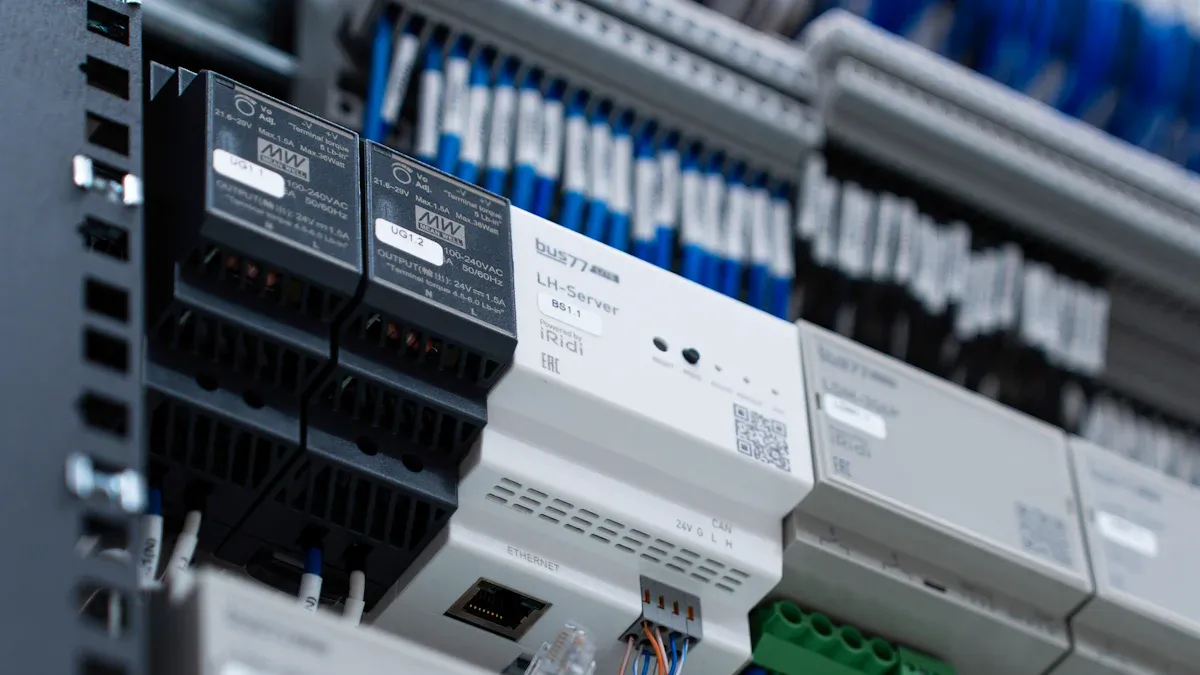
Every reliable automated control system rests on four hardware pillars: sensors, actuators, controllers, and the human machine interface that ties them together. Your choices across these components determine whether your industrial automation and control systems run for years or fail within months. Each part must work with the others, and each demands careful selection based on your specific environment.
Sensors, Actuators, and Controllers
Sensors gather data from your process. Actuators perform physical actions. Controllers, such as programmable logic controllers (PLCs) or distributed control systems (DCS), process the data and issue commands. Your automated control system design must account for the harsh realities of factory floors.
Environmental ruggedness often separates reliable components from constant failures. Consider these factors when selecting sensors and actuators:
Extreme temperatures, corrosive environments, and high-vibration conditions demand specialized actuator designs.
Moisture, dust, and weather resistance require sealed housings, corrosion-resistant materials, and protective coatings.
Enclosure ratings per NEMA standards and ATEX directives for explosive atmospheres ensure proper environmental protection.
Enhanced durability features, such as robust construction and special sealing mechanisms, extend service life in harsh conditions.
Begin your sensor specification with environmental characterization, not catalog browsing. Document wash-down pressure, ambient temperature extremes, chemical splash exposure, and EMI sources. This approach prevents specification errors that create recurring field failures.
Signal accuracy directly impacts your process control quality. Analog and digital systems differ significantly:
System Type | Impact on Signal Accuracy & Reliability |
|---|---|
Analog Control | Susceptible to noise and interference; components drift over time, requiring regular calibration. |
Digital Control | High precision through complex algorithms; digital signals resist noise, ensuring stable control in harsh environments. |
Closed-loop control systems use feedback to monitor and adjust performance continuously. This feedback mechanism keeps operations stable even when conditions vary. Redundant controllers eliminate single points of failure. The primary controller operates I/O and mirrors its state to a secondary controller. Upon a major fault, the system performs a switchover within a single control execution sweep, making the transition effectively bumpless.
HMIs and Communication Networks
Your human machine interface provides visibility and control. Industrial HMI hardware must withstand continuous operation in demanding environments. Look for wide operating temperature ranges, ingress protection ratings against dust and moisture, and high-brightness readability for high-ambient-light areas. Optical bonding reduces glare and improves durability. Choose manufacturers with clear upgrade roadmaps to avoid obsolescence issues.
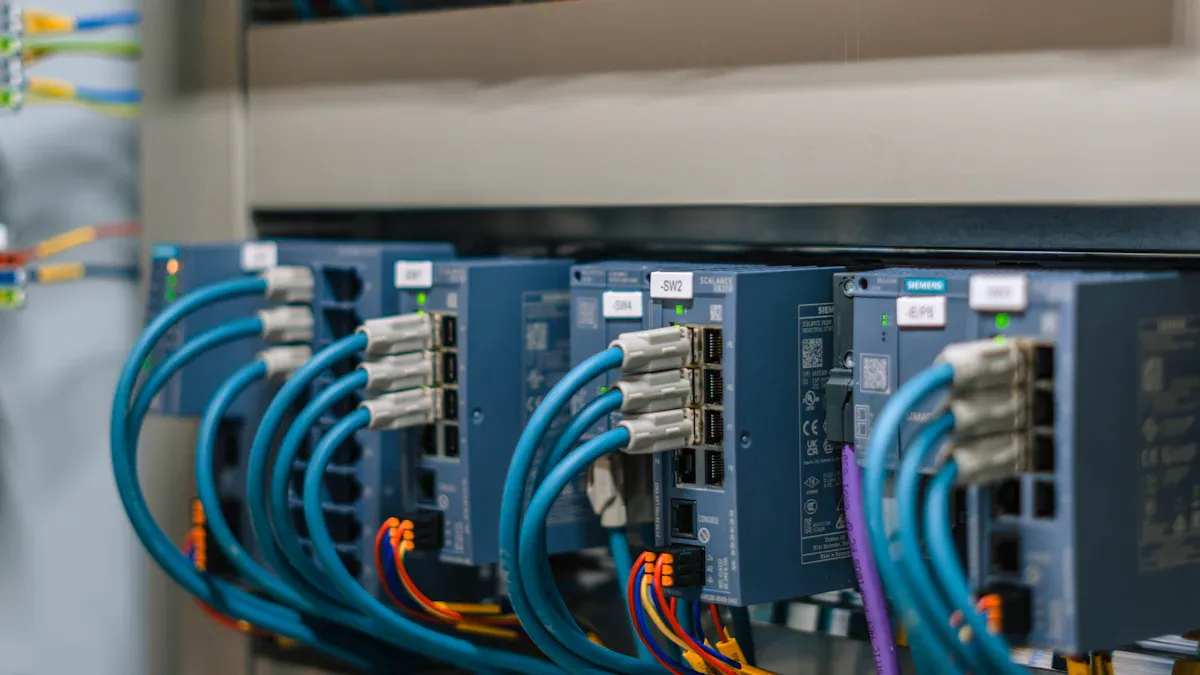
Communication networks connect all components. Industrial automation solutions rely on protocols like EtherNet/IP and PROFINET. Your network topology affects fault tolerance. Ring topologies provide alternate paths if one link fails. Redundant power supplies and dual communication channels ensure continuous operation in critical processes. This integration of hardware and network design forms the backbone of modern industrial automation controls. The performance of your entire system depends on these foundational choices.
Automated Control System Design Principles
Your automated control system design must rest on two foundational principles: modularity and safety. These principles directly affect how your industrial automation and control systems perform over time. Without them, even the best components will fail to deliver reliable operation.
Modular Hardware Design for Scalability
Modular hardware design lets you add or swap components without reworking your entire system. This approach reduces downtime and avoids full replacements. Your system can grow and adapt over time as production needs change.
Modular hardware design enables components to be added or swapped without reworking the entire system. This ensures the system can grow and adapt over time, reducing downtime and avoiding full replacements.
Modern industrial automation solutions rely on modular PLC platforms. These platforms use standardized hardware components that you can assemble and configure easily. The design allows flexible expansion by adding or removing functional modules. This architecture enables manufacturers to create scalable automation solutions adapted to different production requirements without complete system redesign.
Two key features make modular designs work well in practice:
Hot-swappable modules: You can replace or add modules during operation without system shutdown. This significantly reduces maintenance downtime and improves system availability.
Redundancy mechanisms: Backup power supplies, redundant communication paths, and failover capabilities automatically switch to backup modules when primary components malfunction. This ensures continuous operation even when individual modules fail.
The process for building with modular PLC platforms follows several steps:
You select standardized hardware components from a modular PLC platform.
You assemble and configure these components for your specific application.
You expand the system by adding or removing functional modules as needed.
You create scalable automation solutions that adapt to different production requirements.
Modern modular PLC platforms employ distributed control architectures. These architectures distribute processing tasks across multiple interconnected modules. This approach enhances system reliability, performance, and flexibility. Control functions execute closer to the point of operation. The distributed architecture supports network-based communication between modules. This enables coordinated control across multiple zones or production lines. It improves fault tolerance and allows independent operation of subsystems during network disruptions.
The benefits of modular design extend across the entire system lifecycle. Assembly benefits from pluggable connectors and fast-install terminals that reduce manual wiring. Commissioning benefits from pre-tested connections and clear terminal identification that help reduce troubleshooting. Operation benefits from secure terminations and proper strain relief that improve reliability. Maintenance benefits from pluggable interfaces and clearly marked terminals that simplify component replacement and system upgrades.
Safety and Compliance in Component Selection
Safety standards directly shape your automated control system design. ISO 13849 and IEC 62061 (SIL) mandate the calculation of the probability of dangerous failures per hour (PFHd). This quantitative metric comes from component failure rates. It forces you to select reliable components and architect systems that meet specific performance targets.
ISO 13849 describes safety functions and general design requirements for control systems. SIL standards guide the overall safety lifecycle. They ensure that safety functions behave correctly even during fault conditions.
To meet SIL or PL targets, your design must incorporate redundancy and diagnostic coverage. Faults must be detected, reported, and acted upon in time. This drives architectural decisions. You can choose between centralized logic, which simplifies validation, and decentralized designs, which reduce wiring and create modular safety zones. Smart devices with built-in safety features—such as sensors and drives with integrated diagnostics—reduce panel complexity while improving maintainability.
The two main safety frameworks differ in application and approach:
Aspect | SIL | PL |
|---|---|---|
Standard | IEC 61508 / IEC 62061 | ISO 13849-1 |
Application | Process industries (oil & gas, chemical) | Machinery and industrial equipment |
Levels | SIL 1 – SIL 4 | PL a – PL e |
Focus | Probability of Failure on Demand (PFD) | PFHd and system architecture |
Method | Quantitative | Quantitative plus qualitative |
Correlation mapping helps you translate between systems: SIL 1 ≈ PL c, SIL 2 ≈ PL d, SIL 3 ≈ PL e. Use SIL for process safety and PL for machine safety.
The critical selection rule is simple: the safety chain is only as strong as its weakest component. A standard proximity sensor connected to a safety PLC input does not constitute a safety function. The sensor itself must carry a safety rating appropriate to the required Performance Level. Risk assessment per ISO 12100 drives everything. You identify hazards, estimate risk based on severity, frequency, and avoidance, and determine the required risk reduction before selecting any safety hardware.
When selecting components for SIL-rated systems, you must consider several requirements:
Reliability and durability: Resistance to harsh conditions
Accuracy: High repeatability
Redundancy: Multiple sensors for continuous operation, required at higher SIL levels
Self-diagnostics: Autonomous fault detection
SIL levels dictate the degree of these requirements. SIL1 requires basic safety functions. SIL2 requires some redundancy and regular testing. SIL3 requires high redundancy and advanced diagnostics. SIL4 demands the highest degree of redundancy and most stringent procedures.
Compliance with ISO 13849 and IEC 61508 improves reliability by mandating redundancy and diagnostics. Dual-channel architectures with cross-monitoring are common. These standards quantify reliability through SIL and PL. You achieve these levels by combining system architecture, component reliability (MTTFd), diagnostic coverage, and protection against common cause failures.
Common cause failure protection requires specific measures:
Physical separation of redundant components
Use of diverse technologies or suppliers
Independent power supplies
Protection against shared environmental factors
Structured documentation and scoring per ISO 13849-1 Annex F
Your industrial automation controls must integrate these safety and compliance requirements from the start. The integration of safety into your design prevents costly retrofits later. Programming safety functions correctly requires understanding both the standards and the hardware capabilities. The combination of modular design and proper safety compliance creates a foundation for long-term reliable operation.
Industrial Automation Controls: Wiring and Layout
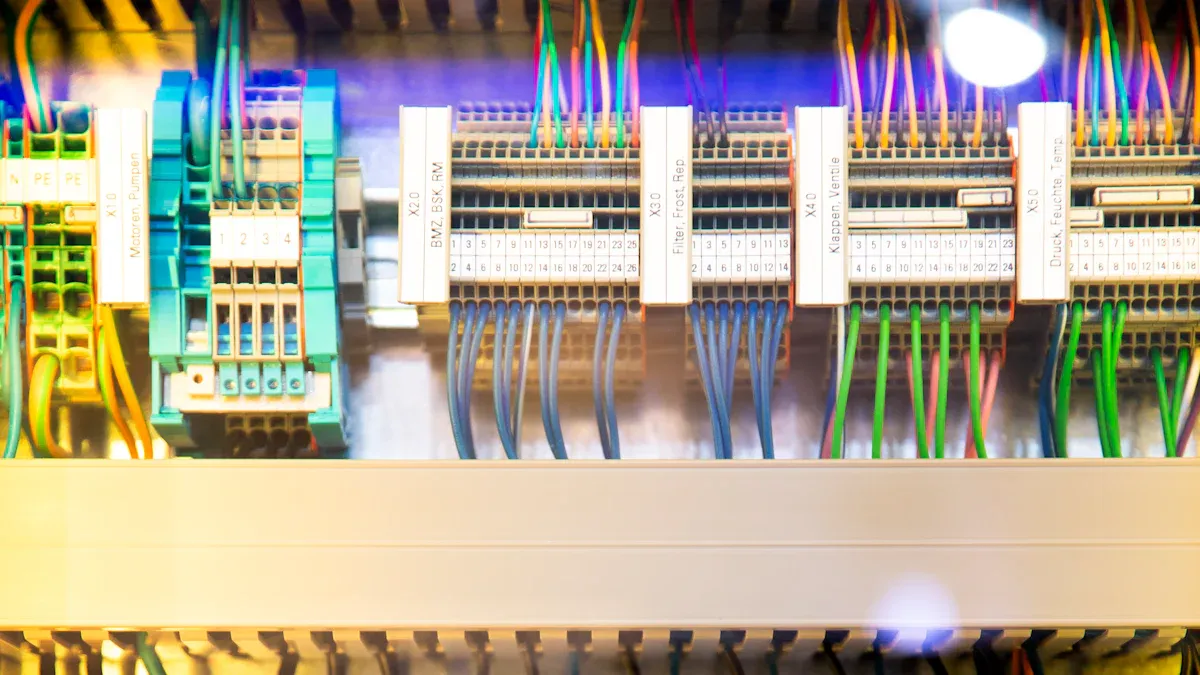
The wiring and layout of your control panel decide if your industrial automation and control systems can handle the factory floor or break down. This part of automated control system design turns part choices into a working machine. Every choice affects how well the control systems perform.
Optimizing Panel Layout for Heat and Maintenance
Heat harms electronic parts. Check your current panel for heat and airflow. Find anything that blocks air. Then add cooling the right way.
Use both passive and active cooling. Put vents near hot areas. Place exhaust at the top. Let cool air come in from below. For forced air, use filters. Manage cables so they don’t bunch up. Lay cables flat to leave gaps for hot air.
Seal any gaps in the enclosure. This keeps out humidity and dust that raise temperatures. Use heat sinks on important parts. Think about other cooling like thermoelectric coolers. Use thermal imaging to watch for hot spots. This stops surprise failures.
How easy maintenance is gets decided during the design phase. A good panel layout makes everything easy to reach. Group related parts together. Label every connection clearly. This saves time and cuts downtime. Using labels automatically improves efficiency.
Key features for easy service include clear labels, modular parts, organized wire channels, and easy-to-reach devices. These features directly affect operating costs. Hard-to-reach parts make troubleshooting take longer. An organized panel cuts troubleshooting time and makes technicians safer. Your industrial automation controls benefit from this approach.
Best Practices for Wiring and Grounding
Good cable management helps system reliability. It cuts downtime because technicians can find faults quickly. It improves safety by reducing contact with live circuits. It makes changes easier. It boosts reliability with secure connections. These practices help industrial control systems.
By organizing cables, you reduce overheating and improve airflow. Use structured wiring with cable trays and conduits. Manage cable lengths and avoid sharp bends. Label cables clearly. Industrial automation solutions depend on organized wiring. In industrial automation, proper wiring is critical.
Now deal with electromagnetic interference. Twist cables together to cancel magnetic fields. Tighter twists block high-frequency noise better. Use shielding with foil or braided shields. Foil shields give 100 percent coverage for high-frequency noise. Braided shields last longer with flexing. Connect shields with 360-degree contact. Proper programming of diagnostic functions finds interference problems. Keep control of your wiring.
For grounding, follow NEC Article 250. Use separate grounds for noise-sensitive circuits like PLC and analog signals. This reduces electrical noise and limits ground loops. Keep power and signal cables apart. Run them in separate ducts. Cross them at 90 degrees if needed. Safety and compliance with grounding rules protects people and equipment. This approach controls the risk of interference.
Inside the panel, use wire duct to keep runs tidy. Label wires at both ends. Follow color codes. Put ferrules on wire ends. Key rules for cable routing are: separate power and signal cables, avoid running them side by side, cross cables at 90 degrees, and keep loop areas small. These control system design rules form the base of reliable wiring. This cuts down human error.
Well-shielded cables can still get interference if routing is wrong. Noise can get into encoder feedback lines and sensor signals. This causes unstable system performance. Use mesh cable trays with dividers to separate control cables from power cables. This cuts electromagnetic interference and protects sensitive signals. Your automated control system depends on these practices. Clean wiring and grounding ensure a reliable PLC system.
Network Architecture for Reliable Automated Control Systems
Your network architecture links every part of your industrial automation and control systems. These industrial control systems rely on two main choices: which protocol to use and which topology to set up. Your decisions affect fault tolerance, automation uptime, and real-time performance.
Selecting Protocols and Topologies
Start with your control needs when picking a protocol. EtherNet/IP works well with Rockwell PLC and DCS platforms and offers strong diagnostics. PROFINET delivers excellent real-time performance with cycle times under 1 ms for multi-axis motion synchronization. This makes PROFINET great for precise process control. PROFINET IRT needs managed switches with IEEE 1588 support. Choose EtherNet/IP for flexible integration across large networks. Choose PROFINET for ultra-fast deterministic control in motion applications. Avoid mixing protocols. Gateways between them add failure points to your automated control system design.
Your topology choice directly affects fault tolerance. Star topology isolates device failures. One bad cable affects only that connection. The central switch, however, is a single point of failure. Ring topology with redundancy protocols like DLR or MRP provides sub-200 ms failover. A broken link does not stop the network. Mesh topology offers the highest fault tolerance through multiple redundant paths. Data can reroute around any failure. Use hybrid topologies for large networks. Place mesh at the core. Use star for end-user access. This balances cost and reliability.
Security in your automated control system design is critical. Use CIP Safety or PROFIsafe on top of standard Ethernet. Place a DMZ between enterprise and plant networks. Segment VLANs by function. Disable unused ports. Deploy industrial firewalls with allow-lists. These steps protect your industrial automation controls.
Implementing Redundancy for High Availability
Redundancy removes single points of failure. Start with power. Use dual power supplies from separate sources. Add an uninterruptible power supply to bridge gaps during transfers. A failed power supply becomes an incident, not an outage. This keeps your control systems running.
For network redundancy, three protocols dominate. Rapid Spanning Tree Protocol (RSTP) reconfigures after a failure. Recovery takes hundreds of milliseconds. This works for DCS and distributed control systems in many factories. Parallel Redundancy Protocol (PRP) sends duplicate frames over two independent networks simultaneously. Failover time is zero. PRP works with standard switches. It is ideal for substation SCADA and process automation. High-availability Seamless Redundancy (HSR) also provides zero failover time but uses a ring topology. HSR requires fewer cables but reduces bandwidth by roughly 50 percent. Use PRP for critical processes. Use RSTP for less demanding applications.
Your monitoring and programming practices keep these systems reliable. Monitor network health continuously. Document all commissioning details. Test failover before production. Reserve 40–50 percent bandwidth headroom. These steps ensure your industrial automation solutions deliver the reliability you designed for.
Overcoming Common Design Challenges
Mitigating Latency and Signal Integrity Issues
Signal integrity problems can make your automated control system work worse. Common issues include crosstalk, reflection, electromagnetic interference, signal loss, ground loops, and environmental factors. Each problem has a clear way to fix it.
Signal Integrity Issue | Mitigation Strategy |
|---|---|
Crosstalk, reflection, and timing issues in fast data lines | Use proper termination, controlled impedance, and differential signaling. |
Cable impedance mismatches and poor termination | Match cable impedance to driver or receiver; use proper termination resistors. |
Electromagnetic interference from VFDs, power supplies, and large machines | Apply shielding, filtering, and good grounding; use differential signaling to cancel out common noise. |
Signal loss over long distances | Use signal conditioning, amplification, and the right cable. |
Ground loops and ground voltage differences | Use single-point grounding or isolated signal conditioning circuits. |
Environmental factors (temperature, moisture, vibration) | Use temperature-compensated parts, sealed connectors, and vibration-resistant cables. |
Mixing old analog and new digital systems | Use signal conversion and interface design (ADC/DAC, signal conditioning) to connect different voltage levels and impedance. |
To lower network delay, use differential signaling with adaptive equalization. Fiber optic modules can send data up to 100 km without repeaters. Built-in signal integrity monitoring with automatic gain control and noise filtering helps. For critical tasks, think about dual path source synchronous interfaces. This lowers clock frequency and improves signal integrity. Over-terminating differential mode impedance at the receiving end makes the eye-opening characteristics better. These methods help your control systems keep reliable communication. Making sure communication is reliable is key for process control.
Addressing Cybersecurity and Legacy Integration
“Having many layers of defense is often more reliable. A single point of failure can and will fail.”
This idea guides how you protect your industrial automation and control systems from cyber threats. Start including security in the design from the very beginning. Use network segmentation and DMZs to keep older SCADA equipment separate from company IT and internet-connected systems. Use extra controls like protocol-aware intrusion detection, allow only approved software on HMIs, and make historian interfaces read-only. For secure remote access, use jump servers with multi-factor authentication, session recording, and time-limited permissions.
When adding new hardware to older systems, use risk-based upgrades with tools like Cyber-PHA or CyberHAZOP to focus on the most important changes, and pay attention to how things connect. Follow standards like IEC 62443 to plan upgrades safely. Choose PLCs and DCS controllers that have secure boot, encrypted communication, and digitally signed firmware. These features protect your control systems over their whole life. Plans for patching and updating that keep the plant running for a long time are important. Industrial automation solutions benefit from this complete approach to cybersecurity. Your industrial automation controls also benefit from this complete approach.
Start with modular design. Pick parts using safety and reliability measures. Build networks with built-in backup paths. These steps form your base.
Reliability comes from looking at the whole system. Hardware, software, and network design all work together. Your industrial automation and control systems rely on this connection. Strong industrial automation controls stop failures. Modern industrial automation solutions use PLC and DCS platforms well. SCADA systems give you important monitoring. Your automated control system design must include all these parts.
Work with skilled system integrators. They handle tough problems. They help you succeed over the long run. Their skills cover programming, safety, and performance tuning. They know industrial control systems inside and out.
Keep improving to make future automated control systems work better. Industrial automation changes all the time. Your automation path never really ends. Keep refining to get lasting control and reliability.
FAQ
What is the difference between SIL and PL safety standards?
SIL (IEC 62061) is used in process industries like oil and gas. PL (ISO 13849) is used for machinery. Both help you design your control system. Your industrial automation controls must reach the needed safety level.
How do you choose between a PLC and a DCS?
Use a PLC for controlling single machines. Use a DCS for controlling processes that run all the time. Your industrial automation and control systems might need one or the other. Both control systems connect to sensors and actuators.
What network topology works best for reliable automation?
Ring topology with redundancy gives quick recovery after a failure. Star topology keeps a device failure from spreading. Your automated control system works better with this choice. Industrial automation needs good monitoring for network health.
How can you reduce signal interference in a control panel?
Keep power and signal cables apart. Use cables with twisted wires and good shielding. Connect all grounds to one point. These steps make things work better. They make industrial control systems more reliable.
What are the benefits of modular design for your system?
Modular design lets you add parts while the system is still running. It makes it easier to add new parts. It takes less time to program. It works with SCADA systems. Your automation system gains from these industrial automation solutions.