Have you ever put your phone on a pad and seen it start charging? It seems like magic, but a smart protocol makes it happen. This post explains the Qi Wireless Charging Protocol, including how it works and saves energy. You’ll learn how this technology protects your battery. We will also compare how efficient it is to a wired connection. For instance, wireless charging can use 75% more energy than a cable. It also takes more than twice as long to fully charge a device. Understanding these trade-offs helps you make smart choices about your daily charging habits. Let’s explore the technology behind the convenience.
Key Takeaways
Qi wireless charging uses magnets and electricity to move power, but it works less well than plugging in a cable. It only keeps 60-80% of the energy, while cables keep over 90%.
The Qi 2.2 standard boosts energy efficiency and safety through improved coil alignment, adaptive frequency control, and advanced foreign object detection.
Qi chargers use smart power negotiation to deliver only exact power your phone needs. This reduces waste and heat, and they use little standby power when idle.
Qi 2.2 has strong safety features, like heat tracking and foreign object detection, to keep your device and battery safe.
Qi 2.2 gives charging speeds close to a cable (up to 25W) and works with all devices, so it’s a more flexible choice than MagSafe, which only works with Apple devices.
Decoding the Qi Wireless Charging Protocol
The Basics of Inductive Power Transfer
The qi wireless charging protocol operates on a principle called electromagnetic induction. A transmitter coil inside your charger pad receives an alternating current. This current creates a fluctuating magnetic field around the coil. When you place your phone on the pad, a second coil inside your device sits inside that field. The fluctuating field induces an alternating current in your phone’s coil. A rectifier circuit converts this alternating current into direct current that provides power to your battery. The process operates at frequencies between 100 and 300 kHz. This wireless charging technology forms the foundation of all modern qi chargers, providing high-frequency wireless power delivery.
The distance between the pad and your device affects efficiency. The optimal gap for power transfer is direct contact (0 millimeters). Standard qi chargers work reliably up to 8 millimeters, though the specification supports up to 40 millimeters. In practice, the reliable maximum is about 30 millimeters. At direct contact, wireless charging achieves 60% to 80% transfer rate. A 20-millimeter surface drops the rate to 60% to 70%. The wireless charging technology relies on standardized coil designs and communication protocols. These standards guarantee a charger from one brand works with a device from another. The qi wireless charging protocol ensures interoperability through rigorous testing. Enhanced tests in qi2 include cross-profile compatibility checks and load quality factor measurements. These tests account for camera bumps and thick cases. Such standards ensure consistent power transfer across all devices.
The Evolution from Qi to Qi 2.2
The qi standard has evolved since its launch in 2010. The table below shows the maximum power output for each major version.
Maximum Power | Notes | |
|---|---|---|
Baseline (pre-1.2) | 5 W | Baseline Power Profile |
1.2 (2015) | 15 W | Extended Power Profile |
1.2.3 (2017) | 30 W | Extended Power Profile Class 0 |
2.2 (2025) | 25 W | Qi2 standard (newest) |
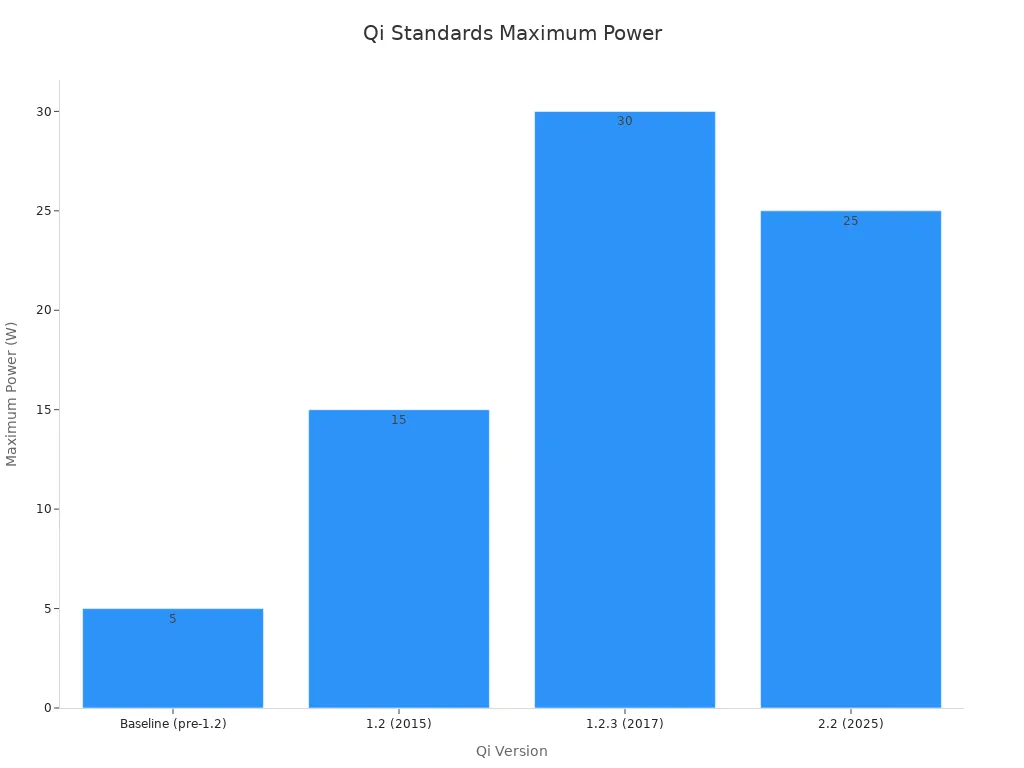
The jump from 5 watts to 15 watts in 2015 made wireless charging practical for smartphones. The 2017 update to 30 watts offered faster charging. The qi2 standard introduced in 2023 focused on alignment and safety. The qi 2.2 version, launched in 2025, represents the latest advancement in the qi wireless charging protocol and wireless charging technology. It supports up to 25 watts of power transfer, a 66% increase from the original qi2 15-watt limit. Key improvements include adaptive frequency control, improved transmitter coil design, and advanced communication protocols. The Magnetic Power Profile 2.0 achieves magnetic precision within ±0.5 millimeters, reducing energy loss and heat generation. Enhanced smart power management provides real-time thermal monitoring and battery-aware power delivery. Advanced foreign object detection uses Q-factor variance with pulse response profiling to identify metal objects before power transfer begins. These qi2 standard features make power transfer safer and more reliable, increasing power output consistency.
Qi 2.2 also introduces robust safety features. Overvoltage protection monitors input power output and shuts down power delivery if voltage exceeds safe limits. Enhanced thermal monitoring tracks heat in multiple locations, reducing power output or stopping power delivery when temperatures approach maximum limits. Sophisticated foreign object detection sends low-power test signals before initiating full power transfer. If metal interference appears, power delivery does not start. Authentication protocols verify that devices and chargers meet qi2 standard specifications. These standards for wireless charging technology prevent counterfeit accessories from accessing full power delivery speeds. The qi 2.2 standard, the newest qi2 standard, remains backward compatible with older qi chargers and devices like the iPhone 11 through 16. This compatibility ensures your existing wireless charging technology remains useful as you upgrade your devices.
All these improvements make the qi wireless charging protocol a sophisticated system for wireless power delivery. The qi 2.2 standard delivers faster power delivery, better efficiency, and enhanced safety. The qi wireless charging protocol continues to evolve with new standards. Whether you use qi2 or qi 2.2, the qi2 standard ensures a reliable wireless charging experience for your smartphones and other devices. This wireless charging technology represents the future of convenient power transfer.
How Qi Optimizes Energy Efficiency
Smart Power Negotiation and Delivery
The qi protocol does not just send power to your device. It uses a smart system called in-band communication. This system uses special signals to create a feedback loop between your phone and the charger. Your phone is the receiver, and the charger is the transmitter. Together, they agree on how much power to send before charging starts. This step sets the rules and makes sure the charger never sends more power than your phone asks for.
The negotiation process uses control error packets, or CEP values. Your phone figures out a CEP by checking its actual battery voltage against a target voltage. This check happens over and over while charging. The process follows a clear order:
Your phone checks the current battery voltage and compares it with the target voltage.
A positive CEP tells the charger to send more power by raising the duty cycle or lowering the operating frequency.
A negative CEP tells the charger to send less power, so it does not over-supply.
If the charger does not respond to the CEP, your phone turns off and sends an End of Power Transfer signal.
This closed-loop feedback system makes sure the charger sends only the exact power level your phone needs.
This constant adjustment directly improves charging efficiency. The qi 2.2 standard supports up to 25 watts, but device makers may set their own limits for their devices. This cap stops wasted energy and extra heat.
Qi2/MagSafe technology supports 15W charging, and 15W has become a common standard, applied more efficiently with the qi 2.2 update.
The power transfer efficiency differs between methods. The table below shows the comparison:
Metric | Qi Wireless Charging | Wired Charging (PD/QC) |
|---|---|---|
Energy conversion efficiency | 60%–80% (20%–40% loss) | Higher than wireless (less loss) |
Typical device temperature during charging | Typically warmer than wired | Typically cooler |
The qi 2.2 standard boosts energy efficiency with better coil alignment and adaptive frequency control. These features cut down on energy lost as heat during power transfer. The improved energy efficiency means your phone gets more of the energy the charger pulls from your wall outlet. This charging efficiency gain matters for daily use, especially when you charge overnight or during work.
Reducing Standby Power Consumption
Standby power is a hidden cost in many electronic devices. A charger that sits idle still pulls electricity from your wall outlet. The qi protocol tackles this problem directly. When you take your phone off the pad, the charger notices the change and drops its output to almost nothing. A qi wireless charging pad uses only a negligible amount of standby power when idle. This number is a specific measurement of the unloaded state. Compare that with older chargers that might draw several watts while doing nothing useful.
The qi 2.2 standard goes further with better power management. The charger keeps checking whether a device is on the pad. When your phone hits full charge, the power transfer stops. The charger does not keep sending energy. This behavior cuts wasted electricity and lowers heat exposure for your battery. The improved energy efficiency of qi 2.2 means you can leave your charger plugged in without worrying about phantom energy drain.
This mix of smart negotiation and low standby use forms the core of the qi energy-saving promise. The charging efficiency gains in qi 2.2 deliver real benefits. You get faster charging with less waste. Your battery stays cooler, which helps it last longer. Your electricity bill stays lower because the charger draws almost nothing when idle. The qi2 standard and its qi 2.2 update show a smart approach to wireless charging that values both convenience and conservation. Every power transfer cycle uses only the energy your device truly needs, nothing more.
Safety Features in Qi Certified Wireless Chargers
Foreign Object Detection (FOD) and Heat Management
A qi certified wireless charger uses several safety layers. Foreign Object Detection (FOD) begins before power flows. The transmitter checks its open-air quality factor, called Q. If a metal item like a coin sits on the pad, the Q value shifts a lot. No receiver answers the charger’s signal. The system sees this change as a foreign object. It then shows safe power levels to avoid danger. This pre-power check happens each time you place your device.
During active charging, FOD keeps watching. The receiver sends estimated received power data to the transmitter. The transmitter figures out possible foreign object power. If this value goes past the limit, the system lowers power. It renegotiates to a safer, lower level. This “best effort charging” stops the metal object from overheating while your device still charges. Eddy currents in metal turn electromagnetic energy into heat. Without FOD, that heat could harm your device or the charger.
Heat management goes beyond FOD. Most smartphones stop charging if internal heat reaches a certain threshold, based on the manufacturer. Qi 2.2 technology changes power delivery in real-time. It keeps temperatures safe while boosting speed. The table below shows common thermal methods:
Strategy | How It Works |
|---|---|
Regular charging | Device sends end-of-charge signal at max temperature |
Throttled charging | Device reduces rate when temperature crosses threshold |
Fast charge switching | Device drops from fast to standard protocol |
These safety standards make sure your qi certified wireless charger protects both you and your device.
Protecting Long-Term Battery Health
Qi 2.2 thermal management directly helps battery life. Dynamic power adjustment gives exact current at each stage. This stops overcurrent and heat stress. Temperature sensors watch heat constantly. They slow charging when temperatures go past safe limits. Your battery stays in its ideal 20–40°C range.
Research shows that charging habits matter more than the method. For example, charging to a lower percentage can reduce capacity loss compared to charging to full, and heat from charging can accelerate battery degradation.
Qi 2.2 magnetic alignment reduces energy loss and heat generation compared to non-aligned pads. Automatic trickle charging stops active power transfer once your battery is full. This prevents long high-voltage stress. Smart charging charges fast only up to a certain percentage, then slowly reduces current. This lowers heat buildup during the final phase.
These safety standards make qi certified wireless charger products dependable choices. The qi2 standard and qi 2.2 update focus on your battery’s long-term health. Every qi certified wireless charger meeting these safety standards gives protection you can rely on.
Qi 2.2 vs. Wired vs. MagSafe: A Practical Comparison
Efficiency and Charging Speed in Real-World Use
You have to decide between two ways to charge your phone. A wired cable typically achieves higher efficiency than wireless charging. The qi wireless method only turns 60% to 80% into power. That difference means you lose some energy as heat with wireless charging. But the ease of putting your phone on a pad often makes up for that loss. You get freedom from cables and connectors that break over time.
Charging speed is also similar. The table below shows what each method can do.
Charging Standard | Maximum Power |
|---|---|
Qi 2.2 | |
Qi2 / MagSafe | 15W |
Standard Qi (1.x) | 5W to 15W |
Wired Fast Charging | Varies (typically higher than wireless) |
The qi 2.2 standard with a compatible adapter can deliver up to 25W to compatible smartphones. That speed is as good as many wired chargers for daily charging needs. Older devices may charge at lower speeds depending on their support. Standard qi pads provide lower power. Wired fast charging can be faster, but qi 2.2 makes the gap much smaller. The qi 2.2 update also improves alignment, which makes wireless charging more efficient. MagSafe chargers use similar magnetic alignment.
Convenience, Compatibility, and the Future of Wireless Charging
The qi standard is great because it is open. You can use any qi-certified charger with any qi-certified device. This universal compatibility gives a smooth charging experience across brands. These standards make sure different brands work together.
Qi (pronounced “chee”) is the universal, open standard for wireless charging. Think of it like “Wi-Fi” for power. If a device and a charger are both Qi-certified, they will work together, regardless of the brand.
Device Type
Qi Standard
MagSafe
iPhone
✅ Works (Qi-based coils)
✅ Works
Samsung Galaxy
✅ Works
❌ Does not work
Google Pixel
✅ Works
❌ Does not work
Smartwatches
✅ Works
❌ Does not work
Wireless headphones
✅ Works
❌ Does not work
MagSafe works only with Apple devices. A magsafe charger cannot charge a Samsung or Pixel phone. MagSafe keeps you inside Apple’s world. The qi2 standard, however, works with every device type. This flexibility makes qi2 better for homes with different devices. You buy one charger and it charges all your gadgets. The qi2 standard is the current best for wireless charging. The qi2 magnetic alignment also cuts energy loss.
The future of wireless charging looks good. The next step after qi 2.2 adds support for more devices. Making chargers will cost less as more people use them. Qi2 will allow faster speeds while keeping safety and battery life. The magnetic locking feature helps new device shapes like AR/VR headsets and add-on batteries. These standards keep improving your charging experience with each update. New standards will also make charging speed even faster. MagSafe might use future qi standards to stay useful. More smartphones will support qi 2.2 as the system grows.
The qi 2.2 standard gives you a charging experience that balances speed, efficiency, and safety. You get nearly wired performance with wireless freedom for your daily charging routine. The qi2 system keeps growing, and your qi-certified gear stays useful for years. Whether you choose magsafe for Apple-only ease or qi 2.2 for universal compatibility, you get smarter charging technology. These standards make sure your devices stay powered with little trouble. MagSafe is still a good choice for iPhone users who want smooth integration.
The qi protocol is more than just easy to use. Qi gives you safe, steady, and smart power. Your qi 2.2 charger talks with your phone and uses very little power when idle. That makes it a good pick for everyday use. Qi certified qi 2.2 chargers hit 60-80% efficiency when lined up right. Qi 2.2 pads are designed to manage heat effectively. The qi2 standard keeps your device cool while charging. Qi2 magnetic alignment cuts wasted energy. Magsafe chargers work with qi 2.2 devices. Qi2 makes magsafe work better. Wireless charging with qi 2.2 gives you magsafe-style ease. Qi2 tech supports magsafe add-ons. Future qi 2.2 updates promise better efficiency for charging. Qi 2.2 is the next step for charging for magsafe and qi2 fans. Qi tech keeps your smartphones safe. Magsafe users gain from qi 2.2 upgrades. Qi wireless charging is a smart daily pick. Magsafe products work smoothly with qi 2.2.
FAQ
Is Qi wireless charging safe for my phone?
Qi certified chargers have many safety layers. Foreign Object Detection stops power when metal is on the pad. Thermal monitoring keeps heat at safe levels. The qi 2.2 standard adds real-time power changes. These features keep your device safe during every charge. Qi 2.2 meets strict safety rules for wireless charging.
Can I use any Qi charger with any device?
The qi standard is open and works with everything. Any qi certified charger works with any qi certified device. The qi2 standard improves alignment with magnetic precision. Qi 2.2 still works with older devices. These standards make sure different brands work together. Qi2 also supports magnetic add-ons.
Does wireless charging waste more energy than wired?
Qi wireless charging gets 60-80% efficiency, while wired charging is generally more efficient. The qi 2.2 standard narrows this gap with better coil alignment. Smart power talks send only the energy your device needs. Standby power drops to a negligible amount when idle. These qi2 upgrades make wireless charging more efficient. Qi 2.2 follows strict efficiency rules.
Will wireless charging damage my battery over time?
Qi 2.2 heat control protects battery health. Dynamic power changes stop overcurrent and heat stress. Charging to 80% causes less damage than charging to 100%. The qi2 standard includes automatic trickle charging. These safety rules extend your battery’s life.
How does qi 2.2 compare to MagSafe?
This standard works with any device brand. MagSafe only works with Apple products. The qi2 standard offers up to 25W, and MagSafe is a compatible implementation. Qi 2.2 chargers follow universal rules. This makes qi 2.2 the better pick for homes with many devices. Both follow different rules.