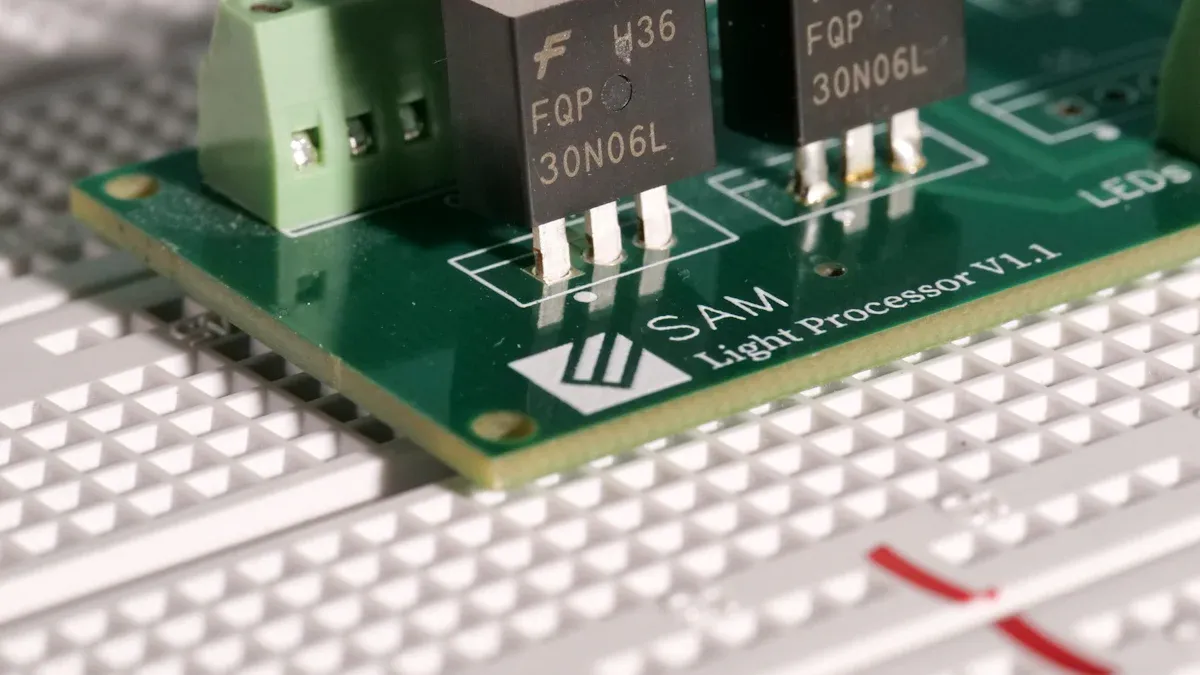
Vibration and moisture wreck electronic projects. Solder joints crack from constant shaking. Moisture gets in and eats away delicate traces. Race cars and railway systems fail without proper protection. You need anti-shake and waterproof design from the start.
The cost savings prove the value. One project cut unit cost from $6.75 to $3.85, a 43% savings. Assembly labor dropped from $1.45 to $0.08 per unit. Warranty costs fell from $0.85 to $0.02 per unit. Field failure rates improved from 12.5% to 0.3%. The return on investment arrived in just 5.8 months.
Practical strategies include conformal coating, potting compounds, and proper mounting. These methods shield your circuit from harsh environments. You extend product lifespan and reduce maintenance dramatically.
Key Takeaways
Use conformal coating, potting, or nano-coating to protect your circuit from water damage and rust.
Make the circuit board stronger where it attaches, and seal every opening to keep out shaking and water.
Test your design early using industry standards like MIL-STD-810H and IEC 60068 to find failures.
Pick silicone conformal coating when you need flexible moisture protection, but make sure it is neutral-cured.
Understanding Vibration and Moisture Threats
Vibration and moisture are two big dangers for your electronics. Each one attacks your circuit in a different way. Knowing how they work helps you pick the right protection.
Mechanical Stress and Solder Joint Fatigue
When a PCB bends from vibration, stress builds up at certain frequencies. A normal PCB has a first natural frequency around 60 Hz. The standard test range for industrial electronics is 20 to 2000 Hz. This range causes resonances at the box, board, and component levels.
Heavier parts like batteries and sensors face more risk. They move differently than the board surface. Your solder joints fight this movement. Cyclic shear and peel stresses gather at sharp spots like the heel of gull-wing leads.
These stresses attack the brittle intermetallic layer at the solder-copper joint. Cracks start at these weak points and spread along the layer. Vibration fatigue is high-cycle fatigue, usually over 10^5 cycles.
Attribute | Vibration Fatigue | Thermal Fatigue |
|---|---|---|
Driving force | Cyclic mechanical stress from board deflection | CTE mismatch between PCB laminate and component |
Cycle classification | High-cycle (>10^5 cycles) | Low-cycle (<10^4 cycles) |
Crack path | Along IMC/bulk-solder interface (brittle) | Through bulk solder (ductile) |
A good anti-shake design makes the board stiffer and reduces vibration. This lowers the stress on every solder joint.
Moisture, Corrosion, and Short Circuits
Water gets into your enclosure in several ways. Capillary action pulls water through tiny gaps. Pressure changes push water in when temperatures drop. Vapor diffusion moves water molecules through materials. Main entry points include gasket edges, cable glands, and seams. A temperature drop makes the air inside shrink. This creates a vacuum that pulls humid air inside.
Once moisture gets in, three chemical actions attack your circuit. Electrochemical migration moves metal ions across an insulating surface under electrical bias. Conductive dendrites grow between conductors. They cause short circuits that come and go. You need three things: ionic residue, water, and electrical bias.
Galvanic corrosion happens when two different metals touch with an electrolyte present. Electrolytic corrosion occurs when an ionic liquid contaminates nearby traces under electrical bias. Metal ions move and form conductive slivers. These slivers connect traces and cause short circuits.
You need a moisture barrier to stop these issues. A conformal coating gives great moisture protection. This coating seals the circuit from water. Your electronics last longer and work reliably. Proper waterproof methods stop these failures before they start.
Benefits of Anti-Shake and Waterproof Design
Enhanced Durability and Reduced Maintenance
You save real money when you design for tough conditions from the start. Field failures drop a lot. Warranty claims go down. Your product lasts longer in use. Anti-shake mounting cuts outside vibrations that reach enclosures. This reduces stress on parts and prevents damage. Your system’s mean time between failures improves directly.
Better mounting plans boost measurement accuracy and extend equipment life. A semiconductor plant installed advanced elastomer-based mounts with built-in sensors. Within three months, the defect rate fell by over 15%. Unplanned fixes decreased. The plant saw clear proof of improved mean time between failures.
Conformal coating gives similar benefits for moisture protection. Outdoor electronics, like automotive or military gear, face wet and humid conditions all the time. In these cases, conformal coatings are critical to ensuring reliability and operational lifespan.
For instance, outdoor electronics, such as automotive electronics or military devices, are often exposed to wet and humid conditions. In these cases, conformal coatings are critical to ensuring the reliability and operational lifespan of the devices.
The coating provides multiple layers of defense:
Prevents Short Circuits and Electrical Failures: Moisture and contaminants cause electrical shorts. The coating adds an extra layer of protection.
Enhances Insulation Properties: The coating increases insulation resistance on PCBs. Sensitive applications benefit greatly.
Protects Against Environmental Factors: Moisture, dust, chemicals, and extreme temperatures stay out.
Increases Longevity and Reliability: By preventing wear and tear, the coating extends PCB life. Your electronics perform reliably for years.
Meeting Industry Standards (IP Ratings)
IP ratings give you a benchmark for waterproofing electronics. The Ingress Protection code classifies enclosure sealing. IP67 and IP68 represent the most common targets for demanding environments.
Rating | Test Condition |
|---|---|
IP67 | |
IP68 | Manufacturer-specified depth and duration, typically >1 m |
IP67 ensures full dust protection. It allows temporary immersion up to one meter for 30 minutes. IP68 extends immersion beyond that. Marine equipment, subsurface systems, and industrial areas with persistent moisture require IP68. These applications need robust sealing, thicker gaskets, and materials that maintain structural integrity over long durations.
You should understand the limits of IP ratings. They test the enclosure only. They say nothing about cable entry points, connectors, or interfaces. A product can have an IP67-rated housing and still fail at every cable that enters it. IP ratings also do not address corrosion, UV degradation, or thermal cycling. A product can pass an IP67 test on day one and fail the same test after two years of outdoor use.
An IP rating is more than just a label. True ingress performance is determined by how well the entire product design integrates sealing strategies, material choices, manufacturing tolerances, and protective features. Evaluating these elements early helps ensure the final IP rating accurately reflects real-world conditions.
A good waterproof effect requires attention to every penetration point. Your overall system performance depends on the weakest seal. Design for the whole product, not just the housing.
Practical Design Strategies for Waterproofing Electronics

Conformal Coating, Potting, and Nano-Waterproof Liquid Coating
You have three main ways to protect your circuit board from moisture. Each method has different strengths. Your choice depends on your environment, budget, and service needs.
Conformal coating puts a thin protective layer over your PCB. Before applying it, preheat the board to 100–150°F. This step removes trapped moisture and helps the coating spread evenly. Use neutral-cured silicone for best results. Acid-cured silicone can damage your solder joints over time. The coating seals your traces from moisture while still letting the board flex naturally.
Conformal coatings are usually not fully waterproof because they are semi-permeable. However, parylene coatings, 2-part epoxy coatings, and potting compounds can provide true waterproofing protection.
Potting waterproof methods go further. You fully encase the entire assembly in a resin block. This approach suits harsh places like marine or industrial settings. Choose flexible potting materials over rigid ones. Flexible compounds absorb mechanical stress from vibration and thermal expansion. Rigid materials pass that stress directly to your solder joints. Potting adds weight and makes rework nearly impossible, so save it for designs you will not need to repair.
Nano-waterproof liquid coating offers a modern option. This ultra-thin treatment creates a superhydrophobic surface that repels water. The nano coating reaches tight spaces that traditional coatings miss. It adds almost no weight and cures at room temperature. High-volume production lines favor this method for its speed.
Aspect | Potting | Nano-coating |
|---|---|---|
Moisture Protection Level | Strong, full encapsulation; ideal for long submersion | Superhydrophobic, ultra-thin layer; repels water but not for long submersion |
Weight and Thickness | Adds significant weight and thickness | Minimal thickness, no noticeable weight |
Reworkability | Very difficult or impossible | Possibly reworkable depending on formulation |
Application Ease | Full encapsulation, longer process time | Quick dip or vapor deposition, room temperature curing |
Cost | Higher material and labor cost | Moderate to high per-unit cost, cost-effective in high volumes |
Suitability | Excellent for extreme moisture and vibration | Good for lightweight, complex assemblies |
Three anti-paint waterproof treatments stay popular for general-purpose protection. This conformal coating type resists moisture, mold, and salt spray. It forms a pinhole-free protective film that fits complex board shapes. The three anti-paint waterproof approach works well for consumer electronics and automotive modules. Parylene nano-coating protection delivers even better results. Parylene deposits as a true conformal layer with minimal thermal expansion. This parylene nano-coating protection keeps high dielectric strength even at nanometer thicknesses.
Structural Waterproofing and Anti-Shake Mounting
Your coating choice matters, but the physical structure of your enclosure matters just as much. Structural waterproofing starts with sealing every penetration point. Wiring entries cause most moisture failures.
Component Placement and Orientation: Put critical components, such as heavy capacitors or connectors, in areas of the PCB with minimal vibration impact. Orient components perpendicular to the direction of dominant vibration to reduce stress on solder joints.
For wiring penetrations, follow these rules:
Use one hole for one wire. This makes sealing much easier.
Install gaskets at exterior penetrations. Gaskets allow movement during thermal expansion while keeping the seal.
Route conduits underground to remove exterior holes entirely.
Avoid low-quality sealing methods. Expanding 1-part open-cell foam and duct putty fail under pressure. They crack and leave water pathways. Invest in expanding 2-part closed-cell foam or mechanical seals instead. These options create strong watertight seals that last.
Anti-shake mounting requires rigid PCB attachment. Solder joints should never be the only structure holding a heavy component. Use brackets, clamps, and staking to support transformers, large capacitors, and connectors. Place mounting points so board flexure does not peak beneath large packages. Keep brittle ceramic components away from highly loaded mounting points. Transfer connector insertion forces into the chassis rather than the board. Specify torque values and locking methods for every board mount. Always test the full assembly with the enclosure and harness. A bare-board fixture can hide system-level loads.
This combination of circuit board structure waterproof design and proper mounting creates a waterproof structure that survives real-world conditions. Your electronics stay dry and stable. You achieve good waterproof effect without sacrificing serviceability. The right protective coatings and mounting strategy extend your product’s life dramatically.
Testing and Validation Methods

You should test your prototypes for moisture and vibration resistance early in development. Waiting until production reveals costly problems. Early testing helps you catch design flaws when changes cost little. Your testing plan should match the real conditions your product will face.
Environmental Testing for Vibration and Moisture
Industry standards give you a framework for testing. Military and commercial sectors rely on these established methods. You can choose the right standard based on your target market.
Standard | Focus | Application |
|---|---|---|
Vibration, temperature, humidity | Military and rugged commercial gear | |
Sinusoidal vibration | General electronics | |
IEC 60068-2-78 | Damp heat | Moisture resistance |
JEDEC JESD22-B103 | Variable frequency vibration | Semiconductor components |
AEC-Q100/Q200 | Combined thermal and mechanical stress | Automotive electronics |
MIL-STD-810H offers several vibration procedures. Procedure I applies to secured cargo and deployed equipment. Procedure II simulates loose cargo bouncing on a truck bed with 25.4 mm peak-to-peak motion at 5 Hz. Procedure III covers large assemblies that form a big part of vehicle mass. Procedure IV handles aircraft stores and missiles. Each procedure matches a specific real-world scenario.
For moisture testing, IEC 60068-2-78 provides the damp heat method. You expose your product to high humidity at a set temperature for a fixed duration. MIL-STD-810H also includes humidity testing procedures. Combined environment testing follows IEC 60068-2-53 for temperature plus vibration. No single standard covers vibration and moisture together, so you must run separate tests.
Test durations vary by product category. Small electronic devices need 168 hours of basic verification. Smartphones and smart watches require 504 hours as an industry minimum. Automotive electronics and photovoltaic panels demand 1000 hours. Outdoor power equipment needs 2000 hours of extreme reliability testing. These durations follow IEC 60068-2-67-2019 guidance.
Reliability Testing and Stress Analysis
Reliability testing predicts how long your product survives real conditions. Statistical models help you extrapolate test results to normal operation. The Arrhenius model handles temperature acceleration in stress testing. It converts failure rates observed at elevated temperatures back to expected rates at normal temperatures. Temperature remains the most common stress variable in accelerated testing.
IEC 61709 provides stress models based on field data analysis. These models convert base failure rates at reference conditions to rates at actual operating conditions. You input your operating environment, temperature, and stress factors. The model outputs a predicted failure rate for your specific use case.
Your reliability testing should include thermal cycling per JESD22-A104. This test exposes components to alternating hot and cold temperatures. Thermal cycling stresses solder joints differently than vibration does. Combined testing gives you a complete picture of your product’s durability.
A cargo truck delivering four 2U rugged servers to a military installation traversed rocky desert terrain. The servers became unsecured and endured violent vibrations strong enough to detach fasteners and crack chassis. Because the servers passed MIL-STD-810 certification, they survived intact while other items in the trailer suffered damage. This real case shows why proper testing matters.
Your testing program should verify the performance of your conformal coating and potting materials. Apply the coating to test boards and expose them to humidity chambers. Check for delamination, cracking, or loss of adhesion. Your silicone-based conformal coating should maintain its protective barrier throughout the test period. The nano coating option also needs verification under your specific moisture conditions.
Document every test result. Track failures and analyze root causes. Use this data to improve your circuit design and coating application process. Your waterproof strategy improves with each test cycle. Your electronics gain reliability through this iterative approach. The conformal coating you choose must pass the same tests your final product faces. Test early, test often, and let data guide your design decisions.
Real-World Applications
Automotive, Marine, and Industrial Automation
Race cars and railway systems push your anti-shake design to the limit. These environments combine high vibration with moisture exposure. Your circuit must survive both threats at the same time.
In automotive applications, three common failure patterns emerge from vibration stress. First, solder joints on battery FPC connectors fail when a pad step difference of 50-60μm creates stress concentration. Large voids up to 75% with flux residue weaken the joint further. The joint separates from the intermetallic layer. Second, connector contact wear from continuous small vibrations removes gold plating. Contact resistance increases and signals become unstable. Third, unsecured cables transmit vibration energy directly to connection points. The cable breaks or the connector housing cracks. You prevent these failures with proper mounting and a high-quality conformal coating. This silicone-based conformal coating seals your circuit from moisture.
Railway electronics follow EN 61373 standards. This standard requires lighting fixtures to withstand random vibrations from 5 to 150 Hz with accelerations up to 5.4 m/s². An LED profile with proper cover, end caps, and silicone potting acts as a damping system. The aluminum cross-section becomes the determining factor for heat dissipation in damp environments. You need rugged construction with aluminum alloy housing and anti-corrosion treatment. Your silicone-based layer provides the moisture barrier these systems need.
Marine equipment demands even higher standards. Most marine electronics carry IPX7 or IPX8 ratings. IPX7 handles submersion up to one meter for 30 minutes. IPX8 handles long-term submersion at manufacturer-specified depths. You apply marine-grade silicone or epoxy sealants to electrical connections. Heat shrink tubing conforms tightly to wires when heated. You wrap connections with marine-grade electrical tape that resists saltwater. Your conformal layer on boards insulates from moisture and corrosion. This coating protects your electronic assembly from salt spray. A nano-based treatment option adds lightweight protection for complex assemblies. Dielectric grease on connectors prevents salt corrosion. You manage humidity with ventilated lockers and desiccant packs.
Industrial automation controllers face similar challenges. A wind power enterprise discovered that ordinary SSDs had a 5% data loss rate under 10g vibrations. Upgrading to industrial-grade SSDs resolved the issue. Wind power monitoring systems under 10g random vibrations achieve a bit error rate of 0.001% or less on CAN bus. Mining drill controls withstand 200g shocks with 100% SSD data integrity and system restart under 10 seconds. Automotive welding stations handle 20g vibrations with data transmission delay of 5ms or less, ensuring welding accuracy of ±0.1mm. Your system performance depends on the reliability of these components.
Your anti-shake and waterproof strategies protect electronics across all these environments. The right materials, mounting, and sealing methods prevent failures. Your product performs reliably in the harshest conditions.
You now know why anti-shake and waterproof design matters. These steps stop failures, lower repair costs, and make products last longer. You have learned simple methods: conformal coating, potting compounds, and nano-waterproof liquid coating. Each coating type gives specific protection from moisture and shaking. Your PCB layout and mounting choices are just as important. Structural waterproofing seals every spot where water could enter. Anti-shake mounting keeps heavy parts secure. Good testing checks your design before it goes into use. Silicone-based conformal coating creates a reliable moisture barrier. Flexible potting absorbs mechanical stress well. This silicone shield greatly improves your electronics’ performance. Look at your current projects now. Use these proven methods early. You will avoid costly field failures and build products that survive harsh conditions. Your next design deserves this protection.
FAQ
What makes silicone conformal coating different?
Silicone conformal coating stays flexible when temperatures change. It blocks moisture better than acrylic options. Only use neutral-cured material. Acid-cured types harm your solder joints over time.
How do you apply silicone conformal coating correctly?
First, preheat your board to 100–150°F. This step removes trapped moisture. Apply the coating evenly. Use neutral-cured silicone. Let it cure fully before testing. Your circuit stays protected.
What waterproof rating do you need for outdoor electronics?
IP67 handles one meter of water for 30 minutes. IP68 goes deeper and lasts longer. Match your rating to your environment. Marine gear usually needs IP68. Consumer devices often work fine with IP67.
Does silicone coating provide moisture protection?
Yes. Silicone coating forms a barrier that blocks moisture. It handles humidity and temperature changes well. Your electronics gain reliable protection against corrosion and short circuits.