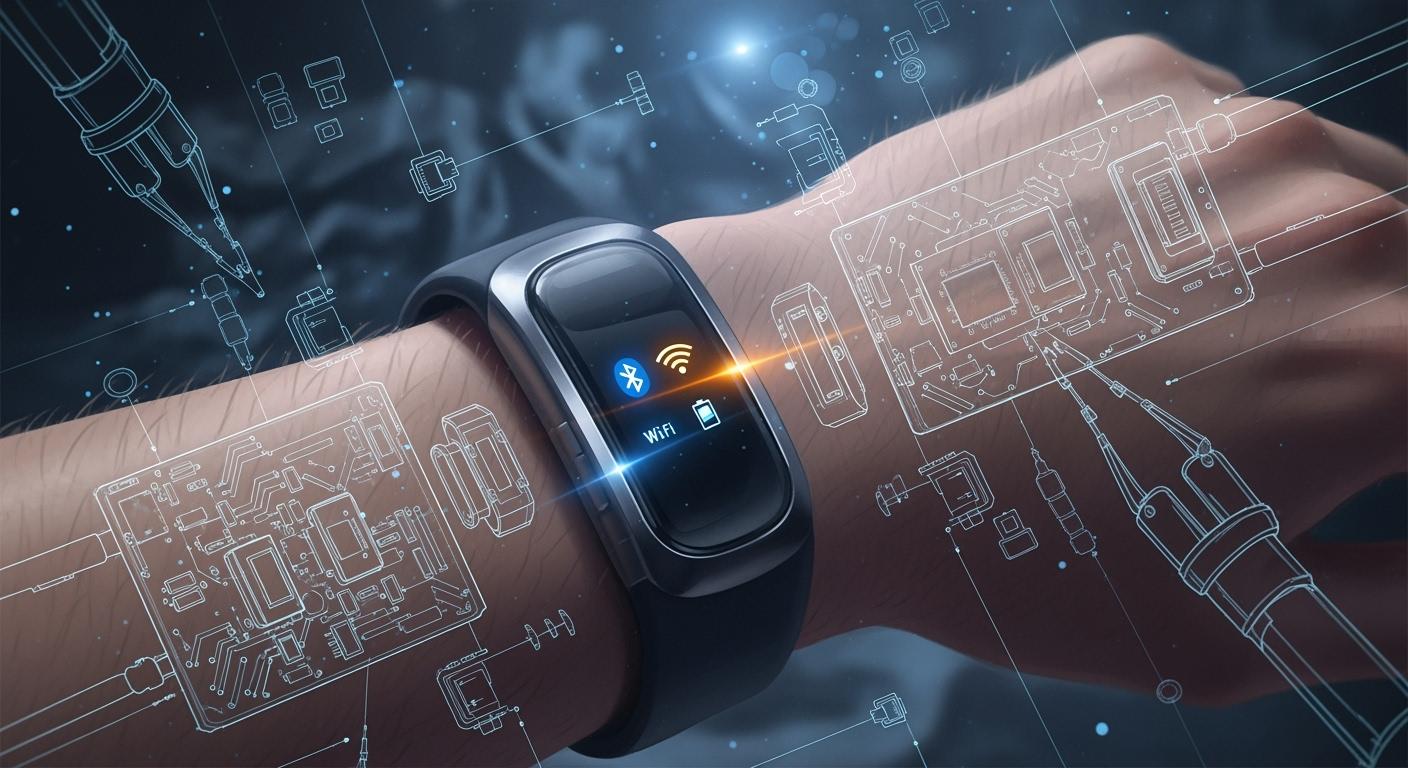
You can see that Bluetooth Wristbands are now used by many people every day. Their design is not just for talking to others anymore. These wristbands now help track health, give safety alerts, and let you change settings for special events. The worldwide market for smart wristbands was USD 2008.3 million in 2024. In that year, 385 million wristbands were shipped.
In 2023, 336 million smart wristbands were shipped around the world.
The market will keep growing at a 2.9% CAGR.
Feature Type | Percentage of Devices | Description |
|---|---|---|
Activity Tracking | 25% | Finds movement, falls, steps, and distance. |
Cardiac Monitoring | 26% | Checks heart rate, arrhythmia, blood pressure, oxygen. |
Sleep Phase Detection | 23% | Watches sleep phases. |
User Location Measurement | 15% | Finds where users are. |
Stress Measurement | 7% | Checks stress. |
Breathing-Related Events Detection | 1% | Finds breathing and diabetes events. |
Mental Health Monitoring | N/A | Checks mental health. |
Other Features | N/A | Finds epilepsy and sweat. |
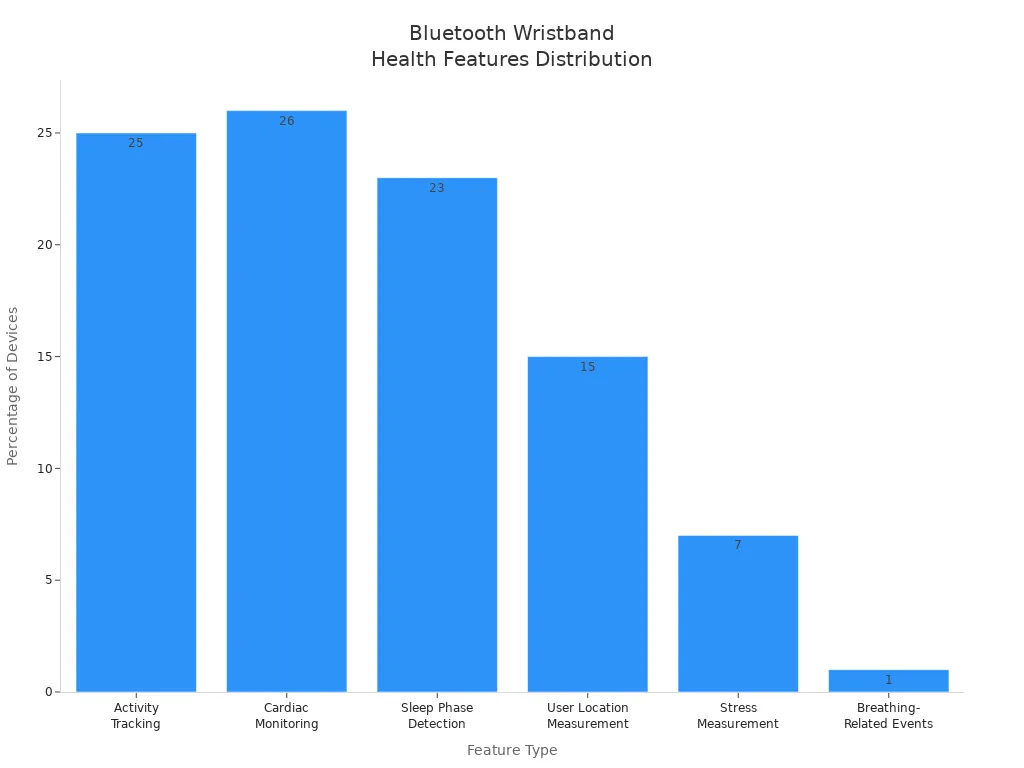
You can use these wristbands to watch your health, get emergency alerts, and get into events. This makes them useful for both personal and public needs.
Key Takeaways
Bluetooth wristbands can do many things. They help track health, give safety alerts, and let people get into events. This makes them useful for both personal and public use.
People can change settings to get health alerts. They can also pick their own designs. This makes the wristbands more fun and interesting to use.
Good design and making of wristbands need careful planning. You must pick the best materials and check quality. This helps the wristbands stay safe to use.
Testing and updating the wristbands often is important. This keeps them working well and makes sure they follow rules.
Knowing what people like and what is popular helps make new ideas. This leads to better wristbands for health and daily life.
Bluetooth Wristbands Overview
Functions and Applications
Bluetooth Wristbands are used in many places. Hospitals use them to keep patients safe. Staff can call for help fast with these wristbands. At events, they make check-in quick and easy. Organizers can see where people are. If there is an emergency, you can find the nearest doctor or staff member. During big accidents, wristbands help track patients. This makes sure everyone gets care. They also keep at-risk patients away from danger.
Here is a table that shows how Bluetooth Wristbands help in healthcare and safety:
Function/Application | Description |
|---|---|
Patient Safety | Bluetooth wristbands help staff call for help fast in emergencies. |
Staff Safety | Staff can ask for help quickly, which lowers workplace violence. |
Fast Access to Personnel | You can find the closest doctor or staff member fast. |
Automated Check-In | Check-in is faster for patients and staff, with less waiting and paperwork. |
Enhanced Patient Security | Tracks at-risk patients so they do not go into dangerous places. |
Mass Casualty Management | Helps track patients in big emergencies, so care is given well. |
Bluetooth Wristbands are also used at concerts and sports games. They help you get into the event. Organizers can know where you are. These wristbands make events safer and more fun.
Programmable and Custom Features
You can change Bluetooth Wristbands to fit what you need. Some let you set health alerts, like heart rate warnings or step goals. You can program them to send an emergency signal if you press a button. Many let you pick colors, logos, or messages for special events. You can connect them to your phone to track health or get reminders.
Some Bluetooth Wristbands are waterproof, so you can swim with them. You can choose wristbands with GPS to track where you are. Many let you add new features with updates. You can use these wristbands for health tracking or getting into events.
Design Steps
Concept and User Needs
When you design Bluetooth Wristbands, you must think about what people want. Many people want to track their health and fitness. Some want their wristband to feel special to them. People also want new technology that works with healthcare. The market is growing because more companies use digital tools. Governments also help these changes happen. Older adults need better health tracking features.
Here are some main reasons for making new wristbands:
Health monitoring and fitness tracking
Personalized experiences
Integration with healthcare systems
Digital transformation in industries
Regulatory support
Applications in many commercial and tech areas
Special features for elderly users
You should pick clear goals before you build the product. The table below shows some important goals for Bluetooth Wristbands:
Key Product Goals | Description |
|---|---|
Health Tracking Accuracy | Advanced features such as precise heart rate monitoring and detailed sleep tracking. |
GPS Integration | Reliable GPS functionality is emphasized for accurate location tracking. |
Waterproofing | Water resistance ratings of IP67/IP68 are becoming standard for durability in various environments. |
Hardware
You must choose the right hardware for your wristband. This means picking Bluetooth modules, sensors, and batteries. The table below lists some popular modules:
Module Name | Description |
|---|---|
BL654 | Provides design flexibility and performance with Bluetooth 5, NFC, Thread, and mesh capabilities. |
BL654PA | Offers enhanced power and range with PA/LNA support, ideal for challenging RF environments. |
Sterling-EWB | Combines WLAN and Bluetooth with a robust MCU for IoT design flexibility. |
Sentrius™ BT710 | A durable, long-range Bluetooth tracker with integrated sensors for personnel tracking. |
You can add sensors like:
Accelerometer
Barometer
Temperature sensor
For power, you can use:
Coin-cell batteries for small, low-power designs.
Lithium-ion batteries for rechargeable wristbands.
Alkaline batteries for disposable options.
Bluetooth Wristbands use Bluetooth Low Energy (BLE) to send data. They have a Bluetooth radio, a microprocessor, batteries, and sensors. This setup helps with tracking and contact tracing.
PCB Design
You need to make a printed circuit board (PCB) that fits all the parts. The PCB connects the Bluetooth module, sensors, and battery. The design should be small and work well. Good PCB design helps the wristband last longer.
Here are some hardware features from real products:
Feature | Lansitec Bluetooth Bracelet | B9 Cut-off Alert Wristband |
|---|---|---|
Bluetooth Version | Bluetooth 5.0 | Bluetooth LE 5.0 |
Health Monitoring | Yes (skin temp, heart rate, blood pressure) | No |
Pedometer | Yes | No |
Waterproof Rating | IP67 | N/A |
Battery Capacity | 210 mAh | N/A |
Usage Duration | 4 to 10 days | N/A |
Charging Method | Magnetic adsorption | N/A |
Cut-off Alert | No | Yes |
App Control | No | Yes |
Eco-friendly | N/A | Yes |
FDA Compliance | N/A | Yes |
Software
You need good software to make Bluetooth Wristbands work well. The software has firmware and mobile apps. Firmware controls the device and helps it run smoothly. You can use Bluetooth, BLE, Wi-Fi, NFC, Zigbee, or LoRa to connect.
You should:
Make strong firmware for the device.
Use custom firmware like bare metal, BSP, DSP, Linux Kernel, or AOSP.
Add middleware for machine learning or voice assistants.
Use SDKs, drivers, and libraries to help development.
For mobile apps, you need tools and APIs to connect to the wristband. The app should help users find, connect, and share data with the device. You can show sensor data on a phone or tablet. You can also control the wristband from the app.
To keep the software safe and working well:
Make Bluetooth security better to stop attacks.
Work with security experts when you design.
Update firmware often.
Teach users about possible risks.
Industrial Design
You want your wristband to look nice and feel good. Ergonomics are very important. The device should fit the wrist’s shape. It should not be heavy or big. Most wristbands weigh less than 100 grams and are about 50x50x20 mm.
You should use materials that are:
Lightweight
Breathable
Hypoallergenic
Common materials are:
Silicone and thermoplastic elastomers (TPE) for sweat resistance and flexibility
Bio-compatible metals with hypoallergenic coatings
Self-healing materials to stop scratches
How the wristband looks is also important. People like wristbands that match their style. The table below shows what matters in design:
Aspect | Description |
|---|---|
Aesthetics | Engages the senses and shapes user interactions, with aesthetically pleasing designs preferred. |
Comfort | Critical for user acceptance, requiring ergonomic design and hypoallergenic materials. |
User-friendly | Designs must avoid overly secure fastenings to reduce anxiety and agitation. |
Size & Weight | Recommended to be under 100g and dimensions of 50x50x20 mm for discretion and comfort. |
The wristband must balance how it works and how it feels. If you focus on comfort, people will wear it longer and like it more.
Tip: Always test your design with real users. This helps make sure it feels good and works well every day.
Bluetooth Wristbands Manufacturing
Sourcing and Assembly
Electronic Sourcing
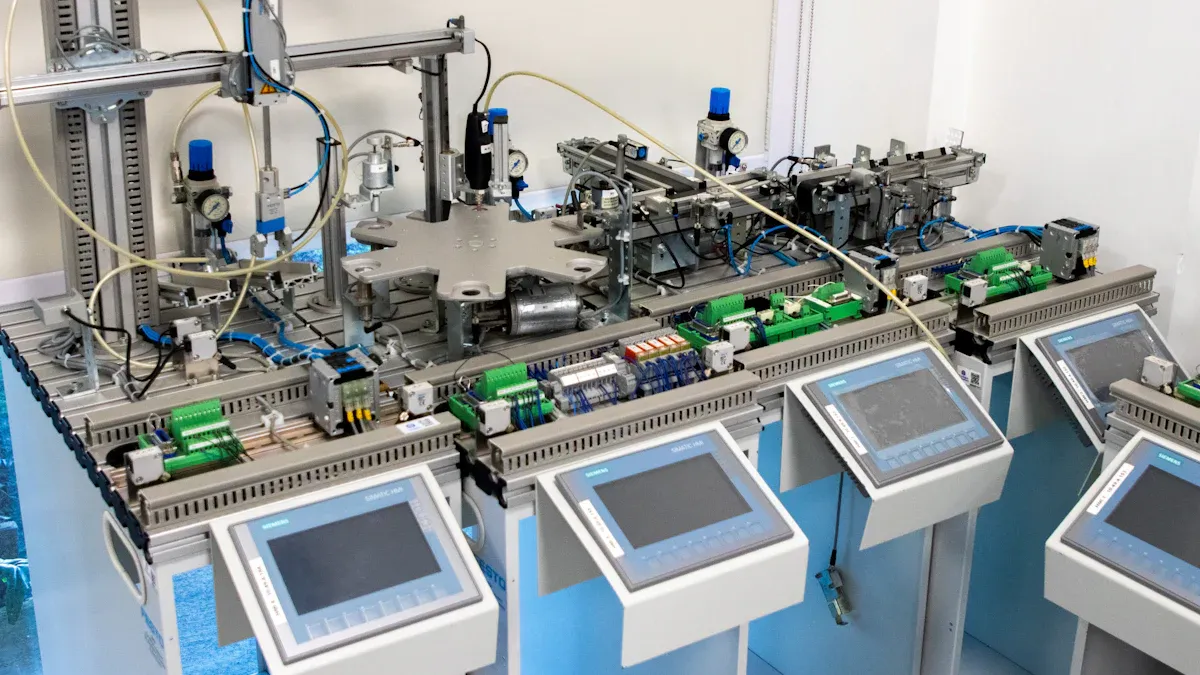
You begin by picking the right electronic parts for your wristband. This step matters a lot for cost, quality, and how well it works. There are many problems when you look for parts. It is hard to know if prices are fair. Sometimes, supply chains are slow or break. This can cause delays and bad quality. Rules change a lot, so you must keep up. Many companies want the same parts. It is hard to be different from others. Technology changes fast, so you must keep making your wristband better. Finding good sellers is not easy. You want the best parts for the best price. New companies have a hard time joining the market. People may not trust them. You also need to fit many parts in a small space. The wristband must be strong to last every day.
PCB Assembly
You carefully put together the printed circuit board, or PCB. The PCB holds the processor, memory, and Bluetooth module. You use a four-layer PCB that is about 30 mm by 28.5 mm. The main processor is usually an nRF52833 SoC. It runs at 64 MHz. You add 512 kB of flash memory and 128 kB of RAM. The board works from −40 °C to 105 °C. It supports Bluetooth Direction Finding and has +8 dBm power.
Component | Specification |
|---|---|
PCB Dimensions | 30.00 mm × 28.50 mm |
PCB Layers | Four-layer architecture |
Main Processor | nRF52833 SoC (64 MHz Arm Cortex-M4) |
Flash Memory | 512 kB |
RAM | 128 kB |
Operating Range | −40 °C to 105 °C |
BLE Features | Bluetooth Direction Finding, +8 dBm transmission power |
You use special ways to add sensors. For TPU-based sensors, you may use heat to cover them. Some wristbands use a fabric bandage with a capacitive sensor. You use a safe TPU layer and silver nanowires for electrodes. You join layers with heat to make the band strong. You put the detection circuit and wireless module in a 3D-printed case.
Quality Control
You check every wristband to make sure it works and is safe. You use many steps for quality control.
Quality Control Measure | Description |
|---|---|
Accurate Health and Activity Data Collection | The wristband only records health data when you wear it. This stops false readings and makes health tracking reliable. |
Emergency Response Efficacy | The SOS button sends alerts and shares your location. This helps you get help fast in emergencies. |
Data Privacy Concerns | You protect health and location data with strong encryption and access controls. This keeps your information safe. |
Integration with Existing Systems | You make sure the wristband works with other health and emergency systems. You offer technical support to keep everything running smoothly. |
You test the wristbands for electrical safety and battery safety. You also check electromagnetic compatibility, wireless performance, and how easy it is to use.
Tip: Always test your wristbands in real-life situations. This helps you find problems before users do.
Mass Production
You make lots of wristbands at once to meet demand. You use smart ways to keep costs low and quality high.
Strategy | Description |
|---|---|
Automation | You use machines to build wristbands. This lowers labor costs and speeds up production. Machines also make fewer mistakes. |
Traditional Manufacturing | You use tried-and-true methods for large batches. This is cheaper than 3D printing for most wristbands. |
Material and Design Optimization | You pick the best materials and simple designs. This saves resources and cuts waste. |
You must follow rules for health and safety. In the EU, you need MDD and MDR certification. In the US, you need FDA clearance and Health Canada licensing. You test for electromagnetic compatibility, battery safety, and cybersecurity. You also check if the wristband works with other devices.
Region | Standards/Certifications |
|---|---|
EU | MDD (93/42/MDD), MDR (2017/745/EU) |
US | FDA clearance, Health Canada licensing |
General | EMC, radio frequency testing, battery safety, cybersecurity, interoperability testing |
You make sure your wristbands are waterproof. You use silicone and sealed fabric to meet IP67 or IP68 standards. This means your wristband works in the shower, pool, or rain. You test health monitoring features to make sure they are correct.
Waterproof RFID wristbands use silicone and sealed fabric.
Smart bands with IP67 rating are safe for daily water exposure.
Many RFID wristbands meet IP67/IP68 standards for pools and rainy days.
Note: You must check local rules for medical devices and wellness products. Each region has different standards for radiofrequency, safety, and health monitoring.
Bluetooth Wristbands need careful planning and testing at every step. You make sure each wristband is safe, accurate, and ready for everyday use.
Challenges and Solutions
Miniaturization and Battery Life
Making Bluetooth wristbands smaller is hard. Power management is very important. The battery is usually the biggest part. You need to make it smaller but still work well. Custom sensors help track health. These sensors must also be tiny and use little power.
Power management lets you use a smaller battery without losing power.
Custom sensors help you track health in new ways, but they must fit in small spaces.
To fix battery problems, you can use new technology. The ATM2 solution from Atmosic Technologies uses very little power. This can make your wristband last twice as long as others. The ATM3 solution uses energy from outside sources. This means your wristband might not need a battery at all.
Connectivity and Compliance
Bluetooth wristbands sometimes have trouble connecting. Devices may not pair or disconnect often. Sometimes, the sound is not clear. Other devices can cause problems too.
Issue | Solution |
|---|---|
Connectivity problems | Make sure Bluetooth is on, restart both devices, and reset the connection if needed. |
Battery drain | Check battery levels often and charge when needed. |
Strap wear | Look at the strap for damage and replace it to keep good connectivity. |
Following rules is also a challenge. You must plan for rules early. You need to follow privacy and data safety laws, especially in health care. If you do not follow these rules, people may not trust your product. You should check for EMC, biocompatibility, and water protection from the start.
Tip: Always check for rules at every design step. Planning early saves time and money.
Customization and Reliability
You want your wristband to fit your needs. Custom features make your device special. You must test these features to make sure they work every day. Reliability means your wristband works well, even after many uses. You should use strong materials and test for wear and tear.
Customization lets you choose colors, logos, and health alerts.
Reliability comes from good testing and strong design.
Reverse Engineering and Redesign
Sometimes you need to change your wristband or make it better. Reverse engineering helps you learn how it works. You can find problems and fix them. Redesign lets you add new features or improve old ones. You should always look for ways to make your wristband safer, more comfortable, and more useful.
Note: Regular updates and redesigns help your wristband stay ahead of new trends and user needs.
Best Practices
Efficient Prototyping
You can make Bluetooth wristbands faster by picking good prototyping methods. Rapid prototyping helps you test ideas fast and change them before making many wristbands. Some companies, like Neuranics, use special prototypes that sense muscle activity with magnetomyography (MMG). This technology finds magnetic fields from your muscles. It is more sensitive and accurate than old ways. Using these prototypes helps you go from research to real products quickly. When you make your prototype, remember these tips:
Try new sensor technologies like MMG for better results.
Use prototypes that work for both research and selling.
Test your design with real people to spot problems early.
Tip: Testing early helps you fix mistakes before they cost a lot.
Streamlined Manufacturing
You can make building wristbands easier by using some smart steps:
Look at your production steps and fix slow spots.
Use machines and robots to work faster and make fewer mistakes.
Buy better machines for more accurate and quicker work.
Work with suppliers and keep track of your parts.
Use quality systems to keep your standards high.
These steps help you save time and money. They also make sure your wristbands are what customers want.
Ensuring Quality
You must keep quality high all the time. Good quality control stops problems before users get your wristbands. You should do these things:
Functional testing checks if your wristband works right.
Defect tracking helps you find and fix problems fast.
Test automation lets you check important features often and saves time.
Note: Testing and tracking often make your wristbands more reliable and trusted.
If you follow these best practices, your Bluetooth wristbands will work well, last longer, and make users happy.
You can make good Bluetooth wristbands if you follow these steps. First, think of your idea and learn about the market. Next, design your wristband, build a model, and test it. Last, make your wristband and start selling it.
Stage | Key Focus |
|---|---|
Design | Add custom features and make it comfortable |
Manufacturing | Use strong parts and eco-friendly materials |
Quality Control | Test the wristband and meet all standards |
Remember: New ideas, custom choices, and careful testing help you do well. Use smart steps and fix problems to make wristbands people trust.
FAQ
How long does a Bluetooth wristband battery last?
You can expect most Bluetooth wristbands to last between 4 and 10 days on a single charge. Battery life depends on how often you use features like health tracking or GPS.
Can you wear a Bluetooth wristband while swimming?
You can wear many Bluetooth wristbands in the pool or shower. Look for wristbands with an IP67 or IP68 waterproof rating. Always check the product details before swimming.
What health data can you track with a Bluetooth wristband?
You can track steps, heart rate, sleep patterns, and sometimes blood pressure or oxygen levels. Some wristbands also measure stress or skin temperature. Check the wristband’s specifications for available features.
How do you keep your health data safe?
You should use wristbands with strong encryption and privacy controls. Always update your device’s firmware. Avoid sharing sensitive data with unknown apps.
Can you customize the look of your Bluetooth wristband?
You can choose colors, add logos, or select special bands for events. Many brands offer custom options. Check with the manufacturer for available choices.