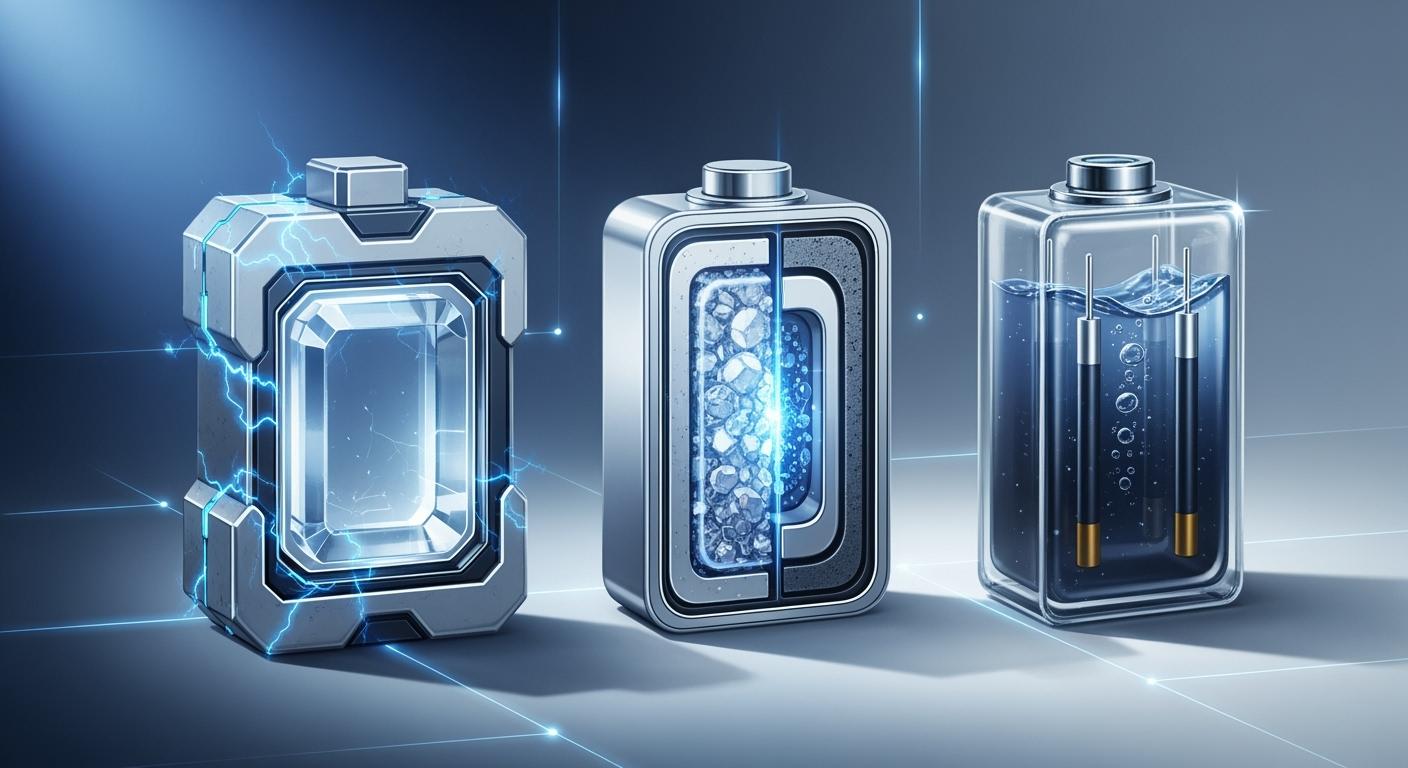
You can see big changes in battery technology now. Solid-state batteries use solid electrolytes. They are safer and have more energy than regular lithium batteries. Semi-solid-state batteries have both solid and liquid parts. They are safer and last longer, but may not work well in very hot or cold places. Liquid batteries, which most people know, use liquid electrolytes. They work in many temperatures but are less safe. These differences are important when picking batteries for cars, phones, or power grids. New batteries are getting more attention as the market grows fast:
Year | CAGR (%) | Regional Share (%) | |
|---|---|---|---|
2024 | 98.96 million | N/A | 43.76 (Asia Pacific) |
2025 | 119.00 million | N/A | N/A |
2032 | 1,359.18 million | 41.61 | N/A |
Semi-solid-state batteries change more inside than liquid batteries.
Liquid batteries work the same in different vehicles.
Semi-solid-state batteries may lose power and be less reliable in hard conditions.
When you compare batteries, look at safety, energy, how they work, cost, and real use.
Key Takeaways
Solid-state batteries are the safest choice. They use solid electrolytes. This stops leaks and fires. They are good for electric cars and airplanes.
Semi-solid-state batteries are safe and work well. They charge fast and last longer than old batteries. They are good for many uses.
Liquid batteries are used a lot because they are cheap. They also work in very hot or cold places. But they can be dangerous and may catch fire.
When picking a battery, think about safety and energy density. Also think about how fast it charges and how long it lasts. Each battery type has special benefits for different needs.
Keep learning about new battery technology. Solid-state and semi-solid-state batteries are getting better. They may soon be easier to get and cost less.
Quick comparison
Key differences
There are big differences between these three battery types. The table below shows how they are not the same in important ways:
Metric | Solid-State Battery | Semi-Solid State Battery | Liquid Battery |
|---|---|---|---|
Energy Density | Highest | High, but less than solid-state | Varies |
Charge-Discharge Rate | Slower | Faster | Varies |
Cycle Life | High | Moderate | Moderate |
Manufacturing Complexity | More complex | Simpler, uses old methods | Varies |
Solid-state batteries have a solid electrolyte. This makes them safer and gives them the most energy. Semi-solid-state batteries have both solid and liquid parts. They charge faster and have good energy. Liquid batteries use a liquid electrolyte. They are used in many things, but they are not as safe.
Note: Semi-solid-state batteries have a gel. This gel helps ions move fast. It lets the battery charge quickly and stay safer than liquid batteries.
Pros and cons
Each battery type has good and bad points. You should know these before you pick one.
Battery Type | Advantages | Disadvantages |
|---|---|---|
Solid-state batteries | Enhanced safety, high energy density, stable in heat and cold | Slow charging, complex to make, higher cost |
Semi-solid-state | Easier to scale up, good energy density, safer than liquid | Some safety risks remain, not as stable as solid |
Liquid batteries | Well-known, easy to produce, works in many temperatures | Fire risk, lower energy density, shorter lifespan |
Solid-state batteries are the safest and have the most energy. Semi-solid-state batteries are a good mix of safety, speed, and price. Liquid batteries are easy to make and common, but they have more dangers.
Solid-state batteries
Solid state battery features
A solid-state battery uses a solid electrolyte, not a liquid. This change helps make the battery safer and work better. Solid-state batteries do not leak or catch fire easily. They have more energy packed into a small space. These batteries last longer than regular lithium-ion batteries. They can be charged many times before wearing out. You can use them in electric cars and airplanes. Safety and reliability are very important in these places.
Here is how solid-state battery features compare in tests:
Evidence Description | Key Findings |
|---|---|
SEM–EDS analysis of the NCM811 cathode and LLZTO electrolyte | Better surface contact and Li ion movement, which helps performance. |
XPS analysis of TPP’s effect | Keeps the battery stable when hot and stops bad reactions. |
Flammability tests | The battery can put out fires by itself if it has enough TPP. |
Capacity retention after cycling | The battery keeps most of its power after many uses, even when hot. |
Safety performance | The battery works safely at high temperatures and can stop fires. |
TPP’s role in thermal stability | TPP helps the battery stay safe when hot and lets it work again after problems. |
Solid-state batteries are strong and safe. They work well in tough places.
How solid-state batteries work
A solid-state battery moves lithium ions through a solid part. The solid part does not leak or burn. This makes the battery safer than other types.
Solid-state electrolytes take the place of liquid ones, making batteries safer.
They do not leak or catch fire because they are stable.
The chance of overheating and fire is much lower.
Solid-state batteries are safer than regular lithium-ion batteries. The solid part does not burn or leak, even when hot.
Feature | Solid-State Batteries | Conventional Lithium-Ion Batteries |
|---|---|---|
Electrolyte Type | Solid | Flammable Liquid |
Risk of Thermal Runaway | Lower because it is stable | Higher because the liquid can burn |
Thermal Stability | Higher | Lower |
Chemical Stability | Higher | Lower |
Scientists think solid-state batteries will be used more soon. They have more energy and are safer. But it is still hard to make them work with all materials and to make lots of them. These problems slow down making them for everyone, but people are working to fix them.
Semi-solid-state batteries
Semi-solid-state batteries features
Semi-solid-state batteries have both solid and liquid electrolytes. This mix helps keep the battery safe and working well. The gel inside lets ions move fast. This means your device can charge quicker. These batteries are less likely to leak or catch fire than liquid batteries.
Semi-solid-state batteries can hold more energy in the same space. This lets devices run longer without making the battery bigger. The gel also helps protect the battery parts from damage. You can charge and use these batteries many times before they wear out.
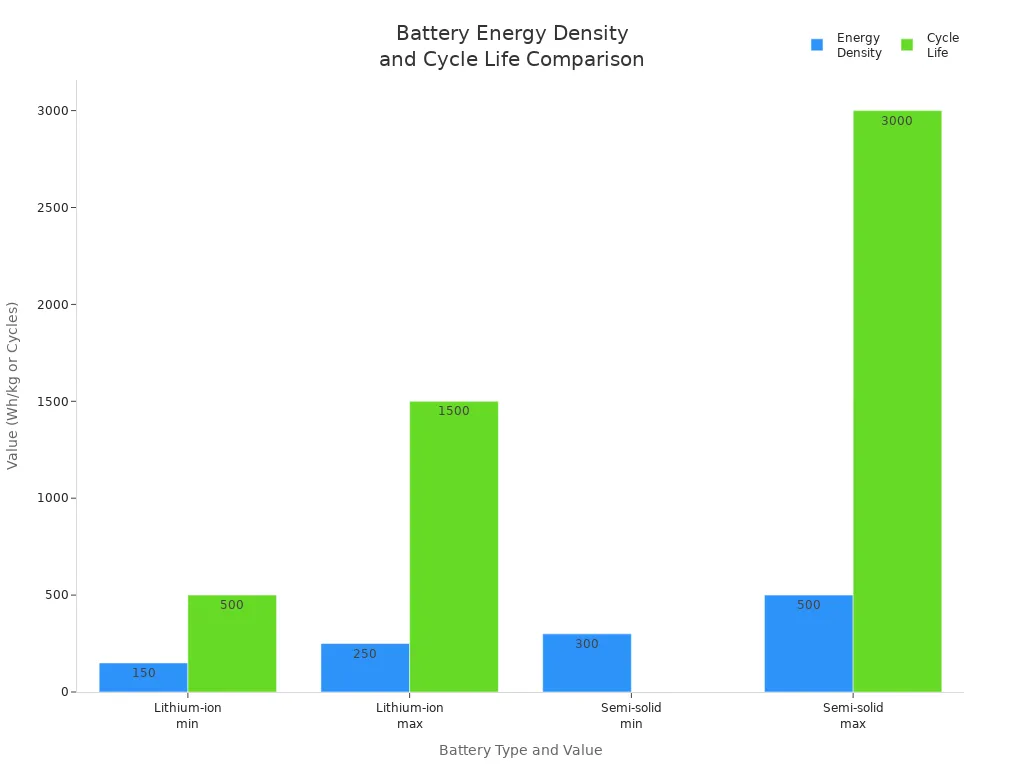
Here is a table that shows how semi-solid-state batteries and lithium-ion batteries compare:
Aspect | Lithium-ion | Semi-solid-state |
|---|---|---|
Energy Density | 150-250 Wh/kg | 300-500 Wh/kg |
Cycle Life | 500-1500 cycles | Up to 3000 cycles |
You can see that semi-solid-state batteries last longer and store more energy.
Tip: If you want a battery that lasts longer and holds more energy, semi-solid-state batteries are a good pick.
How semi-solid battery works
A semi-solid battery uses both solid and liquid parts to move ions. The gel sits between the battery’s electrodes. It lets ions move fast, so the battery charges quickly. The solid part makes the battery strong and safe. The liquid part keeps it flexible.
These batteries are safer than liquid batteries, but not perfect. The gel lowers the chance of leaks and fires, but some risk is still there. Semi-solid-state batteries are not as safe as solid-state batteries. Still, they give you high energy, long life, and better safety.
Semi-solid batteries can store about twice as much energy as regular batteries.
The gel inside helps the battery last for more charge cycles.
These batteries are safer than regular ones, but not as safe as solid-state batteries.
If you want a battery that charges fast, lasts long, and is safer than regular batteries, a semi-solid battery is a strong choice.
Liquid batteries
Liquid battery features
You see liquid batteries in many things, like phones and cars. These batteries use a liquid electrolyte to move ions. The liquid helps the battery work in hot or cold weather. You can trust liquid batteries to start your car in winter. They also keep your phone working in summer.
Liquid batteries charge fast and give steady power. The liquid lets ions move quickly, so the battery works well. These batteries are simple to make and cost less than new types. Many factories already know how to make them. That is why you see them in lots of products.
Note: Liquid batteries work well when it is cold. You can use them where other batteries might not work.
But you need to be careful with safety. The liquid inside can catch fire. If the battery gets damaged, it might burn or even explode. Here are some facts about liquid electrolytes:
Liquid electrolytes move lithium ions fast, so batteries work better.
The liquid can burn if the battery breaks.
More liquid can help charging, but it makes fires more likely.
Solid-state batteries with a little liquid make less heat in fires than regular liquid batteries.
How liquid batteries work
Liquid batteries move ions through a liquid. When you charge or use the battery, ions go back and forth. The liquid helps this happen fast, so the battery charges quickly and gives strong power.
You should know about the main safety risks. The table below shows what can go wrong with liquid batteries:
Safety Risk | Description |
|---|---|
Thermal Runaway | A chain reaction that can cause battery fires and explosions. |
Off-gassing | Flammable gases, like hydrogen, can escape and cause explosions. |
Toxic Gas Release | Harmful gases, like hydrogen fluoride, can come out during fires. |
Liquid batteries have been used for a long time. You find them in most devices today. They work well, but you must be careful. If you want a battery that works in many temperatures and charges fast, liquid batteries are a good choice. Just remember the safety risks and use them safely.
Battery comparison
Electrolyte type
Each battery uses a different kind of electrolyte. The electrolyte lets ions move inside the battery. This is important for how the battery works. The table below shows what each type does and how it affects the battery:
Electrolyte Type | Characteristics | Impact on Performance |
|---|---|---|
Liquid | Made with organic liquids and lithium salts. It lets ions move fast. | Charges and discharges well, but can catch fire and does not work with lithium metal anodes. |
Solid-state | Uses ceramics or polymers. It does not have things that burn. | Safer and stops dendrites from growing, so the battery lasts longer. |
Semi-solid (Quasi) | Has a solid with some gel or liquid. It mixes safety and good performance. | Less likely to burn and lets ions move fast at room temperature. Easier to make than solid-state. |
Solid-state batteries use a solid, so they are safer and last longer. Semi-solid-state batteries mix a gel or liquid with a solid. This gives you both safety and fast charging. Liquid batteries use a liquid, so they charge fast but can be dangerous.
Safety
Safety is very important when picking a battery for your car, phone, or home. You want a battery that will not leak or catch fire. Here is a table that shows how safe each battery is:
Battery Type | Thermal Stability | Risk of Leakage | Thermal Runaway Temperature |
|---|---|---|---|
Solid-State | Best | No | About 200°C |
Liquid | Not as good | Yes | About 70°C |
Semi-Solid-State | In the middle | Low | Not listed |
Solid-state batteries are the safest. They do not leak and can handle more heat before problems. Semi-solid-state batteries are safer than regular lithium batteries, but not as safe as solid-state. Liquid batteries can leak and catch fire, especially if they get too hot.
Tip: For the safest battery, pick solid-state batteries.
Energy density
Energy density means how much energy fits in a small space. This matters for cars and phones because you want them to last long without being big or heavy.
Solid-state batteries hold the most energy in a small size.
Semi-solid-state batteries also hold a lot, but not as much as solid-state.
Liquid batteries hold less, so you need a bigger battery for the same power.
Solid-state and semi-solid-state batteries are better than regular lithium batteries for energy density. This makes them good for new energy needs.
Lifespan
You want your battery to last a long time. Lifespan means how many times you can charge and use it before it stops working well.
Solid-state batteries last the longest because the solid part does not break down.
Semi-solid-state batteries also last a long time, sometimes up to 3,000 charges.
Liquid batteries can last long, but most regular ones wear out faster.
Solid-state batteries give you the longest life, so you do not need to replace them often.
Charging speed
Charging speed is important if you want to use your device or car soon. You do not want to wait a long time for a full charge.
Solid-state batteries can charge from 15% to 90% in about 18 minutes. In the future, they may charge fully in 10 to 15 minutes.
Semi-solid-state batteries charge faster than regular lithium batteries, but the time depends on the design.
Liquid batteries charge fast and are known for quick charging and power.
If you want the fastest charging, look for new solid-state or advanced semi-solid-state batteries.
Cost
Cost matters when you pick a battery for your project or product.
Solid-state batteries cost the most right now. They are about eight times more expensive than regular lithium batteries. This is because they need special factories and new technology. Semi-solid-state batteries use the same factories as regular lithium batteries, so they cost less. Liquid batteries are the cheapest to make and use.
Note: If you want the lowest price, pick liquid batteries. If you want the newest tech, solid-state batteries cost more.
Technology maturity
You want to know if you can buy and use the battery today. Technology maturity tells you how ready each battery is for real use.
Solid-state batteries are still new. The market is growing, but most are not ready for everyone yet. Companies like QuantumScape and Toyota are working to make them better and cheaper. Semi-solid-state batteries are easier to make because they use old factory ways. You can find them in some new products now. Liquid batteries are the oldest and most used. You see them in almost every phone, car, and device today.
If you want a battery that is proven, pick liquid batteries. If you want the newest energy storage, watch for solid-state batteries as they get better.
Applications
All-solid-state batteries use cases
All-solid-state batteries are used where safety and high energy are needed. These batteries help electric cars go farther on one charge. They also make cars lighter. Airplanes use them because every pound matters. Car makers want these batteries to make cars safer and cheaper. These batteries could change electric vehicles in big ways.
These batteries weigh less than liquid electrolyte batteries.
They have more energy, so cars can drive longer.
They help lower costs and make cars lighter.
They improve how well cars work.
They help more people use electric cars and clean energy.
All-solid-state batteries can make travel safer and better. They are important for the future of cars and planes.
Semi-solid-state batteries use cases
Semi-solid-state batteries are used in many businesses and factories. They help keep the power grid steady and save energy when it is busy. You find them in buildings that need to stay safe. Tech companies use them in data centers to keep computers working. In faraway places, they store solar energy and lower fire risk. Companies with many electric cars use these batteries to keep cars running safely. Builders use them in city buildings to fix safety problems.
They help balance the power grid.
They are used in important buildings.
Tech companies use them in data centers.
They store solar energy in off-grid places.
They power many electric cars for businesses.
They are used in city buildings for safety.
Semi-solid-state batteries are safer and last longer. They are good for big energy needs.
Liquid batteries use cases
Liquid batteries are found in many things you use every day. Flow batteries, like vanadium redox flow batteries, store a lot of energy. Power companies use them to back up the grid and store wind or solar power. These batteries last a long time and help keep power on when needed.
Flow batteries last a long time and can be made bigger.
They are used as backup power for the grid.
They store energy from wind and solar power.
Flow batteries give steady energy to keep the grid working.
Liquid batteries help power your phone, car, and even cities. They are very important for energy today.
Best use cases
Electric vehicles
You see electric vehicles on roads everywhere today. Picking the right battery helps your car go farther and stay safe. Most electric vehicles use lithium-ion batteries. These batteries hold a lot of energy, so cars can drive longer. They are also light, which helps cars use less power. New changes make these batteries safer and more dependable.
Here is a table that shows how battery types compare for electric vehicles:
Battery Type | Energy Density | Efficiency | Weight |
|---|---|---|---|
Lithium-ion | High | High | Lightweight |
Sodium-ion | Moderate | Moderate | Heavier |
Lithium-ion batteries are used most in electric cars.
They help you drive longer without charging often.
Sodium-ion batteries are newer and not used as much.
Tip: For the best mix of range, safety, and price, lithium-ion batteries are the best pick for electric cars.
Consumer electronics
You use batteries every day in phones, tablets, and laptops. Lithium-ion batteries work well because they store lots of energy in small spaces. This means you can use your device longer before charging. These batteries last through many charges, so you do not need to replace them often.
High energy density lets your device run longer.
Long life saves you money over time.
New battery designs make devices lighter and charge faster.
Better lithium batteries help your electronics last longer and work better.
Grid storage
The power grid needs strong and steady storage. Lithium-ion batteries are best for short-term storage because they cost less and work well. Their price dropped from $800/kWh in 2013 to under $140/kWh in 2023. For longer storage, flow batteries and pumped storage hydropower are good choices. Sodium-ion batteries are getting more popular for grid storage and may save money soon.
Lithium-ion batteries are best for short-term grid storage.
Flow batteries and pumped storage are good for longer needs.
Sodium-ion batteries could lower costs as they get better.
Note: The best battery for grid storage depends on how long you need to store energy and how much you want to spend.
You have learned what each battery does best. Solid-state batteries are very safe and hold lots of energy. They are used in special things. Liquid batteries work in many devices and are cheaper. Semi-solid batteries mix safety and good performance. You should think about what you need before picking a battery. New battery technology will change how we use energy soon.
FAQ
What makes solid-state batteries safer than other types?
Solid-state batteries have a solid electrolyte. This solid part does not leak or catch fire. There is less chance of fire or explosion than with other batteries.
Can semi-solid-state batteries work in cold weather?
Semi-solid-state batteries work better in the cold than regular ones. The gel inside helps ions move. But they might not work as well as liquid batteries when it is very cold.
Why do liquid batteries charge quickly?
Liquid batteries use a liquid electrolyte. The liquid lets ions move fast between parts. This helps the battery charge quickly and gives strong power.
Which battery lasts the longest?
Battery Type | Lifespan (Charge Cycles) |
|---|---|
Solid-state | Up to 5,000 |
Semi-solid-state | Up to 3,000 |
Liquid | 500–1,500 |
Solid-state batteries last longer than the others.
Are new battery technologies expensive?
New battery technologies cost more because they use special stuff and new ways to make them. Old batteries cost less, but new ones might save you money later.