You might see some warning signs if your battery current sensor fails. Watch for wrong readings, no output, changing numbers, shaky signals, or error codes on your dashboard. Finding these problems early can help you stop bigger issues later. Acting fast keeps your car working well and saves you from expensive repairs that happen with big battery problems.
Key Takeaways
Look for warning signs like wrong numbers, no output, or error codes. Finding problems early can stop bigger battery troubles.
Check your battery current sensor often for changes or shaky output. This helps your battery work right and stops confusion.
Look at the connections and clean off any rust or dirt from wires. Good connections help your sensor send clear messages.
Use special tools to find sensor problems fast. These tools make fixing problems easier and quicker.
Get a new sensor if you keep seeing no output or error codes. A new sensor keeps your battery system safe and working well.
Battery Current Sensor Symptoms
Inaccurate Readings
Sometimes, the numbers on your battery monitor look wrong. You might see numbers that do not match what you expect. This can make it hard to trust your battery management system. The sensor might show more or less current than is really there. This can make you confused when you check if your battery is charging or not.
You can use special ways to check if the readings are wrong. These ways help you see if your battery current sensor works right. Here is a table with two ways to check for this problem:
Method Description | Key Features |
|---|---|
Improved Equivalent Circuit Battery Model | Uses voltage as input and current as output to detect faults. Uses least squares and Kalman filter for fault estimation. |
Multi-method Fusion | Combines model-based and non-model-based methods. Compares estimated and true values for current and voltage sensors. |
If you see wrong numbers, check your battery management system. Use these ways to find out if the sensor is bad.
Zero Output
Zero output means your battery current sensor shows no current at all. You might see a flat line or just a zero on your screen. This is a common sign of battery sensor trouble. When this happens, your battery management system cannot see how much current moves in or out.
Some reasons for zero output are:
If one battery cell has a problem, the battery management system may turn off the output, so no current is seen.
Charging system problems can also make the sensor show zero output.
If you see zero output, check your battery management system and charging system soon.
Drift
Drift is when the sensor’s numbers slowly get less correct over time. At first, the numbers are right, but then they start to be wrong. Drift makes it hard to know your battery’s real state. This can make you charge or use your battery the wrong way.
Watch for drift if you use your battery a lot. Checking often helps you find this problem early.
Unstable Output
Unstable output means the numbers on your screen jump or change fast. This can happen even if the battery is not doing much. You might see the current go up and down for no reason. This makes it hard for your battery management system to know what is happening.
Unstable output can confuse you and your battery management system. It can also make your battery work worse. If you see this, check your battery current sensor and look for loose wires or other problems.
Error Codes
Many battery management systems show error codes when something is wrong. If you see a code about the battery current sensor, do not ignore it. These codes help you find the problem fast.
Tip: Always look in your user manual to see what each error code means. This helps you fix the problem faster and keeps bigger problems away.
Knowing these signs helps you find battery sensor problems early. You can keep your battery working well by checking for wrong readings, zero output, drift, unstable output, and error codes. Checking often and measuring current right helps you avoid battery management system trouble.
Causes
Sensor Faults
Battery current sensor problems can happen when the sensor breaks. Sometimes, the sensor gets old after being used a lot. Power surges or short circuits can also hurt the sensor. If the sensor stops working, it sends wrong signals to your battery management system. You might see numbers that are not right, numbers that slowly change, or no numbers at all. If you notice these things, the sensor may need to be fixed or replaced.
Tip: Check how old your sensor is and look for damage. A broken sensor can make battery problems hard to understand.
Connection Issues
Wires that are loose or rusty can make your battery current sensor act strange. If wires are not tight, you might see numbers that jump around or show zero. Rust on connectors can stop electricity from moving. This makes the sensor send weak or no signals. Sometimes, a connector or pin can break and cause problems.
Look for:
Wires that are loose
Rust or dirt on connectors
Pins or plugs that are broken
You can fix many sensor problems by making wires tight or cleaning off rust. Always turn off the power before you touch any wires.
Environmental Factors
Your battery current sensor can have trouble because of things around it. Changes in temperature can make the sensor work less well. Very hot or cold weather can change the inside parts of the sensor. This makes it less correct. Humidity can also hurt the sensor, especially if it is not sealed. Wet places can cause short circuits or rust.
Things in the environment that can hurt sensors:
Big changes in temperature can make sensors work worse.
Lots of humidity can damage sensors that are not sealed.
Water can cause rust or short circuits.
You can keep your sensor safe by keeping it dry and away from very hot or cold places. Checking your sensor often helps you find problems early.
Troubleshooting Battery Current Sensor
Check Connections
Begin by looking at the battery current sensor connections. Follow these steps to check if things are okay:
Look at the sensor. See if it has rust, cracks, or damage.
Check the battery terminals and cables. Make sure they are tight.
Look at the connector pins. See if there is rust or broken wires.
Check for extra electrical accessories on the negative terminal. These can cause problems by bypassing the sensor.
Tip: Always turn off the power before touching wires or connectors.
Recalibrate
Sometimes, the sensor shows wrong numbers because it needs recalibration. Calibration helps make the sensor accurate again. You need special tools for this job:
High-precision current source
Multimeter or oscilloscope
Calibrated shunt resistor
Test cables
Adjustment tools
Calibration software
Use these tools to adjust the sensor. This helps it show the right numbers. Calibrating often keeps your sensor working well.
Inspect Circuitry
Check the wires and circuits near your sensor. Look for wear, burns, or broken parts. If you see damage, replace wires or fix the circuit. Clean off any dirt or rust. Good circuits help the sensor send clear signals.
Note: Bad circuits can make your sensor act weird or stop working.
Diagnostic Tools
You can use diagnostic tools to find sensor problems quickly. Some good tools are:
Analog oscilloscope
Digital storage oscilloscope
Multiple-trace oscilloscope
Universal oscilloscope
These tools help you see how the sensor works. You can connect them and watch the signals. If you see something strange, you know where to check next.
Using the right tools makes troubleshooting easier and helps you fix problems fast.
Repair and Replacement
When to Replace
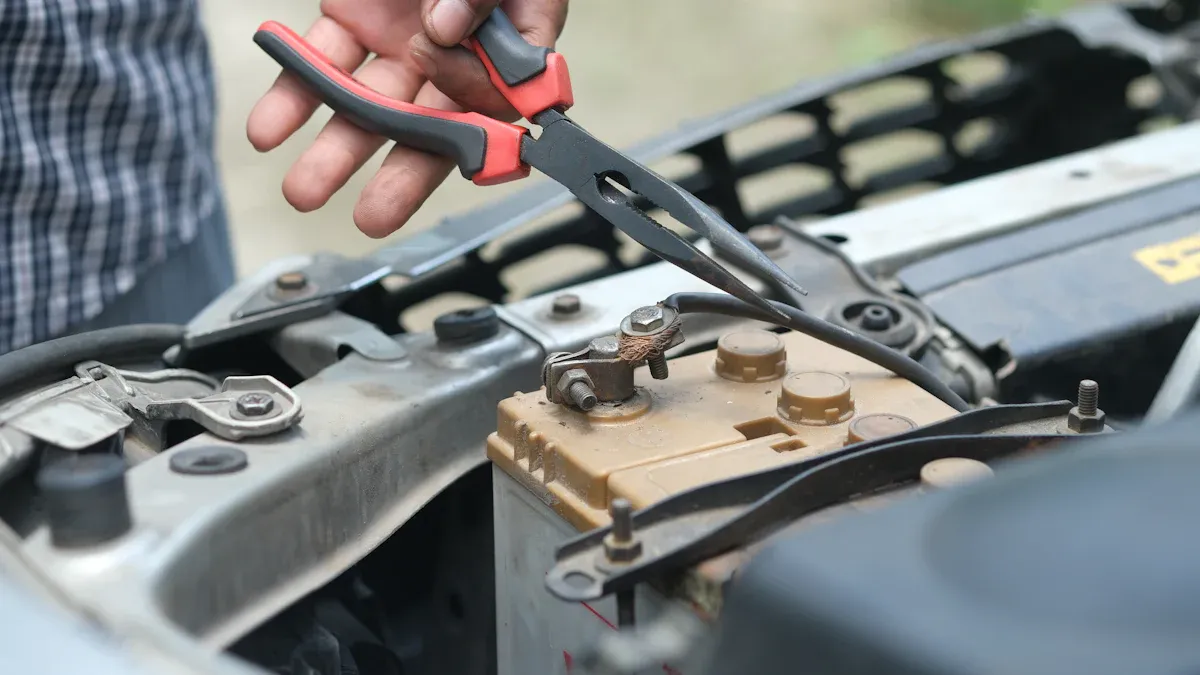
Replace your battery current sensor if you keep seeing wrong numbers, zero output, or error codes that stay after you try to fix them. If you see cracks or rust on the sensor, it is best to get a new one. If the sensor keeps drifting or the numbers jump around, even after you clean and reset it, you should replace it.
Tip: If your car is hard to start or the battery light will not turn off, check the sensor as soon as you can.
Replacement Steps
You can change a battery current sensor by following these easy steps. Always put on safety gloves and glasses before you begin.
Find the battery current sensor on the negative battery cable.
Take off the negative cable clamp to disconnect the battery.
Use a wrench or socket set to take off the old sensor.
Put the new sensor on the negative battery cable and make it tight.
Put the negative cable clamp back on the battery.
Test the new sensor to see if it works right.
Note: Always disconnect the battery before touching any parts. This helps keep you safe from getting shocked.
Professional Help
Sometimes, you need a trained person to fix or change the sensor. If you are not sure what to do, or if the problem does not go away after you try, call a professional. Find a technician who knows how to work with batteries. Here is a quick chart:
Technician Level | Required Skills |
|---|---|
Level 1 | Basic safety and main skills |
Level 2 | Battery basics, care, and putting in sensors |
Level 3 | Can work alone, except for special jobs |
Level 4 | Can add, remove, or change circuits |
If your car has special electronics or you see hard error codes, a Level 3 or Level 4 technician is the best choice.
Manufacturers
There are many companies that make battery current sensors. Some of the biggest brands in the world are:
LEM International SA
Texas Instruments Incorporated
Honeywell International Inc.
TDK Corporation
Allegro MicroSystems, Inc.
Sensata Technologies Holding plc
Infineon Technologies AG
Tamura Corporation
Melexis NV
Now, let’s see what makes four top brands special.
Allegro Microsystems
Allegro Microsystems makes sensors that are small and work well. Their sensors fit in tight spots because they are 40% smaller than most. These sensors have high isolation, which helps keep your system safe. They also have lower resistance, so less power is lost. This means your battery can last longer.
Feature | Allegro Microsystems Sensors | Competitors’ Sensors |
|---|---|---|
Footprint | 40% smaller than 16-pin | Larger than 16-pin |
Isolation | Higher | Standard |
Resistance | Lower | Higher |
Power Dissipation | Reduced | Standard |
Tip: Allegro Microsystems is a good pick if you need a sensor for a small space.
Texas Instruments
Texas Instruments makes sensors for many different things. You can use their sensors in electric cars, solar power, factories, and small gadgets. Their sensors measure battery current very accurately. This helps keep your battery safe and working well.
Application | Description |
|---|---|
Electric Vehicles (EVs) | Measures battery current for safe and efficient battery management. |
Renewable Energy Storage Systems | Monitors current in solar and wind battery banks for reliability. |
Industrial Equipment | Keeps backup power and machines running smoothly. |
Consumer Electronics | Tracks battery health and charging in phones and portable devices. |
Melexis
Melexis makes sensors for cars and factories. Their sensors use advanced chip technology. They give fast and accurate readings. Many car companies use Melexis sensors for battery management. You can also use them in robots and smart machines.
Note: Melexis sensors give steady readings even in hard conditions.
STMicroelectronics
STMicroelectronics has sensors for many battery-powered things. You can use their sensors in electric cars, power tools, and home energy systems. Their products focus on safety and saving energy. These sensors can handle high currents and work in hot or cold places.
If you want a good battery current sensor, pick a brand that matches your needs. Top manufacturers have choices for cars, homes, and more.
Impact on Electronic Design and Manufacturing
Design Considerations
Sensor placement and integration
You have to pick a good spot for the battery current sensor. Putting it close to the battery gives better numbers. The sensor should fit with other parts in your system. If you connect it well, it works smoothly with your battery management system.
Compatibility with system voltage and current ranges
Check if the sensor matches your system’s voltage and current. If it cannot handle the power, it might stop working or show wrong numbers. Always pick a sensor that fits your battery’s needs.
Minimizing signal interference
Signal interference can mess up sensor readings. You can use shielded cables to help stop this. Keep the sensor away from strong electrical things. This helps you get clear and steady data.
Tip: Good design choices help you avoid mistakes and keep your battery safe.
Here is a table that shows how battery current sensors help electric vehicles:
Aspect | Description |
|---|---|
Monitoring Performance | Sensors give important data about battery performance. |
Safety | Sensors help stop overcharging and over-discharging. |
Battery Lifespan | Sensors help you take care of the battery and make it last longer. |
State of Charge (SOC) | Sensors help you know how much battery power is left. |
State of Health (SOH) | Sensors let you see how much power the battery can still hold. |
Over-current Protection | Sensors help stop damage from too much current. |
Cell Balancing | Sensors help balance battery cells during charging for longer life. |
Manufacturing Challenges
Ensuring consistent sensor calibration
You need to make sure every sensor is set up the same way. If not, you might get wrong numbers. Checking calibration often keeps sensors working right.
Quality assurance during assembly
Checking quality during assembly helps you find problems early. Look at each sensor and connection before you finish the product. This helps you avoid trouble after the product leaves the factory.
Managing supply chain for reliable components
Pick suppliers who give you good sensors and parts. Good parts help you make better products and stop failures. Managing your supply chain well keeps your work going smoothly.
Quality Control and Testing
Routine sensor performance testing
Test sensors often to make sure they work well. Regular checks help you find problems before they hurt your battery system.
Detecting early failures in production
Finding sensor problems early saves time and money. You can use special tools and software to find issues fast.
Implementing automated inspection systems
Automated inspection systems help you check sensors quickly and accurately. These systems use smart software and real-time checks to keep quality high.
Here is a table with good ways to control quality for battery current sensors:
Quality Control Measure | Description |
|---|---|
Real-time monitoring of critical parameters | Lets you change production fast to keep sensors working well. |
Advanced measurement technologies | Uses new sensors and AI for better quality control. |
Robust inspection strategies | Checks sensors closely to find problems early. |
Smart Meter Verification software | Watches sensor performance and helps plan repairs. |
Conductivity measurements | Checks how well sensors work with battery materials. |
Note: Strong quality control and testing help you make reliable battery systems and avoid big mistakes.
You can keep your battery system safe if you find battery current sensor problems early and fix them quickly. Checking and taking care of your battery often helps stop sudden problems and makes your battery last longer.
You stop your battery from breaking down when you do not expect it.
You help your battery last longer and keep sensors working right.
Picking sensors from good companies makes your battery safer and stronger.You protect your battery from getting too hot or catching fire.
You help your battery age slowly and keep everything safe.
Most sensor problems can be fixed if you check carefully, so you can feel sure your battery will stay healthy.
FAQ
What happens if you ignore a faulty battery current sensor?
If you ignore a bad sensor, your battery may not charge or discharge correctly. You could see warning lights or get stuck with a dead battery. Fixing the problem early helps you avoid bigger issues.
Can you drive with a bad battery current sensor?
You can drive for a short time, but you risk battery problems. Your car may not start, or you might lose power. Always fix the sensor soon to keep your car safe.
How do you test a battery current sensor at home?
Use a multimeter to check voltage and current.
Look for error codes on your dashboard.
Inspect wires and connectors for damage.
Tip: Always turn off the car before testing.
How much does it cost to replace a battery current sensor?
Sensor Type | Estimated Cost (USD) |
|---|---|
Basic Sensor | $30 – $80 |
Advanced Sensor | $100 – $250 |
Labor costs may add $50–$150. Prices depend on your car and sensor type.