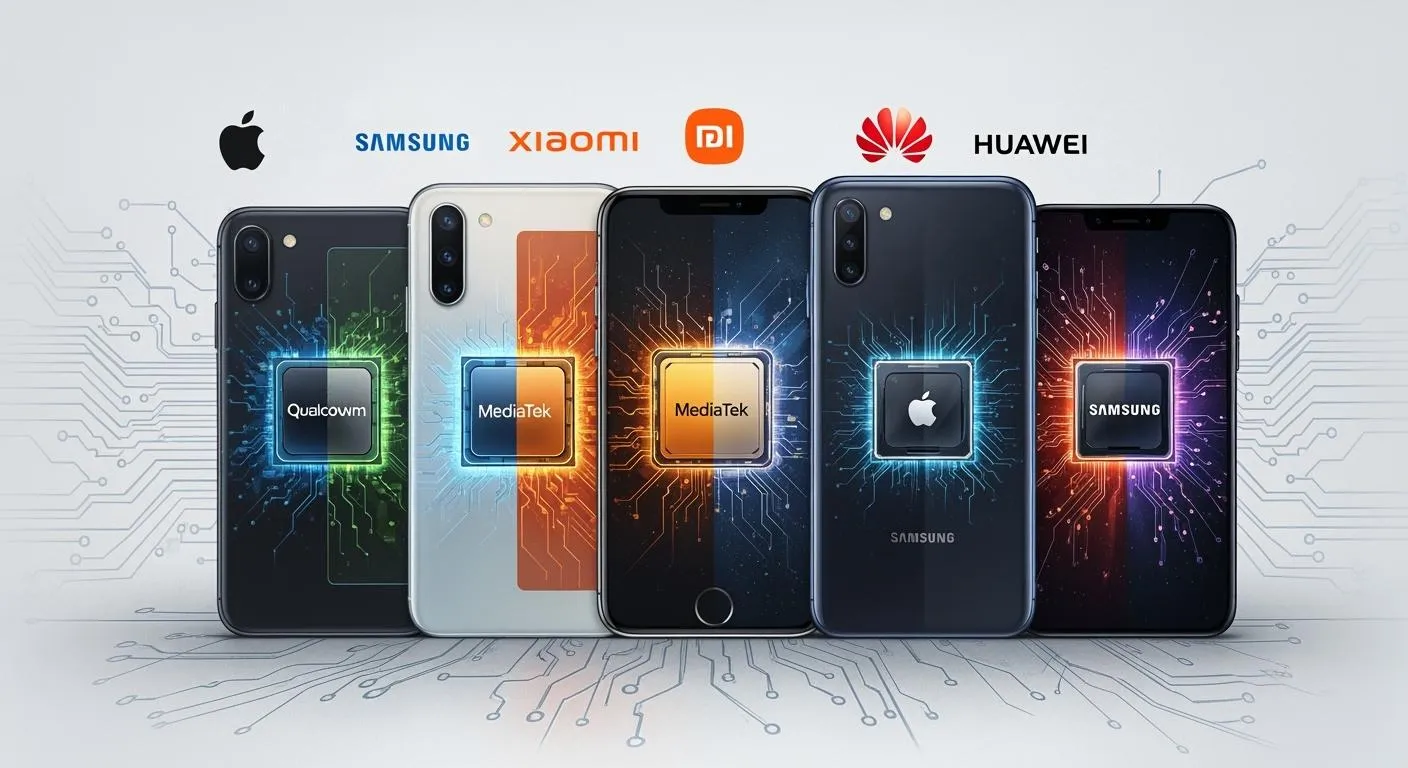
You can find many smartphone chips in popular phones today. The table below lets you compare top chip types and the brands that use them. Each chip has something special. Snapdragon chips are fast and work well for Android brands. Apple A-series chips are powerful and work best with iOS. Samsung Exynos chips try to match Snapdragon and are in Samsung phones. MediaTek Dimensity chips work well and cost less in mid-range phones. Huawei Kirin chips are in Huawei phones. UNISOC chips are found in cheaper phones.
Chip Type | Brands Using It | Performance Characteristics |
|---|---|---|
Qualcomm Snapdragon | Samsung, Xiaomi, OPPO, vivo, OnePlus, Motorola, ASUS, Lenovo, ZTE, Meizu, Sony, Google, Honor, Sharp, Tecno, Infinix, Itel | High speed and good battery life; used in top phones |
Apple A-series | Apple | Custom design; very strong; made for iOS |
Samsung Exynos | Samsung | Competes with Snapdragon; found in Samsung phones |
MediaTek Dimensity | Xiaomi, OPPO, vivo, realme, Tecno, Infinix, Itel, Honor, Meizu, ZTE, Lenovo | Good speed for less money; used in mid-range phones |
Huawei Kirin | Huawei, Honor | Medium speed; has some problems with making more chips |
UNISOC | realme, Tecno, Infinix, Itel, Nokia, ZTE, Motorola | Basic speed; used in cheaper phones |
Key Takeaways
Smartphone chips play a big role in your phone’s speed. They also affect battery life and what your phone can do. Pick a chip that fits what you need.
Qualcomm Snapdragon and Apple A-series chips are great for gaming. They are also good for doing many things at once. These chips keep your phone fast and save energy.
MediaTek and UNISOC are cheaper choices for mid-range and budget phones. They work well for simple, daily tasks.
Samsung Exynos and Huawei Kirin chips are popular too. But they might not be as strong as Snapdragon and Apple chips.
Always look at the chip type before you buy a phone. This helps you get the features and speed you want.
Leading smartphone chips and manufacturers
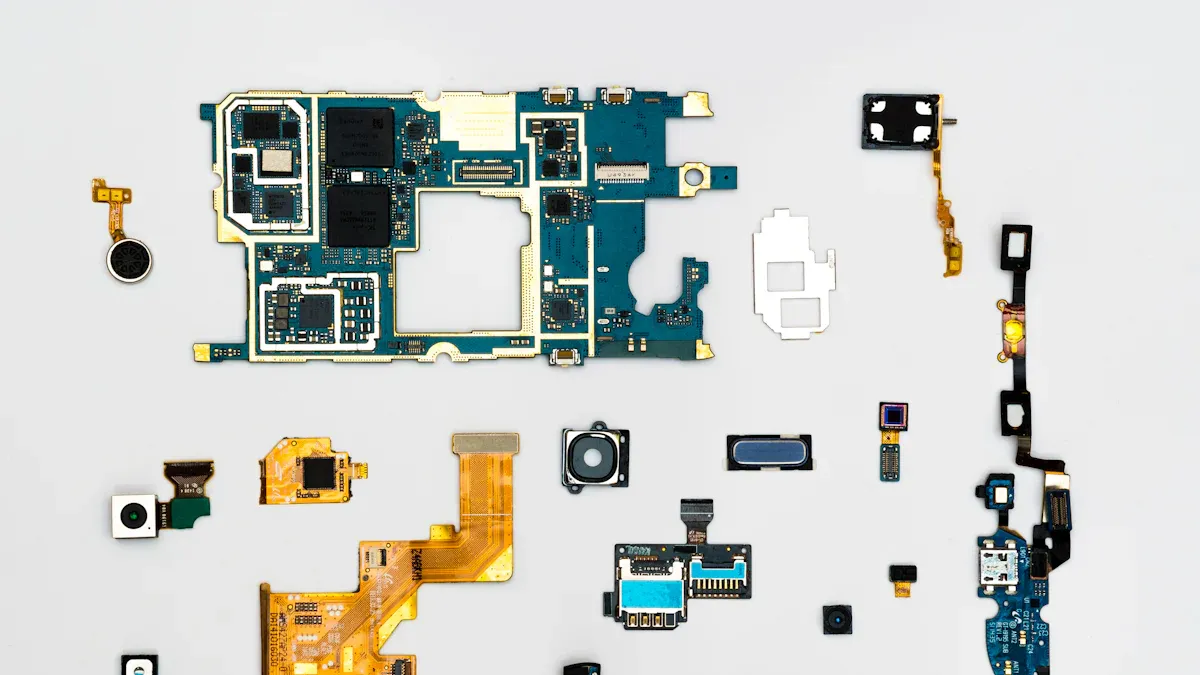
Smartphone chips help your phone work. Many brands use different chips. Each chip has special features. Some chips are fast. Some are good for gaming. Some save battery. Some cost less. Here are the main chipmakers and the brands that use them.
Qualcomm Snapdragon series
Snapdragon chips are in lots of phones. You find them in expensive and mid-range phones. These chips are quick. They make games run smoothly. They help your battery last longer. Snapdragon 8 Gen 3 and Elite are very fast.
If you like gaming, pick a phone with Snapdragon 8 Gen 3 or Elite. These chips let you use screens with high refresh rates. They also support ray tracing.
Performance Table:
Processor | CPU Performance | GPU Performance | AI Performance | Ray Tracing Performance |
|---|---|---|---|---|
Snapdragon 8 Gen 3 | 30% faster | 25% faster | 98% faster | 50% better |
Snapdragon 8 Elite | High frame rates | Efficient gaming | N/A | N/A |
Snapdragon chips use new technology. The Snapdragon 8 Gen 3 uses a 4nm process. This makes it use less power than older chips. Your battery lasts longer. Your phone stays cooler.
Samsung
Galaxy S23 (Snapdragon 8 Gen 2)
Galaxy S22 (Snapdragon 8 Gen 1)
Galaxy A54 (Snapdragon 778G)
Galaxy A52s (Snapdragon 778G)
Galaxy M54 (Snapdragon 888)
Xiaomi
Mi 13 (Snapdragon 8 Gen 2)
Mi 12 (Snapdragon 8 Gen 1)
Redmi Note 12 Pro (Snapdragon 732G)
POCO F5 (Snapdragon 7+ Gen 2)
Mi 11 Lite (Snapdragon 780G)
OPPO
Find X6 Pro (Snapdragon 8 Gen 2)
Reno 10 Pro+ (Snapdragon 8+ Gen 1)
Reno 8 (Snapdragon 7 Gen 1)
K11 (Snapdragon 782G)
vivo
X90 Pro+ (Snapdragon 8 Gen 2)
iQOO 11 (Snapdragon 8 Gen 2)
S17 Pro (Snapdragon 778G)
Y100 (Snapdragon 695)
OnePlus
OnePlus 11 (Snapdragon 8 Gen 2)
OnePlus 10T (Snapdragon 8+ Gen 1)
OnePlus Nord 3 (Snapdragon 782G)
OnePlus 9R (Snapdragon 870)
realme
realme GT 3 (Snapdragon 8+ Gen 1)
realme 11 Pro+ (Snapdragon 778G)
realme 10 Pro (Snapdragon 695)
Motorola
Edge 40 Pro (Snapdragon 8 Gen 2)
Moto G82 (Snapdragon 695)
Moto Edge 30 (Snapdragon 778G)
ASUS
ROG Phone 7 (Snapdragon 8 Gen 2)
Zenfone 10 (Snapdragon 8 Gen 2)
ROG Phone 6 (Snapdragon 8+ Gen 1)
Lenovo
Legion Y90 (Snapdragon 8 Gen 1)
Legion Duel 2 (Snapdragon 888)
ZTE
Axon 40 Ultra (Snapdragon 8 Gen 1)
Nubia Z50 (Snapdragon 8 Gen 2)
Meizu
Meizu 20 Pro (Snapdragon 8 Gen 2)
Meizu 18s Pro (Snapdragon 888+)
Sony
Xperia 1 V (Snapdragon 8 Gen 2)
Xperia 5 IV (Snapdragon 8 Gen 1)
Pixel 5 (Snapdragon 765G)
Pixel 4a (Snapdragon 730G)
Honor
Honor 90 (Snapdragon 7 Gen 1)
Honor 70 (Snapdragon 778G)
Sharp
Aquos R8 Pro (Snapdragon 8 Gen 2)
Aquos Sense7 (Snapdragon 695)
Tecno
Phantom X2 Pro (Snapdragon 8 Gen 1)
Infinix
Zero 5G (Snapdragon 778G)
Itel
S23+ (Snapdragon 680)
Apple A-series chips
Apple makes its own chips for iPhones. These chips are very fast. They help your phone run smoothly. Apple chips do better than other brands. They let you do many things at once. Your phone feels quick and easy to use.
Apple chips have more transistors. This means they work better but do not cost more.
You can open many apps and games on iPhones.
Apple Models:
Apple
iPhone 14 Pro (A16 Bionic)
iPhone 14 (A15 Bionic)
iPhone 13 (A15 Bionic)
iPhone 12 (A14 Bionic)
iPhone SE (2022) (A15 Bionic)
Samsung Exynos line
Samsung makes Exynos chips for some phones. These chips use new ways to build CPUs. They have good AI features. They help cameras work well.
Feature Table:
Feature | Description |
|---|---|
2nm GAA Manufacturing Process | Makes chips faster and saves energy |
Custom CPU Architecture | Eight cores for better speed and battery life |
Enhanced GPU (Xclipse 960) | Up to 50% better ray tracing for games |
AI-focused NPU | Doubles AI speed |
Improved Thermal Management | Keeps phones cooler for longer gaming |
Chipset Comparison Table:
Chipset | Strengths | Weaknesses |
|---|---|---|
Snapdragon | Good all-around, great for gaming | Costs more |
Exynos | Good AI and camera, works well with hardware | Can get hot, sometimes slower than Snapdragon |
MediaTek | Cheap, good for mid-range | Can get warm, sometimes not as smooth |
Samsung
Galaxy S22 (Exynos 2200)
Galaxy S21 (Exynos 2100)
Galaxy A54 (Exynos 1380)
Galaxy A53 (Exynos 1280)
Galaxy M33 (Exynos 1280)
MediaTek Dimensity and Helio
MediaTek chips are in many cheaper phones. Dimensity chips are strong and support 5G. Helio chips do basic jobs and save money.
Dimensity vs. Helio Table:
Feature | Dimensity Series | Helio Series |
|---|---|---|
Market Segment | All types of smartphones | Cheaper and mid-range phones |
Performance Focus | Fast, good for games | Saves money, does simple things |
5G Support | Yes | Mostly 4G |
Target Users | Many users, even premium | People who want low prices |
Chipset Examples | Dimensity 9000, 8000, 7000, 6000 | Older 4G chips |
Performance Table:
Chipset | Performance Comparison |
|---|---|
MediaTek Dimensity 810 | Faster than Snapdragon 665 |
Qualcomm Snapdragon 665 | Good for top phones |
UNISOC T750 | For basic phones |
Xiaomi
Redmi Note 12 Pro+ (Dimensity 1080)
Redmi Note 11T (Dimensity 810)
POCO X4 GT (Dimensity 8100)
Redmi 10 (Helio G88)
OPPO
Reno 8 Pro (Dimensity 8100-Max)
Reno 7 (Dimensity 900)
A78 (Dimensity 700)
vivo
V27 Pro (Dimensity 8200)
Y76s (Dimensity 810)
Y53s (Helio G80)
realme
realme 10 Pro+ (Dimensity 1080)
realme 9i (Helio G96)
realme Narzo 50 (Helio G96)
Tecno
Camon 20 Pro (Helio G99)
Pova 5 Pro (Dimensity 6080)
Infinix
Note 30 5G (Dimensity 6080)
Hot 30i (Helio G37)
Itel
P40 (Helio G35)
Honor
Honor X30i (Dimensity 810)
Honor Play 30 Plus (Dimensity 700)
Meizu
Meizu 18X (Dimensity 900)
ZTE
Blade V40 (Dimensity 700)
Lenovo
K13 Note (Helio G85)
Huawei Kirin processors
Huawei uses Kirin chips in its phones. These chips are good and support 5G. Huawei keeps making better chips, even with trade problems.
Kirin Processor Table:
Processor | Manufacturing Process | Performance Improvement |
|---|---|---|
Kirin 9020 | 7-nm | – |
Kirin 9030 | N+3 | Up to 42% better |
Huawei released the Mate 60 Pro with 5G in 2023. The phone sold over 1.2 million in six weeks. Huawei wants to sell twice as many phones in 2024.
Huawei
P50 Pro (Kirin 9000)
Mate 40 Pro (Kirin 9000)
Nova 9 (Kirin 820E)
P40 (Kirin 990 5G)
Nova 8 (Kirin 985)
Honor (older models)
Honor 30 Pro+ (Kirin 990 5G)
Honor 20 (Kirin 980)
Honor V30 (Kirin 990)
UNISOC SoCs
UNISOC chips are in many cheap phones. You get good value for your money. These chips are fine for simple tasks.
Chip Comparison Table:
Chip Manufacturer | Focus Area | Cost-Effectiveness | Performance |
|---|---|---|---|
UNISOC | Cheap and mid-range phones | High | Medium |
MediaTek | Cheap chips with AI and media | High | Medium to High |
Qualcomm | Fast Snapdragon chips | Low | High |
realme
realme C53 (UNISOC T612)
realme Narzo 50A Prime (UNISOC T612)
Tecno
Spark 10C (UNISOC T606)
Pop 7 Pro (UNISOC SC9863A)
Infinix
Smart 7 (UNISOC SC9863A)
Hot 20i (UNISOC T606)
Itel
Vision 3 (UNISOC SC9863A)
A60 (UNISOC SC9832E)
Nokia
C21 Plus (UNISOC SC9863A)
G11 (UNISOC T606)
ZTE
Blade A31 (UNISOC SC9863A)
Motorola
Moto E20 (UNISOC T606)
Pick a phone with UNISOC chips if you want a cheap phone for daily use.
Smartphone chips affect speed, battery, and features. You can choose a phone that fits you by checking the chip.
Performance and features comparison
Speed and efficiency
You want your phone to be fast and last all day. Different chips give different results. Check this table to see how top chips compare in speed and power use:
Processor | Performance Metrics | Power Efficiency | Notable Features |
|---|---|---|---|
Qualcomm Snapdragon | Top scores in Geekbench | High efficiency | Broad portfolio, premium devices |
Apple A-series | Outperforms competitors | Excellent efficiency | Exclusive to Apple devices |
Samsung Exynos | Competitive alternatives | Balanced performance | Mainly in Samsung smartphones |
MediaTek Dimensity | Competitive AI processing | Scalable solutions | Focus on mid-range and budget segments |
Huawei Kirin | Historically strong | Limited by sanctions | N/A |
UNISOC | Cost-effective options | Growing presence | Entry-level and mid-tier devices |
Phones can get hot if you use them a lot. Vapor chamber cooling helps cool your phone. But there is only so much heat it can handle. If your phone gets too hot, it slows down to stay safe.
AI and graphics
Smartphone chips now use AI to make phones smarter. They also make games look better. You can see this in faster photo editing and voice assistants. Games run smoother too. Here is how top chips compare:
Chipset | AI Processing Capabilities | Graphics Performance Scores |
|---|---|---|
Qualcomm Snapdragon 8 Elite Gen 5 | Pinnacle-tier CPU, faster NPU for AI | Top GPU & multi-core scores |
Apple A19 Pro | Optimized ML pipelines for AI features | N/A |
Google Tensor G4 | Software-first AI features | N/A |
Dimensity 9500 | N/A | Top GPU & multi-core scores |
Feature | Description |
|---|---|
Graphics Performance | Upgraded Adreno GPU makes visuals and animations 11% better. |
AI Performance | Snapdragon 8 Gen 5’s NPU makes AI almost 46% better. |
Camera Enhancements | Triple AI ISP gives better low-light photos and real-time tone changes. |
5G and connectivity
You want fast downloads and smooth streaming. Most new chips support 5G. Some chips have even better 5G features. See how they compare:
Smartphone Model | Chipset | 5G Connectivity Features |
|---|---|---|
OPPO Find X7 series | Qualcomm Snapdragon 8 Gen 3 | Supports 5G Advanced (5.5G) with X75 modem |
Chipset | 5G Capability Description | Download Speed (Gbps) | Upload Speed (Gbps) |
|---|---|---|---|
Snapdragon 780G | X53 modem, 5G-Sub6, 5G-mmWave | Up to 3.79 | Up to 1.28 |
Exynos 1380 | Integrated modem, 5G-Sub6, 5G-mmWave | Up to 3.67 | Up to 0.92 |
Software compatibility
You want your phone to get updates and run new apps. Chip design matters for this. New chip features like FRED and AXV10 keep phones safe and fast. These upgrades help your phone get new features later.
New chip standards make phones faster and safer.
Better compatibility means your phone can use new apps and updates for longer.
Market presence and adoption
Global market share
The smartphone chip market has changed a lot in one year. Some companies are getting bigger, but others are not doing as well. Here are some important things to know:
MediaTek’s share of 5G phones went up from 22.8% in early 2023 to 29.2% in early 2024. You will see more MediaTek chips in new phones, mostly in mid-range ones.
Qualcomm’s share went down from 31.2% to 26.5% during the same time. Qualcomm chips are still in many top phones, but other companies are catching up.
UNISOC is growing fast. Their sales and shipments went up by 24% in one year, reaching $3 billion and 27 million phones. You will find more UNISOC chips in cheaper phones.
These numbers show that the chip market is always changing. It is smart to check what chip is in a phone before you buy it.
Regional trends
Different places use chips in different ways. The table below shows what makes each area special:
Region | Characteristics | Opportunities | Risks | Recommendations |
|---|---|---|---|---|
North America | High-value, innovation-led market with strong purchasing power and early adoption | Premiumization, subscription models, partnerships | Pricing pressure, high acquisition costs | Invest in localized strategies, prioritize enterprise pilots, secure compliance certifications early. |
Europe | Heterogeneous demand with a focus on sustainability in Western Europe | Sustainability-led differentiation, public contracts | Fragmentation, slower procurement cycles | Adopt EU-compliance-first strategy, target high-value clusters, build partnerships with distributors. |
Asia-Pacific | Fastest-growing region with diverse markets, rapid urbanization in China and India | Localized low-cost variants, platform partnerships | Localization complexity, price sensitivity | Pursue hub-and-spoke approach, tailor pricing/features, secure strong local distribution partners. |
You will see more expensive phones in North America. People in Europe care about the environment and rules. Asia-Pacific is growing the fastest, with lots of cheaper phones for local people.
Brand partnerships
Good partnerships help chip companies sell more chips. Many big chip companies work with factories in Asia, like in Malaysia, Thailand, and the Philippines. These partnerships help build new factories and make more chips.
Intel, Infineon, GlobalFoundries, and Texas Instruments have important deals in Asia.
These deals help you get better phones for less money.
Local factories help brands make new phones faster.
You get more choices and new technology because of these partnerships.
Trends in smartphone chips
5G chip competition
You see 5G chips in almost every new smartphone. Chipmakers want to make their chips faster and smarter. They use new designs and features to stand out. The table below shows the main trends in 5G chip competition:
Trend | Description |
|---|---|
Integration of AI and Machine Learning | Chips now use AI to boost speed and save battery. |
Miniaturization and 3D Packaging | Smaller parts help phones get thinner and more efficient. |
Increased Demand for IoT | More smart devices need strong 5G chips to handle many connections at once. |
Focus on Sustainability | Companies work on eco-friendly chips for greener technology. |
Expansion of Sub-6 GHz and mmWave | Using both bands gives you better coverage and faster speeds. |
Tip: When you pick a phone, look for chips that support both Sub-6 GHz and mmWave. You get faster internet and better coverage.
Growth of MediaTek and UNISOC
You notice more phones with MediaTek and UNISOC chips. These companies change the market in big ways:
MediaTek leads the 4G smartphone chip market. You find their chips in many affordable phones.
UNISOC grew quickly, but now its growth slows down. You still see UNISOC chips in many budget models.
You get more choices and lower prices because of this competition.
Custom chips and future tech
Smartphone chips keep getting smarter. Companies now design their own chips to fit your needs. Here are some new trends you should know:
The smartphone chip market will grow and change a lot from 2025 to 2032.
AI features and 5G support will become standard in most chips.
Brands now make custom chips for better speed and battery life.
New designs like gate-all-around (GAA) transistors and AI engines make your phone faster and smarter.
You can expect your next phone to be even more powerful and efficient thanks to these new chip technologies.
You can find many big chipmakers in phones today. Qualcomm Snapdragon and Apple A-series are the fastest chips. They also have the most features. MediaTek and UNISOC are good for cheaper phones. Samsung Exynos and Huawei Kirin are in some phones too.
Check the chip if you want speed or long battery life.
Pick Snapdragon or Apple chips if you want the best.
Tip: Choose a chip that fits what you do. Gamers need strong chips. People who use their phone for simple things can pick cheaper chips.
FAQ
What chip should you choose for gaming?
You want a chip with strong graphics and fast speed. Snapdragon 8 Gen series and Apple A-series chips work best for gaming. These chips keep games smooth and help your phone stay cool.
How do MediaTek and Snapdragon chips differ?
Feature | MediaTek | Snapdragon |
|---|---|---|
Speed | Good | Excellent |
Price | Lower | Higher |
5G Support | Yes | Yes |
You get better value with MediaTek. Snapdragon offers top performance.
Do cheaper chips affect battery life?
You may notice longer battery life with basic chips like UNISOC or Helio.
High-end chips use more power for speed.
Choose a chip that matches your daily needs.
Will your phone get updates with any chip?
You get more updates with Snapdragon and Apple chips. Some MediaTek and UNISOC phones may get fewer updates. Always check the brand’s update policy before buying.