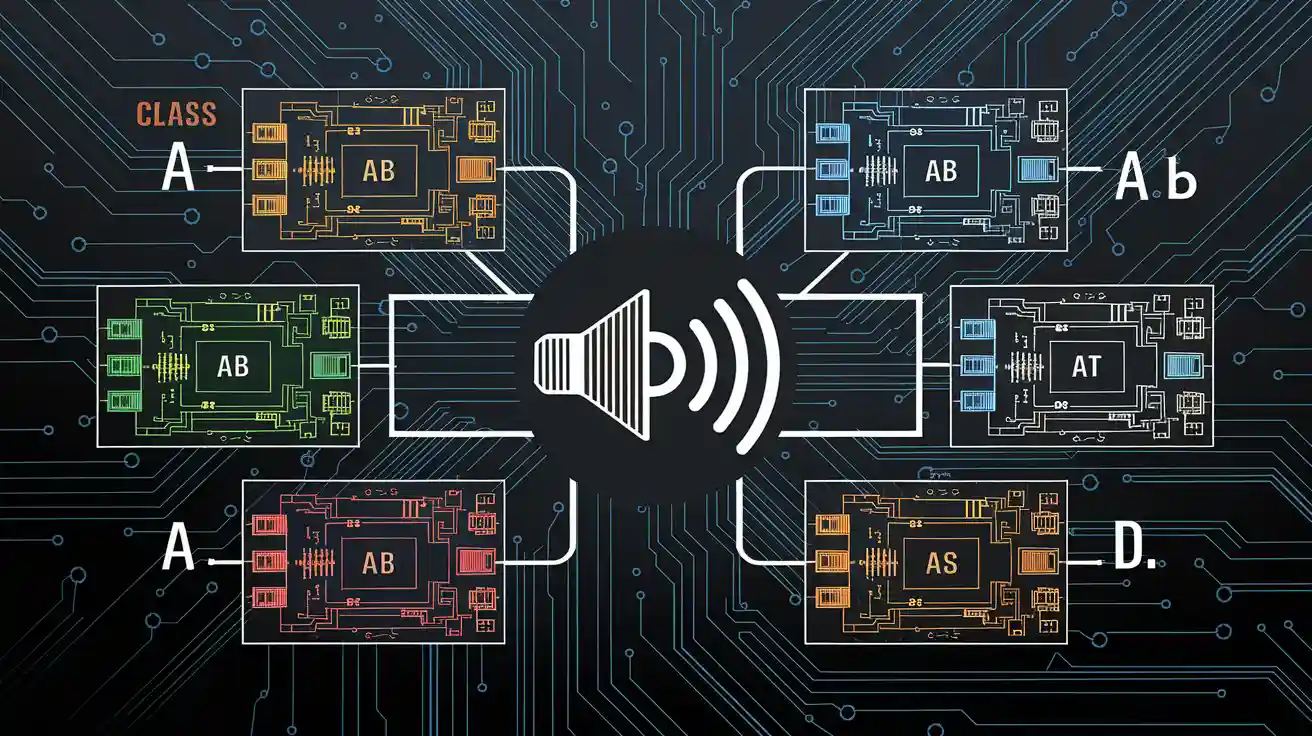
Amplifier circuits are important in electronics. They make weak signals stronger so devices can use them better. These circuits are used in things like audio systems and communication tools. They help send signals clearly and powerfully.
Amplifiers are needed more because of new technology and smart devices. For example, the market for power amplifiers is growing fast. It went from $21.4 billion in 2018 to $30.6 billion in 2023. Developing countries need more amplifiers, too. In Europe, Germany leads the audio amplifier market. The UK is also growing, with a rate of 7.69% each year. These changes show why picking the right amplifier type is so important.
This blog compares Class A, B, AB, C, and D amplifiers. It looks at how good they are, how clear they sound, and what they are best used for.
Key Takeaways
Amplifier types (A, B, AB, C, D) help you pick the best one for sound and energy use.
Class A amplifiers give the best sound but use lots of power. They are great for fancy audio systems.
Class D amplifiers save the most energy, working over 90% efficiently. They are perfect for portable gadgets and saving power.
Class AB amplifiers mix good sound and energy saving. They are popular for home theaters and public speakers.
When choosing an amplifier, think about your needs: for great sound, pick Class A or AB; for saving energy, choose Class D.
Overview of Amplifier Circuit Classes
Definition and Purpose of Amplifier Classes
Amplifier classes explain how amplifiers make signals stronger. Each class shows how current moves and how power turns into amplified signals. These classes help you decide between efficiency, sound quality, and distortion.
Class A amplifiers work during the whole signal cycle. They give great sound but use more power. Class B amplifiers work for half the cycle. They save power but can distort sound. Class AB mixes both, balancing efficiency and sound quality.
These classes help you pick the right amplifier. Whether you want clear sound or save power, knowing these classes helps you choose wisely.
Criteria for Classifying Amplifiers
Amplifiers are grouped by important features:
Conduction Angle: This is how much of the signal cycle the amplifier works. Class A works for 360°, while Class B works for 180°.
Efficiency: This shows how well the amplifier turns power into signals. Class D amplifiers are very efficient, over 90%, and great for portable devices.
Signal Distortion: Distortion happens when the amplified signal changes from the original. Class A has almost no distortion, while Class C allows more distortion for RF transmission.
Class | Conduction Angle | Efficiency | Signal Distortion |
|---|---|---|---|
A | 360° | 25-30% | None if set up well |
B | 180° | 70-80% | At the crossover point |
AB | 180-360° | 50-70% | Small amounts |
C | <90° | >80% | Large amounts |
D | N/A (Switching) | >90% | Minimal |
These features help you compare amplifier types. For clear sound, Class A or AB is best. For saving power, Class D is a good choice.
Class A Amplifier Circuit
Key Characteristics
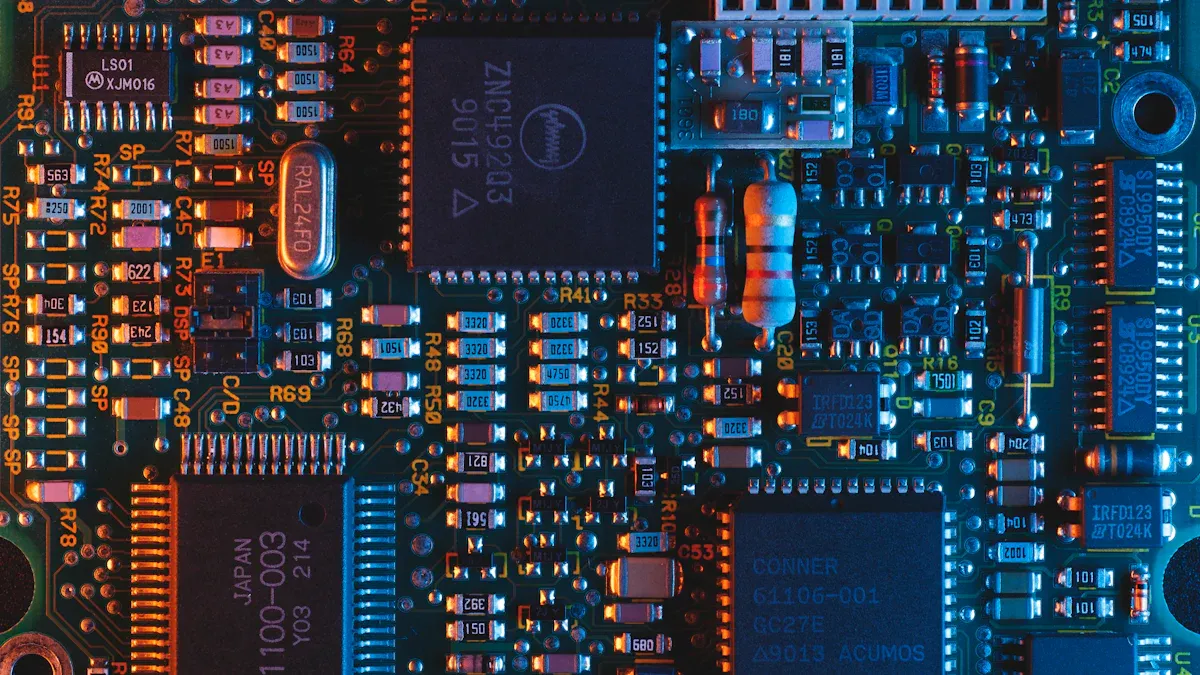
Class A amplifiers are known for their great sound quality. They work during the whole signal cycle, keeping the output smooth. This design focuses on clear sound, making them perfect for important audio tasks.
Here’s a simple look at why Class A amplifiers are great:
Advantage | Description |
|---|---|
Great Linearity | They keep signals accurate, perfect for clear audio. |
High Gain | They can make weak signals much stronger for better sound. |
Low Distortion | When built well, they have very little distortion, improving sound. |
Best Sound Quality | Many say they sound the best for high-quality audio setups. |
Always Conducting | The output is always active, giving smooth and steady sound. |
These features make Class A amplifiers a top pick for people who love amazing sound.
Operational Principles
Class A amplifiers keep their output active all the time. This makes the sound smooth and free of distortion. But, this design uses more power.
Their efficiency is usually less than 30%.
They aim to give the most AC power to the load while using less DC power.
Efficiency is how much output power is compared to the total power used.
Even though they aren’t very efficient, they are worth it for clear and detailed sound.
Common Applications
Class A amplifiers are used where sound quality matters more than saving power. They are common in high-quality audio systems, studios, and fancy home theaters. Their clean sound makes them great for professional audio work.
They are also used in labs for testing and research. Some high-power RF systems also use them because they need clear signals.
Class B Amplifier Circuit
Key Characteristics
Class B amplifiers work with a conduction angle of 180°. This means each transistor works for half of the signal. They are more efficient than Class A amplifiers, with a maximum efficiency of about 78.5%. In real use, their efficiency is closer to 60%.
A key feature of Class B amplifiers is the push-pull setup. This design uses two transistors. One handles the positive signal, and the other handles the negative. This reduces distortion and improves sound quality. Class B amplifiers also waste less power, making them great for energy-saving needs.
Characteristic | Description |
|---|---|
Conduction Angle | 180° (each transistor works for half the signal) |
Efficiency | Around 60% (maximum is ~78.5%) |
Applications | Found in audio systems, linear amplifiers, and battery-powered devices like radios |
Distortion Management | Uses push-pull design to lower distortion |
Advantages over Class A Amplifiers | Better efficiency and less power wasted |
Operational Principles
Class B amplifiers use a push-pull design to amplify signals. One transistor works on the positive part of the signal. The other transistor works on the negative part. This setup saves power and creates less heat, making it good for high-power uses.
These amplifiers are efficient because they stay off during quiet times. Unlike Class A amplifiers, they only work when needed. This design saves energy and avoids extra heat. The simple circuit design also makes them cheaper to build, which is why they are used in many devices.
Common Applications
Class B amplifiers are common in audio systems where clear sound and energy-saving are important. You’ll see them in radios and linear amplifiers. They are also great for battery-powered devices because they use less power.
In high-power audio setups, they give clear sound with little distortion. They are also used in portable systems where controlling heat is important. Their mix of efficiency and low cost keeps them popular in modern electronics.
Tip: Need an amplifier that saves power and sounds good? Class B amplifiers are perfect for audio systems and battery-powered gadgets.
Class AB Amplifier Circuit
Key Characteristics
Class AB amplifiers mix the best parts of Class A and Class B. They give good sound quality and save more energy. This makes them a flexible choice for many uses. Class AB amplifiers fix the problems of both Class A and Class B designs.
They use less power than Class A amplifiers, which always stay on.
They lower the sound distortion seen in Class B amplifiers by using better biasing.
They balance clear sound and energy saving, making them useful for many tasks.
These amplifiers are popular in audio systems and power amplifiers. They work well when both good performance and saving energy are needed. Their ability to handle strong signals with little distortion makes them a favorite for many users.
Operational Principles
Class AB amplifiers work by slightly turning on both transistors during signal changes. This overlap removes the distortion found in Class B amplifiers. The design keeps the amplifier efficient while keeping the sound clear.
Here’s a simple look at how they perform:
Aspect | Description |
|---|---|
Efficiency | They are more efficient than Class A and Class B amplifiers. |
Power Use | They save power by reducing distortion with smart biasing. |
How They Work | Biasing lets transistors overlap during signal changes, cutting distortion. |
Efficiency Formula | Efficiency depends on output signal and supply voltage, shown as Ƞ = π/4 * Vac/Vsupply. |
This design helps Class AB amplifiers give strong signals without wasting much energy. They are a great mix of performance and efficiency.
Common Applications
Class AB amplifiers are used in many devices because they are so versatile. You’ll find them in home theaters and professional audio equipment. Their ability to handle strong signals with little distortion makes them perfect for these systems.
They are also used in portable devices where saving energy is key. You’ll see them in concert sound systems and public address setups. Their balanced design makes them reliable for many different uses.
Note: Want an amplifier that balances great sound and energy saving? Class AB amplifiers are a smart pick.
Class C Amplifier Circuit
Key Characteristics
Class C amplifiers are made to be very efficient. They are used where signal distortion is okay. These amplifiers work with a conduction angle under 90°. This means the transistor is active for a short time. This design saves power, making them more efficient than other types.
Some important features of Class C amplifiers are:
High Efficiency: They can reach over 80% efficiency, great for high power needs.
Significant Distortion: Their short conduction angle causes distortion, limiting their use.
Compact Design: Less heat means smaller parts and simpler circuits.
If you need an amplifier that focuses on saving power, Class C is a good choice.
Operational Principles
Class C amplifiers work by keeping the transistor off most of the time. It only turns on for a small part of the signal. A resonant circuit fixes the output signal and removes extra noise.
This design wastes very little power as heat. That’s why it’s used for high power tasks. But, it causes distortion, so it’s not good for clear sound. In RF transmission, the resonant circuit fixes the distortion, making the signal usable.
Common Applications
Class C amplifiers are used where high power and efficiency matter most. You’ll find them in:
RF Transmission: They send signals far distances for broadcasting.
Radar Systems: They handle high power, perfect for radar setups.
Industrial Equipment: They power tools like RF generators and induction heaters.
Their compact size and efficiency make them great for these jobs. But they aren’t good for audio systems or tasks needing clear sound.
Tip: Working on RF transmission or high power projects? Class C amplifiers are a smart choice for saving energy.
Class D Amplifier Circuit
Key Characteristics
Class D amplifiers are known for being very efficient and small. They use switching technology instead of traditional methods to amplify signals. This reduces power loss and heat, making them great for portable and high-power devices.
Here’s a simple look at their features:
Feature | Description |
|---|---|
Power Efficiency | They can reach over 90% efficiency, saving lots of energy. |
Total Harmonic Distortion (THD) | THD below 0.1% works well for most uses, with audiophiles liking levels as low as 0.05%. |
Output Noise Level | Noise under 500 µV is hard to hear, but over 1 mV can be annoying. |
Dead-Time Impact | Dead-time must be adjusted to balance efficiency and THD for better performance. |
These amplifiers are great for saving energy and being compact. They deliver strong power with little distortion, making them popular for modern audio and portable gadgets.
Operational Principles
Class D amplifiers work by quickly turning transistors on and off. This creates a pulse-width modulated (PWM) signal, which is filtered to make a clean output. Their switching frequency, usually between 250kHz and 1.5MHz, is key to how they work.
Important points about how they work:
They are highly efficient, perfect for portable and small high-power devices.
Advanced modulation removes the need for extra filters and lowers electromagnetic interference (EMI).
Power loss comes from transistor resistance, switching, and standby current, but it’s much lower than in older amplifiers.
This design wastes little energy and works well even in tough conditions. Class D amplifiers are used where compact size and energy saving are important.
Common Applications
Class D amplifiers are used in devices needing high power and energy saving. Their small size and low heat make them perfect for portable gadgets and modern sound systems.
You’ll find them in:
Home Audio Systems: They give clear sound with little distortion, great for music lovers.
Portable Devices: They save battery life in phones, tablets, and Bluetooth speakers.
High Power Applications: They power subwoofers and big sound systems with ease.
Industrial Equipment: They are reliable for motor drives and power tools.
Class D amplifiers are a smart choice for balancing power and energy saving, making them useful in many fields.
Comparative Analysis of Amplifier Circuits

Efficiency and Power Use
Efficiency and power use are key when comparing amplifiers. Efficiency shows how well an amplifier turns input power into output without wasting energy as heat. Class D amplifiers are the most efficient, reaching over 90% due to their switching design. On the other hand, Class A amplifiers are the least efficient, with only 25-30%, as they always use current.
Class B and AB amplifiers are in the middle. Class B amplifiers reach 70-80% efficiency by using transistors alternately for each signal half. Class AB amplifiers, with overlapping conduction angles, achieve 50-70% efficiency while lowering distortion. Class C amplifiers, made for high-frequency tasks, go over 80% efficiency but lose quality in signal reproduction.
The table below compares efficiency across frequency bands and device types:
Frequency Band | Device Type | Efficiency (%) |
|---|---|---|
L-band | Silicon LDMOS | 60% drain efficiency |
GaN HEMT | >80% drain efficiency | |
X-band | MESFET | >30% efficiency |
GaAs pHEMT | >40% PAE | |
GaN HEMT | >50% PAE | |
TWTs | 60% efficiency | |
Ku-band | Solid-state | <10% PAE |
Ka-band | COTS parts | <20% efficiency |
Q and W-band | GaN HEMT | 30% PAE at device level |
For devices needing low power loss, like portable gadgets or high-power systems, Class D amplifiers are best. But if you need better signal quality, Class A or AB amplifiers are better choices.
Signal Quality and Distortion
Signal quality means how well an amplifier copies the input signal at the output. Good quality is important for audio systems and communication tools. Class A amplifiers are the best for quality, giving nearly perfect signals with very little distortion. Class AB amplifiers also give good quality by reducing crossover distortion with better biasing.
Class B amplifiers, while efficient, have crossover distortion where signals switch between transistors. Class C amplifiers, made for RF tasks, allow more distortion, so they’re not good for audio. Class D amplifiers, though efficient, can cause harmonic distortion from their switching. But modern designs with better filters have reduced this problem.
Important ways to measure signal quality include:
P1dB Compression Point: Shows the highest power level for clear operation.
Dynamic Range: Measures the smallest to largest signals an amplifier can handle.
Total Harmonic Distortion (THD): Measures added harmonics from non-linear behavior.
Intermodulation Distortion (IMD): Checks unwanted signals from multiple tones interacting.
The table below explains distortion challenges and solutions:
Evidence Description | Key Insight |
|---|---|
Discusses the difficulty in achieving linearity due to various distortion mechanisms. | Circuit-value changes can affect multiple distortion sources, complicating the measurement of low distortion levels. |
Emphasizes the necessity of measuring open-loop linearity in power amplifiers. | Open-loop gain measurement is crucial for confirming low distortion levels in amplifier circuits. |
Describes the method for measuring open-loop gain using differential amplifiers. | A systematic approach to measuring error voltage can help in assessing distortion across frequencies. |
For tasks needing high signal quality, like professional audio or studio setups, Class A and AB amplifiers are the top picks. Class D amplifiers, with better designs, are also becoming good for high-quality sound.
Best Uses for Each Amplifier
Each amplifier type works best for certain jobs. Class A amplifiers, with their great quality, are perfect for high-end audio, studios, and lab testing. Their low distortion makes them a favorite for audiophiles.
Class B amplifiers, with better efficiency, are good for battery-powered devices and mid-range audio. They balance power use and performance, making them great for portable gadgets. Class AB amplifiers, combining efficiency and quality, are used in home theaters, public address systems, and concerts.
Class C amplifiers are best for RF tasks, radar, and industrial tools. Their high efficiency and small size make them great where distortion is okay. Class D amplifiers, with unmatched efficiency, are ideal for portable devices, Bluetooth speakers, and subwoofers. They’re also used in motor drives and power tools for saving energy.
When picking an amplifier, think about your needs. For audio, focus on quality. For portable gadgets, choose efficiency. For RF and industrial tasks, Class C and D amplifiers are the best options.
Applications of Amplifier Circuits
Amplifier circuits are used in many areas. They improve sound in audio systems and boost signals for communication. Each amplifier class has special features that make it good for certain jobs. Let’s see how they are used in different fields.
Audio Systems
Amplifiers are key to making audio systems sound great. They make weak signals stronger so speakers can play clear and loud sounds. Whether at home or a concert, amplifiers improve the listening experience.
The global market for audio amplifiers is growing fast. It’s expected to reach $78.72 billion by 2032.
Class AB and Class D amplifiers are common in modern audio systems. Class AB amplifiers balance sound quality and efficiency, making them great for home theaters and professional setups.
Class D amplifiers are small and efficient, perfect for portable devices like Bluetooth speakers and soundbars.
New technology, like Digital Signal Processing (DSP), makes amplifiers even better. DSP reduces distortion and saves energy, making these amplifiers essential for today’s audio systems.
Did you know? Class A amplifiers are often used in high-end audio systems because they provide the best sound quality.
RF Transmission
Amplifiers are important in RF transmission. They make signals strong enough to travel far without losing power. These amplifiers are used in communication, broadcasting, and radar systems.
Class C amplifiers are popular here because they are very efficient. Even though they cause distortion, resonant circuits can fix the noise. New designs, like the Doherty amplifier, are 11% to 14% more efficient than older Class AB amplifiers. This makes them perfect for modern wireless systems.
RF amplifiers are used for:
Broadcasting: They help send clear radio and TV signals.
Radar Systems: They provide the power needed to detect objects far away.
5G Networks: They improve signal strength and coverage for faster connections.
Advances in RF amplifiers are helping improve communication technology, making them essential for staying connected.
Portable and Power-Efficient Devices
Portable devices need amplifiers that save space and energy. Class D amplifiers are great for this. They are over 90% efficient and waste little power, making them ideal for battery-powered gadgets.
You’ll find Class D amplifiers in:
Smartphones and Tablets: They power sound while saving battery life.
Bluetooth Speakers: These amplifiers deliver great sound in small devices.
Wearable Devices: Smartwatches and fitness trackers use them for better performance.
The market for automatic gain-controlled amplifiers is also growing. This is due to trends like automotive radar and medical imaging. North America leads in design, while Asia-Pacific is the top manufacturer. These trends show how important efficient amplifiers are for portable and special devices.
Tip: Designing a portable gadget? Use Class D amplifiers for their small size and high efficiency.
Picking the right amplifier depends on what you need. Each type has its pros and cons. Class A amplifiers give great sound but use more power and get hot. Class B amplifiers save energy but might cause sound distortion. Class AB amplifiers mix good sound and energy saving, making them flexible. Class C amplifiers are very efficient but distort sound, so they’re best for RF tasks. Class D amplifiers are super efficient and small, perfect for portable gadgets and modern audio setups.
Think about things like noise, grounding, and heat control when choosing. Reduce noise by limiting bandwidth and using special low-noise parts. Proper grounding stops interference, and wide traces help with high currents. For devices that get hot, use heat sinks or pads to keep parts safe.
Tip: Want the best sound? Go for Class A or AB amplifiers. Need to save energy? Class D amplifiers are your best bet.
FAQ
What is the most efficient amplifier class?
Class D amplifiers are the most energy-saving. They use switching methods to lower power waste, reaching over 90% efficiency. This makes them great for portable gadgets and high-power uses where saving energy matters.
Which amplifier class gives the best sound quality?
Class A amplifiers offer the clearest sound. They work all the time during the signal cycle, keeping distortion very low. This makes them ideal for fancy audio systems and professional studios.
Can Class C amplifiers work in audio systems?
No, Class C amplifiers are not good for audio systems. They cause a lot of distortion because they only work for a small part of the signal. They are better for RF tasks and high-power jobs where clear sound isn’t needed.
Why are Class AB amplifiers common in home theaters?
Class AB amplifiers mix good sound and energy saving. They cut distortion by slightly overlapping signal parts and use less power than Class A amplifiers. This makes them a great choice for home theaters and professional sound setups.
How do I pick the right amplifier?
Think about what you need most. For clear sound, pick Class A or AB amplifiers. For saving energy, choose Class D. If you need strong power for RF tasks, go with Class C. Match the amplifier to your specific job.
Tip: Check your device’s power and performance needs before picking an amplifier.