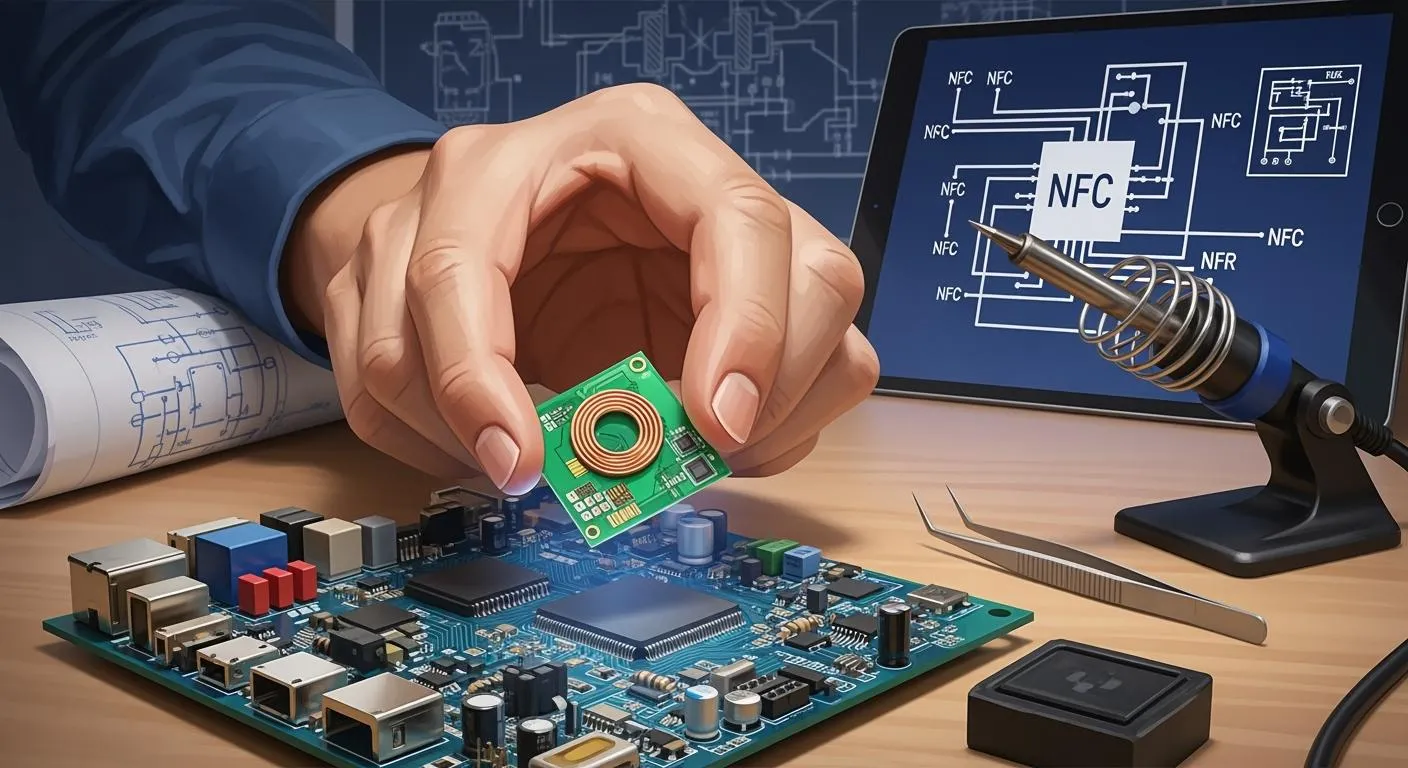
You start to design NFC Modules by learning how nfc technology works. You select the right parts and create the design for the circuit. You lay out the board and plan where each part will go. You build a sample and test it to make sure everything works. You can ask experts for help and use special tools to improve your design.
Key Takeaways
Learn the basics of NFC technology to make good modules. NFC lets devices talk by touching. This helps keep data safe when moving it.
Pick the best parts for your NFC module. Choose pieces that fit what you need. Make sure they work well and last a long time.
Use smart steps when making your PCB design. Good layout and shielding help signals stay strong. This also makes your module work better.
Test your prototypes well before making many. Early tests find problems fast. This saves you time and money later.
Think about custom solutions for special uses. Custom NFC devices can fit business needs. They also help keep things more secure.
NFC Modules and Technology Basics

What is NFC
You use nfc technology when devices need to talk by touching or being very close. This wireless connection only works over a short distance, just a few centimeters. You start nfc with a tap, so it is simple for anyone to use. The short range helps keep your information safe because not many people can listen in. You use nfc for reading data, sharing files, or making payments like a card. Many systems use RFID, and nfc works well with these systems.
Key Principles of NFC:
Works only over a short distance.
Starts with a touch.
Short range helps keep things safe.
Can read, share, or act like a card.
Works with RFID systems.
NFC Modules Overview
You see nfc modules in many shapes and sizes. Some look like sticker tags you put on products to track them. Others are badges or ID cards for access control. Anti-metal tags go on metal surfaces in factories. PROX tags help with security and entry. For animals, you use special tags to track pets or livestock. Jewelry tags help you keep track of small valuable things. Wristband tags are good for events. Laundry tags can go through washing and help track fabric. Carrier tracking tags help you follow items in manufacturing.
Sticker Tags
Badges & ID Cards
Anti-Metal Tags
PROX Tags
Livestock/Pet Tags
Jewelry Tags
Wristband Tags
Laundry/Fabric Tags
Carrier Tracking Tags
Key Applications
You see nfc modules used in many industries. Manufacturing uses nfc to track inventory and make work easier. Logistics companies use nfc to track shipments and assets in real time. The table below shows how different industries use nfc modules:
Industry | Application Description |
|---|---|
Manufacturing | Uses nfc to track inventory and make production better. |
Logistics | Uses nfc to track shipments and assets right away. |
You find nfc modules in things you use every day. You use them for payments, security, and tracking. These modules help you work faster and keep your information safe.
NFC Module Design Essentials
Component Selection
You begin by picking the right parts for your nfc module. You look for parts that fit your needs for speed and power. You want your module to work well and last long. You check if the antenna matches the nfc chip. This helps stop signal problems. You choose inductors and capacitors with the right values. These help your module work at the correct frequency. You also think about where you will use the nfc module. If it is in a factory, you need strong parts. These parts should handle heat, water, and bumps. You want the antenna’s Q-factor to be higher than your system’s. This lets you control how much energy is lost. You check the self-resonant frequency. It should be at least 25 MHz. The table below shows what to look for when picking parts for nfc modules:
Criteria | Explanation |
|---|---|
Impedance Matching | Matches the nfc chip to the antenna for clear signals. |
Environmental Factors | Considers antenna size and case material for best performance. |
Component Values for Matching | Picks the right inductors and capacitors for the needed frequency. |
Q-Factor | Chooses antennas with a high Q-factor for better control. |
Self-Resonant Frequency | Makes sure the frequency is high enough for nfc modules to work well. |
PCB Design
A good PCB design helps your nfc module work better. You keep ground planes away from antenna coils. This stops unwanted currents. You use split ground planes for boards with many layers. You make traces wide and keep them apart. This lowers resistance and stops arcing. You use 45° corners to cut down on interference. You balance the antenna layout. This keeps the magnetic field even. You pick board materials like FR4 or polyimide. You shield the board and keep it away from fast digital traces. This helps stop interference. Here are some best practices for PCB design:
Keep ground planes away from antenna coils.
Use split ground planes for multilayer boards.
Make traces wide and spaced out.
Use 45° corners for less interference.
Balance antenna layout for even fields.
Pick the right board material.
Shield and separate from fast digital traces.
Tip: Good PCB design helps your nfc modules read tags faster and more reliably.
Antenna Integration
You need to focus on antenna integration in your nfc module design. A bigger antenna can pick up more magnetic field lines. This helps your nfc module read tags from farther away. The way you place the antenna matters. The size of the reader’s antenna also affects how well your module works. New nfc standards, like Release 15, let your module work at ranges up to 20mm. This makes it easier to use nfc for payments and other tasks. Using the right antenna gives you better communication and more reliable performance.
Bigger antennas help you read tags from farther away.
How antennas connect affects how well they work.
New standards let nfc modules work at longer distances.
Better antenna design means nfc works more reliably.
Host Interface Options
You decide how your nfc module talks to other devices by picking a host interface. You can use SPI, I2C, or UART. Each one has good and bad sides. SPI is fast and lets you send and get data at the same time. But it uses more power and does not work well over long distances. I2C lets you connect many devices and has built-in addressing. But it gets slower if you add more devices. UART uses less power and is simple. But it only connects two devices and is slower than SPI. The table below helps you compare these options:
Protocol | Advantages | Disadvantages |
|---|---|---|
SPI | Fast data, full-duplex | More power, not for long distances |
I2C | Connects many devices, built-in addressing | Slows down with more devices |
UART | Low power, simple | Only two devices, slower than SPI |
Note: You pick the host interface based on your system’s needs and how you want your nfc modules to work.
NFC Module Requirements
You need to meet some technical requirements when you design nfc modules for industry. You check how far your module can read a tag. You make sure the module fits in the space you have. You look at how much memory you need. You think about security features like passwords or tamper detection. You consider the environment, such as temperature and moisture. You make sure your module works with the right standards, like ISO/IEC15693. You also pay attention to antenna size and circuit parts, like EMI filters and matching networks. The table below lists the main requirements for nfc modules:
Requirement | Description |
|---|---|
Read distance | How far the nfc reader can talk to a tag. |
Size constraints | The size of the nfc modules and tags for easy installation. |
Memory needs | How much data the nfc modules can store and keep. |
Security features | Passwords, tamper detection, and privacy measures. |
Environment | Handles heat, moisture, and shock. |
Compatibility | Works with the right reader and standards. |
Antenna specifications | Antenna size and design for best range and power use. |
Circuit components | Uses the right nfc chip, EMI filter, and matching network for good performance. |
You make sure your nfc modules meet these requirements so they work well in your application.
Manufacturing Operations for NFC Modules

Prototyping and Assembly
You begin by making a prototype of your near field communication module. Prototyping lets you test your design before making many modules. You build a few modules to see if they work right. You put together the antenna, chip, and PCB. You check that each part fits well. Machines help place tiny parts on the board. You look at how the parts line up and if the soldering is good. You search for problems in the assembly. You fix any issues early so you do not waste time or money later. Prototyping shows how your near field communication module works in real life.
Testing and Validation
You must test every near field communication module before making lots of them. Testing checks if your module meets all the rules. You measure how strong the signal is when sent and received. You check if the frequency is correct. You look at how many packets have errors. You measure how close the signal is to perfect. You test if the module talks well using near field communication standards. The table below lists important tests for near field communication modules:
Testing Parameter | Description |
|---|---|
Transmit (Tx) Power | Checks if the sent signal is strong enough. |
Receive (Rx) Strength | Makes sure the received signal is strong and clear. |
Frequency Accuracy | Checks if the module uses the right frequency. |
Packet Error Rate (PER) | Counts how many packets have mistakes. |
Error Vector Magnitude (EVM) | Shows how close the signal is to the ideal one. |
NFC Communication Integrity | Tests if the module follows near field communication rules. |
Tip: You run these tests on each prototype to find problems early. You make sure your near field communication modules work well before making many of them.
Production and Quality Control
You start full production after your prototypes pass all tests. You set up machines to build many near field communication modules fast. You use strict quality checks to keep every module working well. You use special tests that do not harm the product to find defects. Machines help you spot problems quickly. You track each module with RFID and near field communication. Skilled workers run tests and keep machines working right. You use special tools to check materials and finished modules. You keep machines clean and working well. You ask workers to join groups and share ideas to make quality better.
Quality Control Measure | Description |
|---|---|
Non-Destructive Evaluation (NDE) | Uses safe tests to make sure modules meet high standards. |
Automated Inspection Systems | Machines check modules for problems with great accuracy. |
Traceability | Lets you follow each module through the whole process. |
Skilled Personnel | Trained workers help keep quality high. |
Advanced Analytical Techniques | Special tests check materials and finished modules. |
Regular Maintenance and Calibration | Keeps machines working right for good quality. |
Quality Circles and Employee Engagement | Workers share ideas to help improve quality. |
You check quality at every step of making modules.
Using machines helps you save money and make better modules.
Tracking modules helps you find and fix problems fast.
Keeping machines in good shape helps them work well.
Design Validation Services
You use design validation services to make sure your near field communication modules are strong and safe. These services test your module in many ways. You check if all firmware features work as they should. You test how your module handles heat and wet conditions. You figure out how long your module lasts and run aging tests. You check if your module can handle electromagnetic interference. You test if your module is safe to use. The table below shows how each test helps make your module better:
Testing Type | Contribution to Reliability |
|---|---|
Functional Validation | Checks if all firmware features work right. |
Environmental Stress Simulation | Tests how the module works in tough conditions. |
Reliability Tests | Finds out how long the module lasts and if parts wear out. |
EMC Pre-compliance Testing | Checks if the module can handle interference. |
Electrical Safety Pre-compliance | Makes sure the module is safe before making many of them. |
You also use steps for making, cost, testing, fixing, strength, supply chain, and safety. These steps help you build near field communication modules that last longer and work well everywhere. You make sure your manufacturing operations always give you good products.
Custom NFC Device Development
Custom Solutions
You can fix special problems with custom nfc device development and custom rfid device development. You make devices that fit your work and match your business needs. You add features that help your product stand out. You also make security better and follow rules for your industry. The table below shows how custom nfc device development helps you:
Benefit | Description |
|---|---|
Tailored Functionality | You build devices that work with your systems and processes. |
Unique Features | You add new things that make your product different from others. |
Enhanced Security and Compliance | You make devices with strong security and meet important rules. |
Tip: Custom rfid device development lets you make solutions for special jobs, like tracking items or controlling who gets in.
Development Tools
You use development boards and SDKs to make custom nfc device development easier. These tools give you hardware and software to test ideas fast. You connect boards to your computer and use SDKs to write code for your device. You follow easy steps to program nfc tags on Android and iOS. You also use validation centers to check if your device works well. Development boards and SDKs help you finish custom rfid device development faster and with fewer mistakes.
Development boards help you test hardware features.
SDKs let you write and test software for nfc devices.
Validation centers check if your device meets standards.
Application Examples
You see custom nfc device development and custom rfid device development used in many industries. In retail, you use nfc tags to share product details, give discounts, and run marketing campaigns. In healthcare, you scan nfc tags to see medical history, send SOS alarms, and check medicine doses. Smart drug labels use nfc to store expiry dates and dosage information. The table below shows some real-world uses:
Sector | Application Description |
|---|---|
Retail | Share product info, offer discounts, and run marketing campaigns with nfc tags. |
Healthcare | Scan for medical history, send SOS alarms, and check dosage info using nfc features. |
Healthcare | Use smart drug labels with nfc to track expiry dates and medicine details. |
Note: You may have problems like different user interfaces for Android and iOS, security needs, and handling data in many formats. You fix these problems by using strong authentication and checking data.
Reliability Best Practices
Common Challenges
You can run into problems when using nfc modules. Many people make mistakes with how they use their phones. Sometimes, they do not put their phone in the right spot. This can stop the module from working. Apps can also cause trouble. About one in five problems come from apps that do not work well. This is often because the app has bad cache data. Hardware can break if the chip gets hurt or made wrong. Phone cases or other wireless signals can block the nfc module.
Mistakes from putting phones in the wrong place
App problems from broken cache data
Hardware breaks from damage or bad parts
Phone cases or other signals can block nfc modules
Tip: You can help by teaching users how to hold their phones. Keeping apps updated also helps stop problems.
Cost Optimization
You can save money by picking good materials and smart designs. Choose parts that last longer and do not need fixing often. Use machines to build modules faster and cheaper. Test your first modules early to find problems before making many. Track each module as you build it to find defects fast. Work with suppliers who sell good parts for less money. Share ideas with your team to help everyone save money.
Pick strong parts so you do not replace them often.
Use machines to build modules quickly.
Test first modules early to catch mistakes.
Track modules to find problems fast.
Work with good suppliers for better prices.
Share ways to save money with your team.
Performance Tips
You can make your nfc modules work better by using good antennas and materials. Ferrite-backed antennas help in places with lots of noise. Use wires that carry signals well and boards that keep signals strong. Make sure antennas are lined up right. If they are not, the module will not work as well. Ferrite antennas are good for tracking things in noisy places.
Performance Factor | How It Helps Your Module Work Better |
|---|---|
Ferrite-backed antenna | Makes modules work better and stops interference |
High-conductivity wire | Sends signals stronger and faster |
Low-loss substrate | Keeps signals clear and strong |
Proper alignment | Helps modules work well and talk to other devices |
Note: Always check where you put antennas and use good materials. This helps your nfc modules work their best.
You can make NFC modules by following easy steps. First, pick the right parts. Next, design your PCB. Then, build and test some prototypes. Use strong checks to make sure everything works. Expert help and special tools make things easier for you. Experts help you set what your module should do. Tools help you work faster and better. Services make sure your module works with other systems and follows rules.
Custom NFC device development helps you fix special problems. You need to think about some important things:
Factor | Description |
|---|---|
Hardware Design | Choose readers that work for your range and place. |
Software Needs | Use firmware and apps that fit your device. |
Specific Use Cases | Make sure the device matches what your business needs. |
You can learn more by using resources like the NFC Cockpit tool, guides for antenna design, and NFC basics. If you want expert help, companies like TapTrack and Arshon Technology can give you advice, design, and testing services.
FAQ
What is the main benefit of using NFC modules in products?
You add NFC modules to make products smarter. They let you share data, track items, or control access with a simple tap. You make your product easier to use and safer for users.
How do you test if an NFC module works?
You use special tools to check signal strength, frequency, and error rates. You also test if the module can read and write tags. Testing helps you find problems before you build many modules.
Can you use NFC modules outdoors?
You can use NFC modules outdoors if you pick strong parts. Choose waterproof and heat-resistant materials. You also protect the antenna and chip from dust and water.
What tools help you design NFC modules?
You use development boards, SDKs, and antenna design guides. These tools help you test ideas and write code. You also use validation centers to check if your design meets standards.
How do you keep NFC modules secure?
You add passwords, use encryption, and set up tamper detection. You also follow security rules for your industry. These steps help you protect data and stop unwanted access.