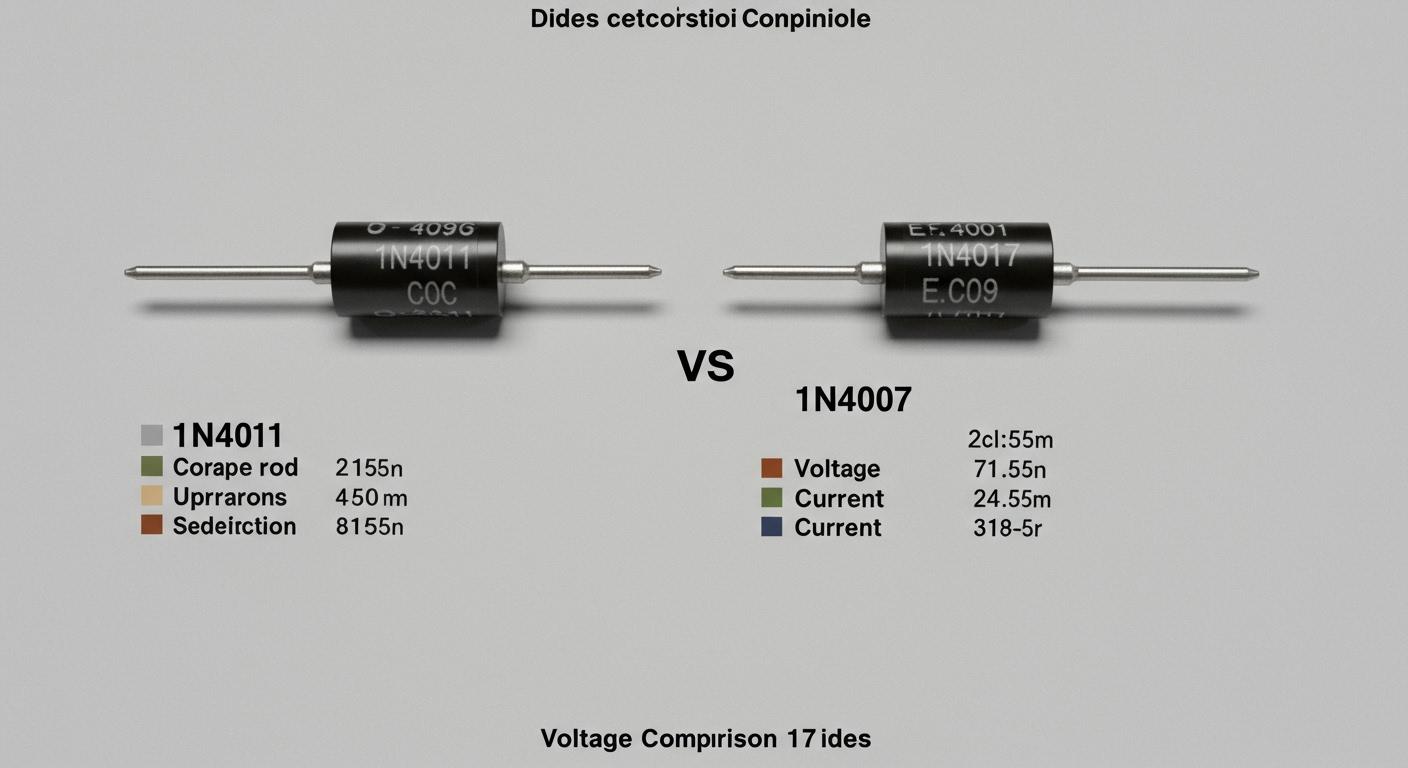
When you compare the 1N4001 vs 1N4007, the main difference lies in their voltage and surge current ratings. Take a look at this table:
Characteristic | 1N4001 | 1N4007 |
|---|---|---|
Peak Repetitive Reverse Voltage | 50V | 1000V |
Average Forward Current Rating | 1.0A | 1.0A |
Non-repetitive Peak Current | 30A | 30A |
Choosing the right diode is crucial. Higher voltage ratings, like those of the 1N4007, help protect your circuit when dealing with significant voltage. It’s essential to select a diode that meets your voltage and current requirements. The 1N4007 is ideal for high-voltage applications, providing protection against strong current spikes. On the other hand, the 1N4001 is more suitable for low-voltage circuits, functioning effectively when large surges are not a concern.
Key Takeaways
The 1N4001 works well for low-voltage jobs. It can handle up to 50V. The 1N4007 is made for high-voltage uses. It can manage up to 1000V.
Both diodes can carry an average forward current of 1.0A. They can also handle a peak surge current of 30A. This makes them good for short times of high current.
Always match the diode’s highest reverse voltage to your circuit. This helps stop damage and keeps things safe.
The 1N4007 gives more protection from voltage spikes. It is safer for projects that might get high voltages.
Both diodes are easy to find and not expensive. But the 1N4007 is often picked more. It works well in many different uses.
1N4001 vs 1N4007 Comparison
Key Specs Table
When you look at 1N4001 vs 1N4007, focus on their main electrical features. The table below puts the most important specs next to each other. This makes it easy to see how each diode works in different cases.
Specification | 1N4001 | 1N4007 |
|---|---|---|
50V | 1000V | |
Average Forward Current | 1.0A | 1.0A |
Non-repetitive Peak Surge Current | 30A | 30A |
0.6V–0.8V | 0.6V–0.8V (low power), ~1V (high power) | |
Recovery Time | ~2µs | ~2µs |
Junction Capacitance | 15pF–30pF | 15pF–30pF |
Tip: Always look at the maximum reverse voltage before picking a diode. This number shows how much voltage the diode can stop before it fails.
Main Differences
You can spot some big differences when you compare 1N4001 vs 1N4007. The biggest one is the maximum reverse voltage. The 1N4001 can block up to 50V. The 1N4007 can block up to 1000V. So, the 1N4007 is better for circuits with higher voltages. If your project might get strong voltage spikes, the 1N4007 gives you more safety.
Both diodes can handle 1.0A of average forward current. They also both handle 30A of peak surge current. This means you can use either one for short bursts of high current.
The forward voltage drop is almost the same for both. Most of the time, it is between 0.6V and 0.8V. If you use the 1N4007 with a lot of power, the drop can go up to about 1V. For small projects, you will not see much difference.
You may wonder if there are other ways they are different. Both have about the same recovery time and junction capacitance. So, they act almost the same in most circuits, except for the maximum reverse voltage.
Here are some things that are the same:
Both 1N4001 and 1N4007 work well for low voltage rectification.
Makers often use the same process to build both diodes, then sort them by their maximum reverse voltage.
You get about the same forward voltage drop and current ratings with both.
When you pick between 1N4001 vs 1N4007, always think about the maximum reverse voltage your circuit needs. If you only use low voltages, the 1N4001 is fine. If you want more protection or want to use the diode in many projects, the 1N4007 is safer. You can use the 1N4007 anywhere you would use the 1N4001, but not the other way around.
If you want your circuits to work well, always match the diode’s maximum reverse voltage to your project. This helps stop problems and keeps your electronics safe.
1N4001 Overview
Features
The 1n4001 is a common diode for simple projects. It has a basic design and works well in low-voltage circuits. Here are its main features:
Specification | Value |
|---|---|
Maximum Reverse Voltage (VRRM) | 50V |
Working Peak Reverse Voltage (VRWM) | 50V |
DC Blocking Voltage (VDC) | 50V |
Average Forward Current (IO) | 1.0A |
Surge Current (IFSM) | 30A |
The 1n4001 can block up to 50 volts in reverse. This means it is best for circuits with less than 50 volts. It lets 1 ampere of current flow during normal use. If there is a sudden surge, it can handle 30 amperes for a short time. These features make it good for many everyday electronics.
When you look at other diodes in the 1N400x series, the 1n4001 has the lowest voltage rating. So, it is not as strong for blocking high voltages. If you work with low-voltage projects, the 1n4001 is cheap and works well.
Note: The 1n4001 does not work for high-voltage circuits. Always check your voltage needs before picking this diode.
Applications
The 1n4001 is used in many devices. Here are some common uses:
Changing AC to DC in small power supplies.
Keeping battery chargers safe from surges.
Helping boost voltage in doubler circuits.
Making sure adapters convert power smoothly.
The 1n4001 is great for general tasks. You will see it in power supplies, battery chargers, and adapters. Its features make it popular with students and hobbyists who want a simple diode for low-voltage jobs.
If you need a diode for basic protection or rectification under 50 volts, the 1n4001 is a good pick. It gives reliable performance without costing more or being complicated.
1N4007 Overview
Features
The 1n4007 is special in the 1N400x series. It can handle much higher voltage than the others. You can use it in circuits that block up to 1000 volts. The 1n4007 also deals with strong current surges. It works well even in tough situations. Its strong design helps your projects last longer and stay safe.
Here is a table that lists the main features of the 1n4007:
Parameter | Value |
|---|---|
Maximum Voltage Rating (VRRM) | 1000 V |
Maximum RMS Voltage | 700 V |
Maximum DC Blocking Voltage | 1000 V |
Maximum Average Forward Rectified Current | 1 A |
Peak Forward Surge Current (8.3 ms) | 30 A |
Non-repetitive Peak Forward Surge Current | 45 A |
Maximum Junction Temperature | 150 °C |
The 1n4007 can handle high voltages and strong surges. It keeps working even when it gets hot. This makes it a good choice for circuits that need extra protection.
Tip: If you need a diode for hard jobs, the 1n4007 is the best in the 1N400x series.
Applications
You can use the 1n4007 in many places where you need to control electricity. It works best in higher voltage projects. You will see it in power supplies, chargers, and circuits that change AC to DC. The 1n4007 also protects your devices from voltage spikes.
Here are some common ways to use the 1n4007:
Power supply rectification in home and industrial equipment
Voltage spike protection in sensitive circuits
Automotive electronics that need strong diodes
Renewable energy systems like solar inverters
The 1n4007 gives you more safety and flexibility than other diodes in the series. You can trust it for jobs with high voltages or sudden surges. Its low forward voltage drop helps your circuits work well. You will find the 1n4007 in many modern devices because it is reliable and strong.
Note: The 1n4007 is the strongest diode in the 1N400x family. Pick it if you want your project to last and stay safe, especially in tough situations.
Choosing the Right Diode
Voltage Needs
First, check the voltage in your circuit. If your project uses less than 50 volts, pick the 1n4001. It is good for most low-voltage jobs. If your circuit might get higher voltages, use the 1n4007. The 1n4007 can block up to 1000 volts. You do not need to worry about voltage spikes. Many people use the 1n4007 even in low-voltage circuits. It works for more types of projects. You feel safe knowing your diode will not break if the voltage goes up.
Use Cases
You can find the 1n4001 and 1n4007 in many projects. Both diodes help power supplies work. The 1n4007 is used in circuits that change AC to DC. It also protects against reverse polarity. It keeps voltage at safe levels. Here are some ways people use these diodes:
Voltage regulator for stable output
Snubber circuit for filtering and protecting voltage
AC to DC conversion in adapters and chargers
Reverse polarity protection in power circuits
Voltage clamp to keep voltage safe
DC-DC converter for step-up or step-down designs
The 1n4001 is good for simple jobs in low-voltage devices. The 1n4007 is better for projects that need more protection or use higher voltages. Both diodes help your circuits work well and stay safe.
Cost and Availability
You can buy the 1n4001 and 1n4007 from many places. These diodes are easy to find and do not cost much. Here is a quick look at what you get from a big supplier:
Diode Type | Supplier Name | Features |
|---|---|---|
1N4001 | Rugao Lian Tuo Electronics Co., Ltd. | General Purpose Rectifier Diodes, competitive prices, various specifications. |
1N4007 | Rugao Lian Tuo Electronics Co., Ltd. | High quality, forward current 1.0 to 10Amp, Reverse voltage from 50 to 1000Volts, Axial-leaded. |
You can buy lots of diodes for big projects or just a few for small repairs. The 1n4007 sometimes costs a little more. The price difference is small. Most people choose the 1n4007 because it works almost everywhere the 1n4001 does. You save time and make fewer mistakes by using one kind of rectifier for many jobs.
Substitution and Compatibility
Interchangeability
You may ask if you can swap a 1N4007 for a 1N4001 or the other way. Most of the time, you can use a 1N4007 instead of a 1N4001 with no trouble. The 1N4007 has a much higher maximum reverse voltage. This lets it work in harder circuits, even with voltage spikes up to 1000V. If you put a 1N4007 in a low-voltage project, it works just like a 1N4001.
But you should not use a 1N4001 instead of a 1N4007 in high-voltage circuits. The 1N4001 only blocks up to 50V. If your circuit goes over this, the diode might break. This could hurt your project or even cause safety problems.
Here is a quick table to help you choose:
Feature | 1N4001 | 1N4007 |
|---|---|---|
Maximum Reverse Voltage | Lower than 50V | Higher than 50V |
Surge Current Handling | Standard | Higher rating |
High-Frequency Suitability | Better | Slower recovery |
Tip: Always check your circuit’s voltage before swapping diodes. Using a 1N4001 in a high-voltage spot can put your project in danger.
Performance Notes
When you pick between these diodes, think about how they work in your circuit. Both have almost the same forward voltage drops and current ratings. For most power supply and rectifier jobs, you will not see a difference.
If your project uses high-frequency signals, the 1N4001 may be a bit better. It has a faster recovery time. This means it can turn off more quickly when the voltage changes. The 1N4007 has a slower recovery time, so it is not best for high-frequency circuits.
Junction capacitance is also important. Both diodes have about the same values, so you do not need to worry about this for most uses. For simple power circuits, either diode will work fine.
Remember: The 1N4007 gives more safety for high-voltage jobs, but the 1N4001 can be better for fast-switching, low-voltage circuits.
Considerations in Electronic Design and Manufacturing
Design Integration
PCB footprint and layout compatibility
You can put both 1N4001 and 1N4007 diodes in the same spot on a PCB. They have the same size and pin setup. This means you can switch them without changing your board. Always look at the voltage rating before picking a diode. If you use a 1N4001 where you need a 1N4007, high voltage can break the diode. This can hurt your circuit. Match the diode to your voltage needs to stay safe.
Diode Model | Peak Reverse Voltage | Current Rating |
|---|---|---|
1N4001 | 50V | 1A |
1N4007 | 1000V | 1A |
Thermal management in circuit design
Think about heat when you design your circuit. Both diodes can handle 1 amp, but strong surges make them hot. Good thermal management keeps your board safe. Put the diode where air can move around it. Use wide copper lines to help heat leave. If your circuit uses high current a lot, check the diode’s temperature during tests.
Impact on circuit reliability
The diode you pick changes how long your product works. The 1N4007 protects better against voltage spikes than the 1N4001. This helps sensitive parts last longer, especially when making lots of products. Using the wrong diode can break your circuit and cost money to fix.
The 1N4007 is good for high-voltage jobs.
It gives better protection from spikes.
The 1N4001 is fine for low-voltage work but may not last in hard jobs.
Manufacturing Processes
Sourcing and supply chain factors
You want diodes that are easy to buy and find in big amounts. Both 1N4001 and 1N4007 are popular and sold by many suppliers. You can order lots for big projects. Always check if your supplier has lead-free and RoHS parts.
Automated assembly compatibility
Both diodes work well with pick-and-place machines. Their normal size and shape help your assembly line run fast. This lowers mistakes and makes production quicker.
Quality control and testing
Test each batch for voltage and current ratings. Make sure the diodes match your design needs. Good testing stops bad parts from getting to customers.
Regulatory and Industry Standards
Compliance with safety and certification requirements
You must follow safety rules when building electronics. Both diodes meet common standards for voltage and current. This helps you pass product tests.
Environmental considerations (RoHS, lead-free, etc.)
You help the planet by picking lead-free diodes. Both 1N4001 and 1N4007 follow RoHS rules. These rules limit bad stuff in electronics. You can use these diodes in products sold everywhere.
1N4007 is lead-free and RoHS safe.
1N4001 is also lead-free and RoHS safe.
Tip: Always look for RoHS and lead-free labels when buying diodes. This keeps your products safe and ready for global sales.
You should pick a diode that fits your project’s voltage and how long you want it to last. The 1N4001 is good for jobs with low voltage. The 1N4007 works better for high voltage and keeps your circuit safer. Both diodes can handle 1 amp of current. Most people choose the 1N4007 because it works in more places and helps stop problems later.
Diode | Current Rating | Breakdown Voltage | |
|---|---|---|---|
1N4001 | 1A | 50V | Low-voltage applications |
1N4007 | 1A | 1000V | High-voltage, more safety |
Always look at your circuit’s voltage.
Choose the diode that will last and keep your project safe.
FAQ
What is the main job of diodes in ac to dc conversion?
You use diodes to let current flow in one direction. In ac to dc conversion, diodes block the reverse flow. This helps you turn ac into dc. Many power supplies use diodes for this reason.
Can you use any diode from the 1n400x series for both ac and dc circuits?
You can use diodes from the 1n400x series in both ac and dc circuits. These diodes work well for rectifying ac to dc. Always check the voltage rating before you pick a diode for your project.
Why do you see so many diodes in dc power supplies?
You see many diodes in dc power supplies because they change ac to dc. Diodes also protect your devices from voltage spikes. You need several diodes to build a bridge rectifier for smooth dc output.
How do you know which diode to pick for your ac to dc project?
You look at the voltage and current in your circuit. If your ac voltage is high, you pick a diode with a higher rating. The 1n400x series gives you many choices for both ac and dc needs.
Are all diodes in the 1n400x series the same for dc circuits?
All diodes in the 1n400x series can handle dc circuits, but their voltage ratings are different. You must match the diode to your dc voltage. Using the right diode keeps your circuit safe and working well.