You will see new chances for electric vehicles as solid-state batteries start to change things in 2025. These batteries let cars go farther, charge faster, and are safer. Toyota and Idemitsu Kosan are putting this technology in real cars now. People feel excited about safer and stronger ways to travel.
You will notice real changes in how you travel and use devices.
Key Takeaways
Solid-state batteries use solid electrolytes. This makes them safer. They are less likely to catch fire than regular batteries.
These batteries can charge in 10 to 15 minutes. You will wait less time to charge. You can spend more time driving.
Solid-state batteries can make electric cars go farther. They can increase the driving range by up to 80%. You can take longer trips with one charge.
As factories get better at making them, the price will go down a lot. This will help more people buy solid-state batteries.
Solid-state technology is not just for cars. It will also make phones and laptops work better. These devices will be safer and use energy better.
Solid-state batteries explained
Key differences
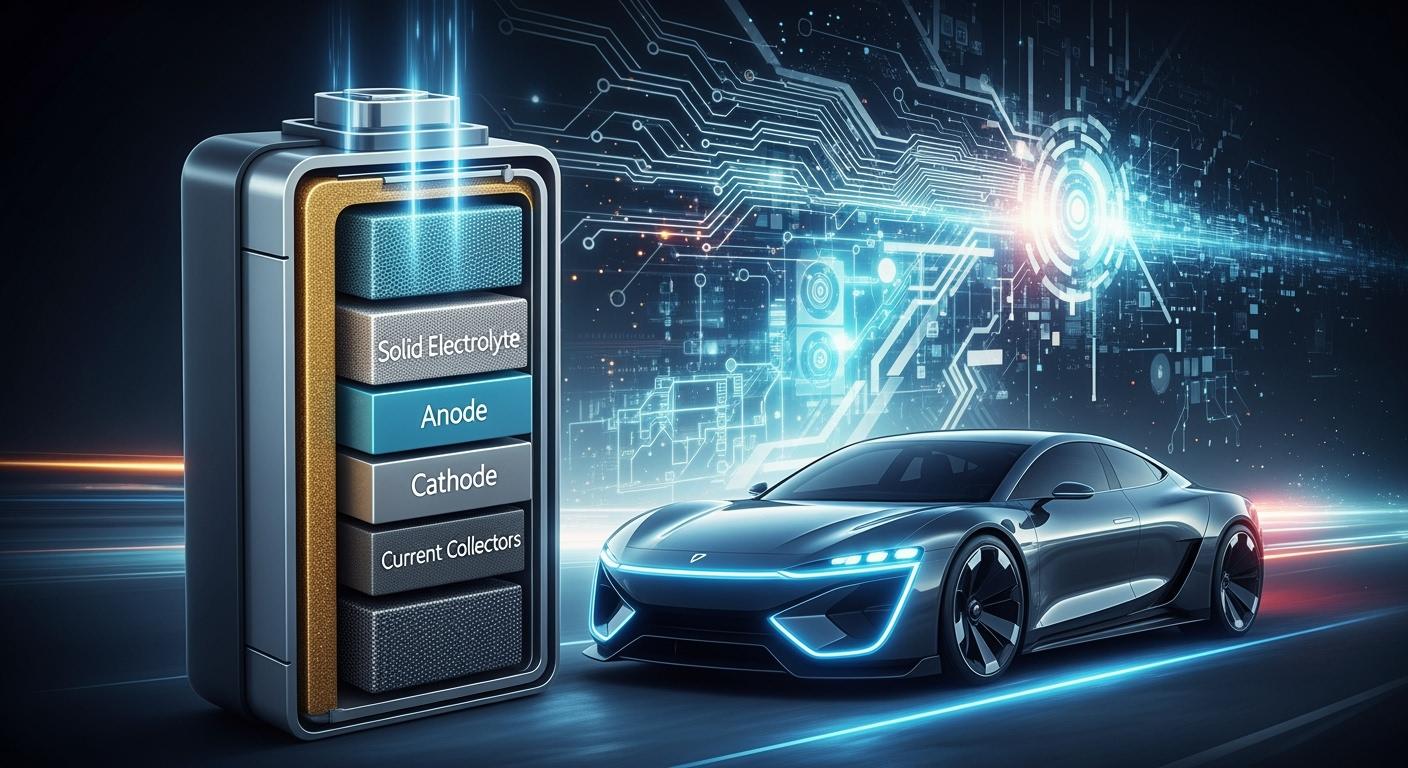
You might ask how solid-state batteries are not the same as the ones in most electric cars now. The biggest change is that they use solid electrolytes, not liquid ones. Solid electrolytes make these batteries safer and stronger. Look at this table to see the differences:
Aspect | Solid-State Batteries | Traditional Lithium-Ion Batteries |
|---|---|---|
Electrolyte | Solid electrolytes (sulfides or oxides) | Liquid electrolytes (organic carbonates) |
Energy Density | Up to 400 Wh/kg | About 250 Wh/kg |
Lifespan | Longer due to less reactivity | Limited number of charge cycles |
Safety | Higher thermal stability, less flammable | Prone to overheating and fires |
Charging Speed | Faster due to high ionic conductivity | Slower compared to solid-state batteries |
Production Cost | Higher due to new materials | Lower due to mature technology |
Solid-state batteries have solid electrolytes. This means they do not need a separator to stay safe. The battery is lighter and can be made in more shapes. Solid electrolytes lower the chance of fire because they do not burn like liquids. These batteries last longer and charge faster.
Why it matters
You want your car to go far and charge fast. Solid-state battery technology helps with both. Solid electrolytes let you store more energy in less space. Your electric car can drive farther on one charge. You also spend less time charging because these batteries fill up faster.
Solid electrolytes make batteries safer and stop leaks or fires.
You can charge these batteries many times, so they last longer.
Better safety means you worry less about getting too hot.
Solid-state batteries are not just for cars. You will find them in phones, laptops, and big energy storage systems. Solid electrolytes make all these things safer and more dependable.
Solid-state batteries are a big improvement. Using solid electrolytes gives you better power, more safety, and a battery that lasts longer. That is why car makers and tech companies are excited about solid-state battery technology.
battery advancements
Range and performance
Electric vehicles will go much farther with solid-state batteries. These batteries hold more energy in the same size. You can drive more miles before charging. Cars will also be lighter. Check the table below for the biggest changes coming in 2025:
Improvement Type | Expected Change |
|---|---|
Energy Density | 80-100% more energy in the same space |
Vehicle Weight | Reduction of up to 200 pounds |
Solid-state batteries can make your car go 50% to 80% farther. Some companies want cars to travel 900 to 1,000 miles on one charge. Charging will be much faster too. These batteries can fill up in 10 to 15 minutes. Old batteries need at least 40 minutes. In a test, a Mercedes-Benz EQS Sedan drove 749 miles with a solid-state battery and still had 85 miles left. This proves you can travel much farther without stopping.
Phones and laptops will also get better batteries. They will last longer and charge faster. The batteries will be smaller and lighter, so your devices are easier to carry.
Safety and stability
You want your car and devices to be safe. Solid-state batteries use solid electrolytes, not liquids. This makes them much safer. The table below shows how safety features compare:
Safety Feature | Solid-State Batteries | Lithium-Ion Batteries |
|---|---|---|
Fire Risk | Reduced fire risk due to non-flammable electrolytes | Higher fire risk due to flammable liquid electrolytes |
Thermal Management | Specific systems to prevent overheating and thermal runaway | Less effective thermal management systems |
Insurance Implications | Potential for lower insurance rates due to reduced risks | Higher insurance premiums due to increased risks |
Procurement Decisions in Industry | Enhanced safety requirements prioritized by utility companies | Standard safety requirements often met |
Solid-state batteries lower the chance of leaks and fires. They stay safe even after many uses. You can charge and use these batteries 8,000 to 10,000 times. This is much more than old batteries. The solid design helps stop overheating and thermal runaway. You will feel safer at home and on the road.
Cost and production
You might wonder about the price of these new batteries. Right now, solid-state batteries cost more to make than lithium-ion batteries. They cost about $400 to $600 per kilowatt-hour. This is four to eight times more than old batteries. Experts think the price will drop to $150-200 per kilowatt-hour by 2030. It could even go down to $100 later.
Making these batteries is hard. Companies need new factories and special tools. They must use high-quality materials and keep things very dry. This makes it tough to make lots of batteries fast. Some companies have made big progress in 2025. You can see their work in the table below:
Company | Breakthrough Description | Year |
|---|---|---|
Toyota | Collaboration with Idemitsu Kosan for lithium sulfide plant, key for solid-state batteries. | 2025 |
QuantumScape | Strategic collaboration with Murata Manufacturing for mass production of ceramic separator. | 2025 |
CATL | Advancement in lithium metal battery endurance using new lithium salt electrolyte. | 2025 |
Samsung SDI | Plans to begin mass production of solid-state batteries aiming for 900 Wh/L energy density. | 2024 |
Chery | Unveiled first self-developed solid-state battery module with 600 Wh/kg energy density. | 2025 |
Toyota | Agreement with Sumitomo Metal Mining for mass production of cathode materials. | 2025 |
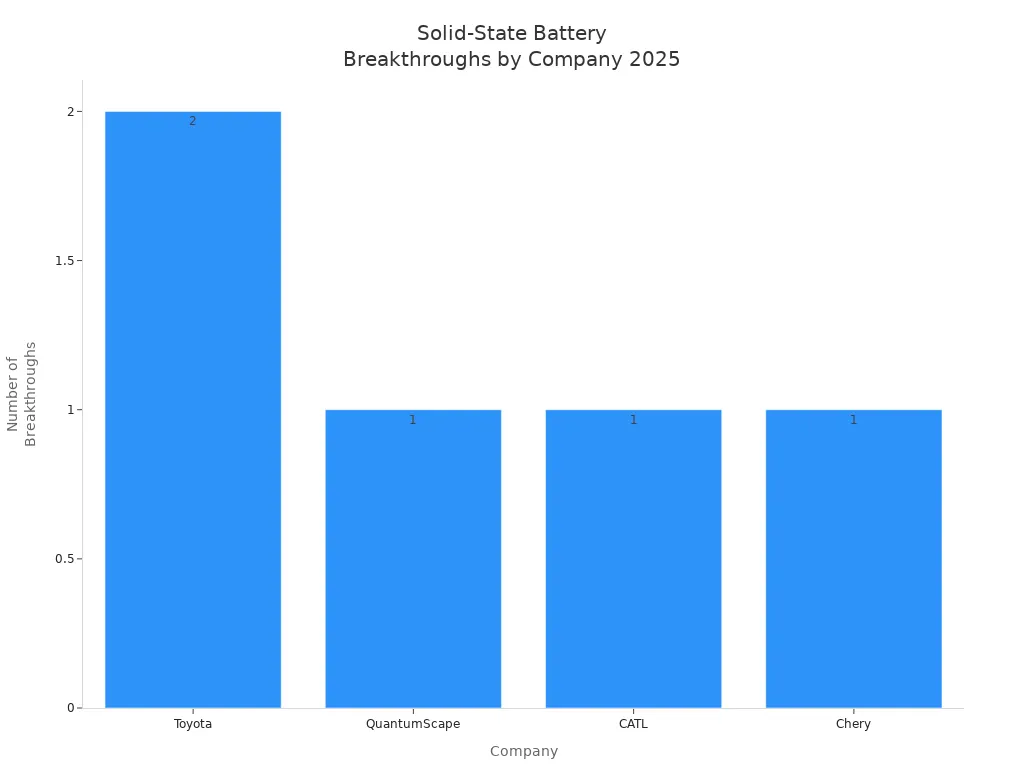
As costs drop and more batteries get made, you will see more electric vehicles and devices using solid-state batteries. These new batteries will change how you travel and use technology every day.
Industry leaders
Automakers
Many car companies want solid-state batteries in electric vehicles. They hope cars will drive farther and charge faster. Some top companies are QuantumScape, Solid Power, Toyota Motor Corporation, Samsung SDI, Panasonic Corporation, LG Energy Solution, CATL, and Ilika.
Automakers work together to make progress faster. Partnerships help solid-state battery technology grow. The table below shows some big team efforts:
Automaker | Partner | Investment/Details |
|---|---|---|
Toyota | Idemitsu Kosan | Working together since 2013 to make all-solid-state batteries; goal is 745-mile range. |
Stellantis | Factorial Energy | Put $75 million in 2021 to get solid-state batteries. |
Hyundai | SES AI | Works with General Motors and Honda to make batteries. |
Nissan | NASA | Long partnership to create solid-state batteries. |
Volkswagen | QuantumScape | Gave $100 million in 2012 for solid-state battery work. |
These partnerships help car makers build safer electric vehicles. Each company brings special skills and tools.
Innovators
Tech companies and startups also help solid-state battery innovation. They work on new materials and designs to make batteries better. Some well-known innovators are Basquevolt (Spain), ION Storage Systems (USA), Factorial Energy (USA), Solid Power (USA), and Theion (Germany).
Many innovators own important patents and special technologies. For example, Toyota has over 1,000 patents for sulfide-based solid electrolytes. Samsung made a multi-layered battery with a special composite solid electrolyte. GM created a lithium-rich ceramic electrolyte with a unique gradient interlayer. In Q2 2025, companies filed over 1,510 new patent applications. LG Energy Solution, Samsung, Toyota, and Chongqing Tailan New Energy lead in new patents.
You will see more breakthroughs as these leaders keep investing in research. Their work helps shape the future of electric vehicles and electronics.
Adoption timeline
Market entry
You will soon see solid-state batteries in real cars and devices. Companies are building new factories and testing first models. QuantumScape wants to open a factory in 2024. This factory will give battery cells to car makers. Toyota plans to sell a car with a solid-state battery in 2025. They will start with hybrid cars. The MG4 is now approved for sale in China. It uses a semi-solid-state battery. These first steps show the market is growing fast.
You can expect more test cars and pilot programs soon. Toyota and Idemitsu Kosan are working together. They want to make lots of solid-state batteries. They plan to open a pilot factory in 2027 or 2028. These projects help companies learn and make batteries better before selling many.
Solid-state batteries are starting to be sold, but experts say it will take time for everyone to use them. Factories are still getting bigger, and companies are learning how to make more batteries.
Growth factors
Many things will change how fast solid-state batteries are sold. Here are the main reasons:
New battery designs and better materials help batteries work better.
Companies need big factories to make enough batteries for everyone.
Lowering costs is important because these batteries cost more than old ones.
Safety rules must be followed to earn trust and pass laws.
People want batteries that last longer and charge faster, so more people want them.
Big car companies like Toyota, Volkswagen, and BMW are spending a lot of money on this technology. Experts think that by 2035, over 60% of new cars will be electric. This will make more people want better batteries. Many people will pay more for better batteries, but price is still important. Right now, solid-state batteries cost 30-50% more than regular batteries.
Government rules and rewards also change how fast you get these batteries. Different places have different safety and environment rules. Sometimes, new rules slow things down because they do not match the new technology. Global rules can help companies sell new batteries in more places faster.
Challenges ahead
Technical barriers
Solid-state batteries have some hard problems to solve before they are in most electric cars.
Picking the right materials is still a big problem. Lithium metal and silicon can grow dendrites and change shape when charging.
When solid parts touch, high resistance can happen. This can lower power and make batteries stop working sooner.
Dendrites can still form and cause safety problems.
The solid electrolyte interphase must stay stable. If it breaks, the battery does not work as well.
It is hard to make all the materials work together. Engineers need to design better places where parts meet to lower resistance and help the battery work better.
Scientists are trying to fix these problems. They test new solid electrolytes like oxides, sulfides, and polymers. They use special tools to watch batteries as they work. As scientists learn more, they will find ways to stop dendrites and help batteries last longer.
Cost hurdles
You may ask why solid-state batteries are not used everywhere yet. The main reason is cost.
Making these batteries is hard. Factories need new machines and very clean rooms.
It is not easy to make enough solid electrolytes.
It is also hard to make batteries with fewer mistakes.
The price for each kilowatt-hour is still much higher than regular batteries.
Right now, these batteries cost more than lithium-ion batteries. Companies must make them cheaper so more people can use them in cars and big energy storage. As factories get bigger and technology gets better, prices will go down.
Regulatory issues
The rules for solid-state batteries are not the same as for old batteries. Here is a table to compare:
Aspect | Solid-State Batteries | Traditional Batteries |
|---|---|---|
Safety Standards | New materials mean new safety tests in each region | Well-known standards like UL 1642 |
Material Restrictions | Must follow strict EU and US rules for minerals | Fewer limits on materials |
Environmental Compliance | Must meet tough EU sustainability rules | Some rules, but less strict |
Certification Processes | More complex and different in each country | More standard across regions |
You will need to pay attention as these rules change. New rules and tests can slow down how fast these batteries are sold. Companies must work with governments to make sure batteries are safe and good for the environment.
You can see that solid-state batteries are making electric vehicles better in 2025. These batteries help cars go farther, charge quicker, and keep you safer.
Nio’s ET7 sedan drove 650 miles before needing a charge.
Samsung’s battery lets cars drive over 600 miles and charges to 80% in less than 10 minutes.
“Each time a test works, we get closer to using solid-state batteries in most cars.”
Keep learning about new battery technology. Your next car might be safer, last longer, and go farther.
FAQ
What makes solid-state batteries safer than regular batteries?
Solid electrolytes do not catch fire. These batteries do not get too hot. They help stop fires from starting. You do not have to worry about leaks or explosions.
How fast can you charge a solid-state battery?
Most solid-state batteries charge in 10 to 15 minutes. Some new ones reach 80% in less than 10 minutes. You spend less time waiting and more time driving.
Tip: Always use the charger your car maker suggests for best results.
Will solid-state batteries make electric cars cheaper?
You might pay more at first. As factories get bigger, prices will go down. Experts think costs will drop by 2030.
Year | Estimated Cost per kWh |
|---|---|
2025 | $400–$600 |
2030 | $150–$200 |
Can you use solid-state batteries in phones and laptops?
Yes, you will soon see them in phones and laptops. These batteries last longer and charge faster. Your devices will be safer and lighter.