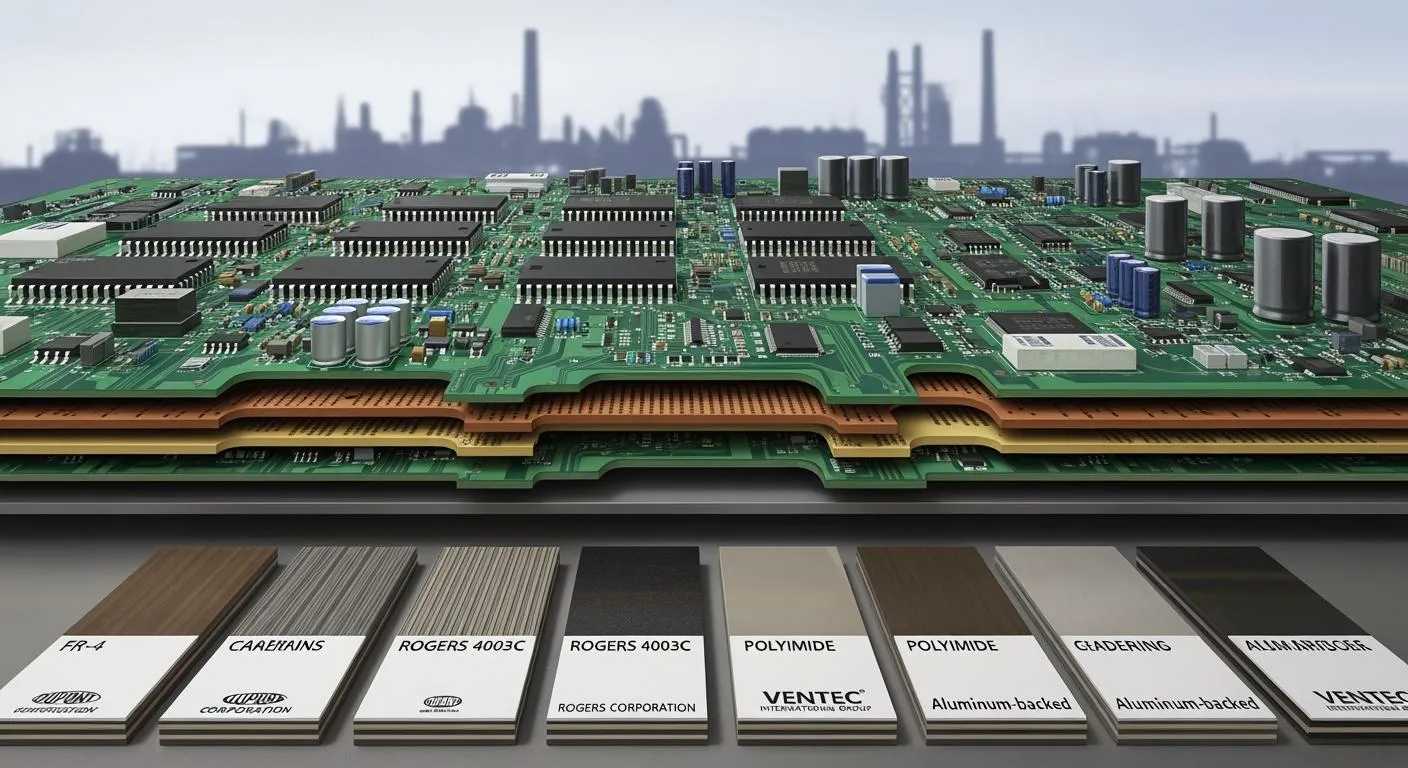
Leading PCB board material manufacturers provide the industry with high-quality materials. These companies include Isola, Rogers, Panasonic, Shengyi, ITEQ, Nan Ya Plastics, Kingboard, Doosan, and Goldenmax.
Common PCB board material types used by PCB board material manufacturers for printed circuit boards include:
FR-4 and glass-reinforced circuit board materials
Polyimide
Ceramic
PTFE
Metal-core
Cellulose-based
The material you choose affects how each PCB works and feels.
Key Takeaways
Picking the right PCB material is very important. It changes how clear signals are, how fast they go, and how long the board lasts.
FR-4 is the most used PCB material. It does not cost much. It is strong and works for many electronics.
Polyimide can bend and does not get damaged by heat. It is good for things that need to bend but not break.
Metal-core PCBs help control heat well. They are needed for strong devices like LED lights and car electronics.
There are also eco-friendly PCB choices. Materials like cellulose break down naturally and work for simple electronics.
Importance of PCB Material Selection
Electrical and Mechanical Impact
Picking the right PCB material is very important. It changes how well the board works. The electrical properties of the material affect signals. They also change how fast signals move. The dielectric constant shows how much energy the board can hold. If the dielectric constant stays the same, signals stay strong. Materials with low dielectric loss are good for fast signals. They help keep signals clear and stop them from getting mixed up. FR-4 is used a lot and has a dielectric constant between 4.4 and 4.8. It works for many things but can lose signals at high speeds. High-frequency laminates help stop signal problems. Polyimide can handle heat well and has different dielectric properties.
The material you pick also changes how strong the board is. The board needs to handle shaking and bumps. Some boards need to bend a lot. Polyimide and PEN are flexible and do not break easily. Strong materials stop cracks and tears. More layers and thicker boards make them stronger.
Tip: The right material keeps signals clear and stops damage to your PCB.
Mechanical Property | Description |
|---|---|
Flexibility and Rigidity | Shows if the PCB can bend or must stay stiff. This matters for boards that move. |
Tensile Strength | Tells how much pulling the board can take before breaking. This is important for tough jobs. |
Layer Count and Thickness | More layers and thicker boards are usually stronger. |
Mechanical Durability | Makes sure the PCB can take hits and last a long time. |
Thermal and Environmental Considerations
The material you use changes how the board handles heat. Good thermal stability means the board works in hot places. Polyimide is great at handling heat. Metal-core materials move heat away from important parts. This keeps the board safe and working.
Materials also need to fight off water and chemicals. Some, like ceramic, protect well in tough places. Boards outside or in factories need strong materials. Picking the right one saves money and makes the board last longer. It also helps the PCB do its job well.
Different Types of PCB Materials and Substrates
FR-4 and Glass-Reinforced Epoxy
FR-4 is the most used pcb material. It is made from glass and epoxy. The glass fabric is woven and covered with epoxy resin. This makes the material strong and a good insulator.
FR-4 is cheap and good for making lots of electronics.
It works well for things like phones and computers.
FR-4 stays strong in heat and lasts a long time.
Glass-reinforced epoxy can have special uses, but FR-4 is best for most products.
Manufacturers use fr-4 for many types of pcbs. It is found in single-sided, multilayer, and rigid pcbs. The copper layer in fr-4 helps with design and picking copper foil.
Note: FR-4 is the main choice for rigid-pcbs because it saves money and works well.
Polyimide and Flexible Substrates
Polyimide is another important pcb material. It is known for being flexible and handling heat. Polyimide can bend without breaking, so it is used in flexible and rigid-flex pcbs.
Material | Thickness Range | Operating Temperature | Key Applications |
|---|---|---|---|
Polyimide | 12.5-125 μm | -55°C to +260°C | Aerospace, automotive, medical |
Polyimide pcbs work in very hot places, up to 260°C. They do not crack when bent or stressed. Flexible pcbs made from polyimide are used in electronics, cars, planes, and medical tools. These materials are tough, resist heat, and work well with electricity.
Polyimide is good at fighting chemicals and bending.
It is used in both flexible and rigid-flex pcbs.
Polyimide is picked when both bending and strength are needed.
Ceramic and High-Frequency Materials
Ceramic is another important pcb material. Ceramic has a dielectric constant from 3 to 10. This is lower than fr-4 and ptfe. It is great for high-frequency and microwave uses.
Material Type | Dielectric Constant | Dielectric Loss Tangent Range |
|---|---|---|
Ceramic PCBs | 3 to 10 | Lower than FR-4 and PTFE |
FR-4 | 4.3 – 4.8 | 0.001 – 0.005 |
PTFE | 2.1 ± 0.04 | 0.0001 – 0.002 |
Ceramic pcbs let signals move the same way in all directions. They also handle heat well and can be made at high temperatures. These features make ceramic good for rf, microwave, 5G, and small devices.
Tip: Ceramic is best for high-frequency circuits where you want very little signal loss.
PTFE (Teflon) and Dielectric Materials
PTFE, or Teflon, is a special pcb material. It is used for high-frequency designs. PTFE has a very low dielectric constant, about 2.1, and a low loss tangent. This means signals move with almost no loss.
Property | PTFE (Teflon PCB) | FR-4 PCB |
|---|---|---|
Typical Dk (1 MHz-10 GHz) | 2.1 ± 0.04 | 4.3 – 4.8 |
Dk Stability vs Frequency | Nearly flat | Slight increase |
Cost | Expensive | Affordable |
Applications | RF, microwave, aerospace | Consumer electronics |
PTFE pcbs stay stable from -200°C to +260°C. They do not get damaged by chemicals or water. PTFE costs more and is harder to make than fr-4. It is used in aerospace, RF, and microwave pcbs.
PTFE has low signal loss, handles heat, and fights chemicals.
It is not as strong as fr-4 and may need extra support in rigid-pcbs.
Metal-Core and Heat Dissipation
Metal-core pcb materials help manage heat. These use a metal base, like aluminum or copper, to move heat away from hot parts. This is important for powerful devices.
IMS pcbs move heat much better than fr-4. The metal core acts as a heat sink and keeps the pcb cool. This is better than fr-4, which often needs extra heat sinks.
Application | Benefits |
|---|---|
LED Lighting | Lowers heat by 20-30°C, making lights last longer. |
Automotive Electronics | Handles heat and shaking, helping cars use less fuel. |
Power Electronics | Keeps things working under high current and heat. |
Industrial Equipment | Manages heat well, so machines do not overheat. |
Consumer Electronics | Makes small, powerful devices safer and last longer. |
Metal-core pcbs are used in LED lights, cars, power tools, and machines. They use copper layers to move heat fast. This makes them a good pick for jobs that need strong heat control.
Cellulose-Based and Composite Materials
Cellulose-based and composite pcbs are good for the environment. They are made from natural fibers and resins that break down. These are a green choice instead of fr-4.
Material Type | Mechanical Properties | Environmental Sustainability |
|---|---|---|
Cellulose PCB Substrate | Flexural strengths up to 100 MPa | Biodegradable, decent electrical insulation (10-15 kV/mm) |
PLA/Flax Composites | Reliable structural performance up to 200 °C | Eco-friendly, flame-retarded |
Cellulose pcbs can break down in water, so they can be recycled. They are used in simple pcbs and some multilayer designs. They cost more than fr-4 and do not work as well with many layers because of water. These materials are best for green projects.
Note: Composite materials like PLA/flax are strong and resist fire, but cost more than fr-4.
Each pcb material has its own strengths. Picking the right one depends on cost, heat, bending, and the environment. Knowing these types helps people choose the best pcb for their needs.
Major PCB Board Material Manufacturers
Isola Group
Isola Group makes materials for pcb boards. They sell laminates and prepregs for making pcbs. Isola’s products work in cars, phones, and factories. Their materials handle heat well and work with electricity.
Rogers Corporation
Rogers Corporation is known for new ideas in pcb materials. They made RO4730G3 laminates with hollow-sphere technology. These laminates are light and stop fire. They use special copper foil and have a dielectric constant of 3.0. RO4730G3 is lighter than PTFE and used in antennas for 4G and 5G. Rogers also made RO4830 Plus for millimeter wave pcbs. These are used in car radar sensors. RO4830 Plus keeps signals strong and does not lose much signal. It works with epoxy/glass and does not have PFAS.
Panasonic Electronic Materials
Panasonic is a big name in pcb materials. They make many types of laminates for fast and high-frequency signals. Panasonic’s materials are used in phones, cars, and machines. Their products are safe and last a long time.
Shengyi Technology
Shengyi Technology is a top supplier for pcbs. They have many products for different needs.
Product Lines | Applications |
|---|---|
CCL | Used in single and double-sided pcbs |
Prepreg | Used in multilayer boards |
Insulation boards | Used in many electronics |
Metal-based CCL | Used in high-end electronics |
Resin-coated copper | Used in home and car electronics |
Coverlay materials | Used in portable electronics |
Shengyi’s materials have global certifications and work in many devices.
ITEQ Corporation
ITEQ Corporation makes pcb materials for the world. They focus on high-frequency and halogen-free laminates. ITEQ’s products are used in phones, cars, and machines. Their materials help signals stay clear and control heat.
Nan Ya Plastics
Nan Ya Plastics is a leader in pcb materials. They make copper-clad laminates and prepregs for pcbs. Nan Ya’s materials are found in computers, phones, and other electronics. Their products are strong and keep electricity safe.
Kingboard
Kingboard is a large pcb material maker in Asia. They make laminates, prepregs, and insulation boards. Kingboard’s materials are used in many electronics. Their products save money and last a long time.
Doosan
Doosan is important in the pcb material market. They make laminates for home electronics and chips. Doosan also makes network boards for phones and computers. Their copper-clad laminates are eco-friendly and do not have halogen. Doosan’s laminates work in advanced electronics with many layers.
Goldenmax
Goldenmax is a growing pcb material company. They make copper-clad laminates and prepregs for pcbs. Goldenmax’s materials are used in computers, cars, and machines. Their products work well and help save money.
PCB Material Selection Guide
Assessing Application Requirements
Picking the right pcb material means knowing what your project needs. Every project is different and has its own needs. Here are some steps to help you figure out what is needed:
See if the pcb will use high voltage. Some materials stop problems like arcing and breaking down.
For radio frequency (RF) designs, choose a material that keeps signal loss small.
If your pcb will be fast, find materials with a low dissipation factor.
Think about how much heat the pcb will get. Materials with good thermal stability work better in hot places.
Check the mechanical strength. Some projects need materials that can bend or take stress.
Look at the process steps, like drilling or soldering, to make sure the material can handle them.
Tip: Always pick a material that fits the electrical, heat, and strength needs of your pcb.
Comparing Material Properties
Once you know what your pcb needs, look at the properties of different materials. Use datasheets to find the important facts. Focus on these main properties:
Dielectric constant and loss tangent for good signals.
Thermal conductivity for moving heat away.
Coefficient of thermal expansion for size changes with heat.
Glass transition temperature for how much heat the material can take.
Property | Description |
|---|---|
Dielectric constant (Dk) | Controls how fast signals move and impedance. |
Dissipation factor (Df) | Shows how much signal is lost. |
Thermal conductivity | Tells how well heat moves through the material. |
Glass transition temperature | Shows how much heat the material can handle. |
CTE | Measures how much the material grows with heat. |
Evaluating Manufacturer Offerings
Not all pcb material makers are the same. Use these things to pick the best one for your project:
Criteria | Description |
|---|---|
Quality Standards and Certifications | Look for ISO 9001 or IPC standards. These show the maker cares about quality. |
Customer Support | Good support helps fix problems fast. |
Location | Local makers may ship faster. Overseas ones might cost less. |
Pricing Structure | Check all costs, not just the price for each pcb. |
Reputation | Read reviews to see if the maker is reliable. |
Note: A good maker will help you pick the right material and support you during the pcb process.
Picking the best pcb material and company is very important. It helps make electronics strong and safe. Big companies like Isola, Rogers, and Panasonic sell materials like FR-4, polyimide, and ceramic. You should think about things like glass transition temperature, dissipation factor, and how strong the material is. Always look at datasheets for more information. The table below explains why these things are important:
Material Property | Importance in PCB Design |
|---|---|
Dielectric Constant (Dk) | Controls signal speed and timing |
Loss Tangent (Df) | Reduces signal loss |
Thermal/Mechanical Traits | Keeps boards safe under stress |
Material Compatibility | Ensures smooth manufacturing |
For the best results, ask experts for help and read technical guides before you decide.
FAQ
What is the most common PCB material?
FR-4 is the most common PCB material. It uses glass fiber and epoxy resin. FR-4 works well for many electronics because it is strong and affordable.
Why do some PCBs use metal cores?
Metal cores help move heat away from important parts. This keeps the PCB cool and safe. Metal-core PCBs work best in LED lights and power devices.
How do I choose the right PCB material?
Check your project’s needs.
Look at heat, strength, and signal speed.
Read datasheets from manufacturers.
Ask experts if you are unsure.
Are eco-friendly PCB materials available?
Yes, some PCBs use cellulose or plant-based materials. These break down more easily and help protect the environment. They work best for simple electronics.