
An RF modulator is a device that transforms baseband signals, such as audio or video, into radio frequency (RF) signals. This process allows the transmission of information over long distances using antennas or cables. You encounter RF modulators in various communication systems, where they play a critical role in delivering content to your devices.
For example, in TV broadcasting, RF modulators convert audio and video signals into RF signals for transmission to home televisions. Cable TV systems use them to distribute multiple channels to subscribers. Even CCTV systems rely on RF modulators to send video signals to monitoring centers. These applications demonstrate how RF modulators ensure seamless communication and entertainment in your daily life.
Key Takeaways
RF modulators change sound and video signals into radio signals.
This helps send signals over long distances easily.
They are important for TV, cable, and security camera systems.
Learning about AM, FM, and PM shows how signals work well.
RF modulators connect old devices with new technology smoothly.
As tech grows, RF modulators will improve for IoT and wireless use.
What is an RF Modulator?

Definition and Function
An RF modulator is a device that converts baseband audio and video signals into radio frequency (RF) signals. This conversion allows the transmission of information over the airwaves or through cables. You might encounter RF modulators in older devices, such as VCRs or gaming consoles, which lack modern input options. By adjusting the frequency, amplitude, and phase of the signals, the modulator ensures compatibility with newer televisions and other receiving devices.
Unlike other signal-processing devices, RF modulators specialize in preparing signals for effective transmission. They play a crucial role in communication systems by enabling the seamless transfer of data over long distances. Whether you’re watching a broadcast on TV or using a satellite communication system, the modulator ensures the signal reaches its destination with minimal interference.
Historical Context and Evolution
The development of RF modulators is deeply rooted in the history of communication technology. Key milestones include:
1887 – Heinrich Hertz demonstrates the existence of radio waves, proving electromagnetic waves can travel through the air.
1895 – Guglielmo Marconi builds the first wireless telegraphy system, using RF waves to transmit signals wirelessly.
1901 – Marconi sends the first wireless message across the Atlantic Ocean, marking a breakthrough in global communication.
1906 – Reginald Fessenden achieves the first long-range radio transmission of voice and music using modulation techniques.
1957 – Sputnik 1 is launched, enabling satellite communications that rely on RF technology.
1973 – The first mobile phone technology emerges, utilizing RF signals for wireless communication.
2003 – The Internet of Things (IoT) begins to take shape, relying heavily on RF for wireless connectivity.
Early RF modulators relied on vacuum tubes for mixing and amplification. These designs were bulky and less efficient. Modern modulators, however, use solid-state components like field-effect transistors (FETs), which improve performance and reduce energy consumption. Advanced filtering techniques and integrated circuits further enhance signal quality, addressing issues like interference that plagued earlier designs.
The evolution of RF modulators reflects the broader advancements in communication technology. From early radio transmissions to modern IoT applications, these devices have consistently adapted to meet the demands of new technologies.
How Does an RF Modulator Work?
Signal Conversion Basics
Baseband Signals vs. RF Signals
To understand how an RF modulator operates, you first need to know the difference between baseband signals and radio frequency signals. Baseband signals are low-frequency signals that carry raw data, such as audio or video, in their original form. These signals cannot travel long distances effectively. On the other hand, RF signals are high-frequency signals that can travel over the air or through cables, making them ideal for broadcasting and communication systems. The modulator bridges this gap by converting baseband signals into RF signals for efficient transmission.
Overview of the Modulation Process
The modulation process involves several key steps to ensure the signal is ready for transmission. Here’s how it works:
Select a suitable baseband signal source, such as a DVD player or gaming console.
Connect the baseband signal to the RF modulator.
Perform modulation using one of three techniques:
Amplitude Modulation (AM): Adjust the amplitude of the carrier signal.
Frequency Modulation (FM): Change the frequency of the carrier signal.
Phase Modulation (PM): Adjust the phase of the carrier signal.
Conduct frequency upconversion to increase the transmission frequency.
Output the modulated RF signal for broadcasting or cable transmission.
This process ensures the signal is robust enough to travel long distances without significant loss or interference.
Types of RF Modulators
Diode Hybrid Modulators
Diode hybrid modulators use diodes to mix baseband signals with a carrier signal. These modulators are simple and cost-effective, making them suitable for basic applications like analog TV broadcasting. However, they may not provide the precision required for advanced communication systems.
Gilbert Cell Modulators
Gilbert cell modulators are more advanced and rely on transistor-based circuits to achieve modulation. They offer higher accuracy and are widely used in modern communication systems, including wireless networks and IoT devices. Their ability to handle complex modulation techniques makes them a preferred choice for professional applications.
Key Components of an RF Modulator
Oscillators
Oscillators generate a local oscillator signal, which serves as the carrier signal for modulation. This signal is phase-shifted and amplified to drive the mixer, ensuring the modulator operates efficiently.
Mixers
Mixers combine the local oscillator signal with the baseband signal to produce a modulated output. This step is crucial for converting the low-frequency baseband signal into a high-frequency RF signal.
Amplifiers
Amplifiers boost the modulated signal to the desired output level. This ensures the signal is strong enough for effective transmission, whether it’s over the airwaves or through cables.
Types of RF Modulation Techniques
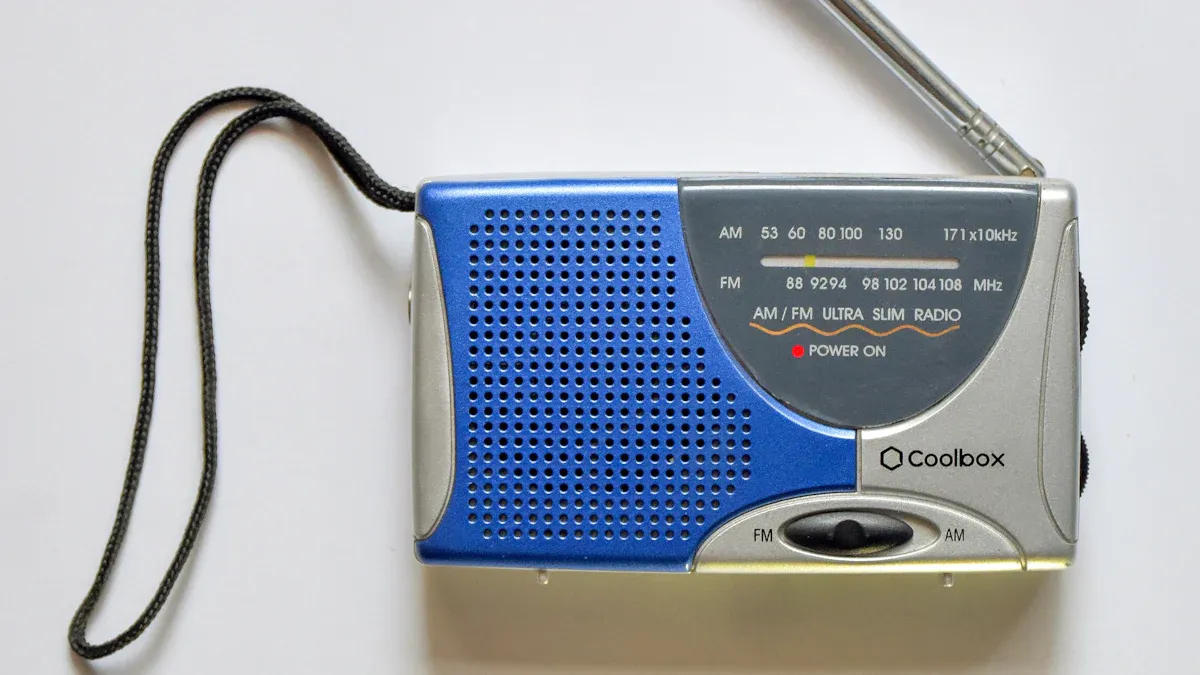
Amplitude Modulation (AM)
Amplitude Modulation (AM) adjusts the amplitude of a carrier signal to encode information. This technique is one of the simplest forms of modulation and has been widely used in communication systems for decades. You can often find AM in applications like radio broadcasting and public address systems.
AM offers several advantages:
Simplicity: The equipment required for AM is straightforward and easy to implement.
Cost-effectiveness: AM transmitters are less expensive to build and maintain.
Compatibility: Many devices can decode AM signals, ensuring accessibility.
Efficiency: AM works well for long-distance transmissions due to its use of lower frequencies.
However, AM also has limitations:
Vulnerability to noise interference: External noise can degrade the quality of AM signals.
Limited bandwidth efficiency: AM requires more frequency spectrum, reducing channel capacity.
Lower resistance to multipath fading: Variations in transmission paths can disrupt the signal.
Despite these drawbacks, AM remains a practical choice for specific applications due to its simplicity and cost benefits.
Frequency Modulation (FM)
Frequency Modulation (FM) modifies the frequency of a carrier signal to transmit information. This method is known for its superior sound quality and resilience to noise. FM is commonly used in music broadcasting and high-fidelity audio systems.
The table below highlights key differences between AM and FM:
Feature | Amplitude Modulation (AM) | Frequency Modulation (FM) |
|---|---|---|
Susceptibility to Noise | High – vulnerable to external noise interference | Low – more resilient to noise |
Bandwidth Efficiency | Limited – requires wider frequency spectrum | Efficient – accommodates more channels |
Sound Quality | Lower – poorer audio clarity | Higher – superior sound quality |
Applications | Broadcasting, two-way communication, air traffic control, public address systems | Music and high-fidelity broadcasting |
FM’s ability to deliver high-quality audio and its resistance to interference make it ideal for modern broadcasting systems.
Phase Modulation (PM)
Phase Modulation (PM) alters the phase angle of a carrier signal based on the input message signal. Unlike AM and FM, PM keeps the amplitude constant, which enhances its noise immunity. This technique is particularly effective in noisy environments, ensuring better signal integrity.
PM is widely used in telecommunications, including mobile networks, satellite communications, and GPS systems. It also requires less power compared to FM for similar performance, making it an energy-efficient choice. By leveraging PM, you can achieve reliable communication in challenging conditions.
Applications of RF Modulators
Broadcasting
Television and Radio Transmission
RF modulators play a vital role in television and radio broadcasting. They convert baseband audio and video signals into radio frequency signals, enabling transmission over the airwaves or through cables. This process ensures that the content reaches your television or radio with minimal interference. For example, when you tune into a TV channel, the modulator has already prepared the signal for seamless delivery to your device. Without modulators, broadcasting systems would struggle to transmit high-quality signals over long distances.
Satellite Communication
In satellite communication, RF modulators are indispensable. They prepare signals for transmission to satellites orbiting the Earth. These satellites then relay the signals back to ground stations or directly to your devices. RF modulators ensure compatibility between the baseband signals and the satellite’s transmission requirements. Their ability to handle high-frequency signals makes them essential for maintaining reliable communication links.
Key functions of RF modulators in satellite communication include:
Converting baseband signals into RF signals for transmission.
Ensuring compatibility with older devices that rely on RF interfaces.
Facilitating connections between modern multimedia devices and older systems.
Consumer Electronics
Use in Older Devices
Older consumer electronics heavily relied on RF modulators to transmit audio and video signals. Devices like VCRs, early video game consoles, and home computers used modulators to connect to televisions. These modulators allowed you to enjoy multimedia content even when your TV lacked modern input options.
Device Type | Examples |
|---|---|
Video Game Consoles | Up to and including the fourth generation |
VCRs | Commonly integrated |
Home Computers | 8- and 16-bit systems |
Integration in Modern Devices
Modern consumer devices still incorporate RF modulators, though their design has evolved. For instance, they allow older technologies like VCRs and retro gaming consoles to transmit signals over RF channels. This feature is especially useful for connecting to televisions without HDMI or composite inputs. Over time, RF modulators have become smaller and more efficient due to advancements in manufacturing processes. These improvements enhance performance while reducing energy consumption.
Emerging Technologies
Role in IoT and Wireless Communication
RF modulators are crucial in the Internet of Things (IoT) and wireless communication. They enable devices to transmit data over radio frequency channels, ensuring seamless connectivity. For example, smart home devices use RF signals to communicate with each other and with your smartphone. The modulator ensures that these signals remain strong and interference-free, even in crowded wireless environments.
Future Trends in RF Modulation
The future of RF modulation technology looks promising. You can expect advancements in modulation schemes that focus on miniaturization and multifunctionality. Manufacturing processes like low-temperature co-fired ceramic (LTCC) will improve consistency and reduce costs. Additionally, Gilbert integrated modulators are likely to replace diode-based modulators in mobile communication due to their superior performance and affordability. These trends will make RF modulators even more efficient and versatile.
RF modulators play a vital role in communication systems by converting baseband signals into RF signals for transmission. This working principle ensures compatibility between older devices and modern systems, preserving their functionality. You encounter their impact in TV broadcasting, cable distribution, and CCTV systems, where they enable seamless signal transmission. As technology evolves, RF modulators remain essential in IoT and wireless communication. Exploring advancements in modulation techniques can help you understand their growing importance in shaping future connectivity.
FAQ
What is the purpose of an RF modulator?
An RF modulator converts baseband signals, like audio or video, into RF signals. This process allows you to transmit data over long distances through cables or airwaves. It ensures compatibility between devices and enables seamless communication in broadcasting and consumer electronics.
Can RF modulators work with modern devices?
Yes, RF modulators can connect older devices, like VCRs or retro gaming consoles, to modern TVs. They bridge the gap by converting signals into RF format, ensuring compatibility even when newer devices lack traditional input options.
What are the main types of RF modulation techniques?
The three main techniques are:
Amplitude Modulation (AM): Adjusts signal amplitude.
Frequency Modulation (FM): Changes signal frequency.
Phase Modulation (PM): Alters signal phase.
Each method suits different applications, such as broadcasting or wireless communication.
Why are RF modulators important in IoT?
RF modulators enable IoT devices to transmit data wirelessly. They ensure strong, interference-free signals, allowing smart devices to communicate effectively. This technology supports seamless connectivity in smart homes, wearable tech, and industrial IoT systems.
How do RF modulators handle interference?
RF modulators use advanced filtering and amplification techniques to minimize interference. These methods ensure the transmitted signal remains clear and strong, even in environments with high noise levels or competing frequencies.
💡 Tip: If you experience poor signal quality, check your RF modulator’s connections and settings for optimal performance.