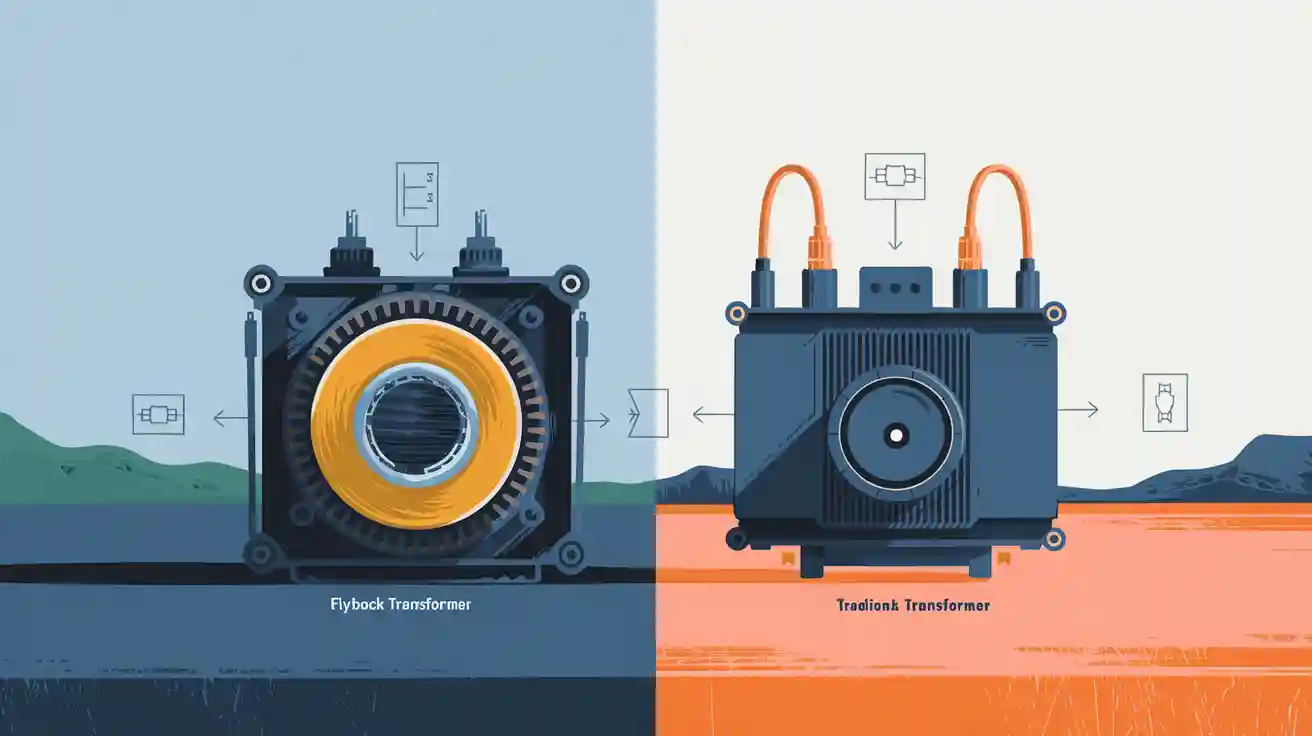
Flyback transformers and traditional transformers do not work the same way. Engineers use a flyback transformer in switching power supplies. It stores energy and lets it out fast. Traditional transformers move energy all the time. Flyback transformers often have a gapped core. This helps them deal with pulsed loads. Many flyback transformer designs give high voltage output for special uses. Picking the right transformer changes how well it works, how safe it is, and how efficient it is.
Operating Principles
Energy Storage
Flyback transformers and traditional transformers do not work the same way. A flyback transformer stores energy in its core’s magnetic field when the switch is on. The energy stays there until the switch turns off. When the switch opens, the transformer sends the stored energy to the output. This helps the flyback converter handle quick bursts of power and give high voltage. Traditional transformers do not store energy like this. They move energy right away from one winding to the other. This difference changes how each transformer controls power and voltage.
Mutual Induction
Both types of transformers use mutual induction. In a traditional transformer, the first winding makes a magnetic field. This field creates voltage in the second winding at the same time. This happens all the time. In a flyback transformer, mutual induction works with energy storage. The transformer stores energy first, then sends it to the second side. This lets the flyback transformer make higher voltage spikes. These spikes help with some power jobs. The flyback converter uses this to work well in small spaces.
Frequency and Output
Frequency is important for how these transformers work. Flyback transformers often use higher frequencies than traditional ones. Higher frequency means the core can be smaller and lighter. A flyback transformer can give positive or negative voltage, depending on how the windings are set up. Traditional transformers usually give AC voltage. Flyback transformers can give DC voltage after rectification. This makes flyback transformers good for modern power systems where size and voltage are important.
Note: Picking the right transformer depends on what voltage, efficiency, and use you need.
Flyback Transformers vs. Traditional

Core Design
Engineers make flyback transformers with a gapped core. The gap helps store energy in the magnetic field. This design lets the transformer handle quick power bursts and high-voltage spikes. The gap also stops the core from getting overloaded. Traditional transformers have a closed core. The closed core moves energy straight from one winding to another. This design gives steady energy and works best for systems needing constant voltage. The way the core is built changes how each transformer controls energy and voltage. Flyback transformers work well in systems needing short, high-voltage bursts. Traditional transformers are better for systems needing steady voltage and nonstop power.
Output Type
Flyback transformers can give both AC and DC output. Most use rectifiers to change the output to DC voltage. This makes flyback transformers good for systems needing high-voltage DC, like TV power supplies or LED drivers. They can also make negative voltage if needed. Traditional transformers usually give AC output. The output voltage depends on the number of turns in the windings. These transformers are good for systems needing AC voltage, like audio amplifiers or power networks. Being able to give high-voltage DC helps flyback transformers in modern electronics.
Tip: When picking a transformer, check if your system needs AC or DC voltage. Flyback transformers are more flexible for high-voltage DC jobs.
Size and Power Density
Flyback transformers are often smaller than traditional transformers. Using higher frequencies lets engineers shrink the core size. Smaller cores make transformers lighter and easier to fit in tight spaces. This is important for portable devices or small power supplies. Flyback transformers can also be very efficient. Traditional transformers are usually bigger and heavier. They work at lower frequencies, so they need a larger core for the same power. These transformers are best for systems needing lots of power and steady voltage for a long time. The size and power density difference decides where each transformer works best.
Feature | Flyback Transformer | Traditional Transformer |
|---|---|---|
Core Type | Gapped | Closed |
Output Type | AC or DC (often high-voltage DC) | AC (sometimes high-voltage AC) |
Size | Small, lightweight | Large, heavy |
Power Density | High | Moderate |
Typical Use | High-voltage, compact systems | Stable, high-power systems |
Flyback transformers are great for high-voltage, small systems. Traditional transformers work best in big, steady power systems.
Applications
Switch-Mode Power Supplies
Switch-mode power supplies use a flyback transformer to change voltage. These power supplies are found in many devices. Engineers pick them because they are small and give high voltage. A flyback converter stores energy and lets it out fast. This helps small devices change power. Switch-mode power supplies must handle high-voltage spikes. The flyback transformer is good for this job. Many electronics, like TVs and chargers, use these power supplies. High-voltage is important for these uses.
Switching Power Supply Role
A switching power supply changes electrical energy into another form. It uses a flyback converter to control voltage and current. This power supply is used in many things. Engineers put it in electronics, machines, and medical devices. The flyback transformer helps make high voltage. It also keeps devices safe and working well. Some systems, like LED drivers and screens, need high voltage. The switching power supply can give AC or DC voltage. This makes it useful for many jobs.
Note: The flyback converter is important for making high voltage in new switching power supply designs.
Other Uses
Transformers are used for more than just power supplies. In cars, engineers use transformers for ignition and charging batteries. Solar inverters need high-voltage conversion. Medical devices need steady voltage and high-voltage isolation. Factories use transformers for motor drives and controls. Electronics need transformers for safe voltage. Each job needs a different transformer. The flyback transformer is best for small, high-voltage devices. Traditional transformers are better for big, steady systems.
Application Area | Example Devices | Voltage Need |
|---|---|---|
Consumer Electronics | TVs, chargers, LED drivers | High-voltage DC |
Industrial | Motor drives, controls | High-voltage AC |
Automotive | Ignition, battery chargers | High-voltage DC |
Renewable Energy | Solar inverters | High-voltage DC |
Medical Devices | Imaging, monitors | Stable voltage |
Switch-mode power supplies and switching power supply designs need the right transformer for safe and good power conversion. Making high voltage is still very important in many new devices.
Advantages and Disadvantages
Benefits
Flyback transformers and traditional transformers both have special benefits. Flyback transformers are good for switching power supply use. They can handle high voltage and keep input and output apart. Engineers pick flyback transformers for small devices. These transformers save space and are not heavy. Flyback transformers can give different types of output. They can make both positive and negative voltage. This helps them work in many new electronic devices.
Traditional transformers give steady power. They are best for systems that need the same voltage all the time. These transformers are simple and last a long time. Big machines and power grids use traditional transformers a lot. Their strong build lets them handle heavy loads.
Limitations
All transformers have some limits. Flyback transformers can make high voltage spikes. These spikes can hurt other parts in the circuit. Flyback transformers might not be as efficient with high power. Engineers must design them well to stop overheating. Sometimes, flyback transformers do not control voltage very well.
Traditional transformers are big and heavy. They do not fit in small devices. These transformers work at lower frequencies. This means they need bigger cores, so they get even bigger. Traditional transformers cannot easily give DC output for switching power supply use.
Note: Each transformer type is good for different jobs. Engineers must look at the good and bad points before picking one.
Selection Tips
When picking a transformer, engineers should think about these questions:
Does the system need AC or DC voltage?
How much space is there for the transformer?
Will the transformer be used in a switching power supply?
How much voltage control is needed?
What kind of devices will use the transformer?
A table can help compare the choices:
Factor | Flyback Transformer | Traditional Transformer |
|---|---|---|
Size | Small | Large |
Output | AC/DC | AC |
Best Use | Compact devices, switching power supply | Large machines, power grids |
Picking the right transformer makes devices safer, more efficient, and work better.
Failure and Reliability
Overheating
Overheating is a big reason why transformers stop working. Both flyback transformers and traditional transformers can get too hot. If a transformer works at high voltage for a long time, it heats up. The core and windings get very warm. Too much heat can ruin the insulation and make the core weak. If cooling does not work, the temperature goes up fast. Engineers use fans or heat sinks to cool transformers down. Overheating can cause short circuits or even start a fire. High voltage makes overheating worse, especially in small flyback transformers. Good design helps stop this problem from happening.
Voltage Stress
Voltage stress is another main cause of transformer failure. Flyback transformers often deal with sharp voltage spikes. These spikes can hurt the insulation and cause arcing between windings. Traditional transformers also have voltage stress, but usually not as much. High voltage can break the insulation layer. If the insulation breaks, the transformer may stop working or become unsafe. Engineers test transformers for voltage stress before using them. They use thicker insulation and special materials for high voltage. If voltage stress is too high, the transformer can fail quickly.
Tip: Always check the voltage rating before using a transformer in a new circuit.
Aging and Design
Transformers get older over time. Heat, high voltage, and bad design make them age faster. Old insulation can crack and lose strength. High voltage makes this problem worse. Engineers look for signs of aging, like strange noises or lower output. Regular checks help find problems early. Good design slows down aging and lowers the chance of failure. Using the right materials and planning for voltage stress keeps transformers safe. If engineers ignore aging or use bad design, the transformer is more likely to fail.
Cause of Failure | Effect on Transformer |
|---|---|
Overheating | Insulation breakdown, fire |
Voltage Stress | Arcing, short circuit |
Aging | Lower output, noise, failure |
A flyback transformer is good for small devices with high voltage. Traditional transformers are better for big systems that need steady power. Engineers must check what voltage type the system needs. They also look at the size and safety for their use. Efficiency and reliability are important to think about too. New designs use smaller parts and work at higher frequencies. Power electronics will keep changing as technology gets better.
FAQ
What makes a flyback transformer different from a traditional transformer?
A flyback transformer keeps energy in its core. It lets the energy out fast. A traditional transformer moves energy straight between windings. This difference changes how each works in electronics.
Where do engineers use flyback transformers most often?
Engineers put flyback transformers in switch-mode power supplies. They also use them in LED drivers and chargers. These transformers fit well in small devices needing high-voltage DC.
Can a traditional transformer create DC voltage?
A traditional transformer gives AC voltage. To get DC voltage, engineers add a rectifier after it. This setup works best in big systems needing steady power.
How do engineers prevent transformer overheating?
Engineers use heat sinks and fans to cool transformers. They check the temperature often. They pick materials that handle heat well. Good cooling helps transformers last longer.
Tip: Always check the transformer’s voltage and power ratings before using it in a new device.