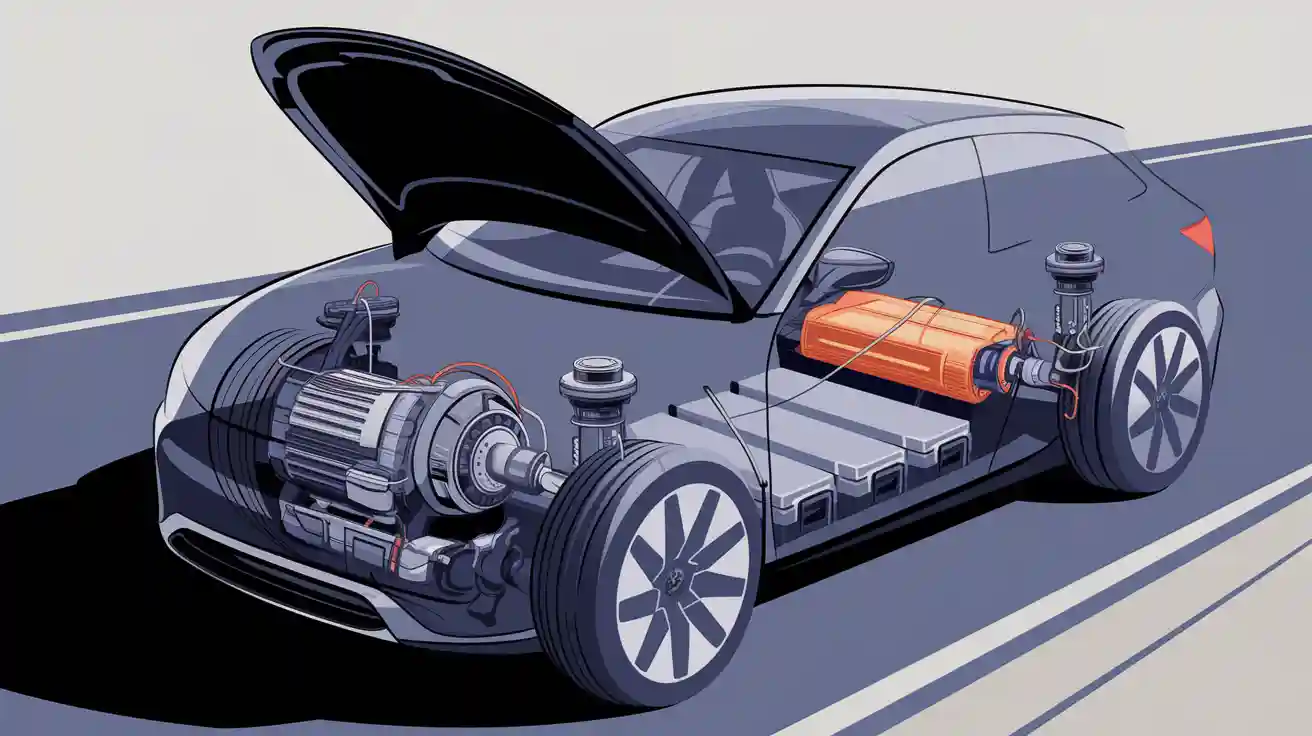
An electric motor in electric vehicles changes battery energy into movement. This lets cars drive without making pollution. Drivers see better efficiency and smoother rides when they start their cars. The electrical drive system controls how the electric motor gets power. This helps the car use energy well at different speeds. For example, when a car speeds up fast or goes up a hill, the electrical drive system helps the electric motor use battery energy smartly. Electric vehicles need these systems for good efficiency and strong performance.
Electric Motor and Drive System Basics
What Is an Electric Motor?
An electric motor in electric vehicles changes battery power into movement. It uses electromagnetic ideas to spin and turn the wheels. Engineers make electric motors work well, so cars can go farther on one charge. The electric motor is quiet and gives quick power, which helps cars speed up fast. Most electric vehicles have motors that do not need much fixing and last a long time.
Electric motors are important for making electric vehicles work well. They use battery power in a smart way, so they are needed for today’s cars.
What Is an Electrical Drive System?
The electrical drive system controls how the electric motor gets power from the battery. This system has parts like inverters, controllers, and power electronics. The electrical drive system changes the speed and power of the electric motor for different driving needs. It helps electric vehicles save energy when speeding up, driving, or stopping.
Key functions of the electrical drive system:
Controls how power moves from the battery to the electric motor.
Helps save energy in different ways of driving.
Makes the car work better by changing motor power.
Helps get energy back when braking.
The electrical drive system helps electric vehicles use less energy and be better for the planet. By controlling how the battery gives power, it helps cars make less pollution and waste less energy. Electric vehicles need both the electric motor and the electrical drive system to work well, go fast, and keep the air clean.
Key Components in Electric Vehicles
Battery Pack
The battery pack holds energy for electric vehicles. Engineers make each battery pack give strong power. The battery sends energy to the electric motors using the drive unit. Most battery packs use lithium-ion cells because they store lots of energy in small spaces. The battery pack also helps with regenerative braking by saving energy when the car slows down. A good battery pack lets electric vehicles go farther and work better.
Electric Motors
Electric motors change energy from the battery into movement. These motors are inside the drive unit and link to the wheels. Electric motors give instant torque, so electric vehicles speed up fast. Many electric vehicles have more than one electric motor for better control and efficiency. How electric motors are made affects how smooth and quiet the ride is.
Power Electronics and Inverter
The power electronics module controls how electricity moves between the battery and the electric motors. The inverter turns direct current (DC) from the battery into alternating current (AC) for the motors. This lets electric vehicles change speed and power for different driving needs.
Boost Converter
A boost converter raises the voltage from the battery to help the electric motors. This device helps the drive unit give strong performance, especially when speeding up or going up hills.
On-Board Charger
The on-board charger lets electric vehicles recharge the battery pack from outside power sources. It controls how much electricity goes into the battery and keeps it safe from harm.
Controller
The controller is like the brain of the drive unit. It chooses how much power the electric motors need based on what the driver does and the road. The controller also helps with regenerative braking to save energy.
Transmission
Some electric vehicles use a simple transmission to move power from the electric motors to the wheels. Most systems have fewer gears than regular cars, which makes them work better.
Regenerative Braking
Regenerative braking saves energy when the vehicle slows down. The system sends this energy back to the battery pack. Regenerative braking helps electric vehicles use less energy and go farther.
Cooling System
The cooling system keeps the battery pack, electric motors, and power electronics module at safe temperatures. Good cooling stops overheating and helps electric vehicles work well in all kinds of weather.
Types of Electric Motors in EVs
Electric vehicles use different electric motors for power and reliability. Each motor type works best for certain driving needs. Engineers pick the right motor for the car’s design and cost. They also think about how well the motor performs.
DC Motors
DC motors are one of the oldest used in electric vehicles. These motors use direct current from the battery to spin. Engineers like DC motors because they are simple and easy to control. But DC motors need regular fixing because of brushes and commutators.
DC motors give strong torque at low speeds. Early electric vehicles used DC motors before new types became popular.
Advantages of DC Motors:
Simple build
Easy speed control
Good for slow driving
Disadvantages:
Brushes wear out over time
Not as efficient as newer motors
Induction Motors
Induction motors are used in many modern electric vehicles. These motors use alternating current and do not need brushes. Engineers like induction motors because they last long and need little fixing. Induction motors work well and are efficient at different speeds.
Feature | Induction Motors |
|---|---|
Maintenance | Low |
Efficiency | High |
Cost | Moderate |
Application | Passenger cars, buses |
Induction motors are good for cars that need to work well for a long time. Tesla uses induction motors in some of its cars because they are reliable.
Synchronous Motors
Synchronous motors have a magnetic field that spins with the rotor. These motors use permanent magnets or windings to make the field. Engineers choose synchronous motors because they are efficient and easy to control.
Synchronous motors work well in cars that need smooth acceleration and exact speed control.
Key Features:
High efficiency
Exact speed control
Used in advanced electric vehicles
Permanent magnet synchronous motors are a common type. They use strong magnets to save energy and work better.
Brushless DC Motors (BLDC)
Brushless DC motors are popular in electric vehicles because they do not use brushes. These motors use electronic controllers for speed and torque. Engineers like BLDC motors because they are quiet and last a long time.
BLDC motors give instant torque.
They need less fixing than brushed motors.
Many electric vehicles use BLDC motors for smooth driving.
Switched Reluctance Motors
Switched reluctance motors have a special design that uses magnetic reluctance. These motors do not use magnets or brushes. Engineers pick switched reluctance motors because they are tough and work in hard conditions.
Switched reluctance motors are good for cars that need to last and work well.
Benefits:
Simple and strong build
Can work in high heat
Lower cost for some uses
Stepper Motors
Stepper motors move in small steps, not in a smooth spin. Engineers use stepper motors in electric vehicles for exact control of things like power steering or battery systems. Stepper motors do not drive the main wheels but help with other car parts.
Applications in Electric Vehicles:
Battery cooling fans
Power window systems
Instrument clusters
Electric vehicles use different motors for different jobs. Engineers match the right motor to the car’s needs. They balance cost, efficiency, and how well the motor works.
How Electric Motors Work
Operating Principles
Electric motors in electric vehicles use electromagnetic forces to make things move. When electricity goes through wires inside the motor, it creates a magnetic field. This field pushes against magnets or other coils in the motor. The push makes the shaft spin. The spinning shaft connects to the wheels. This moves the car forward.
Engineers build electric motors to work with high efficiency. They use strong magnets and special wire windings. These parts help the motor turn more battery energy into movement. Less energy is lost as heat. High efficiency lets electric vehicles go farther on one charge.
Most electric vehicles use alternating current motors. The inverter changes the battery’s direct current into alternating current. The controller sends signals to the inverter. These signals control how fast and which way the motor spins. The system can also work backward. When the car slows down, the motor acts like a generator. It sends energy back to the battery. This is called regenerative braking.
Note: High efficiency in electric motors helps electric vehicles save energy and cut waste. This makes them better for the planet.
Performance Comparison
Different electric motors give different efficiency and performance. Engineers compare motors to pick the best one for each car.
Motor Type | Efficiency | High Efficiency | Performance Level | Typical Use in EVs |
|---|---|---|---|---|
DC Motor | Moderate | No | Good torque | Older or low-cost models |
Induction Motor | High | Yes | Strong, reliable | Many modern EVs |
Synchronous Motor | Very High | Yes | Smooth, precise | Premium and advanced EVs |
Brushless DC Motor (BLDC) | High | Yes | Quiet, fast | Most new electric vehicles |
Switched Reluctance Motor | Moderate-High | Sometimes | Durable | Special applications |
Electric vehicles with synchronous motors or BLDC motors often have the highest efficiency. These motors use less energy and give smooth acceleration. Induction motors also give strong performance and last a long time. DC motors cost less but need more fixing and do not reach high efficiency.
Engineers look at what each car needs. For city driving, they may pick motors with quick response and high efficiency. For heavy cars, they may choose motors that give strong torque and can handle tough jobs.
Tip: Picking the right electric motor helps electric vehicles get the best mix of efficiency, performance, and cost.
Advantages and Disadvantages
Pros of Electric Motors in EVs
Electric motors give electric vehicles many good things. They make rides quiet and smooth for drivers. These motors react fast when you press the pedal. Electric vehicles use energy better because electric motors are efficient. Less energy is lost as heat.
Electric motors need less fixing than gas car engines.
They help electric vehicles make no tailpipe pollution.
High efficiency lets electric vehicles go farther per charge.
Regenerative braking saves energy and helps efficiency.
Note: Electric motors make electric vehicles greener and simpler to own.
Cons of Electric Motors in EVs
Electric motors also have some problems. They need battery packs, which are heavy and cost a lot. Charging takes more time than filling up with gas. Some electric vehicles lose efficiency in very hot or cold weather.
Disadvantage | Impact on Electric Vehicles |
|---|---|
Battery weight | Makes cars go less far |
Charging time | Takes longer than gas fill-ups |
Efficiency loss in extremes | Lower range in hot or cold |
Limited repair options | Not many trained repair people |
Some electric motors do not work well if batteries get too hot or cold. Owners may also have trouble finding shops to fix electric vehicles.
Electronic Design and Manufacturing of Motor Controllers for Electric Vehicles
Innovative Motor Controller Design
Engineers make motor controllers that control how motors get power. They use new software and hardware to help controllers work fast and safe. Designers try to make controllers small, light, and strong. They put in smart sensors and ways to watch the controller in real time. These things help motors react quickly when drivers do something. Teams test new controllers in labs before putting them in cars.
Tip: Smart motor controllers help cars speed up and save energy.
Manufacturing Process and Quality Standards
Motor controllers are made in very clean factories. Machines put tiny parts on the circuit boards. Each controller is checked many times to find any problems. Quality teams follow strict rules to make sure controllers work well. They use world rules like ISO 9001 to help their work. Companies keep track of each controller from start to finish.
Step | Description |
|---|---|
Assembly | Machines put parts on boards |
Inspection | Workers look for problems |
Testing | Controllers run in test systems |
Certification | Products meet safety rules |
Overcoming Technical Challenges
Teams have many problems when making motor controllers. Heat can hurt parts, so engineers make cooling systems. Electrical noise can cause mistakes, so designers add filters. Controllers must work in rain, dust, and very hot or cold weather. Engineers test controllers in hard places to make sure they last. They update software to fix problems and make controllers better.
Note: Fixing these problems helps controllers last longer and stay safe.
Representative Projects and Industry Applications
Companies have made motor controllers for many kinds of vehicles. Some controllers are used in city buses, and others are in delivery trucks. Engineers made special controllers for race cars that need to react fast. Industry leaders share what they learn from real projects to show how their controllers work. These projects help make better designs and set new rules.
Trends in Electrical Drive Systems
New Materials and Technologies
Engineers use new materials to make the drive unit better. They pick metals that are light and strong composites. These materials help make the drive unit weigh less. Lighter drive units help cars use less energy. Some teams use special magnets and copper windings. These changes help the drive unit give more power and make less heat.
Note: New materials help the drive unit last longer and work well in hard places.
Advanced Cooling
Modern drive units need good cooling systems. High heat can hurt parts and lower efficiency. Engineers design liquid cooling and heat sinks for the drive unit. These systems keep the motor and other parts cool. Good cooling helps the drive unit work well when driving fast or carrying heavy things.
Liquid cooling takes away heat fast.
Heat sinks move heat away from important parts.
Sensors check temperature to keep things safe.
Integrated Drive Units
Many companies put the motor, inverter, and gearbox together in one drive unit. This saves space and makes the drive unit lighter. Integrated drive units help cars use less energy by stopping energy loss. Fewer connections mean fewer problems. The drive unit is easier to put in and fix.
Benefit | Impact on Drive Unit |
|---|---|
Compact design | Saves space |
Fewer parts | Makes it work better |
Better efficiency | Uses less energy |
Power Electronics (SiC, GaN)
Power electronics help the drive unit work better. Silicon carbide (SiC) and gallium nitride (GaN) parts switch power faster than old ones. These materials help the drive unit stay cool and use energy well. SiC and GaN parts let the drive unit handle more power in a small space. This helps cars charge faster and perform better.
Tip: SiC and GaN help the drive unit get smarter and work better for new cars.
Market Outlook for Electric Vehicles
Dominant Technologies
Big companies keep making electric drive systems better. Tesla, BYD, and Volkswagen spend money on new motor designs. They also work on better power electronics. Most new cars use permanent magnet synchronous motors or induction motors. These motors work well and give strong power. Silicon carbide and gallium nitride power electronics help cars charge quickly and go farther. Automakers use integrated drive units to save space and make cars lighter.
Note: Using new materials and small designs helps cars work better and last longer.
Innovations and Future Trends
Engineers find new ways to make drive systems better. Solid-state batteries can help cars go farther and charge faster. Smart controllers use artificial intelligence to change power for different roads. Wireless charging and bidirectional charging let cars share energy with homes or the grid. Companies test light materials and cooling systems to make cars safer and more efficient.
Innovation | Benefit for Vehicle |
|---|---|
Solid-state battery | Longer range |
AI motor controller | Smarter power use |
Wireless charging | Easier charging |
Bidirectional energy | Power sharing |
Matching Systems to Vehicle Needs
Engineers pick drive systems based on what each car does. Small city cars need motors that save energy and fit in small spaces. Delivery vans need strong torque and good cooling. Buses and trucks use big motors and smart controllers for heavy loads. Sports cars need fast speed and exact control. The right motor and drive system help each car do its job well.
Tip: Picking the best drive system helps each car work better and gives drivers a good experience.
Electric motors and drive systems change how cars move. These systems help cars use energy better. Drivers get smoother rides because of them. Engineers work to make these systems stronger. They want cars to go farther and have more power.
Learning about new technology helps people know what is coming. Future cars will have new ideas and be cleaner for the planet.
FAQ
What is the main job of an electric motor in an EV?
An electric motor uses battery energy to make the car move. It spins the wheels so the car can go forward. This helps the car speed up fast and drive smoothly.
How does regenerative braking help electric vehicles?
Regenerative braking saves energy when the car slows down. The system sends this saved energy back to the battery. This helps the car go farther and use energy better.
Why do electric vehicles use different types of motors?
Engineers pick motors based on what the car needs. Some motors give strong power for heavy things. Others work well for city driving and save energy. The right motor helps the car work better.
What role does the inverter play in an electric vehicle?
The inverter changes battery power from DC to AC for the motor. This lets the motor run at different speeds and power levels.
Are electric drive systems hard to maintain?
Electric drive systems are easier to care for than gas engines. They have fewer parts that move and do not need oil changes. Owners mostly check the cooling system and update the software.