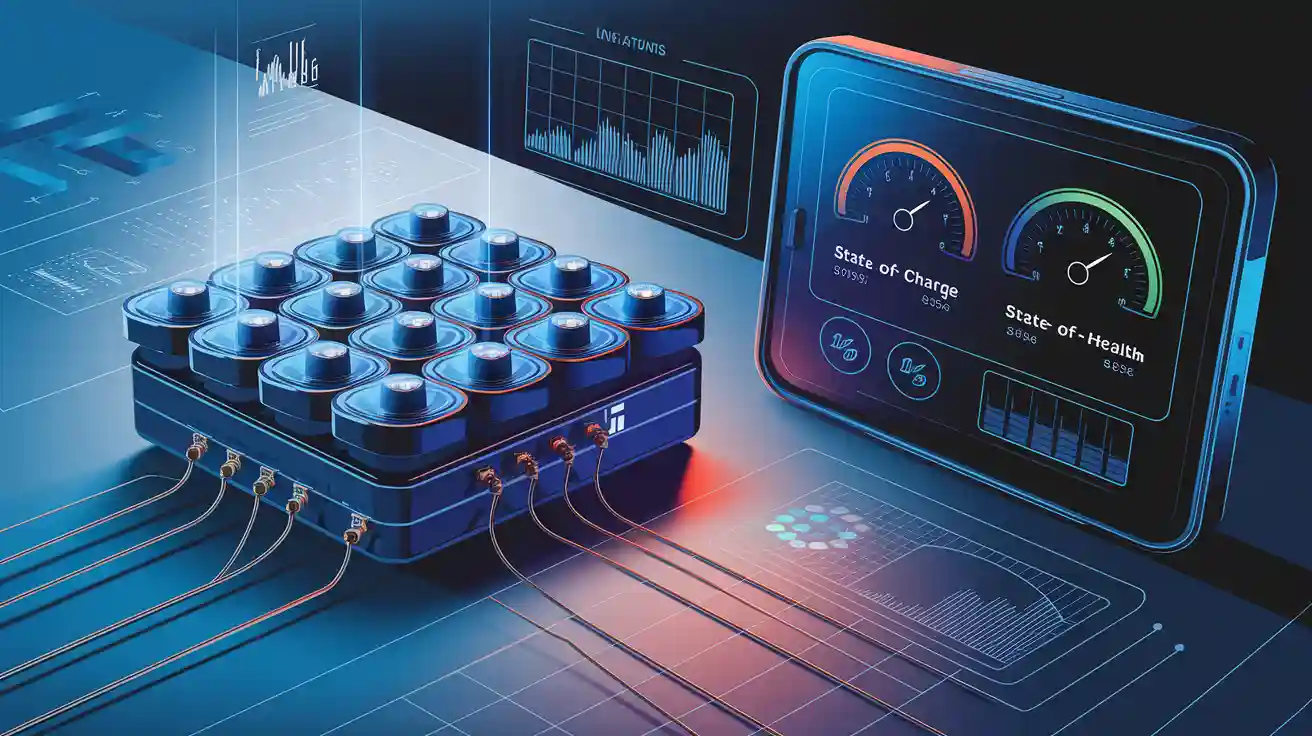
A battery management system finds out the state of charge and state of health in lithium-ion batteries by using indirect estimation techniques. It cannot measure these things directly because the battery has complex reactions inside. So, the system uses methods like statistical feature extraction, Coulomb counting, and advanced data-driven models. For example, it looks at statistical metrics like variance, mean, and skewness from voltage and current curves to watch for battery degradation. Using indirect estimation methods, like machine learning and observer-based approaches, helps make soc estimation more accurate and safe. These soc estimation methods help the battery management system predict changes in lithium-ion batteries. They also help manage capacity loss, aging, and risks better. Good state of charge estimation and state of health estimation help every lithium-ion battery work better and last longer.
Accurate soc estimation in lithium-ion battery systems keeps the battery safe from overcharging, overheating, and sudden failures. This makes strong estimation techniques very important for modern battery management systems.
Statistical Metric | Description | Correlation with Battery Degradation |
|---|---|---|
Variance | Checks how steady voltage/current changes are | Higher variance means uneven inside resistance and chemical reactions, and electrode damage |
Maximum Value | Highest voltage/current during charging or discharging | Lower numbers show less load capacity and possible safety problems like overcharging or overheating |
Minimum Value | Lowest voltage/current during charging or discharging | Shows capacity loss and safety problems |
Mean (Average) | Average voltage/current during a cycle | Changes show electrolyte breakdown and less energy output |
Skewness | How uneven the voltage/current is spread | Used in feature extraction to predict SOH |
Excess Kurtosis | How sharp the voltage/current peak is | Higher numbers mean more polarization and less lithium insertion ability |
Key Takeaways
Battery management systems cannot measure charge or health directly. They use indirect ways like statistical analysis, Coulomb counting, and machine learning. These methods help estimate battery charge and health.
Knowing the state-of-charge helps keep batteries safe. It stops overcharging, overheating, and sudden problems.
There are different ways to check batteries. Open Circuit Voltage, Coulomb Counting, Kalman Filtering, and AI-based models are some methods. Each one has good points and bad points. Using them together makes results better and more reliable.
State-of-health estimation checks how old a battery is. It looks at capacity loss and internal resistance. This helps guess battery life and avoid safety problems.
Hybrid approaches mix model-based and data-driven methods. These give the best results. They can change with real-world use. This helps batteries last longer and work better.
Battery Management System Basics

Key Functions
A battery management system is very important for lithium-ion batteries. It helps keep lithium-ion batteries safe and working well. The system checks each lithium-ion battery cell for voltage, current, and temperature. It also makes sure all lithium-ion battery cells charge and discharge evenly. This helps each lithium-ion battery last longer and work better.
The battery management system watches the state of charge and state of health for each lithium-ion battery. It uses these numbers to stop overcharging and deep discharging, which can hurt lithium-ion batteries.
Safety comes first. The system will disconnect the lithium-ion battery if it finds problems like overheating or short circuits. It can use backup cells or packs to keep things working.
Communication matters. The battery management system uses SPI and CAN bus to send data to other parts of the device or vehicle.
There are different types, like centralized or distributed, so the battery management system can fit many lithium-ion battery designs.
Some systems have extra features like remote monitoring, lifecycle prediction, and fault detection. These use cloud computing and machine learning to help the battery work better and safer.
Key Function / Algorithm | Description |
|---|---|
Cell Monitoring | Watches voltage, current, and temperature of each lithium-ion battery cell. Finds problems and starts safety actions. Figures out state of charge and state of health. |
Power Optimization | Controls charging and discharging to keep lithium-ion battery cells safe. Works with other systems to use power in a smart way. |
Safety Assurance | Stops dangers like thermal runaway. Uses backup plans and keeps people safe from electric shock. |
Battery Charging Optimization | Changes charging to lower stress on each lithium-ion battery cell. Saves fault codes for later checks. |
Cell Balancing Algorithm | Makes sure all lithium-ion battery cells have the same voltage. Uses active or passive balancing to help the battery work better. |
Communication Algorithms | Sends data between the battery management system and other devices. Stops charging if it finds unsafe conditions. |
Tip: Using ready-made software and hardware tools can help engineers build and test a battery management system for lithium-ion batteries faster.
Supported Chemistries
A battery management system needs to work with many lithium-ion battery chemistries. Each chemistry, like NMC, LFP, and NCA, has its own good and bad points. For example, NMC lithium-ion batteries have high energy density. LFP lithium-ion batteries last longer and handle heat better. The battery management system changes how it works to fit each lithium-ion battery chemistry.
Recent studies look at how different lithium-ion battery chemistries work in electric vehicles. These studies show that battery management systems must handle changes in energy density, cost, and cycle life. They also show that thermal management and advanced state estimation are important for each lithium-ion battery type. Machine learning models can help predict state of health for lithium-ion batteries by using filtered data. This lowers mistakes and helps the battery management system deal with the way each lithium-ion battery chemistry ages.
A flexible battery management system can work with many lithium-ion battery chemistries. This helps every application, from electric vehicles to portable electronics, get the best battery performance and safety.
State of Charge in Lithium-Ion Batteries
The state of charge is very important for lithium-ion batteries. It helps keep the battery safe and working well. If the state of charge is not right, the battery can get too hot or lose power. This can make the battery break or even cause dangerous problems like fires. In electric cars, knowing the state of charge helps with braking and charging. It also makes the battery last longer. Studies show that good state of charge estimation lowers mistakes and helps the environment.
You cannot measure the state of charge directly in a lithium-ion battery. The chemical reactions inside are hidden and hard to see. Sensors can be wrong because of noise and changes in the battery. So, battery management systems use special ways to guess the state of charge. They look at voltage, current, and temperature to figure it out. These methods help deal with sensor problems and battery aging.
OCV Method
The Open Circuit Voltage method guesses the state of charge by checking the battery voltage after it rests. Each battery chemistry has its own voltage and state of charge link. This method is simple and does not cost much. It works well for the first state of charge check and does not need a big battery model.
Aspect | Details |
|---|---|
Principle | The battery voltage is measured after resting. The OCV and state of charge link is found by testing each battery type. |
Benefits | 1. Simple process |
Limitations | 1. Needs a long rest time (over 2 hours if cold) |
The OCV method cannot check state of charge while the battery is working. Lithium-ion batteries often change quickly, so waiting for the battery to rest is not useful. Flat spots in the OCV curve make it easy to get big mistakes from small voltage changes.
Coulomb Counting
Coulomb Counting, or Ah counting, guesses the state of charge by adding up the current going in and out. It starts with a first state of charge number and changes it as current moves.
Evaluation Aspect | Details |
|---|---|
Method | Improved Coulomb Counting algorithm |
Validation Approach | MATLAB test compared with real state of charge from charging/discharging curves |
Max Error (End of Charging) | About 3.5% |
Error During CC Stage | Less than 2% |
Error During CV Stage | Less than 1% |
Error Trend | Gets bigger over time before state of health check |
Important Factors | Good first state of charge and charging checks lower mistakes |
Advantages | Simple math; good enough accuracy; no extra battery data needed |
Constraints | Mistakes add up over time; needs good first state of charge and state of health numbers |
Coulomb Counting is easy to use and does not need extra battery data. But mistakes can add up over time. Small errors in current or first state of charge can get worse. This method works best with regular checks or other ways to help.
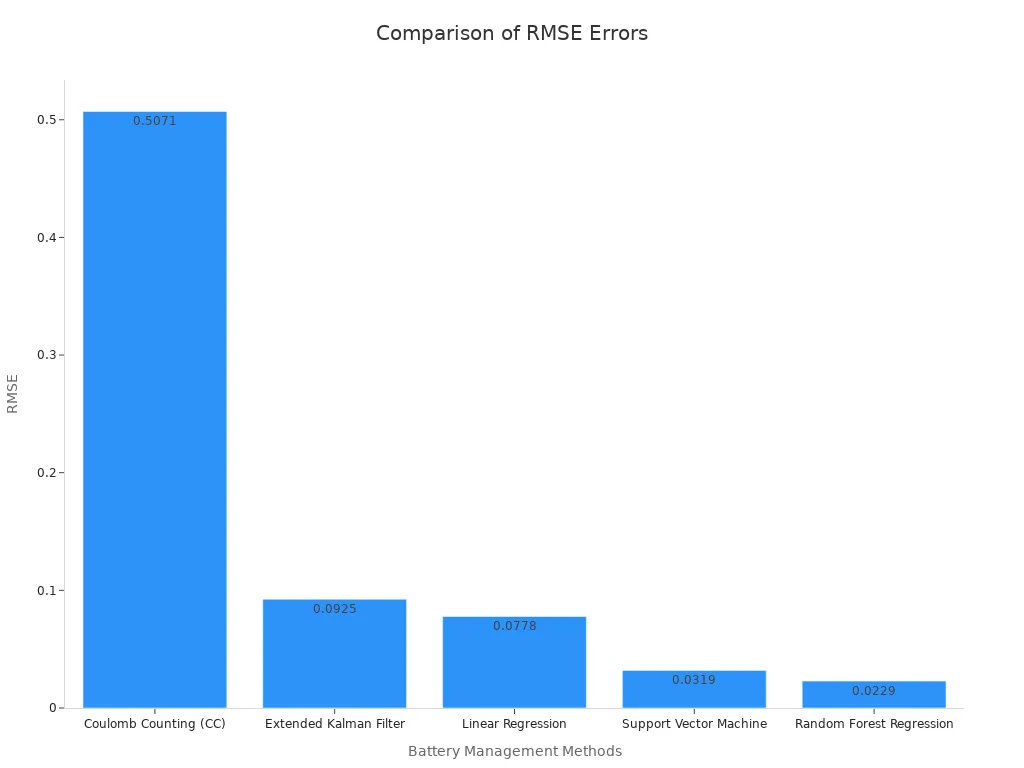
Method | RMSE | MSE | MAE | Key Findings |
|---|---|---|---|---|
Coulomb Counting (CC) | 0.5071 | 0.2572 | 0.4571 | Highest mistakes because of sensor noise and errors; not good for long-term use |
Extended Kalman Filter | 0.0925 | N/A | N/A | Better accuracy with model help; needs a good battery model |
Linear Regression | 0.0778 | N/A | N/A | Better than EKF but not perfect for state of charge changes |
Support Vector Machine | 0.0319 | N/A | N/A | Handles changes better; needs more computer power |
Random Forest Regression | 0.0229 | 0.0005 | 0.0139 | Best accuracy; works well with noise and changes; good for real battery management |
Kalman Filtering
Kalman Filtering uses math models to guess the state of charge. The extended Kalman filter and unscented Kalman filter are popular. These filters mix real-time data with battery model guesses. They fix their guesses as new data comes in.
Kalman filtering methods like EKF, UKF, adaptive Kalman filters, and dual Kalman filters are used a lot.
These filters use simple battery models and more complex ones to get better results.
Tests show Kalman filters handle changes, battery memory, and sensor noise well.
Changing settings and using neural networks make them even better.
Updating numbers again and again helps fix mistakes from model changes and sensor drift.
Studies show adaptive and dual Kalman filters do better than regular EKF for state of charge.
Kalman Filtering gives good, real-time state of charge guesses for lithium-ion batteries. It needs careful setup and a good battery model. It can be hard to use, but it works well when things change fast.
Hybrid and AI Methods
Hybrid and AI methods mix model-based and data-based ways to guess state of charge. These use machine learning, like neural networks, support vector machines, and random forest regression. They learn from voltage, current, and temperature data. Hybrid methods fix problems that single methods cannot.
Aspect | Description |
|---|---|
Method | Hybrid state of charge guess using Coulomb Counting and Relevance Vector Machine (movIRVM-Coulomb) |
Dataset | Single battery cell data, battery pack test data, Advisor simulation data |
Conditions | Tests with US06, UDDS, NYCC, 1015 drive cycles; temperatures 0°C, 25°C, 45°C; first state of charge 50%, 80% |
Accuracy (RMSE) | Within 2% for many tests and temperatures |
Improvement | Over 30% better than movIRVM alone; fewer mistakes over time |
Key Constraint Addressed | Fixes mistake build-up in pure Coulomb Counting |
Additional Notes | Uses moving average to cut noise; only needs 10-30% training data for RVM part |
Hybrid methods mix data and models to handle weird battery actions.
Data-based methods include neural networks, support vector machines, Gaussian process regression, wavelet neural networks, and fuzzy logic.
These ways guess state of charge from signals you can measure.
Problems include battery differences, strange use, and battery wear.
Now, researchers like data-based methods because models alone cannot fix all problems.
New studies using deep learning and real car data show hybrid and AI methods can guess state of charge with less than 2% error. These ways are very accurate and work well, even when things change a lot.
Note: Statistical methods help state of charge guessing by fixing uncertainty, sensor mistakes, and random noise. Calibration, regression, and testing make all state of charge methods more reliable.
State of Health Estimation Methods
State of health, or SOH, tells us how much a lithium-ion battery has aged. It compares the battery now to when it was new. SOH is found by looking at the current capacity and comparing it to the original capacity. It can also be checked by comparing the inside resistance to a new cell. When SOH drops below 80% or 70%, the battery is at the end of its life. SOH matters because it affects how well the battery works, how safe it is, and how long it lasts. As SOH goes down, the battery holds less energy. This means electric cars cannot go as far and devices do not run as long. If a battery ages a lot, it can swell, leak, or even catch fire. Good SOH prediction helps stop these problems and keeps batteries safe.
Aspect | Evidence | Numerical Data / Details |
|---|---|---|
Definition of SOH | SOH is the ratio of current capacity to the starting capacity or compares inside resistance to a new battery. | SOH end-of-life levels are 80% or 70% capacity left. |
Impact on Longevity | SOH shows how much capacity is lost, which limits how far electric vehicles can go. Battery aging means less capacity. | Electric vehicle batteries used for over 10,000 km and more than 800 days show patterns of losing capacity. |
Impact on Safety | Bad aging can cause leaks, swelling, overheating, and fires. | Safety risks get worse as SOH drops, so checking SOH is important. |
Data Source | Data comes from many electric vehicles with different ways of driving and charging. | The dataset has 347 electric vehicles, charging records for 25 months, and lots of real-world changes. |
Challenges in SOH Estimation | Real-world changes, mistakes in SOC, noisy data, and not enough samples make SOH hard to check. | SOC mistakes get bigger as batteries age, and BMS has trouble updating capacity quickly. |
Advanced Methods | Machine learning and data-based ways make SOH checks better. | BiGRU, support vector regression, and deep neural networks help guess SOH and SOC more exactly. |
Internal Resistance
Internal resistance is very important for checking SOH in lithium-ion batteries. As batteries get older, their inside resistance goes up. This happens because parts inside the battery wear out and break down. If the resistance doubles or the capacity drops to 70-80%, the battery is at the end of its life. Many ways to check SOH use internal resistance. Measuring resistance directly gives good results but usually needs the battery to rest, which is hard during normal use.
Scientists have made new ways to use internal resistance to make SOH checks better. For example, they fix the open-circuit voltage curve using resistance data. This helps lower mistakes from changes in charging speed. This way uses things like constant current charging time instead of hard math. Tests on real battery data show this method can lower the mean absolute error to about 1.28% for some voltage ranges. These results show that watching internal resistance makes SOH checks stronger and more exact.
Impedance
Impedance-based ways use how a battery reacts to electricity to check SOH. These ways often use electrochemical impedance spectroscopy or similar tests. By seeing how the battery acts with different frequencies, engineers can spot aging and guess SOH. Impedance ways can be very exact, with root mean square errors between 0.75% and 1.5% SOH units.
Method Type | Description | SOH Prediction Accuracy (RMS Error) | Practical Considerations |
|---|---|---|---|
Direct EIS Data | Uses raw electrochemical impedance spectroscopy data | 0.75% – 1.5% SOH units | Fast to measure, but cells can be different |
Equivalent Circuit Fits | Matches EIS data to circuit models | 0.75% – 1.5% SOH units | Needs more work and math, but has less uncertainty |
Distribution of Relaxation Times (DRT) | Looks at how long it takes for things to settle using EIS data | 0.75% – 1.5% SOH units | Takes a lot of computer power, but is flexible |
Nonlinear Frequency Response Analysis (NFRA) | Uses special frequency data to check SOH | 0.75% – 1.5% SOH units | Gives good info about battery actions, faster than full discharge |
Impedance-based ways work well in labs and give lots of details about battery aging. But these ways can be hard and tricky to use in real-time battery systems. They often need special tools and careful setup. Newer data-based ways are starting to take over by using machine learning to guess battery aging without hard models.
Cycle Counting
Cycle counting is one of the oldest ways to check SOH in lithium-ion batteries. This way counts how many times a battery is charged and used. Each full cycle makes the battery age a little. By counting cycles, engineers can guess how much the battery has worn out.
Cycle counting is easy and does not need special tools or hard math. But it does not look at how each cycle is different. Things like temperature, how much the battery is used, and how fast it charges all change how fast it ages, but cycle counting treats every cycle the same. This can make SOH checks wrong, especially in real life where batteries face many kinds of stress.
Advanced Methods
Advanced ways to check SOH use machine learning and artificial intelligence to study lots of battery data. These ways learn from voltage, current, and temperature to guess SOH better than old ways. Machine learning models like support vector machines, random forests, and deep neural networks can find tricky battery aging patterns.
Recent studies show that these data-based ways work better than old physical models. For example, support vector regression and Gaussian process regression can get root mean square errors below 0.4% when guessing SOH. Feed-forward neural networks and adaptive neuro-fuzzy inference systems also do well, with low mistakes and good results for different batteries.
Machine learning ways do not need detailed battery models.
Cloud computing lets bigger models run, making SOH checks better even if the battery system is small.
Using more than one machine learning model can make SOH checks even more exact.
These ways can get mean absolute errors within 3% and root mean square errors within 2% in real tests.
But, advanced ways need good and lots of training data. They can have trouble with strange battery aging or big changes in how batteries are used. Picking good features from charging data is important, since charging is more regular than using up the battery in electric cars. Engineers must make sure these ways are strong and safe before using them in battery systems that protect people.
Note: Moving from old physical models to data-based ways shows we need better and more flexible SOH checks for lithium-ion batteries. Machine learning helps spot battery aging early and makes batteries work better by finding signs of problems sooner.
Combining Methods for Accuracy
Hybrid Approaches
Battery management systems work better when they use more than one method to check state of charge and state of health. One method alone cannot solve every problem in lithium-ion battery systems. Hybrid methods mix model-based, data-driven, and learning algorithm strengths. This helps cut down on noise, handle unknowns, and keep up with battery aging.
Many optimization algorithms, like least squares, Sunflower Optimization Algorithm, and bald eagle search algorithm, make state of charge checks better. For example, the bald eagle search algorithm had a peak error of just 1.06% for SOC.
Improved Self-Organization Maps and semi-supervised learning have shown top errors near 1.25% and RMSE as low as 0.55%. These results mean hybrid methods give strong SOC checks for lithium-ion batteries.
Using active cell balancing with machine learning for remaining useful life helps with cell differences and battery aging. Balanced cells give better state of charge data, which helps predict lithium-ion battery health.
Hybrid neural network models help with temperature changes and how batteries are used. By mixing physical balancing and data-driven methods, battery management systems can help lithium-ion batteries last longer and work better. Multi-model fusion, like Random Forest, makes state of health checks even stronger by using the best parts of different models.
Hybrid methods help battery management systems handle real-world changes. This makes them more reliable for electric vehicles and other uses.
Application Considerations
Picking and using hybrid methods in real lithium-ion battery systems needs careful planning. Engineers must think about what each use needs, like electric cars or storage.
Data-driven methods use real-time sensor data and change as batteries age or get used. These ways are more accurate, work with different chemistries, and handle sensor noise well.
Hybrid frameworks mix better random forest algorithms, physics-based models, and other machine learning tools. This balance gives accuracy, works fast, and can be used for many lithium-ion battery types and situations.
Engineers must solve problems like needing lots of good data, picking the right features, and computer costs. Mixing features and tuning settings can make predictions better and help with real-time changes.
Lots of data, like cell voltage, current, temperature, and cycle count, help pick the best hybrid methods. These ways help with noisy or missing data and give special results for each use, not just basic state of charge and state of health. In real life, hybrid methods work well in labs and in the field, like in electric cars, where they keep batteries safe and working under different conditions.
Tip: When picking hybrid methods, engineers should match the method to the battery system’s goals, data, and where it will be used. This helps make sure lithium-ion battery management is reliable, can grow, and works in real time.
Knowing the right soc and SOH is very important for how well and how safely lithium-ion batteries work. Every method has its own good points, but using more than one method together in a battery management system gives the best results for making lithium-ion batteries last and work better. New research shows that using smart ways to pick out important data and improved neural networks can make mistakes very small, even down to 0.16%. This helps batteries last longer and stay safer. It is important to pick the estimation method that fits what each lithium-ion battery needs.
FAQ
What is the main job of a battery management system?
A battery management system keeps batteries safe. It checks state of charge and state of health. The system balances cells so they work together. It stops batteries from getting too hot or too full. This helps batteries last longer and work better.
Why can’t sensors measure state of charge directly?
Sensors cannot look inside a battery. Chemical reactions happen inside where sensors cannot see. Sensors only measure voltage, current, and temperature. The system uses these numbers with special algorithms to guess state of charge.
How does temperature affect battery state estimation?
When it is very hot or cold, battery reactions change. The system might make mistakes in state of charge or state of health. Good battery management systems change their math to fix these mistakes.
Which method gives the most accurate state of health estimate?
Method | Accuracy Level |
|---|---|
Machine Learning | Very High |
Impedance Analysis | High |
Internal Resistance | Medium |
Cycle Counting | Low |
Machine learning usually gives the best results if the data is good.