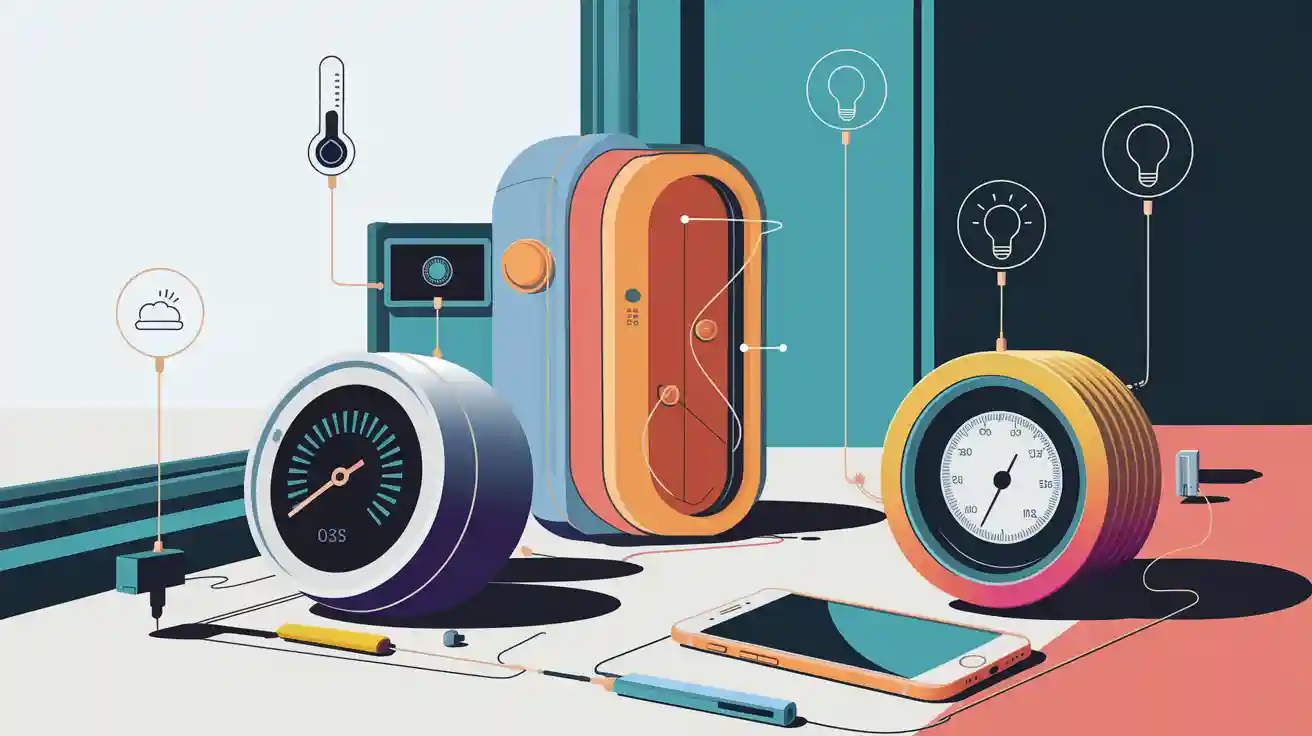
Sensors let you check changes around you. You use many types of sensors each day. Temperature sensors watch heat in your house or car. Level sensors keep liquids at safe levels in machines. Pressure sensors check force and help machines stay safe. Humidity sensors show water vapor in the air. Motion sensors warn you when things move. Knowing how these types of sensors work helps you see how technology protects you and makes life simple.
Types of Sensors
Sensors help you check things around you. You see sensors in homes, cars, and factories. IoT devices use sensors too. Each sensor does a special job. You can learn how sensors work. You use sensors every day.
Temperature Sensors
Temperature sensors check heat or cold. They keep rooms comfy and protect machines. They also help with food safety. The main types are thermocouples, thermistors, and RTDs. Thermocouples work in hot places like engines. Thermistors help with HVAC and batteries. RTDs give very good readings in labs.
Tip: You find temperature sensors in smart thermostats, fridges, and medical tools.
Sensor Type | Accuracy | Temperature Range | Response Time | Durability | Cost |
|---|---|---|---|---|---|
Thermocouples | Moderate | Up to 1700ºC | Fast | Very rugged | Low |
RTDs | High | Up to 650ºC | Slow | Less rugged | High |
Thermistors | High | Below 130ºC | Very fast | Varies | Low |
You see temperature sensors in factories, energy plants, cars, and medicine.
Pressure Sensors
Pressure sensors check force in gas or liquid. They help keep machines safe. These sensors watch hydraulic systems and tank levels. They also track weather changes.
Type of Pressure Sensor | Typical Use Cases |
|---|---|
Sealed pressure sensors | Submarines, deep-sea equipment |
Strain gauge pressure sensors | Industrial machines, process control |
MEMS pressure sensors | IoT sensors, smart devices, automotive |
Level transmitter | Tank fluid level monitoring |
Vacuum pressure sensors | Manufacturing, laboratory equipment |
Piezoelectric pressure sensors | Fast response systems, safety devices |
You find pressure sensors in cars, water systems, and factories.
Proximity Sensors
Proximity sensors know when something is close. They do not need to touch it. You use them in phones, cars, and factories. These sensors help with doors and parking.
In factories, proximity sensors check if parts are in place.
In cars, they help with parking and keyless entry.
In phones, they turn off the screen when you hold it to your ear.
Proximity sensors make smart devices better by sensing movement.
Light Sensors
Light sensors check how bright it is. You use them to control lights and save energy. They also help keep you safe. Common types are photoresistors, photodiodes, phototransistors, and ambient light sensors.
Type of Light Sensor | Applications in Smartphones and Smart Lighting Systems |
|---|---|
Photoresistors (LDRs) | Street lights, garden lights |
Photodiodes | Smoke detectors, optical communication |
Phototransistors | Automatic doors, remote controls |
Ambient Light Sensors (ALS) | Smartphones, smart lighting |
Infrared Sensors | Motion detection, remote controls |
Light sensors help smart homes and phones change brightness.
Humidity Sensors
Humidity sensors check water vapor in the air. You use them to keep air safe and control climate. These sensors help in HVAC, farming, and food storage.
Technology Type | Application Sectors |
|---|---|
Capacitive | HVAC, healthcare, agriculture, automotive, manufacturing |
Resistive | HVAC, healthcare, agriculture, automotive, manufacturing |
Optical | HVAC, healthcare, agriculture, automotive, manufacturing |
You find humidity sensors in smart buildings and greenhouses.
Accelerometers
Accelerometers check movement and shaking. You use them in fitness trackers, phones, and cars. These sensors count steps and detect falls. They also trigger airbags.
Application Area | Example Use Case |
|---|---|
Automotive Safety Systems | Airbag deployment, vehicle stability monitoring |
Wearable Devices | Step counting, distance tracking, calorie calculation |
MEMS accelerometers are common in smart wearables.
Gyroscopes
Gyroscopes check rotation and direction. You use them in navigation, robots, and games. These sensors help drones fly steady and guide ships.
Gyroscopes track movement in three ways.
You find them in phones, drones, and cars.
Robots use gyroscopes to move right.
Gyroscopes work with accelerometers to track movement.
Gas and Chemical Sensors
Gas and chemical sensors find gases and chemicals in air. You use them to keep places safe and check air quality. These sensors help in factories, farms, and smart homes.
Sensor Type | Description | Best For |
|---|---|---|
Infrared Sensors (NDIR) | Measures gas presence by absorbing infrared light. | Carbon dioxide, hydrocarbon gases |
Electrochemical Sensors | Generates electrical current through a chemical reaction to detect gases. | Hazardous gases in confined spaces |
You find these sensors in food plants and indoor farms.
Infrared Sensors
Infrared sensors check heat and movement. You use them in alarms, remotes, and factories.
Passive infrared sensors sense heat from people and animals.
These sensors set off alarms when they see movement.
Infrared sensors also check temperature and help with thermal images.
Infrared sensors make smart security and automation better.
Ultrasonic Sensors
Ultrasonic sensors use sound waves to check distance. You use them in parking, robots, and smart devices.
In cars, ultrasonic sensors help with parking.
In robots, they guide machines and avoid crashes.
These sensors also check if people are there and control gestures.
Ultrasonic sensors help smart parking and automation.
Inductive Sensors
Inductive sensors find metal objects. You use them in factories and smart machines.
Inductive sensors use magnetic fields to find metal.
They work well in tough places and ignore non-metals.
These sensors help with safety and quality checks.
Inductive sensors are important in smart factories.
Photoelectric Sensors
Photoelectric sensors use light to find objects. You use them in packaging, conveyor belts, and safety systems.
Note: Photoelectric sensors can see farther and are more accurate than other optical sensors.
You find photoelectric sensors in smart factories.
Flow Sensors
Flow sensors check how fast liquids or gases move. You use them in water systems, HVAC, and medical tools.
Flow Sensor Type | Description | Applications |
|---|---|---|
Mechanical Flow Sensors | Use moving parts to measure flow rate. | Industrial, commercial, residential fluid monitoring. |
Thermal Flow Sensors | Detect flow by measuring temperature changes. | HVAC, industrial processes, medical equipment. |
Ultrasonic Flow Sensors | Use sound waves to measure fluid flow. | Water management, industrial processes. |
Coriolis Flow Sensors | Measure flow using vibrating tubes and Coriolis force. | Fluid mass flow in various industries. |
Flow sensors help smart devices manage water and energy.
Level Sensors
Level sensors check how much liquid or solid is in a container. You use them in tanks and silos.
Level Sensor Type | Description | Applications |
|---|---|---|
Float level sensors | Use a floating part to detect liquid levels. | Water, oil, chemicals, hydraulic fluid. |
Optical level sensors | Use light to sense liquid presence. | High precision, high-temperature, small amounts. |
Ultrasonic level sensors | Use sound waves for non-contact measurement. | Abrasive media, harsh conditions. |
Radar level sensors | Use electromagnetic waves for non-contact measurement. | Vapors, extreme temperatures, dust. |
Capacitance level sensors | Measure changes in capacitance as levels rise. | Small tanks, solids and liquids. |
Conductivity level sensors | Detect levels in conductive liquids. | Multiple switching points. |
Vibrating (tuning fork) sensors | Use vibration to detect liquid presence. | Overfill prevention, dry-run protection. |
Magnetostrictive level sensors | Use magnetostriction for continuous measurement. | Precise liquid level and interface measurement. |
Level sensors help smart tanks and process control.
Electromechanical Sensors
Electromechanical sensors use moving parts and electric circuits. You use them to check pressure, temperature, position, and movement.
Primary Functions | Applications |
|---|---|
Convert stimuli into electrical signals | Automotive: Airbags, ABS, fuel monitoring |
Measure variables like pressure, position | Healthcare: Heart rate monitors, infusion pumps, prosthetics |
Combine mechanical and electrical parts | Industrial automation: Machinery monitoring, robotic arms, quality control |
Consumer electronics: Smartphones, wearables |
Electromechanical sensors power smart cars, factories, and devices.
Sensors, detectors, and transducers all help measure and change signals. Sensors measure things. Detectors find if something is there or not. Transducers change energy from one type to another.
Category | Definition |
|---|---|
Sensors | Devices that measure and quantify properties like temperature, pressure, or light, producing a signal proportional to the measured variable. |
Detectors | Devices that identify the presence or absence of a specific entity or phenomenon, often functioning in a binary manner. |
Transducers | Devices that convert one form of energy into another, such as transforming mechanical pressure into an electrical signal. |
You use sensors every day. Smart sensors make homes, factories, and cities safer.
Sensor Classification
You can sort sensors in different ways. Knowing these groups helps you pick the right sensor. You look at how sensors work. You check what kind of signal they send. You also see where you use them.
Analog vs Digital Sensors
Sensors send out two kinds of signals. These are analog and digital. Analog sensors give a smooth signal that changes slowly. Digital sensors send signals in steps, like on or off. You use analog sensors to measure things like temperature or light. Digital sensors work well for devices that need quick signals. Smart home systems and robots use digital sensors.
Feature | Analog Sensors | Digital Sensors |
|---|---|---|
Output Signal | Continuous | Discrete (binary) |
Noise Sensitivity | High | Low |
Integration with Digital Systems | Needs converter | Direct compatibility |
Accuracy & Reliability | Can lose signal quality | Less affected by noise |
Response Time | Fast | Depends on processing speed |
Cost | Lower | Higher |
Best for | Smooth measurements | Automation and IoT |
Tip: You use analog sensors for thermometers and light meters. You use digital sensors in smart watches and security systems.
Analog sensors have some good points:
They give smooth and exact measurements.
You do not worry about limits in detail.
They respond quickly.
Digital sensors have other good points:
They are more accurate.
You connect them easily to computers.
They need less care.
Active vs Passive Sensors
Sensors can be active or passive. Active sensors need power to work. They send out energy and measure what comes back. Passive sensors do not need extra power. They use energy already around them.
Sensor Type | Energy Requirement | Typical Applications |
|---|---|---|
Active | Needs power and emits energy | Radar, sonar, some motion detectors |
Passive | Uses natural energy | Photodiodes, thermocouples, light sensors |
Active sensors help you measure distance or find things with radar or sonar.
Passive sensors let you check light or heat without extra power.
Note: Pick active sensors when you need to send signals out. Pick passive sensors when you want to save energy.
By Application
You use sensors in many places. You pick a sensor based on what you want to measure. Here are some common sensor types and where you use them:
Sensor Type | Examples |
|---|---|
Temperature Sensors | Humidity sensor, current sensor, lidar sensor |
Chemical Sensors | Vibration sensor, pressure sensor |
Proximity Sensors | Fingerprint sensor, PIR sensor |
Touch Sensors | Cameras, GPS |
Light Sensors | Digital compass sensor, sound sensor |
Tilt Sensor | Ultrasonic sensor, gyroscope sensor |
Metal Detectors | Accelerometer sensor, odometer sensor |
When you choose a sensor, you look at accuracy and sensitivity. You also check size, energy needs, speed, and cost. Make sure the sensor fits your system and meets safety rules.
Sensors help you solve problems in homes, factories, cars, and smart devices. You make better choices when you know how sensors are grouped.
Different Types of Sensors in Real-World Applications
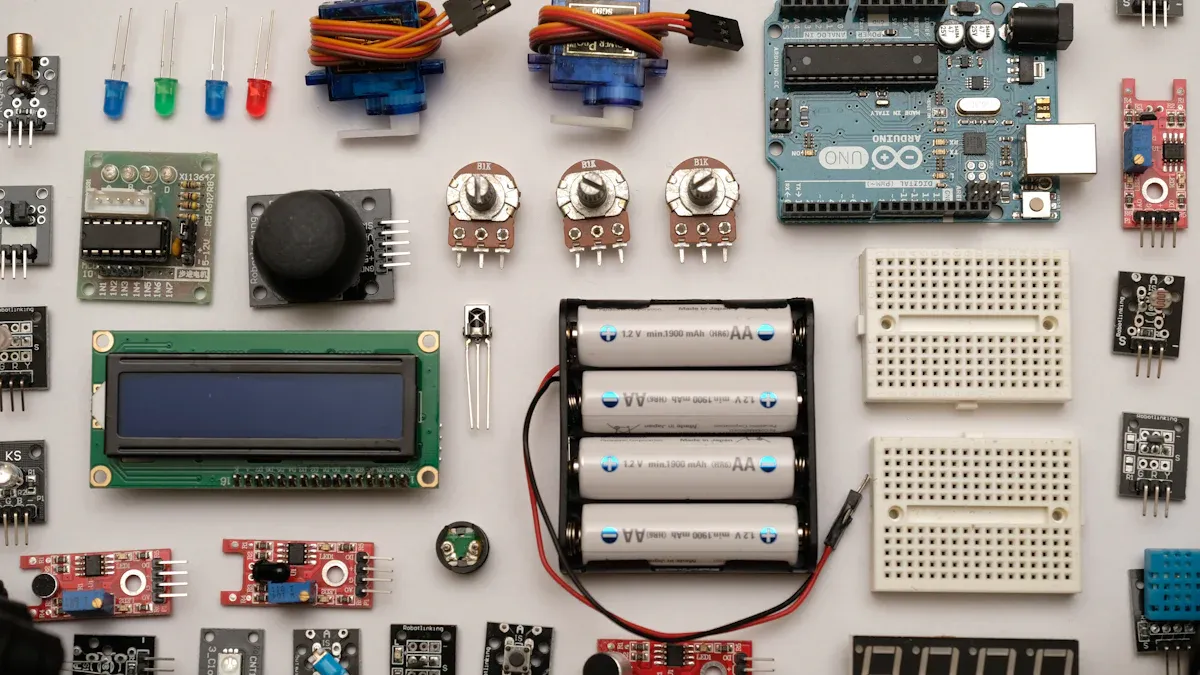
Consumer Electronics
You use sensors in things like phones and smartwatches. Image sensors help you take good photos, even in low light. Motion sensors, such as accelerometers and gyroscopes, let your device know when you move it. These sensors make games and augmented reality more exciting. Proximity sensors turn off your screen when you hold your phone to your ear. Sensors collect data to help your device last longer and work smarter.
Tip: Sensors in cameras and phones let you take pictures and use your device in new ways.
Industrial Automation
Factories use sensors to keep machines working and products safe. Some sensors watch temperature and vibration to stop problems before they happen. Optical and ultrasonic sensors check if products are made right and help cut down on waste. Proximity and position sensors help robots move and keep track of items. Safety sensors find dangers and help companies follow rules. Sensors give real-time data to help save energy and make things run better.
Sensors watch machines and warn about problems.
Sensors check if products are good quality.
Sensors help move and track materials.
Sensors keep workers safe and help follow rules.
Sensors help make factories work better.
Healthcare and Medical Devices
Hospitals and clinics use sensors in many ways. Sensors watch your vital signs, heart rate, and blood sugar. Diagnostic sensors help doctors see inside your body. Therapeutic sensors control things like insulin pumps and pacemakers. Sensors also send data to doctors so they can watch your health from far away.
Sensor Type | Application |
|---|---|
Diagnostic Devices | Blood glucose monitors, ECGs, imaging |
Therapeutic Devices | Insulin pumps, pacemakers, defibrillators |
Monitoring Devices | Vital signs monitors, wearables |
Remote Monitoring | Continuous tracking of vital signs |
Sensors spot health changes quickly.
Sensors help you visit the hospital less.
Sensors let patients take care of their health.
Medical sensors help patients by giving early warnings and helping doctors make better plans.
Smart Homes and IoT
Smart homes use sensors to make life easier and safer. Temperature sensors help keep rooms comfortable. Humidity sensors check air quality. Pressure sensors watch water and gas systems. Light sensors change lights based on how bright it is. Gas sensors find leaks and keep you safe. IoT devices use these sensors to collect data and do things automatically, making homes smarter and saving energy.
Note: Sensors in IoT devices help you save energy and keep your family safe.
Transportation and Automotive
Cars, buses, and trains use sensors to stay safe and work well. Vehicle detection sensors watch traffic and help with flow. Temperature sensors check battery health in electric cars. Pressure and humidity sensors find problems early. Radar, LIDAR, and cameras help cars drive themselves. Steering and brake sensors keep you safe. Wheel speed sensors help with smart driving features.
Current and voltage sensors help manage car batteries.
Sensors give real-time data for traffic and car health.
Sensors help cars talk to each other and to roads.
Sensors in transportation help fix problems like traffic jams and safety, making travel easier and safer.
You can see how sensors change your world. Sensors help keep you safe and save energy. They also make smart devices more fun to use. Each sensor gives you data you need for work or daily life. You use sensors to check temperature, watch movement, or measure pressure. Sensors make homes, cars, and factories smarter. When you learn about new sensor technology, you understand more.
Keep asking questions about sensors. You can find new ways to use them every day.
Sensors make your life better.
Almost every device has a sensor inside.
FAQ
What is a sensor?
A sensor is a device that notices changes around it. You use sensors to check things like heat, light, or movement. Sensors help you get information and make good choices.
How do sensors help in daily life?
You use sensors all the time. They keep your house comfy, help your phone work, and make cars safer. Sensors also help you save power and stay healthy.
Can sensors work without electricity?
Some sensors do not need electricity. Passive sensors use energy from their surroundings. You see these in simple things like thermocouples and some light sensors.
Why do smart devices need sensors?
Smart devices need sensors to collect data and react to changes. You get automatic lights, safe gadgets, and better phone tools because sensors help devices know what is happening.