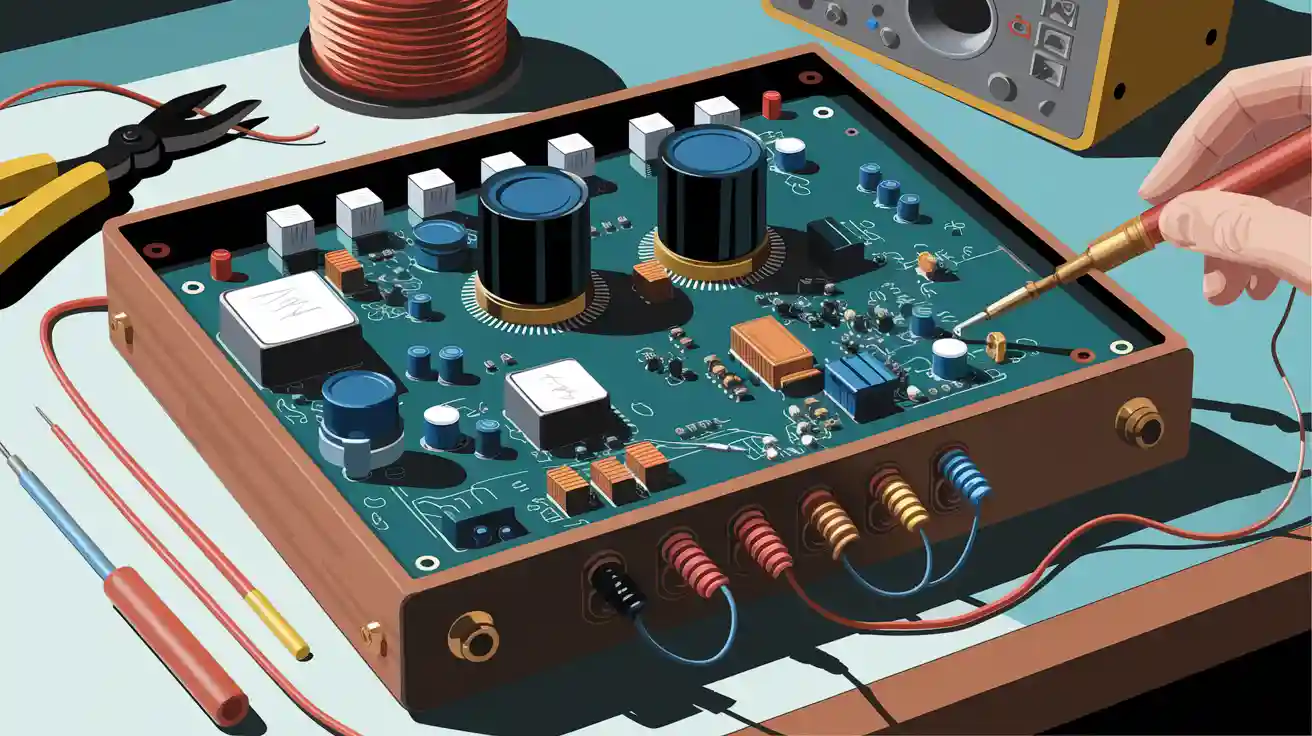
An amplifier circuit is a basic electronic system. It makes weak signals stronger. These circuits help improve sound, video, or other signals in devices. They are important in electronics. Amplifiers make signals strong enough for speakers, screens, or other outputs.
Amplifiers are very useful today. Look at these facts:
The global audio amplifiers market was worth about $15 billion in 2023. It might grow to $25 billion by 2032, with a 5.5% yearly growth.
Amplifiers are key in devices like phones, TVs, and wireless speakers. These devices are part of everyday life.
People want better sound and smart technology. This shows why amplifiers are important for connected experiences.
Key Takeaways
Amplifier circuits make weak signals stronger for devices like speakers.
There are different amplifiers, like voltage and operational ones, for specific jobs.
Knowing amplifier types (A, B, AB, C, D) helps pick the right one.
Biasing circuits keep amplifiers steady and stop sound distortion.
Amplifiers are important in sound systems, communication tools, and medical devices.
What Is an Amplifier Circuit?
Definition and Purpose
An amplifier circuit is a key part of electronics. It takes a weak signal and makes it stronger. This stronger signal can then be used by devices like speakers or screens. Think of it as a tool that boosts electrical signals to make them useful.
Amplifiers are very important in modern technology. They keep signals clear and strong during use. For example, in audio systems, amplifiers make sound signals louder for speakers. In communication devices, they help signals travel far without losing quality.
To understand amplifiers, you need to know their main features. These include voltage gain, power gain, and efficiency. The table below explains these features:
Parameter | Description |
|---|---|
Voltage Gain | How much the output voltage increases compared to the input. |
Power Gain | How much the output power increases compared to the input. |
Equivalent Input Noise | The noise level at the output divided by the voltage gain. |
Bandwidth | The range of frequencies where the amplifier works best. |
Efficiency | How much power is used effectively by the amplifier. |
Rise Time | How quickly the output goes from low to high. |
Settling Time | How long the output takes to become steady after a change. |
Overshoot | How much the output goes above its final value during a change. |
These features show how well an amplifier works in different situations. Learning about them helps you see why amplifiers are so useful in electronics.
Importance in Signal Processing and Electronics
Amplifiers are crucial for keeping signals strong and clear. They work well even in tough conditions. For example, in factories, amplifiers improve signal accuracy and reliability. Over half of industrial systems use amplifiers to make processes better.
Amplifiers are also important in everyday devices. Phones, TVs, and wireless speakers use them to give great sound and video quality. Portable devices often use special amplifiers that save battery while working well. These amplifiers adjust power use to stay efficient.
The table below shows how amplifiers are grouped by signal type, setup, and frequency:
Type of Signal | Type of Configuration | Classification | Frequency of Operation |
|---|---|---|---|
Small Signal | Common Emitter | Class A Amplifier | Direct Current (DC) |
Large Signal | Common Base | Class B Amplifier | Audio Frequencies (AF) |
Common Collector | Class AB Amplifier | Radio Frequencies (RF) | |
Class C Amplifier | VHF, UHF, and SHF Frequencies |
Knowing these groups helps you pick the right amplifier for your project. Whether you’re building a simple circuit or a complex system, understanding these details is very helpful.
Types of Amplifiers
Amplifiers have different types, each made for specific tasks. Knowing these types helps you pick the right one for your needs.
Weak Signal Amplifiers
A weak signal amplifier makes small signals stronger for further use. These are important in devices like radios and medical scanners. They help detect very faint signals. Key features of weak signal amplifiers include:
Gain: How much stronger the output signal is than the input.
Noise figure: How much extra noise the amplifier adds.
Linearity: The ability to amplify without changing the signal shape.
Power consumption: The energy the amplifier uses to work.
Figure of merit (FOM): A score combining efficiency and performance.
Weak signal amplifiers are often designed to reduce noise. For example, in a radio, they make weak signals louder while keeping them clear.
Power Amplifier Circuits
Power amplifiers are made to handle high-power outputs like speakers or antennas. These are used in audio systems, broadcasting, and wireless devices. They focus on giving strong output power while staying efficient. But, they might distort signals at high frequencies.
Power amplifiers are grouped by their control input and uses. The table below shows some common types:
Amplifier Type | Advantages | Disadvantages | Control Input | Usage/Applications |
|---|---|---|---|---|
Voltage-Controlled Amplifiers | Flexible, adjustable gain | Can be unstable, depends on load | Voltage | Audio systems, radio signals, telecom signals |
Current-Controlled Amplifiers | Good for low-impedance loads, simple design | Sensitive to load changes, less common | Current | Current-mode communication systems, some audio applications |
Power Amplifiers | Drives high-power loads, efficient | May distort at high frequencies, bulky | Voltage/Current | Broadcasting systems, audio systems, wireless communication |
Power amplifiers ensure devices like speakers and transmitters work well.
Voltage, Current, and Operational Amplifiers
Amplifiers can also be grouped by the type of signal they boost.
Voltage amplifiers: Boost voltage signals, used in audio and video systems.
Current amplifiers: Work well with low-impedance loads, used in current-based systems.
Operational amplifiers (op-amps): Very flexible, used for filtering, signal processing, and math tasks.
A single-stage amplifier, like an op-amp, can do many jobs. These amplifiers are key in modern electronics, from playing music to solving complex problems.
How Amplifier Circuits Work
Key Parts (Transistors, Resistors, Capacitors)
Amplifier circuits need three main parts: transistors, resistors, and capacitors. Each part has a special job to make the circuit work well.
Transistors: These are the main amplifying parts. They control current flow and increase signal strength. Transistors like BJTs and MOSFETs are common in amplifiers. Their features, like gain and efficiency, affect how well the circuit works.
Resistors: Resistors manage current and voltage. They set safe operating levels and keep the circuit stable. Resistors also help with impedance and heat control, which are important for smooth operation.
Capacitors: Capacitors store energy and do many tasks. They connect signals between stages, reduce noise, and steady the power supply. This helps keep the output signal clean and clear.
The table below shows their roles and effects:
Component | Job | Effect on Circuit |
|---|---|---|
Transistors | Control current, increase signal strength | Affect gain, power, and efficiency |
Resistors | Manage current, set voltage levels | Help with stability, impedance, and signal levels |
Capacitors | Store energy, reduce noise, steady signals | Keep signals clean and stable |
Why Biasing Circuits Matter for Gain
Biasing circuits are key to making amplifiers work properly. They set the right conditions for the amplifier to stay stable and give consistent gain. Almost all amplifiers use biasing circuits to keep transistors in the active zone for smooth operation.
Biasing controls the voltage and current going to the transistor. This stops distortion and keeps the amplifier’s gain steady. For example, in voltage amplifiers, biasing ensures the gain stays the same even if input signals change. Biasing also helps the circuit handle temperature changes that can affect transistors.
Feedback circuits often work with biasing. In operational amplifiers, feedback improves stability and accuracy. Closed-loop setups with feedback give better gain and frequency control than open-loop ones. This makes them great for precise tools like scientific devices and communication systems.
How Signals Get Amplified
Amplifiers turn weak signals into stronger ones. This happens in steps, with each step adding to the final output. Here’s a simple breakdown:
Input Signal: The amplifier gets a weak signal, like a sound wave or pulse.
Voltage Boost: The first stage increases the signal’s voltage while keeping its shape.
Current Boost: Next, the signal’s current is increased to handle low-impedance devices like speakers.
Power Boost: The last stage combines voltage and current boosts to make the signal strong enough for use.
Output Signal: The amplified signal is sent to a device, like a speaker or screen.
Operational amplifiers combine these steps into one unit. They are flexible and can also filter signals or do math tasks. Feedback circuits make the process more accurate and stable, ensuring the output is reliable.
By learning these steps, you can see how amplifiers turn weak signals into strong ones, powering many electronic devices.
Amplifier Classes and Their Characteristics
Amplifier classes are grouped by how they handle signals and their working time. Each class has special traits, making it good for certain uses. Let’s look at the common classes: Class A, Class B, and Class AB.
Class A Amplifiers
Class A amplifiers work all the time (360 degrees of the signal). This means the output is always on, giving clear signals with little distortion. They are great for tasks needing accurate sound, like high-quality audio systems.
Main Features:
Always active, giving clear and smooth signals.
Low efficiency, around 25%, as most energy turns into heat.
Transistors stay active, helping with steady signal boosting.
Note: Class A amplifiers are very clear but waste energy, so they’re not ideal for high-power tasks.
Class B Amplifiers
Class B amplifiers work for half the signal time (180 degrees). They are more efficient than Class A but can cause crossover distortion when switching between signal halves. Still, they are used in audio and radio systems where saving energy matters.
Feature | Class A | Class B |
|---|---|---|
Efficiency | Low (~25%) | Moderate (~50%) |
Linearity | High | Moderate |
Harmonic Content | Low | More noticeable |
Input Drive Required | Low | High |
Pros:
Better efficiency than Class A amplifiers.
Good for medium-energy tasks.
Cons:
Crossover distortion can lower signal quality.
Class AB Amplifiers
Class AB amplifiers mix Class A and Class B designs. They work for more than half but less than the full signal time (180–360 degrees). This design lowers crossover distortion and improves efficiency compared to Class A.
Key Traits:
Efficiency is moderate to high, based on the setup.
Clearer signals than Class B amplifiers.
Useful for audio and broadcasting systems.
As you move from Class A to AB, there’s a balance between energy use and signal clarity. Class AB amplifiers are flexible and fit many needs.
Class C Amplifiers
Class C amplifiers work for less than half the signal cycle. They usually operate between 0° and 90° of the conduction angle. These amplifiers are very efficient, often over 78.5%, and can sometimes reach nearly 100%. But this high efficiency causes a lot of signal distortion. Because of this, they are not good for audio systems. Instead, they are used in high-frequency devices like radio transmitters, where efficiency matters more than clear signals.
Researchers have found some interesting behaviors in Class C amplifiers:
Extra capacitance and inductance in the circuit can make the amplifier act unpredictably.
Nonlinear feedback, described by certain math functions, affects how the amplifier behaves.
Bipolar transistors in the circuit can cause chaotic performance under certain conditions.
Knowing these details helps engineers design better circuits for high-frequency uses.
Class D Amplifiers
Class D amplifiers work differently from other types. Instead of boosting signals continuously, they use pulse-width modulation (PWM) or similar methods. This means the transistors switch on and off very quickly. This design reduces energy loss, making Class D amplifiers very efficient—often over 90%. They are common in modern audio systems because they provide high power with little heat.
The biggest benefit of Class D amplifiers is their efficiency. However, they need special filters to remove noise caused by the fast switching. When designed well, these amplifiers work great for audio and other low-frequency tasks.
Efficiency and Conduction Angle Comparison
An amplifier’s efficiency depends on its conduction angle. The table below shows how different amplifier classes compare:
Amplifier Class | Conduction Angle | Efficiency (%) |
|---|---|---|
Class A | 360° | 20-30 (max 50) |
Class B | 180° | max 78.5 (real ~70) |
Class AB | 180°-360° | between Class A and B |
Class C | 0°-90° | above 78.5 (up to 100) |
Class C and Class D amplifiers are the most efficient. This makes them great for high-power or high-frequency tasks. But the best amplifier depends on what you need, like clear signals or high power.
Practical Uses of Amplifier Circuits
Amplifier circuits are important in many areas, like music and healthcare. Let’s see how they improve sound systems, communication tools, and medical devices.
Sound Systems and Broadcasting
Amplifiers are key to sound systems and broadcasting. They make sound signals louder and clearer. In sound systems, amplifiers strengthen weak signals to power speakers. This is needed for great sound in home theaters, concerts, and studios.
Broadcasting uses power amplifiers to send signals far away. These amplifiers help radio and TV signals reach far places without losing quality. For example, broadcast transmitters use power amplifiers to boost signals. Wireless transmitters also use them for strong communication over large distances.
The table below shows how amplifiers are used in sound and broadcasting:
Use Area | Purpose |
|---|---|
Power Amplifiers in Broadcasting | Boost signals in broadcast and wireless transmitters for better strength. |
High-End Audio Systems | Make audio signals stronger for clear sound in homes and studios. |
Speaker Driving | Power speakers with low input impedance for high output. |
Long-Range Transmission | Help antennas send signals far with strong power. |
These uses show how amplifiers improve sound and signal range in sound and broadcasting systems.
Communication Tools
Amplifiers keep signals strong and clear in communication tools. Phones, radios, and satellites use amplifiers to send and process signals well. Voltage amplifiers make weak signals stronger so they can travel far without losing quality.
Modern communication also uses operational amplifiers to process signals. These amplifiers remove noise and keep signals clear for better communication. For example, in wireless systems, amplifiers boost signal strength for long-distance use.
By making signals stronger and clearer, amplifiers make communication tools work better and more reliably.
Medical Devices
Amplifiers are very important in medical devices. They make weak body signals stronger for accurate testing. For example, operational amplifiers boost small signals like heartbeats or brainwaves, which are too weak to study directly.
Differential amplifiers are helpful in medical tools. They amplify the difference between two signals while ignoring noise. This is useful in ECG machines, where clean signals are needed. Operational amplifiers also have high input resistance, which keeps the original signal unchanged.
Amplifiers make weak body signals stronger for better testing.
Differential amplifiers cut noise for accurate medical results.
High input resistance keeps signals clear without changes.
These features make amplifiers essential in medical devices, from checking vital signs to advanced imaging tools.
Industrial and Scientific Applications
Amplifiers are very important in factories and science labs. They make signals stronger and more accurate, which helps advanced tools work better. You can find them in places like automated factories and research equipment.
In factories, amplifiers improve how sensors and control systems work. They boost weak signals from sensors to give accurate readings. This helps with tasks like keeping temperatures steady or moving robotic arms. Amplifiers work efficiently, with energy use between 72% and 87.6%. Their Power Added Efficiency (PAE) can go up to 80%, making them reliable even in tough conditions.
In science, amplifiers are used for collecting and processing data. Labs use them in tools like oscilloscopes and spectrometers to study signals carefully. Some amplifiers have a gain of 62.9449 dB and a Unity Gain Bandwidth of 33 MHz. These features help scientists get clear and detailed results. Their small size, just 0.001476 μm², makes them perfect for tight spaces.
Here’s a simple table showing key amplifier features for science:
Feature | Value |
|---|---|
Gain | 62.9449 dB |
CMRR | 92.8079 dB |
Unity Gain Bandwidth | 33 MHz |
Size | 0.001476 μm² |
Power Supply | 3.3 V |
Amplifiers are also used in powerful machines like particle accelerators and radio telescopes. These need output power between 39.3 and 41 dBm for big tasks. Amplifiers make sure these tools work at their best by boosting signals properly.
Whether in a factory or a lab, amplifiers give the accuracy and dependability needed for modern technology.
Amplifier circuits are important in electronics. They make weak signals stronger for many uses. You’ve learned about different types, like voltage, current, and operational amplifiers. They are also grouped into classes, such as Class A, B, AB, C, and D. Each type has special uses. For example, some are great for medical tools, while others work well in digital systems. Knowing about amplifier gain and features, like voltage limits and frequency range, helps you pick the right one. Try learning more or building a simple amplifier to see how it works.
Tip: Begin with easy designs, like single-stage amplifiers, to understand the basics before trying harder setups.
FAQ
What does an amplifier circuit do?
An amplifier circuit makes weak signals stronger. It helps improve sound, video, or data in devices like speakers, TVs, and phones. This ensures signals are clear and strong enough to use.
How can you pick the right amplifier?
Choose an amplifier based on your project needs. Think about signal type, frequency, and power. For audio, use Class AB or D amplifiers. For high-frequency tasks, Class C is better. Match the amplifier to your device’s needs.
Why do amplifiers need biasing circuits?
Biasing circuits help transistors work properly. They keep the gain steady and stop distortion. Without biasing, amplifiers may not work well or give poor signals. Biasing also helps with temperature changes.
Can amplifiers handle digital signals?
Yes, amplifiers can work with digital signals. Class D amplifiers are best for this. They use fast switching to boost signals efficiently. You’ll see them in modern audio and digital devices.
What are operational amplifiers used for?
Operational amplifiers, or op-amps, are very useful. They filter signals, do math tasks, and boost weak signals. They’re used in medical tools, science equipment, and audio systems. Their flexibility makes them important in electronics.