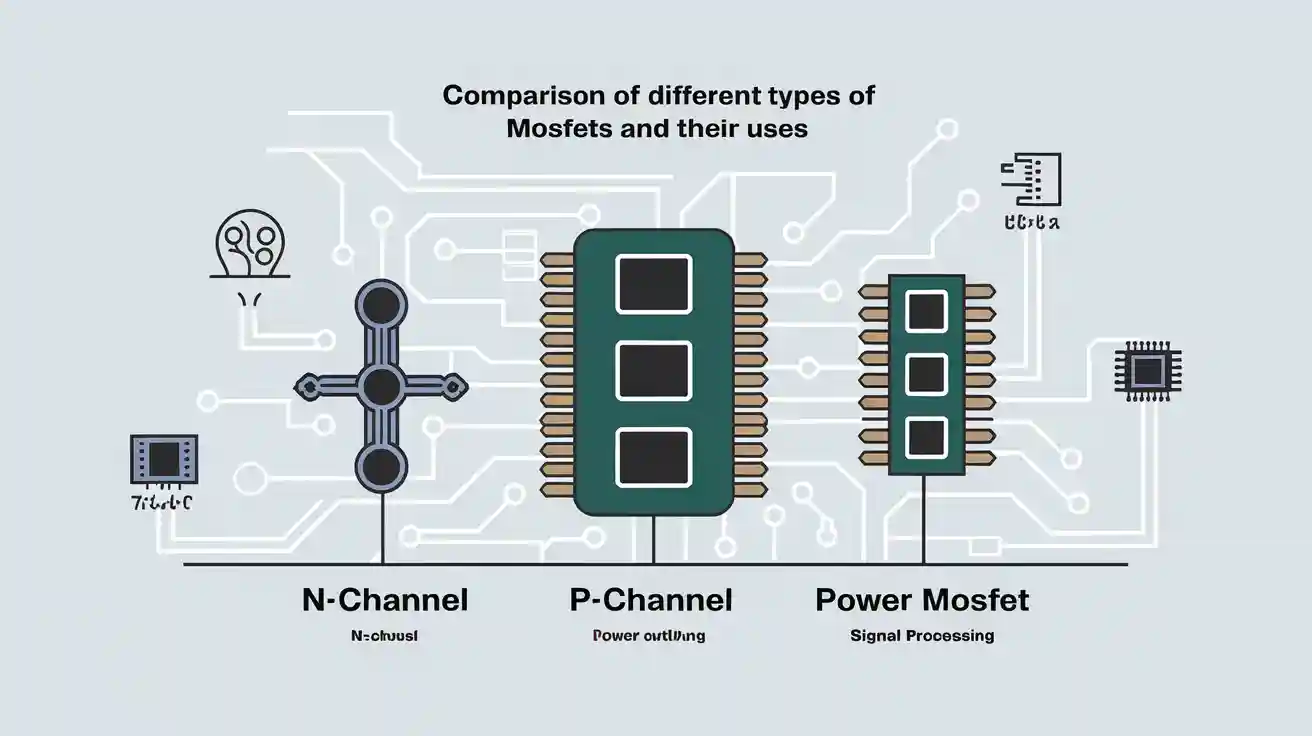
You can see big differences between types of MOSFETs in how they work and where they are used. Enhancement-mode MOSFETs are the most common among the various types of MOSFETs. They are used in electric cars, home machines, and factories. These types of MOSFETs make up over 85% of the power MOSFET market. Depletion-mode MOSFETs are not used as much. They are good for special jobs like controlling voltage and RF amplifiers. When you pick a MOSFET, you must match its features to your project. The world market is growing fast for types of MOSFETs in energy management and electric cars.
Many businesses want MOSFET technology to save money and work better.
Types of MOSFETs
There are four main groups of MOSFETs. Each group works in its own way. They are used for different jobs in switches and power circuits. You should know how each type works before picking one.
Enhancement-Mode
Most modern electronics use enhancement mode MOSFETs. These MOSFETs are off if there is no voltage at the gate. You need to add a voltage above a certain level to turn them on. This makes them easy to use in digital circuits and switches.
Tip: Enhancement mode MOSFETs are the top choice for switching and amplifying signals in computers, cars, and home appliances.
Here is a table that shows how enhancement mode MOSFETs and depletion mode MOSFETs are different:
Feature | Enhancement-Mode MOSFET | Depletion-Mode MOSFET |
|---|---|---|
Default State | Off at zero gate-source voltage | On at zero gate-source voltage |
Threshold Voltage | Positive threshold voltage | Negative threshold voltage |
Common Usage | Common in integrated circuits | Used as load resistors in logic circuits |
Enhancement mode MOSFETs need a positive gate voltage to work. They act like switches that stay off until you turn them on.
Depletion-Mode
Depletion mode MOSFETs are found in special analog circuits. These MOSFETs work even if you do not add voltage to the gate. You can turn them off by adding a negative voltage. Depletion mode MOSFETs help make steady current sources and voltage controls.
Here is a table that explains the main benefits of depletion mode MOSFETs in analog circuits:
Advantage | Description |
|---|---|
Built-in channel | Depletion mode MOSFETs have a built-in channel between source and drain. |
Dual-mode operation | They can work in both enhancement and depletion modes, so you get more design options. |
Zero gate voltage operation | They work at zero gate voltage, so you do not need a gate drive circuit all the time. |
Ideal for stable current sources | You can make steady current sources, which helps your circuit work better. |
You use depletion mode MOSFETs when you need a part that works without a gate signal. These MOSFETs help you build analog circuits that need steady current or voltage.
N-Channel
N-channel MOSFETs are used in most power circuits. These MOSFETs use electrons to carry charge. Electrons move faster than holes. This means n-channel MOSFETs have lower resistance and work better. They make less heat and work faster.
N-channel MOSFETs use electrons, which move fast and make the device efficient.
You get better conduction and less loss with n-channel MOSFETs.
N-channel MOSFETs are good for high-current and high-frequency circuits.
N-channel MOSFETs are more efficient than p-channel MOSFETs because electrons move faster than holes. You see less heat and lower resistance in n-channel MOSFETs under the same load.
P-Channel
P-channel MOSFETs are used to control power on the high side of a circuit. These MOSFETs use holes to carry charge. Holes move slower than electrons. So, p-channel MOSFETs have higher resistance and lose more power when switching. You find p-channel MOSFETs in battery devices and power management systems.
You use p-channel MOSFETs as high-side switches in DC circuits.
P-channel MOSFETs help protect against reverse battery connections.
You see p-channel MOSFETs in switching converters, motor control, LED switching, and load disconnect switches.
P-channel MOSFETs control power flow and protect circuits. You use them when you need to switch the positive side of the power supply.
Note: N-channel MOSFETs are better for high-speed and high-current jobs. P-channel MOSFETs are best for high-side switching and protection.
You need to pick the right MOSFET for your project. Enhancement mode MOSFETs are good for most digital and switching jobs. Depletion mode MOSFETs help with analog and special circuits. N-channel MOSFETs give you speed and efficiency. P-channel MOSFETs help you control and protect power flow.
MOSFET Structure
Basic Design
A mosfet has four main parts. The source and drain use special semiconductor material. The gate sits above the body but does not touch it. A thin silicon dioxide layer separates the gate from the body. The body is lightly doped and makes a channel for current.
The gate controls how electricity moves between the source and drain. The oxide layer lets you make an electric field by adding voltage to the gate. The body creates a channel when you turn on the mosfet. This design helps you switch the mosfet on and off fast.
Tip: The thickness of the gate oxide changes how well a mosfet works. If the oxide is thin, the mosfet works better but may break more easily. If the oxide is thick, the mosfet is stronger but needs more voltage to turn on.
Here is a table that shows how gate oxide thickness affects mosfet performance and reliability:
Aspect | Thicker Gate Oxide | Thinner Gate Oxide |
|---|---|---|
Reliability | Makes the mosfet stronger and safer | Can cause problems and break more easily |
Threshold Voltage | Needs more voltage to turn on | Needs less voltage to turn on |
Channel Conductance | Makes the channel weaker | Makes the channel stronger |
Capacitance | Has less capacitance | Has more capacitance and changes how it works |
Operation Principles
You control a mosfet by changing the voltage at the gate. The mosfet works in two main ways.
In the Cut-off Region, the gate-source voltage is too low. The mosfet stays off, and no current moves.
In the Saturation Region, the gate-source voltage is high enough. The mosfet turns on, and lots of current moves.
The gate-source voltage decides if the mosfet is on or off. For n-channel mosfets, you use a positive voltage at the gate. For p-channel mosfets, you use a negative voltage. You can switch the mosfet quickly because the gate does not touch the channel.
Note: The resistance between the drain and source changes when you switch the mosfet. When the mosfet is on, the resistance is very low. When it is off, the resistance is very high. This makes mosfets good for switching and controlling power.
You use mosfets in many circuits because they are easy to control and switch fast. The design and how they work help you choose the best mosfet for your project.
Electrical Characteristics
Threshold Voltage
It is important to know about threshold voltage. Threshold voltage is the gate voltage that turns the mosfet on. If the voltage is too low, the mosfet stays off. You use threshold voltage to decide when the mosfet starts working. Most enhancement-mode mosfets need a positive voltage at the gate. Depletion-mode mosfets can work with zero or negative voltage. Always check the threshold voltage in the datasheet before using a mosfet.
On-Resistance
On-resistance matters for how well a mosfet works. When you turn on a mosfet, current moves from drain to source. The resistance in this path is called on-resistance. Lower on-resistance means less power loss and better results. You want low on-resistance for high-power jobs.
Lower on-resistance helps save energy and keeps the mosfet cool.
Here is a table that explains why on-resistance is important:
Key Point | Description |
|---|---|
On-resistance | Low on-resistance helps reduce power loss in mosfets. |
Efficiency | Less loss means better efficiency overall. |
On-resistance (Rds(on)) is important for high-power mosfet use.
Lower on-resistance means less power loss.
Better efficiency comes from lower on-resistance.
New technology makes device features better.
Low on-state resistance helps efficiency.
Switching works better with different loads.
Switching Speed
Switching speed shows how fast a mosfet turns on and off. You need high switching speed for circuits that change quickly. Fast switching speed helps in power supplies, converters, and motor control.
Device Type | Turn-On Time (ns) | Turn-Off Time (ns) | Practical Switching Frequency Range |
|---|---|---|---|
mosfet | ~44 | ~48 | Hundreds of kHz |
IGBT | ~34 | ~250 | Tens of kHz |
Mosfets switch faster than IGBTs. You use mosfets for high-frequency switching. Fast switching speed means less heat and better efficiency.
Tip: High switching speed lets you build circuits that work fast and respond quickly.
Power Handling
Power handling tells you how much voltage and current a mosfet can take. You need to pick a mosfet that matches your power needs. Many n-channel and p-channel mosfets can handle up to 1700 V. New technology like MDmesh and STMESH helps mosfets work in tough jobs. You use these mosfets in cars, factories, and energy systems. High power handling lets you use mosfets where you need strong and reliable devices.
The breakdown voltage for n-channel and p-channel mosfets can reach up to 1700 V.
Advanced technology helps mosfets handle more power.
These mosfets are made for high-efficiency jobs in factories and cars.
Comparison Table
Key Differences
It is important to know what makes each mosfet type special. The biggest differences are in how they work and where you use them. Enhancement-mode mosfets do not turn on until you add voltage to the gate. Depletion-mode mosfets are already on, so you need a negative gate voltage to turn them off. N-channel mosfets use electrons. Electrons move fast and help with switching high power and high frequency. P-channel mosfets use holes. Holes move slower and are best for high-side switching in strong power systems.
Here is a table that helps you see how the main mosfet types compare:
Characteristic | Enhancement-Mode MOSFETs | Depletion-Mode MOSFETs | N-Channel MOSFETs | P-Channel MOSFETs |
|---|---|---|---|---|
Default State | Normally Off | Normally On | Off (at zero VGS) | Off (at zero VGS) |
Threshold Voltage | 2–4 V (power), 0.7–1.5 V (logic) | -1 V to -5 V | Positive | Negative |
On-Resistance | < 2 mΩ (modern) | ~1 Ω | Low | Higher |
Leakage Current | pA to µA | Conducts heavily at VGS = 0 | Very low | Low |
Carrier Type | N/A | N/A | Electrons | Holes |
Application | Fail-safe, high-power switching | Analog, voltage control | High-power, fast switching | High-side, protection |
Tip: N-channel mosfets work better for high-power jobs. Electrons move faster than holes, so you get more efficiency.
Pros and Cons
When you pick a mosfet for strong power circuits, you should look at the good and bad sides. Enhancement-mode mosfets are reliable and cost less. They also lose less power. Depletion-mode mosfets are good for analog circuits but need harder designs. N-channel mosfets switch fast and handle high power well. P-channel mosfets are good for high-side switching but have more resistance.
Here is a table that shows the good and bad points for each mosfet type:
Type | Pros | Cons |
|---|---|---|
Enhancement-Mode MOSFETs | Reliable, low cost, low power loss, simple design | Less flexible for analog, needs gate voltage |
Depletion-Mode MOSFETs | Works at zero gate voltage, good for analog | Higher cost, more power loss, complex circuit |
N-Channel MOSFETs | Fast switching, low resistance, high-power use | Needs positive gate voltage, shorter lifespan |
P-Channel MOSFETs | Easy high-side switching, protects circuits | Higher resistance, slower, less efficient |
Enhancement-mode mosfets are simple and cheap.
Depletion-mode mosfets help keep current steady but cost more.
N-channel mosfets are fast and strong for high-power circuits.
P-channel mosfets make high-side switching easy but lose more power.
Note: Pick the mosfet type that fits your power needs. N-channel mosfets are best for high power and fast switching. P-channel mosfets help with protection and high-side control.
MOSFET Applications in Power Electronics
High-Current Uses
MOSFETs are used in power electronics that need lots of current. They can handle big currents and do not waste much energy. N-channel MOSFETs are the best for these jobs. Their channel lets electrons move fast, so they work well and save energy. You find these MOSFETs in electric cars, big motors, and battery systems. N-channel MOSFETs have low on-resistance, so they do not get hot or waste power. This makes them great for strong electronic designs. If you want your circuit to be fast and efficient, use n-channel MOSFETs. Their channel helps them switch quickly and stay cool. You can trust these MOSFETs for hard power jobs.
Load Switching
MOSFETs are good switches in cars and factories. You use them to turn things like lights and motors on or off. Both n-channel and p-channel MOSFETs can do this, but n-channel types are more efficient. P-channel MOSFETs are helpful when you need to control the positive side. Here is a table with some MOSFET models used in cars:
MOSFET Model | AEC-Q101 Qualified | Applications |
|---|---|---|
SSM6N7002KFU | Yes | Automotive electronics, EV power management, ADAS |
DMP210DUFB4-7 | Yes | In-vehicle infotainment, automotive lighting, power management in new energy vehicles |
IRF9540 | No | Power management systems across various applications |
You pick a MOSFET by looking at its channel, speed, and how well it works. N-channel MOSFETs are good for high current and fast switching. P-channel MOSFETs make high-side switching easier.
Tip: Always check if your MOSFET is AEC-Q101 qualified for car use. This helps keep your circuits safe and reliable.
AC/DC and DC/DC Converters
MOSFETs are in almost every AC/DC and DC/DC converter. These converters change voltage for different devices. MOSFETs help these circuits work better by having low on-resistance. This means less energy is lost as heat. They also switch fast, so less power is wasted. Sometimes, MOSFETs replace diodes to save even more energy. This is called synchronous rectification. It helps recover power that would be lost as heat. If you want your power electronics to work well, use MOSFETs. Their channel and fast switching make them perfect for computers, solar panels, and battery chargers.
Note: The right MOSFET can make your converter more efficient and keep it cool.
Complementary Pairs
You can use both n-channel and p-channel MOSFETs together in circuits. This is called CMOS. It gives you many good things:
Uses less power
Works fast
Resists noise
Makes complex logic gates
Saves energy when not switching
Handles noise well
When you use both types, your circuits use less energy and work better. This is good for microprocessors, memory chips, and signal processing. Each MOSFET type helps balance speed, energy use, and reliability.
Tip: Using both types of MOSFETs helps your circuits save power and fight noise.
MOSFETs vs IGBTs
You might wonder how MOSFETs and IGBTs are different. Both are voltage controlled, but each has its own strengths. MOSFETs switch faster and are best for lower voltages. IGBTs can handle higher voltages and currents but are slower. Here is a table that compares them:
Feature | MOSFET | IGBT |
|---|---|---|
Switching Speed | Hundreds of kHz to MHz | Limited to kHz range |
Voltage Handling | Up to 100V | Up to 600V |
Current Handling | Up to 7A | Up to 45A |
Performance at High Temp | Not optimal | Maintains performance at 150°C |
Typical Applications | Low voltage, high-speed circuits | High voltage, high current applications |
Use MOSFETs if you need fast switching and high efficiency at low voltages. IGBTs are better for high voltage and high current, but not fast switching. For high-performance designs, MOSFETs are chosen for their fast switching and efficiency.
Note: For fast switching, MOSFETs work better and save more energy. For high voltage, IGBTs may be the better choice.
You can notice that each mosfet type works differently in power electronics. When you pick a mosfet, look at voltage ratings and on-resistance. Check how fast the mosfet can switch on and off. Make sure the mosfet’s electrical features fit your project. Always read the datasheet for gate threshold voltage and current ratings. Look at thermal limits to keep your circuit safe. Good thermal management helps you avoid problems. Choose the right parts for your design. New mosfet technology makes devices work better and last longer. These improvements help cars, green energy, and phone networks. If you want to learn more, find information about mosfet switches and power converters. In the future, mosfets will have lower resistance and handle more power.
FAQ
What is a metal oxide semiconductor field effect transistor?
A metal oxide semiconductor field effect transistor is a type of transistor you use to control the flow of current. You control it by changing the voltage at the gate. This device helps you switch and amplify signals in many power circuits.
How does the gate control a MOSFET?
You control the metal oxide semiconductor field effect transistor by applying voltage to the gate. When you add voltage to the gate, you create an electric field. This field lets current flow between the source and drain. The gate acts like a switch for power.
Why do you use N-channel MOSFETs for high power?
You use N-channel MOSFETs for high power because electrons move quickly through the channel. This means you get lower resistance and less heat. The gate controls the flow, so you can switch power on and off fast.
Can you use a MOSFET for both switching and amplifying power?
Yes, you can use a metal oxide semiconductor field effect transistor for both switching and amplifying power. The gate lets you control how much current flows. You use it in power supplies, amplifiers, and many other circuits.
What happens if you apply too much voltage to the gate?
If you apply too much voltage to the gate, you can damage the metal oxide semiconductor field effect transistor. The thin layer under the gate can break. Always check the datasheet for the safe gate voltage. This keeps your power circuit safe.