

Voltage regulators are important for controlling electrical power. Knowing their differences helps in better designs. Linear voltage regulators are simple and give clean power. They work well for systems that need low noise. But they are less efficient and can get very hot, like the LM7805. Switching regulators, such as the LM2576, are more efficient. They can reach 75% efficiency at 3.3V. These are good for high-power tasks but can be noisy. Linear regulators, like the NCV8189, are great for low-power setups. They can lower current to just 0.1 µA.
Key Takeaways
Linear voltage regulators give steady power and work well for quiet devices like speakers.
Switching regulators save energy, often over 80%, and are good for powerful jobs.
Linear regulators get hotter, so think about cooling when using them.
Use linear regulators for easy, small jobs and switching ones for energy-saving tasks.
Check your device’s power use, noise level, and cost to pick the best regulator.
What Are Voltage Regulators?
Definition and Purpose
A voltage regulator is a tool that keeps voltage steady. It stops voltage changes that might harm devices or cause problems. Voltage regulators come in different types, like electronic, electromechanical, and automatic systems.
Here’s a simple look at where they are used:
Type of Voltage Regulator | Use Case |
|---|---|
Electronic | Keeps DC voltage steady in things like computer power supplies |
Electromechanical | Manages output in car alternators and power plants |
Automatic Voltage Regulation (AVR) | Keeps voltage stable in power systems, protecting devices from damage due to changes |
Voltage regulators are key for keeping power reliable and safe. They stop equipment from breaking because of uneven voltage and help systems work smoothly.
Role in Power Management
Voltage regulators help control power in electronic devices. They give a steady voltage even if input or load changes. This makes sure devices get the right power to work well.
Here’s what they do for power management:
They lower high voltages to safe levels for electronics.
They remove noise, giving clean power to delicate parts.
They guard systems from sudden voltage jumps, making them last longer.
By controlling voltage, these tools improve how electronics work and last. Whether it’s for a computer, car, or power system, voltage regulation is crucial for smooth performance.
Linear Voltage Regulators
How They Work
Linear voltage regulators keep the output voltage steady. They do this even if the input voltage or load changes. Extra energy is turned into heat to maintain stability. A transistor controls the voltage drop between input and output. This process gives smooth power, perfect for delicate electronics.
Here are some diagrams to explain how they work:
Diagram Type | Description | Source Link |
|---|---|---|
Block Diagram of a Linear Voltage Regulator | Shows the main parts and design of a linear regulator. | nisshinbo-microdevices.co |
Circuit Diagram of Zener Diode | Explains how a Zener diode works as a voltage regulator. | electronics-tutorials.ws |
Zener Diode I-V Characteristics Curve | Displays the current-voltage behavior of a Zener diode. | electronics-tutorials.ws |
Circuit Diagram of a Series Voltage Regulator | Shows how a series voltage regulator is set up. | electronicspost.com |
Efficiency and Heat Dissipation
Linear regulators are simple but not very efficient. Their efficiency depends on the difference between input and output voltage. For example, changing 24 V to 6 V with a 1 A load wastes 18 W as heat. Only 6 W is used by the device. This heat needs good cooling systems to manage.
Here’s a table showing efficiency and heat details:
Parameter | Value |
|---|---|
Efficiency from 5V to 3.3V | 64% |
Improved Efficiency | 89% |
Efficiency Range for Linear | Changes with input/output voltage difference |
Thermal Calculation Factors | Power loss, package thermal resistance, ambient temperature |
Linear regulators give clean power but create a lot of heat. This makes them less useful for high-power tasks. Think about these limits when designing systems needing efficient power.
Applications of Linear Regulators
Linear regulators work well for devices needing low noise and stable power. They are great for audio equipment and battery-powered gadgets.
Here are some examples:
Portable Audio: The CMPWR161 LDO reduces noise for audio CODECs, improving sound quality.
PC Cards and CompactFlash: The CMPWR163 LDO powers devices like digital cameras efficiently.
Digital Cameras and MP3 Players: The CMPWR160 LDO creates 3.3V from USB 5V, saving energy in portable devices.
Linear regulators are simple and reliable for low-power uses. They are perfect for tasks needing clean and steady voltage.
Low-Dropout Regulators (LDOs)
Low-Dropout Regulators (LDOs) are a type of linear regulator. They work well when the input voltage is just a little higher than the output. This makes them great for saving energy in battery-powered devices.
The “dropout voltage” is an important feature of LDOs. It’s the smallest voltage difference needed between input and output to work. For example, if an LDO has a 0.3V dropout and you need 3.3V output, the input must be at least 3.6V. Some modern LDOs have very low dropout voltages, like 0.1V. This makes them very efficient for low-power uses.
LDOs are useful in devices that need clean power. They are great for smartphones, medical tools, and audio devices. Their small size and simple design make them perfect for portable gadgets.
But LDOs have limits. If the input voltage is much higher than the output, they waste energy as heat. This might need extra cooling. Still, LDOs are a good choice for low-noise and accurate voltage needs.
When picking between LDOs and other regulators, think about your device’s power needs. LDOs are simple, efficient, and work well for many electronics.
Switching Voltage Regulators
Operating Principles
Switching voltage regulators work by quickly turning switches, like transistors, on and off. This method reduces energy waste, making them very efficient. The duty cycle is important for controlling the output voltage. It shows how long the switch stays “on” compared to the full cycle. A higher duty cycle increases the voltage, while a lower one decreases it.
The duty cycle is adjusted constantly to keep the voltage steady. This steady power is needed for devices to work well. Switching regulators are great for tasks needing high efficiency and handling changing input voltages. They save energy and are perfect for high-power systems.
Tip: Use switching regulators when efficiency matters, like in laptops or factory machines.
Types of Switching Regulators
There are two main types of switching regulators: inductor-based and inductorless. Each has its own benefits depending on what you need.
Feature | Inductor-based SRs | Inductorless SRs |
|---|---|---|
Cost | More expensive due to inductor | Uses cheaper ceramic capacitors |
Size | Larger because of the inductor | Smaller without an inductor |
Efficiency | Loses up to 10% with cheap inductors | Over 80% efficiency on average |
Fixed conversion efficiency | 85% for VIN=5V to VOUT=3.3V | Similar to inductor-based designs |
Inductor-based regulators are best for high-power uses where size doesn’t matter. Inductorless ones are smaller and cheaper, making them great for portable gadgets.
Efficiency and Noise
Switching regulators are very efficient, often over 80%. This makes them better than linear regulators for high-power tasks. But they can create noise because of their fast switching.
Noise Type | Measurement Range |
|---|---|
Buck Regulator Wideband Noise | 100 μV to 1000 μV |
Newer designs, like the Silent Switcher 3, cut noise a lot. They improve Signal-to-Noise Ratio (SNR) by 20 times and Spurious-Free Dynamic Range (SFDR) by 45 times compared to older models.
If you need both high efficiency and low noise, try advanced switching regulators. These designs balance energy savings and noise control, making them reliable for sensitive devices.
Heat Management
Switching regulators create heat, especially in high-power tasks. Managing this heat is important to keep them working well and avoid damage. You can use passive or active cooling to handle the heat.
Passive cooling uses materials and designs to remove heat naturally. Heat sinks and thermal pads pull heat away from the regulator. A test of a passive cooling system showed big improvements in temperature control. It worked better during ON and OFF times, with a switching ratio of 40:1. Simulations suggested an even higher ratio of 50:1, proving passive cooling works well.
Active cooling uses fans or liquid systems to cool down the regulator. These methods are more complex but work best for high-power systems. Active cooling keeps regulators at safe temperatures even when working hard.
The layout of parts on the circuit board also matters. Spreading out hot parts and adding thermal vias helps heat flow better. Good ventilation in the device case also improves cooling.
Good heat management protects the regulator and makes the system last longer. Using both passive and active cooling can improve how switching regulators perform in tough jobs.
Key Differences Between Linear and Switching Regulators
Efficiency
Efficiency is a big difference between linear and switching regulators. Linear regulators lose extra energy as heat, making them less efficient. This happens more when the input voltage is much higher than the output. For example, turning 24V into 6V wastes a lot of energy. This makes linear regulators less useful for high-power tasks.
Switching regulators are much better at saving energy. They use fast switching to move energy without wasting it as heat. This helps them reach over 80% efficiency, even with heavy loads.
Here’s how efficiency changes with different loads:
Load Condition | Efficiency Rating Range |
|---|---|
Below 100mA | 15% to 99% |
Above 300mA | Steady efficiency ratings across manufacturers |
500mA to 2A | Generally decent performance |
Switching regulators are great for high-power systems where saving energy is important. If you need high efficiency, switching regulators are the better choice.
Thermal Performance
Heat control is another big difference between these regulators. Linear regulators make heat as they lower voltage. The more the input and output voltage differ, the more heat they create. For example, lowering 30V to 15V at 0.5A creates 7.5W of heat. This can raise the temperature by 62°C. Without cooling, this heat can harm parts and lower reliability.
Switching regulators make much less heat. They transfer energy efficiently, so less power is wasted. For the same input and output, a switching regulator only creates 1W of heat. This keeps the temperature around 35.8°C.
Here’s a comparison of heat performance:
Regulator Type | Input Voltage | Output Voltage | Output Current | Input Current | Efficiency | Power Dissipated | Case Temperature |
|---|---|---|---|---|---|---|---|
Linear | 24V | 15V | 0.5A | 0.5A | 62% | 4.5W | 20°C above ambient |
Linear | 30V | 15V | 0.5A | 0.5A | 50% | 7.5W | 62°C |
Switching | 24V | 15V | 0.5A | 0.3A | 94% | 0.5W | 35.8°C |
Switching | 30V | 15V | 0.5A | 0.3A | 89% | 1W | Manageable |
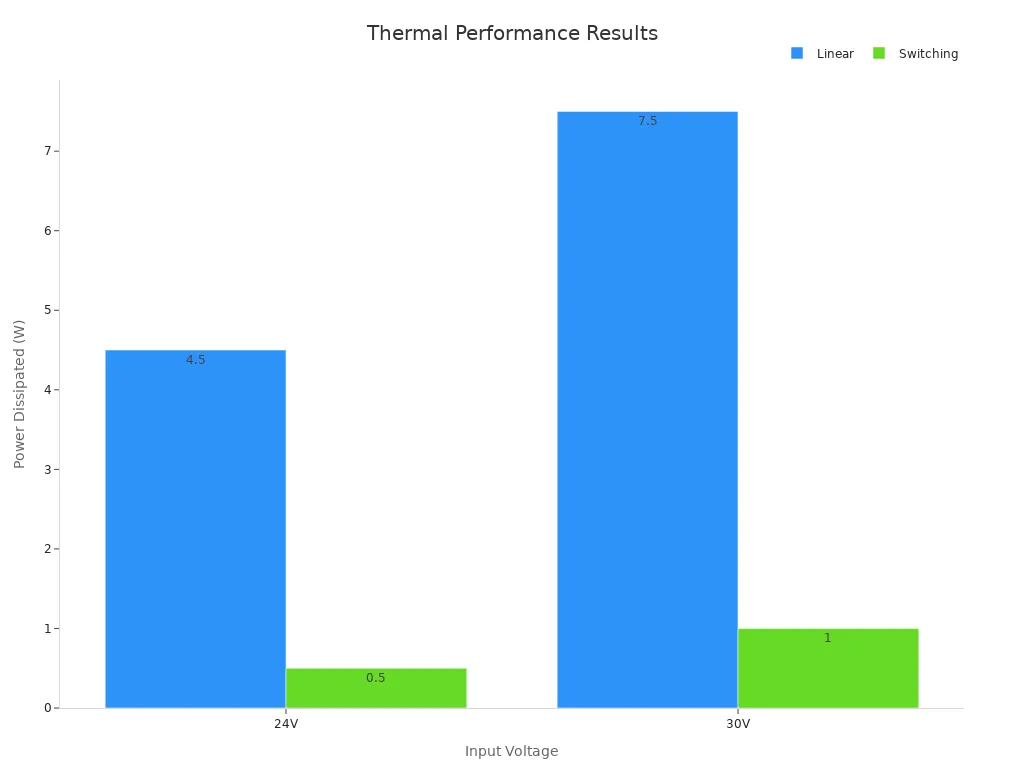
Switching regulators handle heat better, making them good for systems where cooling is important.
Noise Levels
Noise is important for devices that need clean power. Linear regulators give smooth and steady power with very little noise. This makes them perfect for things like audio gear and medical tools, where noise can cause problems.
Switching regulators, however, create noise because of their fast switching. This noise can affect sensitive circuits, especially at high frequencies. Measuring noise correctly is important to see how it affects the system.
Here’s a summary of noise measurement:
Aspect | Details |
|---|---|
Measurement Focus | Noise measurement of 48 V range voltage regulators, up to 65 V. |
Importance of Measurement | Accurate noise evaluation is crucial as power supply noise degrades load circuit performance. |
Measurement Challenges | Issues with connecting high voltage supplies to spectrum analyzers without damaging them. |
Proposed Measurement Setup | A specific setup is developed to measure noise accurately, achieving good results up to 2 MHz. |
Comparison of Methods | Different measurement setups yield consistent results, confirming the reliability of the proposed method. |
New switching regulators, like Silent Switcher models, reduce noise a lot. These designs make switching regulators better for noise-sensitive tasks. But if low noise is your top need, linear regulators are still the best option.
Size and Complexity
When picking between linear and switching regulators, size and design matter. Linear regulators are simple. They have fewer parts, like transistors and resistors. This makes them easy to use in circuits. But for high-power tasks, they can be bigger in size.
Switching regulators are more advanced. They use parts like MOSFETs and inductors to save energy. In the 1980s, MOSFETs changed how switching regulators worked. Faster switching speeds allowed smaller inductors, making regulators smaller. Today, they are compact and light, great for portable devices and tight spaces.
Switching regulators’ complex design has perks. They work better in high-power systems. Use them when size and efficiency are important. While linear regulators are simpler, switching ones are modern and efficient for saving space and power.
Cost
Cost is another big difference between these regulators. Linear regulators are cheaper. Their simple design uses fewer parts, cutting production costs. For low-power tasks, they are a budget-friendly choice.
Switching regulators cost more. They need advanced parts like inductors and MOSFETs, which raise prices. But they save energy, lowering long-term costs. For high-power systems, their efficiency can make up for the higher price.
Think about your budget and needs. Linear regulators are affordable for basic jobs. Switching regulators are worth it for saving energy in the long run.
Application-Specific Considerations
Choosing the right regulator depends on your device’s needs. Linear regulators are best for places needing low noise. Use them in audio gear, medical tools, or systems needing clean power. Their simple design works well for low-power setups.
Switching regulators are better for high-power tasks. They’re great for laptops, factory machines, and solar systems. They handle changing voltages and save space. If you need small size and high efficiency, go with switching regulators.
Think about power needs, noise levels, and space limits. Linear regulators are good for simple tasks. Switching regulators are best for demanding jobs. Picking the right one helps your system work better and last longer.
Choosing the Right Voltage Regulator
Power Needs
Picking the right voltage regulator means knowing your device’s power needs. Look at things like quiescent current, dropout voltage, and heat control. These affect how well the regulator works and fits your device.
For example, the LM1117 linear regulator is great for battery-powered gadgets. It uses very little quiescent current, saving energy. This is helpful for devices like fitness trackers or remote sensors, where long battery life matters. Its low dropout voltage also helps keep power steady, even if input voltage is close to output.
Here’s a simple table of key power factors:
Factor | What It Means |
|---|---|
Quiescent Current | Affects power use in battery devices. The LM1117 keeps this low to save energy. |
Dropout Voltage | Low dropout means better power use in portable gadgets. The LM1117 is great at this. |
Heat Control | Good heat control keeps devices reliable. The LM1117 avoids overheating for steady performance. |
By checking these factors, you can pick a regulator that works well and saves energy.
Noise Concerns
Noise is important when choosing between linear and switching regulators. If your device has sensitive parts, like in audio or medical tools, you need clean power. Linear regulators are best because they make very little noise. Their simple design gives smooth power, perfect for noise-sensitive devices.
Switching regulators create noise because they switch power quickly. Newer models, like Silent Switchers, lower noise a lot but still aren’t as quiet as linear ones. If you need both high efficiency and low noise, advanced switching regulators with noise control can help.
Think about how much noise your device can handle. For devices where noise causes problems, linear regulators are the better choice.
Cost and Budget
Your budget matters when picking a voltage regulator. Linear regulators cost less because they are simple and use fewer parts. They are a good choice for low-power tasks where efficiency isn’t a big deal.
Switching regulators cost more but save energy and work better for high-power systems. They are worth it for devices like CPUs and memory systems, where energy savings can balance the higher price.
Here are some tips to decide:
Linear regulators are cheaper, quieter, and easier to design but less efficient.
Switching regulators are better for saving energy, handling heat, and working with changing voltages.
Think about efficiency, noise, space, and heat when choosing.
Balancing cost and performance is key. If you need high efficiency, go for a switching regulator. For simpler jobs, a linear regulator is a budget-friendly option.
Applications of Voltage Regulators
Linear Regulator Use Cases
Linear regulators are great for jobs needing low noise and simplicity. They are used in audio devices, medical tools, and systems needing clean power. For example, in battery-powered gadgets like music players, they give steady voltage for better sound. Their simple design makes them reliable for low-power tasks, like powering sensors in remote areas.
Low-dropout regulators (LDOs) are a special kind of linear regulator. They work well in devices with limited energy, like smartphones and fitness trackers. LDOs are efficient when the input voltage is close to the output voltage. They are also common in small gadgets where saving space is important.
Linear regulators are best for devices that need very clean power. They are the top choice when low noise is more important than saving energy.
Switching Regulator Use Cases
Switching regulators are best for systems needing high efficiency. They are used in laptops, factory machines, and renewable energy setups. These regulators handle changing input voltages while staying efficient. For example, switching regulators waste less power compared to linear ones.
A 3.3V supply from a linear regulator loses 35% power.
Using an LDO to make 1.8V from 3.3V loses about 45%.
Switching regulators save power in fast systems without hurting performance.
Switching regulators also manage noise well, making them good for fast data systems. Their small size and energy-saving features are perfect for portable gadgets and tight spaces.
Aspect | Switching Regulators | Linear Regulators |
|---|---|---|
Efficiency | High | Low |
EMI and Noise Management | Advanced techniques available | Often problematic |
Power Loss in High-Speed Applications | Minimal | Up to 45% |
Switching regulators are ideal for tasks needing efficiency, small size, and flexibility with power changes.
Industry-Specific Examples
Voltage regulators are important in many industries. In telecom, they keep power steady for fast communication networks. Consumer electronics use small, efficient regulators for devices like tablets and smartwatches. Factory systems, like robots and controllers, need precise voltage for smooth operation.
In renewable energy, switching regulators help solar panels and wind turbines save energy. Cars use linear regulators for quiet parts like sensors and entertainment systems. These examples show how regulators fit into many uses, keeping modern tech running smoothly.
Voltage regulators are key for reliable and efficient systems. Whether for gadgets or factories, picking the right one ensures everything works well.
Knowing the differences between linear and switching voltage regulators helps you design better systems. Linear regulators are easy to use and quiet. Switching regulators are great for saving energy and handling different tasks.
Tip: Pick the right regulator based on your device’s needs.
Think about these three things when deciding:
Efficiency: Switching regulators use less energy in powerful systems.
Noise: Linear regulators give smoother power for delicate devices.
Cost: Linear regulators cost less upfront, but switching ones save money over time.
Looking at these factors will help your system work well and last longer.
FAQ
What’s the main difference between linear and switching regulators?
Linear regulators give smooth power but waste energy as heat. Switching regulators save energy but can make electrical noise.
When should you pick a linear voltage regulator?
Choose a linear regulator for devices needing quiet and steady power. They’re great for audio gear, medical tools, and small gadgets.
Are switching regulators pricier than linear ones?
Yes, switching regulators cost more because they use advanced parts. But they save energy, making them worth it for big power systems.
Can switching regulators work in devices sensitive to noise?
Switching regulators can work in these devices if you use special models. Silent Switchers lower noise while staying efficient.
How do you decide on the right voltage regulator?
Think about your device’s power, noise needs, and budget. Linear regulators are good for quiet tasks. Switching ones are better for saving energy in big systems.



Great comparison! This blog clearly explains linear vs switching voltage regulators, highlighting efficiency, heat, noise differences, and application tips for power designs.