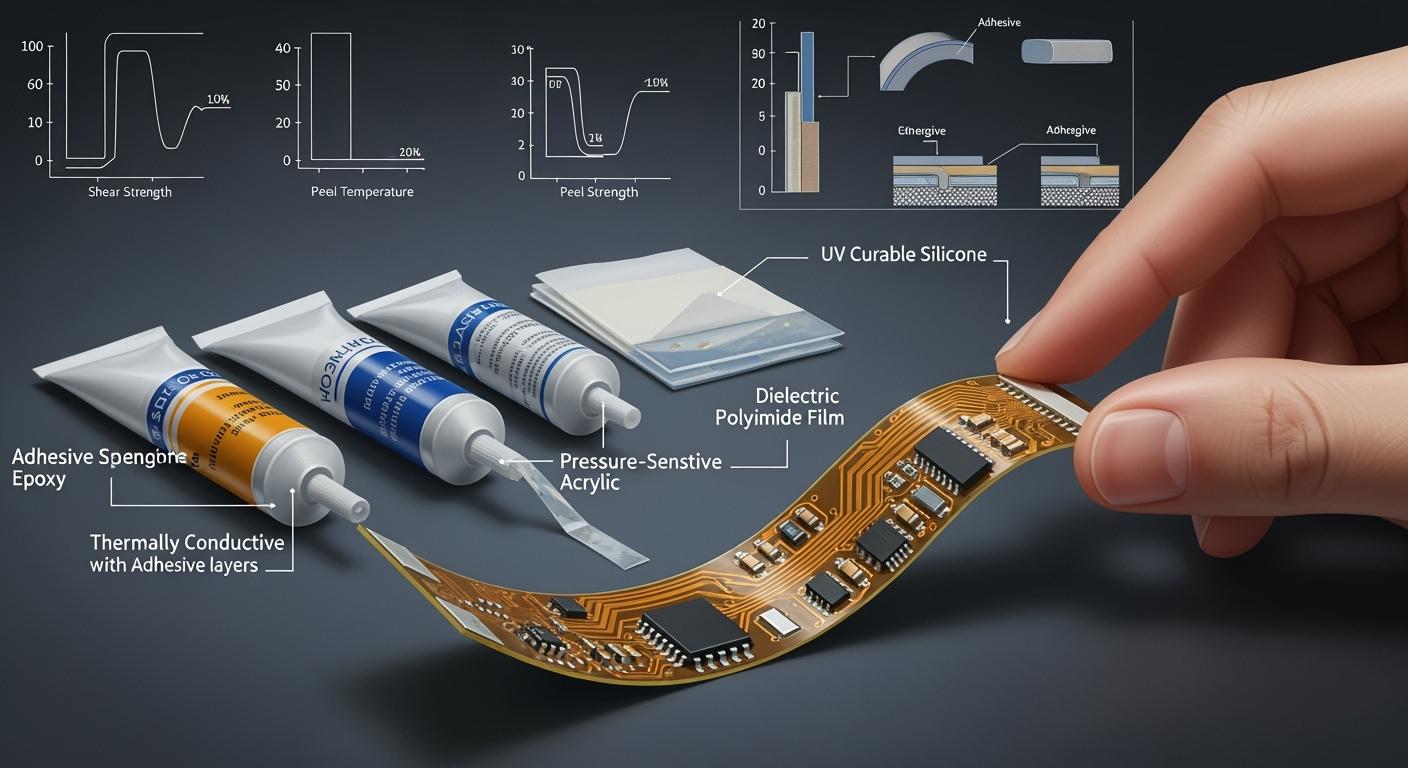
You need to pick the right adhesive for flexible PCB jobs. This helps make strong bonds and keeps things working well. The type you pick changes how your circuit deals with stress, heat, and movement. Some adhesives used in making PCBs are:
Epoxy adhesives are very reliable but work best in less bendy designs.
Acrylic adhesives are flexible and fit many circuit shapes.
Pressure sensitive adhesives are easy to use but cannot handle high heat.
Assembly-resistant adhesives can stand up to heat during making.
Anisotropic adhesives let electricity flow one way for fine pitch boards.
Key Takeaways
Pick the right adhesive to make sure bonds are strong in flexible PCBs. This choice changes how well the board deals with stress and heat.
Learn about the properties of different adhesives. Epoxy is strong but not bendy. Acrylic bends but does not handle heat as well.
Always test adhesives with the same materials you use in your design. This helps make sure they work well and fit real conditions.
Think about the environment when you pick adhesives. High heat and wetness can make bonds weaker, so choose the right one.
Use industry rules like IPC-6013 to help you pick and test adhesives. This helps keep quality and reliability high.
Adhesives in Flexible Circuit Boards: Why Selection Matters
Performance and Reliability Impact
Picking the right adhesive is very important for flexible printed circuit boards. Adhesives hold together layers like laminate, copper, coverlays, bondplys, and stiffeners. Each layer needs to stick well so the board works for a long time. If you use the wrong adhesive, problems can happen. The board might crack, peel apart, or lose its bendy shape. These problems can make the board stop working if it gets hot or moves a lot.
Tip: Always check if the adhesive works for your board’s heat and stress.
The table below shows how different things can change how well flexible printed circuit boards work:
Factor | Impact on Reliability |
|---|---|
Bonding Strength | Weak bonding can make the board break or move. |
Thermal Resistance | If it can’t handle heat, the board can bend or peel. |
Material Compatibility | If materials don’t match, the board can split or break. |
You should pick adhesives that bend easily and stick well. Good heat resistance helps the board last through hot and cold. Using adhesives with low dielectric properties can help stop signal problems and make the board work better. Thin adhesive layers are good for small boards because they save space and keep the board light.
Common Adhesive Applications
Adhesives are used for many jobs in flexible printed circuit boards. They stick copper layers and coverlays together to keep the circuits safe from harm. Coverlay adhesives protect solder joints and traces from rust and damage. Adhesives also hold stiffeners in place to make some parts of the board stronger.
Adhesives help the board keep its shape and work right.
Coverlay adhesives are needed for strength and safety.
Pressure adhesives are easy to use but not good for hot boards.
When you pick the right adhesive, the board works better and lasts longer. The board stays bendy, strong, and ready to do its job.
Types of Adhesives and Their Uses
Flexible PCBs need the right adhesive to work well. You should know about the different adhesives and how they help your design. Each adhesive has special features for certain jobs.
Epoxy, Acrylic, Silicone, Polyurethane
There are four main adhesives for flexible PCBs. These are epoxy, acrylic, silicone, and polyurethane. Each one has its own benefits.
Epoxy adhesives are strong and last a long time. You use them when you need a tough bond. Epoxy works with polyimide and pet films. It can handle chemicals and high heat. Use epoxy if your board faces hard conditions or stress. Epoxy dries hard and does not bend much. This makes it better for boards that do not need to flex a lot.
Acrylic adhesives are good when you need flexibility. You can use acrylic with polyimide and pet layers. Acrylic sticks to metals, plastics, and glass. It can handle chemicals and UV light. Acrylic stays soft after it dries, so your board can bend. Use acrylic for circuits that move a lot. Acrylic does not do well with high heat. It gets soft above 180°C.
Silicone adhesives are very flexible and can handle hot and cold. Use silicone if your board faces extreme temperatures. Silicone works with polyimide and pet. It can handle chemicals and keeps its shape in heat. Silicone is good for boards that heat up and cool down a lot. Pick silicone if your board needs to bend many times.
Polyurethane adhesives are strong and flexible. You can use polyurethane with polyimide and pet. It can handle chemicals and rough use. Polyurethane is good for tough places. Use polyurethane if your board gets handled a lot or needs to last.
Here is a table to help you compare epoxy and acrylic adhesives:
Property | Epoxy Adhesives | Acrylic Adhesives |
|---|---|---|
Flexibility | Not very flexible, dries hard | More flexible, stays soft after drying |
Thermal Resistance | Handles high heat, good for hot boards | Not as good with heat, softens at 180–200°C |
Bond Strength | Best at high temperatures | Not good for hot boards |
Coefficient of Expansion | Low, good for many layers | Higher, can move in Z-axis |
Tip: Use epoxy for strong, heat-safe bonds. Use acrylic for flexible, bendy boards.
Reinforced and Pressure Sensitive Adhesives
You will see reinforced adhesives and pressure sensitive adhesives in many flexible PCB builds. Reinforced adhesives have extra fibers or fillers. These make your board stronger and stop it from tearing. You can use reinforced adhesives with polyimide and pet to help your board last.
Pressure sensitive adhesives stick when you press them down. You do not need heat or special tools. You can use pressure sensitive adhesives to put boards together fast. These adhesives work with polyimide and pet stiffeners. They help you attach stiffeners or shields. Pressure sensitive adhesives do not work well with high heat or heavy stress. Use them for simple jobs or boards that stay cool.
Here are some ways you can use pressure sensitive adhesives:
Attach stiffeners to flexible parts.
Stick shields or covers to polyimide or pet layers.
Hold parts in place while you build.
Note: Pressure sensitive adhesives make building easy, but do not use them for boards that get hot.
Reinforced adhesives and pressure sensitive adhesives help you make strong, safe circuits.
Rigid-Flex vs. Flexible PCB Adhesives
You need to know the difference between adhesives for rigid-flex and flexible PCBs. Rigid-flex PCBs have stiff and bendy parts. You can use thermosetting adhesives or pressure sensitive adhesives in rigid-flex boards. Thermosetting adhesives dry with heat and make strong bonds. Pressure sensitive adhesives help you attach stiffeners or shields fast.
Fully flexible PCBs often use thermosetting adhesives for special jobs. You may need them for ZIF connectors or to stick polyimide layers. Thermosetting adhesives work with polyimide and pet. They help your board stay bendy and strong.
Here is a table to show the differences:
PCB Type | Adhesive Type | Cost Implication |
|---|---|---|
Rigid-Flex | Adhesive or Adhesiveless | Cost changes by stiffener type |
Fully Flexible | Usually Adhesiveless | Often costs more |
You will find special adhesives for rigid-flex boards. FR Series adhesives are UL-approved and used in many flex circuits. LF Series adhesives are for high-reliability jobs. Epoxy-based adhesives give you better hole quality and work up to 150°C. Acrylic-based adhesives work up to 105°C.
Here are some things to remember:
Rigid-flex PCBs can use thermosetting flex adhesive or pressure sensitive adhesives.
Fully flexible PCBs often need thermosetting adhesive for connectors.
You can stick copper to polyimide or pet with thermosetting adhesives.
Stiffeners make flex areas stronger and need strong adhesive bonds.
Thermosetting adhesives are important for both rigid-flex and flexible PCBs. You must use them with polyimide and pet to get strong boards. Pressure sensitive adhesives help you build fast, but use them only for easy jobs.
Key Factors for Selecting Adhesives

When you pick an adhesive for flexible PCB jobs, you need to think about a few important things. The right adhesive helps your board last longer and work better. You should look at flexibility, strength, thermal resistance, environmental conditions, electrical properties, and how well the adhesive fits with flexible substrates. You also need to choose if you want thermosetting adhesives or other types.
Flexibility and Strength
Your adhesive should keep your board strong and flexible. Flexible substrates need adhesives that bend without cracking. Thermosetting adhesives make better bonds for copper foil and stiffeners. These adhesives help your board handle stress and movement. You should check flexural strength and bend radius tolerance. High elasticity adhesives, like acrylics, are good for boards that bend a lot. Thermosetting adhesives give strong bonds for places that need more support.
Here are some things to check:
The adhesive should bond copper foil to flexible substrates.
Thermosetting adhesives help attach stiffeners and keep the board strong.
Pick adhesives that match what your board needs to do.
Thin adhesive layers, about 12 to 25 μm, are best for small designs.
You can use different tests to check flexibility and strength. The table below shows common tests:
Test Method | Description |
|---|---|
Peel Strength Test | Measures how strong the adhesive holds copper and flexible substrates using a 90-degree peel test. |
Static Bend Test | Checks how the board reacts to stress using a 3-point or 4-point setup. |
Dynamic Bend Test | Bends the board many times to see if it gets tired or breaks. |
Roll-to-Flex Bending Test | Tests how the board works when bent over a small radius, which is important for tight bends. |
Tip: Always test your adhesive with the same flexible substrates you use in your design.
Thermal and Environmental Resistance
Your adhesive must handle the temperatures and places your board will be used. Thermosetting adhesives work well for boards that get hot or cold. Flexible substrates like polyimide need adhesives that keep their bond at high temperatures. Thermosetting adhesives help your board survive tough conditions.
The table below shows how different conditions change adhesive performance:
Condition | Effect on Adhesive Performance |
|---|---|
Low Temperature | Adhesives may lose stretch, get brittle, and not stick as well. |
High Temperature | Thermosetting adhesives need to cure right; weak bonds happen if curing is not enough. |
High Humidity | Water can make the bond weaker and lower adhesive quality. |
Extreme Humidity | Condensation can make the bond even weaker. |
You should look at the thermal resistance ratings for different adhesives. The table below helps you compare:
Adhesive Type | Continuous Temperature Rating | Notes |
|---|---|---|
Acrylic-based | Low (standard applications) | Used for boards that do not need high temperature |
Modified flexible epoxy | 130 – 140°C | Good for medical boards that need autoclaving |
Polyimide | 220°C+ | Needed for jobs with high heat like drilling |
Thermosetting adhesives give better thermal stability. You should use them with flexible substrates that need to work in hot or cold places.
Note: Always check if your adhesive can handle the hottest and coldest temperatures your board will face.
Electrical Properties and Compatibility
You need to think about how your adhesive affects your board’s electrical performance. Thermosetting adhesives help keep signals working well. Flexible substrates need adhesives with low dielectric constant and loss tangent. This helps your board work well at high speeds.
You must also check if your adhesive matches your flexible substrates. If they do not match, your board can fail. For example, drilling through acrylic adhesives can hurt plated through holes. This happens because acrylic adhesives move a lot in the Z-axis when heated. Thermosetting adhesives work better with polyimide and PET flexible substrates.
Here is a checklist to help you pick the right adhesive:
Make sure the adhesive matches your flexible substrates.
Use thermosetting adhesives for boards that need high speed or reliability.
Check dielectric properties for good signals.
Look for adhesives that meet IPC standards.
Think about cost and performance; adhesiveless boards cost more but work better.
Tip: Always test your adhesive with your flexible substrates and check for compatibility before you finish your design.
Decision-Making Checklist
You can use this checklist to help you pick the best adhesive for your flexible PCB:
Does the adhesive stick well to your flexible substrates?
Can the adhesive handle the temperatures your board will face?
Does the adhesive stay strong in wet or humid places?
Does the adhesive have the right properties for your signals?
Do thermosetting adhesives meet your reliability needs?
Is the adhesive good for your manufacturing process?
Does the adhesive meet IPC and other standards?
Will the adhesive work with the thickness and bend radius you need?
Are you using thermosetting adhesives for places that need extra strength?
Have you tested the adhesive with your flexible substrates and board design?
If you follow these steps, you can pick the best adhesive for your flexible PCB. Thermosetting adhesives work well for most jobs, especially with flexible substrates. You get better reliability and performance when you match the adhesive to your board’s needs.
Resources and Further Reading
Industry Standards and Testing
You should know the rules and tests for picking adhesives for flexible PCBs. The IPC-6013 standard gives you important tips for choosing and testing adhesives. This rule helps you pick materials that keep your board bendy, strong, and safe. You can use these rules to make sure your board meets what the industry wants.
Here is a table with groups and their rules for flexible circuit boards:
Standard Code | Description |
|---|---|
IPC-6011 | General rules for all printed circuit boards. |
IPC-6012 | Rules for rigid printed circuit boards. |
IPC-6013 | Rules for flexible printed circuit boards. |
IPC-FC-2221 | Guide for designing all printed circuit boards. |
IPC-FC-2223 | Guide for designing flexible printed circuit boards. |
IPC-4203 | Rules for adhesive-coated films for flexible circuits. |
Testing helps you see if your adhesive works well. You can use these tests to check strength and safety:
Testing Protocol | Purpose |
|---|---|
Peel Strength Test | Checks how well copper sticks to the board. |
Tensile and Shear Testing | Checks how strong solder joints and connectors are. |
Environmental and Reliability Testing | Makes sure Flex PCBs work in tough places. |
Tip: Always use the right rules and tests to make sure your adhesive is safe and good quality.
Expert Advice and Consultation
You can make your board better by listening to experts. Experts say acrylic adhesives are good for flexible boards because they stay soft and strong. Epoxy adhesives are best for stiff parts because they dry hard. Pressure-sensitive adhesives are easy to use for most flexible PCB jobs.
IPC 2223 tells you how to build coverlays and use adhesive flex cores.
You can use acrylic or epoxy adhesives for coverlays.
Vias drilled through adhesive can have problems from heat.
If you want the best board, talk to PCB experts or engineers. They can help you pick the right adhesive for your board. You can also check IPC rules and test methods for more help. This way, your flexible PCB will be strong and work well.
Note: Always talk to experts and check the rules before you pick your adhesive.
You make flexible PCBs work better when you pick the right adhesive. Each adhesive type is good for certain jobs. The table below shows what each one does best and where it works:
Adhesive Type | Strengths | Limitations | Applications |
|---|---|---|---|
Epoxy | Makes a strong, hard bond | Does not bend much | Good for strong support and stress |
Acrylic | Bends easily and is simple to use | Not as strong as others | Used for circuits that need to move |
PSA | Bonds fast and is easy to use | Cannot take much heat | Best for short-term or cool jobs |
There are new changes in adhesives, like using AI and IoT. More people want flexible devices now. Always follow the rules and ask experts to get the best results.
FAQ
What adhesive works best for flexible PCBs?
Acrylic adhesives are good for most flexible PCBs. Acrylics bend and keep boards strong. Epoxy adhesives are best for stiff parts. Silicone adhesives help with very hot or cold places.
How do you test adhesive strength in flexible circuits?
You can use a peel strength test. This test shows how well adhesive holds copper. You pull the layers apart and see how much force it takes.
Can you use pressure sensitive adhesives for high-temperature boards?
No, do not use pressure sensitive adhesives for hot boards. These adhesives get weak when they get hot. Thermosetting adhesives work better with heat.
What standards help you choose adhesives for flexible PCBs?
You should use IPC-6013 and IPC-4203 standards. These rules help you pick safe adhesives for flexible circuit boards.
Do all adhesives work with polyimide and PET substrates?
Not every adhesive fits every substrate. You must check if they match before building. Epoxy, acrylic, and silicone adhesives usually work with polyimide and PET.