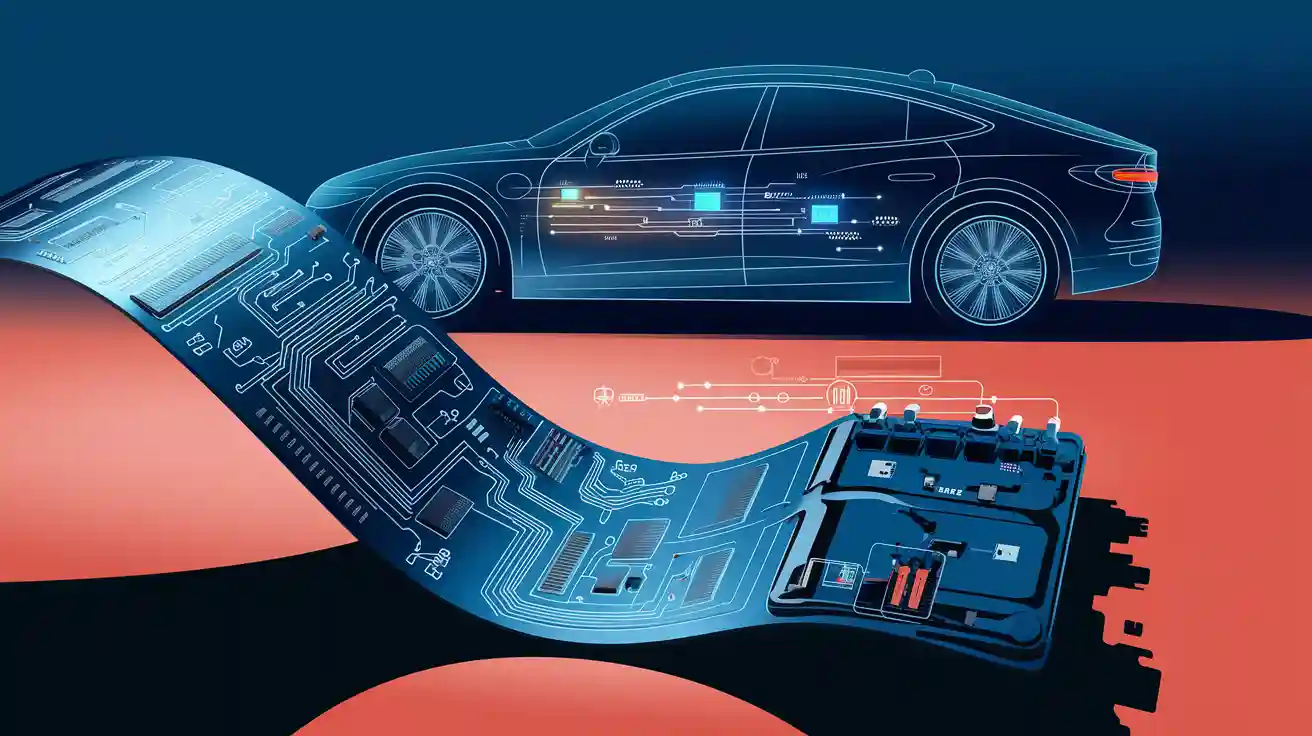
Flexible PCBs change how people control energy in electric cars. These PCBs add flexibility and make car designs more reliable. You need good battery systems for your car to work well and go far. Flexible PCBs deal with shaking, heat, and small spaces better than stiff boards. They help car makers build lighter and smaller cars. Recent data shows more people are using flexible PCBs. For example, the market was $21.42 billion in 2023. It may grow to $61.75 billion by 2032. Big car companies like Volkswagen now use flexible PCBs for battery management in electric cars. This change makes cars work better and safer. It also sets new rules for the car industry.
Key Takeaways
Flexible PCBs can bend and fit into tight spaces. This makes car electronics lighter. It also makes them smaller and more reliable.
They help manage batteries by controlling temperature, voltage, and current. This keeps batteries safer and helps them last longer.
Flexible PCBs deal with heat, shaking, and cold better than stiff boards. This means car electronics work well even in hard conditions.
Using flexible PCBs makes cars lighter and saves space. This helps electric cars go farther and use energy better.
Flexible PCBs cost more at first. But they save money later by needing fewer repairs and having fewer assembly mistakes. They also last longer.
Flexible PCB Basics in Automotive
What Is a Flexible PCB
A flexible PCB is not like other circuit boards. It can bend and twist because it uses special materials. This helps it fit into small or oddly shaped spaces in cars. Most flexible PCBs are made from polyimide. Polyimide can handle heat and stress very well. These boards have thin copper lines that bend many times and do not break.
Here is a table to help you learn about flexible PCBs in cars:
Aspect | Details |
|---|---|
Substrate Material | Flexible substrates like polyimide, allowing bending and folding to fit complex shapes. |
Key Characteristics | Flexibility, lightweight, durability, high-density interconnect capability, thermal management. |
Manufacturing Process | Material selection, circuit patterning, drilling, plating, lamination, component assembly. |
Design Considerations | Bend radius, electrical and thermal management, routing/layout techniques. |
Automotive Applications | Electronic control systems, sensors and displays, infotainment/navigation systems. |
Advantages in Automotive | Reliability, space-saving, durability under mechanical stress and harsh environments. |
Flexible PCBs have thin layers and special coatings to keep circuits safe. You can find them in many car electronics like sensors, screens, and control units. These PCBs help make cars lighter and smarter.
Why Flexible PCBs Matter in Automotive
Flexible PCBs are important in car electronics. Cars need more electronics in smaller spaces as they get smarter. Flexible PCBs can bend and fit into tight places. They connect different car parts without using big wires.
You can see flexible PCBs in battery management, sensors, and screens. They work better with shaking, heat, and cold than stiff boards. This means your car works better in tough places. Flexible PCBs also make cars lighter, so they use less energy and go farther.
Tip: Flexible PCBs help you make car electronics small and strong. You can use them to link rigid boards in tiny spaces. This makes your car’s electronics work better.
Flexible PCBs help with complex car designs. You can use multilayer boards and rigid-flex PCBs, which mix flexible and stiff parts. This design uses fewer connectors and cables. It makes electronics easier to build and more reliable. As cars get more sensors and smart features, flexible PCBs become even more useful.
Applications of Flexible PCBs in Electric Vehicles
Flexible PCBs have changed how people use electronics in cars. You can find these PCBs in many electric vehicle parts. They help make systems smarter, lighter, and more reliable. Flexible PCBs do more than just connect things. People use them for battery management, motor control, sensors, lighting, and displays. These new uses replace heavy wiring harnesses. This makes cars smaller and easier to design.
Battery Management Systems
Battery management systems keep electric vehicles safe and working well. Flexible PCBs are important in these systems. They fit into small spaces inside the battery pack. People use them to connect sensors and controllers. This helps check and control every battery cell.
Here are some ways flexible PCBs help with battery management:
They hold sensors and controllers to talk across the battery pack.
They balance cell voltages so each cell charges evenly.
They watch cell temperatures to stop overheating or freezing.
They limit high currents to keep things safe.
They stop overcharging or deep discharging of cells.
They adjust charging for different sources, like AC or DC fast charging.
They shut down the battery if it gets too hot or has too much current.
You get a system that is strong, heat-resistant, small, and reliable. Flexible PCBs make battery management systems lighter and safer. You can trust them to work in tough car conditions.
Motor Control and Sensors
Motor control is very important in electric vehicles. Flexible PCBs are used in motor control units to manage torque, speed, and efficiency. These PCBs handle high currents and help move heat away. This helps the motor work better and last longer.
Flexible PCBs also help connect sensors. Sensors are needed for smart car features and safety systems. Flexible PCBs for sensors let signals move fast and data get processed quickly. This helps safety features and lets the car react to the road.
Cars have problems like heat, shaking, and small spaces. Flexible PCBs fix these problems. They help build smaller and stronger systems. High-density interconnect PCBs meet the needs of electric vehicles.
Car Lighting and Displays
Lighting is important in every car. Flexible PCBs are used for headlights, taillights, and inside lights. These PCBs let you make new shapes and designs. You can bend them to fit small or curved spaces. This gives more freedom in car design.
Flexible PCBs also power screens in dashboards and infotainment systems. You need clear, bright screens for maps and music. Flexible PCBs make these electronics lighter and more reliable. You can use fewer wires and connectors, which saves space and weight.
Here is a table showing how flexible PCBs help with lighting and displays in electric vehicles:
Application | How Flexible PCBs Help | Benefit to You |
|---|---|---|
Headlights | Allow unique shapes and better heat control | Brighter, more stylish lights |
Taillights | Fit into slim, curved spaces | Sleeker car design |
Interior Lighting | Enable flexible, custom light strips | More comfort and style |
Displays | Support thin, lightweight screens | Better information and safety |
Note: Flexible PCBs for lighting and displays help save space and lower weight. You get more reliable and energy-saving car electronics.
You can see flexible PCBs in many parts of modern electric vehicles. They help make cars smarter, safer, and more efficient. These uses show why flexible PCBs are now very important in car electronics.
Integration with Electric Vehicles: Key Benefits
Space and Weight Reduction
If you want your electric car to go farther, you need to save energy. Flexible PCBs help you do this. These PCBs can bend and fold to fit in small places. You can put them where rigid boards will not fit. This lets you make car parts smaller and lighter.
Flexible PCBs can wrap around curves and corners.
You do not need big connectors or lots of cables.
You can stack or fold PCBs to save even more space.
Using fewer heavy parts makes your car weigh less.
Flexible PCBs help make car electronics tiny. You see them in dashboards, music systems, and battery controls. When you use flexible PCBs, your electronics get lighter and smaller. This helps your car drive better and go longer distances.
Tip: Every bit of weight you save helps your car go farther. Flexible PCBs help you cut weight but keep good performance.
Durability and Reliability
Your electric car faces hard conditions every day. It shakes, gets hot, and cools down quickly. Flexible PCBs are strong and last a long time in these tough spots. They handle shaking, heat, and wetness better than regular boards.
A science test checked PCBs in real car situations. The tests included:
Test Type | Description | Conditions / Parameters | Relevance to EV Conditions |
|---|---|---|---|
Accelerated Life Testing (ALT) | Shows how PCBs last under stress in less time. | 125°C, 85% RH, 1000 hours; like 10 years of use | Proves PCBs last in hot, wet car places. |
Vibration Testing | Checks if PCBs can take shaking from roads. | 5 Hz to 2000 Hz, up to 20 G acceleration, 8 hours test | Makes sure PCBs do not break from car bumps. |
Thermal Shock Testing | Sees if PCBs can handle fast hot and cold changes. | Cycles between -55°C and 125°C with <10s transition, 100-500 cycles | Shows PCBs work in big temperature swings. |
HALT/HASS Testing | Pushes PCBs past normal to find weak spots. | HALT: -100°C to 200°C, up to 50 G vibration; HASS: 120°C, 20 G vibration for 30 min | Checks PCBs are strong for important car parts. |
Flexible PCBs use tough insulation and tight layers. This keeps your electronics safe from cracks. Rigid-flex PCBs mix stiff and bendy parts. You need fewer connectors and cables, so there are fewer things to break. Your car electronics last longer and need less fixing.
Flexible PCBs can take heat, shaking, and wetness.
They keep signals clear and lower electrical resistance.
Your battery systems stay cooler and work better.
You can trust flexible PCBs to keep your car working well. They protect your electronics and make them more reliable in all weather.
Enhanced Energy Efficiency
You want your electric car to use energy smartly. Flexible PCBs help by making systems work better. These PCBs have thin copper lines and small designs. This means less energy is lost and signals move faster.
Flexible PCBs help stop energy from turning into heat. Your battery systems work better and waste less power. Fewer connectors also mean less energy is lost. More power goes to moving your car, not wasted inside.
Flexible PCBs let you build cool 3D designs for better energy flow.
They help your electronics stay cool and not overheat.
Your car works well for a long time.
When you use flexible PCBs, your car systems get smarter and use less energy. Your car can go farther on each charge. This is important for making electric cars better for everyone.
Note: Flexible PCBs save space and weight. They also help your car use energy better and last longer, so they are a smart pick for car electronics.
Overcoming Challenges in Automotive Flexible PCB Design
Manufacturing and Assembly
Working with flexible PCBs in cars is not easy. You need special skills and careful planning to make them. Picking the right materials is important for heat, bending, and stress. Many engineers use both rigid and flexible boards together. This makes the PCBs stronger and easier to use. It also means you need fewer connectors and cables, so your parts are lighter and smaller.
To fix problems in making these PCBs, you can use new design tools and careful engineering. High-density interconnects and 3D printing help you make shapes that fit tight spaces. These new ideas make flexible PCBs work better and are easier to put together. You also get better electrical performance, which is important for cars.
Tip: Rigid-flex PCBs can make assembly easier by removing extra connectors and cables. This helps stop wiring mistakes and makes your electronics work better.
Quality and Reliability Assurance
You want your flexible PCBs to last in tough car conditions. The industry uses strict rules like ISO 26262 and AEC-Q100 to keep PCBs safe and reliable. These rules say you must test PCBs for heat, shaking, and shock. You have to pick materials that do not get hurt by water and can take high heat.
Testing includes bending, heating and cooling, and shaking the PCBs. These tests show if your PCBs can last in real cars. You also need to follow IPC-6012DA rules for making and testing PCBs. Good thermal management keeps your PCBs from getting too hot and breaking. Meeting these rules helps your electronics work well in any weather.
Bend tests check if your PCBs can bend many times.
Thermal tests show if your PCBs can take big temperature changes.
Vibration tests make sure your PCBs do not break on bumpy roads.
Cost and Design Complexity
Flexible PCBs can cost more to make at first. You need special designs and test models, which adds to the price. Not all companies can make these PCBs, so you may have fewer choices. Fixing or changing flexible PCBs is harder than with stiff boards.
But you save money over time. Flexible PCBs make things smaller and lighter, which is good for cars. You use fewer connectors and cables, so building is faster and cheaper. You also make fewer wiring mistakes. The table below shows how flexible PCBs compare to old ways:
Cost Benefit Aspect | Explanation |
|---|---|
Durability and Reliability | Fewer connectors mean longer life and fewer failures. |
Weight and Size Reduction | Smaller and lighter designs help you build compact automotive systems. |
Assembly Simplification | Less wiring means faster, easier assembly and fewer mistakes. |
Testing Efficiency | Fewer test cycles save you time and money. |
Production Cost Savings | Mass production lowers costs with fewer parts and simpler assembly lines. |
Application Suitability | Best for compact, lightweight, and reliable automotive electronics. |
Cost Considerations | Higher initial costs, but long-term savings depend on production volume and expertise. |
Note: Always check the costs and benefits before picking flexible PCBs for your car design. The long-term savings are often worth the higher starting price.
You can see cars changing quickly as electric vehicles get better. Flexible PCBs help make cars safer, lighter, and more efficient. These boards help battery management work well and last longer. Car makers now use new materials and mixed designs to handle heat and hard conditions.
You will see smaller and stronger electronics in new cars.
New ideas include better ways to control heat and use special materials.
More people want these solutions as electric vehicles become more common.
FAQ
What makes flexible PCBs better than traditional wiring in electric cars?
Flexible PCBs can bend and fit in small places. You do not need as many wires or connectors. This makes your car lighter and more dependable. Flexible PCBs also work well with heat and shaking, unlike old wiring.
Can flexible PCBs handle extreme temperatures in electric vehicles?
Yes! Flexible PCBs use polyimide, which is very strong. This material can take a lot of heat and cold. Your car’s electronics stay safe and work in any weather.
How do flexible PCBs improve battery management systems?
You get more control and safety for your battery. Flexible PCBs link sensors and controllers inside the battery pack. This helps you check temperature, voltage, and current for each cell.
Are flexible PCBs expensive to use in electric cars?
Cost Factor | Impact |
|---|---|
Initial Cost | Higher |
Long-Term Saving | Significant |
Maintenance | Lower |
You pay more at the start. Later, you save money because your car breaks less and lasts longer.