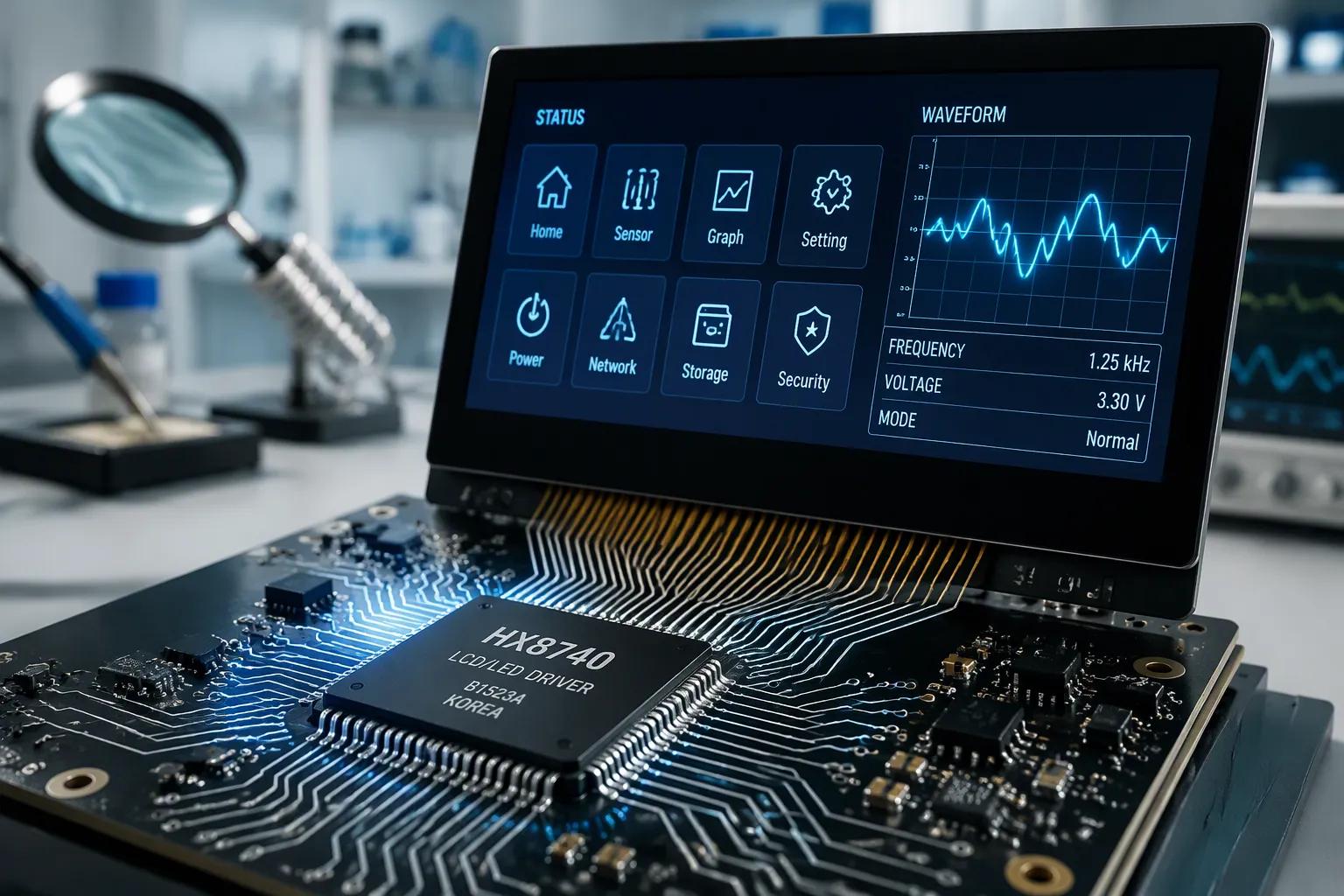
Awakọ ifihan LCD/LED kan n yi data oni-nọmba pada si imọlẹ. Awọn IC awakọ inu module naa n tumọ awọn ifihan agbara oni-nọmba lati inu wiwo si awọn voltages analog. Awọn voltages wọnyẹn n ṣeto imọlẹ pixel kọọkan lori ifihan naa. Ọna lọtọ kan n gbe awọn pulses data ati timing timing ti o jẹ ki gbogbo pixel wa ni igbesẹ.
Think of the division of labor this way: one side is the delivery route, and the driver is the translator at the door. One moves bits; the other converts them into the analog control each pixel needs. Driver ICs also run the control sequence for each frame. Neither half works alone.
O yoo rii ajọṣepọ yii ni ọna ti o dara julọ nipa bibẹrẹ pẹlu nronu funrararẹ, lẹhinna tẹle iran awọ, akoko ifihan agbara, ati apẹẹrẹ akoko ti a ṣiṣẹ.
Awọn Iparo bọtini
Driver ICs turn digital data into analog voltages that set pixel brightness.
Àwọn ìfọwọ́sowọ́pọ̀ bíi RGB parallel, I2C, SPI, àti MIPI DSI máa ń gbé àwọn àmì dátà àti àkókò lọ sí awakọ̀ náà.
Àwọn ìlànà àkókò bíi VSYNC, HSYNC, àti àwọn ìloro gbọ́dọ̀ bá ìwé àkọsílẹ̀ pánẹ́ẹ̀lì mu láti yẹra fún ìṣòro àwòrán.
LED drivers use constant current to keep brightness stable and PWM to dim without color shift.
Àfihàn àṣìṣe nípa ṣíṣàyẹ̀wò ìpele kan ní àkókò kan àti gbígbà àwọn iye àkókò fún àtúnṣe pátákó kọ̀ọ̀kan.
TFT Panel Structure and Operation
How a Thin-Film Transistor Controls a Pixel
You can think of each thin-film transistor as a tiny switch. Column and row wires connect to these switches, with one switch per pixelÀgbékalẹ̀ transistor náà ń gba ìṣàn lọ́wọ́lọ́wọ́ ní ìtọ́sọ́nà kan ṣoṣo. Ìwà ọ̀nà kan náà yẹn ń jẹ́ kí agbára ìṣiṣẹ́ lórí píksẹ́lì kọ̀ọ̀kan má ṣe gbóná láàrín àwọn àtúnṣe.
Púksílì kọ̀ọ̀kan ń ṣiṣẹ́ gẹ́gẹ́ bí kápásítọ̀ kékeré kan. Fíìmù kírísítà omi tí ó ń dènà ìdènà wà láàárín àwọn fẹ́lẹ́fẹ́lẹ́ onímọ́ọ́nì (ITO), sánwísì yìí sì ń tọ́jú agbára náà. Èyí ni èyí charge sequence for a pixel ní ìlà Kìíní, ọ̀wọ́ J:
Sẹ́ẹ̀tì TFT T(I,J) ń ṣiṣẹ́.
Fólẹ́ẹ̀tì àfojúsùn náà ń ṣàn láti ìlà àmì D(I) sí elektirọdu píksẹ́lì.
The switch turns off once the electrode is fully charged, and the pixel capacitor holds the charge.
Awakọ data (column) naa n pese foliteji afojusun, ati awakọ ẹnu-ọna (line) n ṣakoso iyipada titan/pipa.
During the ON stage (tON), a high gate voltage Vg charges the liquid crystal capacitor. The data voltage Vd becomes the pixel voltage Vp. During the OFF stage (tOFF), Vg is low and Vp holds steady. A small drop in Vp at the ON-to-OFF transition is called the feed-through voltage.
Ìṣètò Ẹ̀rọ Itanna Panel àti Ìgbékalẹ̀ Awakọ̀
Pánẹ́ẹ̀lì náà ní àwọn wáyà méjì. Àwọn ìlà ẹnu ọ̀nà ń ṣiṣẹ́ ní àwọn ìlà, àwọn ìlà orísun (dátà) sì ń ṣiṣẹ́ ní àwọn ọ̀wọ́n. Ìrìnàjò ìwakọ̀ ìlẹ̀kùn náà dúró ní etí páànẹ́lì náà ó sì ń lù gbogbo ìlà ní ìtẹ̀léra. Àwọn ics awakọ̀ ìlẹ̀kùn náà wà ní ẹ̀gbẹ́ kejì, wọ́n sì ń fi àwọn fólítì sínú àwọn ọ̀wọ́n náà.
Àwọn awakọ̀ ics wọ̀nyí ni wọ́n ń ṣe ètò ìṣàkóso tí ó so ẹ̀rọ ìtọ́jú rẹ pọ̀ mọ́ gíláàsì. Àwọn awakọ̀ ics ẹnu ọ̀nà ń ṣe àyẹ̀wò àwọn ìlà kan lẹ́ẹ̀kan, àwọn awakọ̀ orísun sì ń kọ dátà sínú ìlà tí a yàn. Ìṣètò yìí jẹ́ kí awakọ̀ àpapọ̀ LCD/LED ṣe àtúnṣe gbogbo píksẹ́lì ní ìtẹ̀léra kíákíá àti ní ìtòlẹ́sẹẹsẹ. Nítorí pé ìpele kirisita omi ń tọ́jú fólítì, ìfihàn náà ń mú àwòrán rẹ̀ dúró ṣinṣin, ipa ọ̀nà ìṣàkóso náà sì lè tún fólítì náà kọ ní kíákíá nípasẹ̀ TFT.
Ilana awakọ ti iboju LED kan
LCD sí LED Backlight àti LED Matrix Panels
Ọ̀pọ̀lọpọ̀ àwọn ọjà tí a tà gẹ́gẹ́ bí TV LED tàbí monitor jẹ́ LCD. Ìlà LED funfun kan wà lẹ́yìn ìpele kristal olomi ó sì ń ṣiṣẹ́ gẹ́gẹ́ bí orísun ìmọ́lẹ̀. Kristali olomi náà ṣì ń ṣe iṣẹ́ pixel náà, awakọ̀ ìmọ́lẹ̀ backlight sì ń ṣètò ìwọ̀n ìmọ́lẹ̀ náà. Ibojú LED gidi yàtọ̀. Pọ́ọ̀sílì kọ̀ọ̀kan jẹ́ LED tirẹ̀, pánẹ́ẹ̀lì náà kò sì nílò ìpele kristal olomi rárá.
This distinction shapes the whole led display system. In a backlit LCD, the led driver only sets overall light output. In a true LED matrix, led drivers set every pixel directly. Both cases rely on the same driving principle of an led screen: feed each LED a controlled current and let light follow.
Ofin Foliteji Iwaju ati Ilana Lọwọlọwọ
LED máa ń tàn nígbà tí fóltéèjì iwájú (VF) bá ń ti iná jáde láti inú ìsopọ̀ náà. VF kò dúró ṣinṣin. Ó máa ń já bọ́ bí ìsopọ̀ náà ṣe ń gbóná sí i, ìdínkù náà sì sinmi lórí ohun èlò LED náà.
Awọ LED | Typical Vf | Olùsọdipúpọ rẹ otutu |
|---|---|---|
Red (AlGaInP) | ~2.0V | −2.0 mV/°C |
Green (InGaN) | ~3.0V | −3.0 mV/°C |
Aláwọ̀ búlúù (InGaN) | ~3.2V | −3.0 mV/°C |
White (InGaN + phosphor) | ~3.2V | −3.0 mV/°C |
Circuit resistor kan n lo lupu ti o lewu:
Iwọn otutu ga soke.
Vf silė.
Ìlọ́wọ́lọ́wọ́ ń ga sí i.
Power and junction temperature rise.
Lílo náà tún ń tún ṣe.
Ìwakọ̀ ìṣàn omi onígbà díẹ̀ máa ń fọ́ ìlù yìí ní ìgbésẹ̀ lọ́wọ́lọ́wọ́. Àwọn ẹ̀rọ ìwakọ̀ ìṣàn omi onígbà díẹ̀ máa ń di ìlù tí a ṣètò mú láìka ìpèsè, ooru, ọjọ́ ogbó, tàbí bíńnì sí. Ìwọ̀n ìṣàn omi wọn dúró lábẹ́ 0.1%, nígbà tí ìdènà ballast kan máa ń yípadà nípa ±10–25% . Fún àwọn LED funfun mẹ́fà láti 24 V ní 20 mA, ìdènà 300 Ω kan ń ṣiṣẹ́ ní ìwọ̀n kan. Ìdàgbàsókè ìpèsè 5% máa ń tì ìṣàn omi sí nǹkan bí 23.3 mA, ìgbóná sì lè fi ìwọ̀n ìṣàn omi onígbà díẹ̀ kún 25%.
Àwọn awakọ̀ ics náà ń ṣàkóso ìṣàkóṣo ìmọ́lẹ̀. Wọ́n ń lo PWM (ìyípadà ìwọ̀n pulse width) láti dínkù láìsí àwọ̀ tí ó ń yí padà. Ètò ìṣàkóso tí a kọ́ lórí àwọn awakọ̀ ics current current ń fi kún ìgbóná àti ìdènà over-current. Ààbò náà ṣe pàtàkì nínú àwọn ohun èlò, ìṣègùn, àti àwọn ìfihàn ilé iṣẹ́. Awakọ̀ LED àti ìlànà ìṣàkóso rẹ̀ ń sọ current raw di ìmọ́lẹ̀ tí ó dúró ṣinṣin, tí ó ṣeé tún ṣe.
From Data to Colored Pixel
Pixel Composition and Matrix Arrangement
Each pixel on the panel is a ìlọ́po mẹ́ta ti àwọn kékeré: one red, one green, and one blue. Your eye cannot resolve these tiny elements at normal viewing distance. It blends their light instead, and you perceive a single hue. This additive mixing explains the whole color system:
Àwọn píkẹ́lì àwòrán kọ̀ọ̀kan máa ń wà lórí rẹ̀ gan-an one red, one green, and one blue subpixel.
The pixel’s RGB values become the subpixel illumination levels directly.
The perceived color of an area is the additive sum of the subpixel emissions.
Red, green, and blue at full strength read as white from a distance.
The eyes register only these three primaries. Every other color you see on the screen is a combination of them.
Ìbánisọ̀rọ̀ RGB Parallel Digital ní 24bpp
Ìfọwọ́sowọ́pọ̀ RGB onípele kan gbé àwọn àwọ̀ mẹ́ta àkọ́kọ́ lórí àwọn ìlà ọ̀tọ̀ọ̀tọ̀. Àwọ̀ kọ̀ọ̀kan ń lo àwọn bit márùn-ún sí mẹ́jọ, nítorí náà bọ́ọ̀sì náà nílò àwọn ìlà data onípele 15 sí 24. Ní 24bpp, olùdarí náà ń wakọ̀ àwọn ìlà data 24 ó sì ń tì pixel kan ní àkókò kan. Aago pixel kan ń ṣàmì sí pixel tuntun kọ̀ọ̀kan ní etí rẹ̀ tí ń gòkè. Ìwọ̀n aago náà fẹ́rẹ̀ẹ́ dọ́gba pẹ̀lú ìwọ̀n ìbú àti gíga àkókò ìtúnṣe; pánẹ́lì 1280×800 ní 60 Hz nílò nǹkan bí 62 MHz.
Awọn ifihan agbara afikun meji ṣe afihan gbigbe data naa. VSYNC resets each new frame, and HSYNC resets each new row. No image data travels during those pulses.
Signal | iṣẹ |
|---|---|
VSYNC | Marks a new frame; blanking intervals VBP and VFP surround the pulse |
HSYNC | Ṣe àmì ìlà tuntun kan; dátà RGB wà láàrín àwọn ìlù HSYNC méjì |
D0…D23 | Ìlà kan fún bit kan, ìlà 24 fún 24bpp |
LCDCLK | Ó ń mú kí ìpele grẹ́y dọ́gba; píksẹ́lì kan fún aago kan |
Àfihàn náà máa ń ya àwọn ohun tí a fi ń ṣe àfikún ní etí aago kọ̀ọ̀kan. Ètò yìí máa ń fún ọ ní ìṣàkóso ìmọ́lẹ̀ tààrà fún subpixel kọ̀ọ̀kan, kò sì nílò ìṣàfihàn PWM lórí bọ́ọ̀sì náà fúnra rẹ̀.
Awọn aṣayan Asopọmọra Awakọ Ifihan LCD/LED
Parallel RGB, I2C, and SPI
Ọ̀pọ̀lọpọ̀ àwọn ìfihàn LCD lo ìsopọ̀ RGB oní-nọ́ńbà kan. Olùgbàlejò náà ń fi 24 bit fún píksẹ́lì kan sí orí àwọn ìlà dátà ọ̀tọ̀ọ̀tọ̀, àti àwọn ics awakọ̀ panel náà ń dí píksẹ́lì kọ̀ọ̀kan ní etí aago. Ìṣètò yìí bá àwọn píksẹ́lì àárín àti ńlá mu dáadáa. Ó fún ọ ní àkókò tí a lè sọtẹ́lẹ̀ láìsí àkójọpọ̀ lórí rẹ̀.
Small displays follow a different path. Instrument clusters, control indicators, and healthcare devices often use I2C or SPI. These communication interfaces need only a few wires, so they fit tight boards and low pin budgets. A small panel in a handheld monitor can share one bus with sensors and memory. The tradeoff is speed. I2C and SPI move far less data than parallel RGB, so they serve modest resolutions and slow refresh rates.
MIPI DSI for High-Speed Displays
Àwọn ìfihàn HD nílò bandwidth tó pọ̀ ju bí RGB parallel ṣe lè gbé lọ láìsí ìṣòro. Bọ́ọ̀sì parallel tó gbòòrò nílò ọ̀pọ̀lọpọ̀ pin, àwọn àmì gígùn sì ń fa ìfàsẹ́yìn àti ariwo. MIPI DSI yanjú èyí pẹ̀lú àwọn ìlà ìyàtọ̀ onípele. Ó jẹ́ ojú ìwòye tó wọ́pọ̀, tó dúró ṣinṣin, tó fẹ̀, tó lágbára díẹ̀, tó sì ní iyàrá gíga tí a kọ́ fún iṣẹ́ yìí gan-an.
Specification | apejuwe awọn |
|---|---|
Oṣuwọn data fun ọna kan (D-PHY v1.2) | 80 Mbps si 2.5 Gbps |
Data rate per lane (C-PHY) | Kọja 5 Gbps |
Lane iṣeto ni | Àwọn ìlà dátà 1–4 + ìlà aago 1 |
Iyatọ ikọjujasi | 100 ohms |
Typical FPC length | 10-15 cm |
Ìyípo foliteji (D-PHY) | ~200 mV (tí a bá fi wé 3.3 V tí ó jọra) |
Active power draw | 50–80 mW (vs 120–150 mW LVDS) |
Nọmba PIN | 20–30 pins (vs 40–60 parallel) |
Pósítà ìsopọ̀/ìwọ̀n | Pípé 0.4 mm, fífẹ̀ ~ 3 mm |
Àpẹẹrẹ bandwidth | Àwọn ọ̀nà mẹ́rin × 2.5 Gbps ≈ 10 Gbps (4K@60Hz) |
Àwọn ọ̀nà mẹ́rin ní 2.5 Gbps kọ̀ọ̀kan ń fúnni ní ìwọ̀n 10 Gbps, èyí tó tó fún 4K ní 60 Hz. Fífi fólẹ́ẹ̀tì kékeré dín agbára kù nípa ìwọ̀n 40% ní ìfiwéra pẹ̀lú LVDS . Ìgbéjáde ìyàtọ̀ fagilé ariwo ipò-àpapọ̀, àti ìdúró frame-buffer-to-pixel dúró lábẹ́ 1 ms. Olùdarí rẹ ní ìjápọ̀ kékeré, kíákíá tí ó ń jẹ́ kí ètò ìṣàkóso náà dáhùn padà.
Àwọn Àmì Ìbánisọ̀rọ̀ RGB Parallel
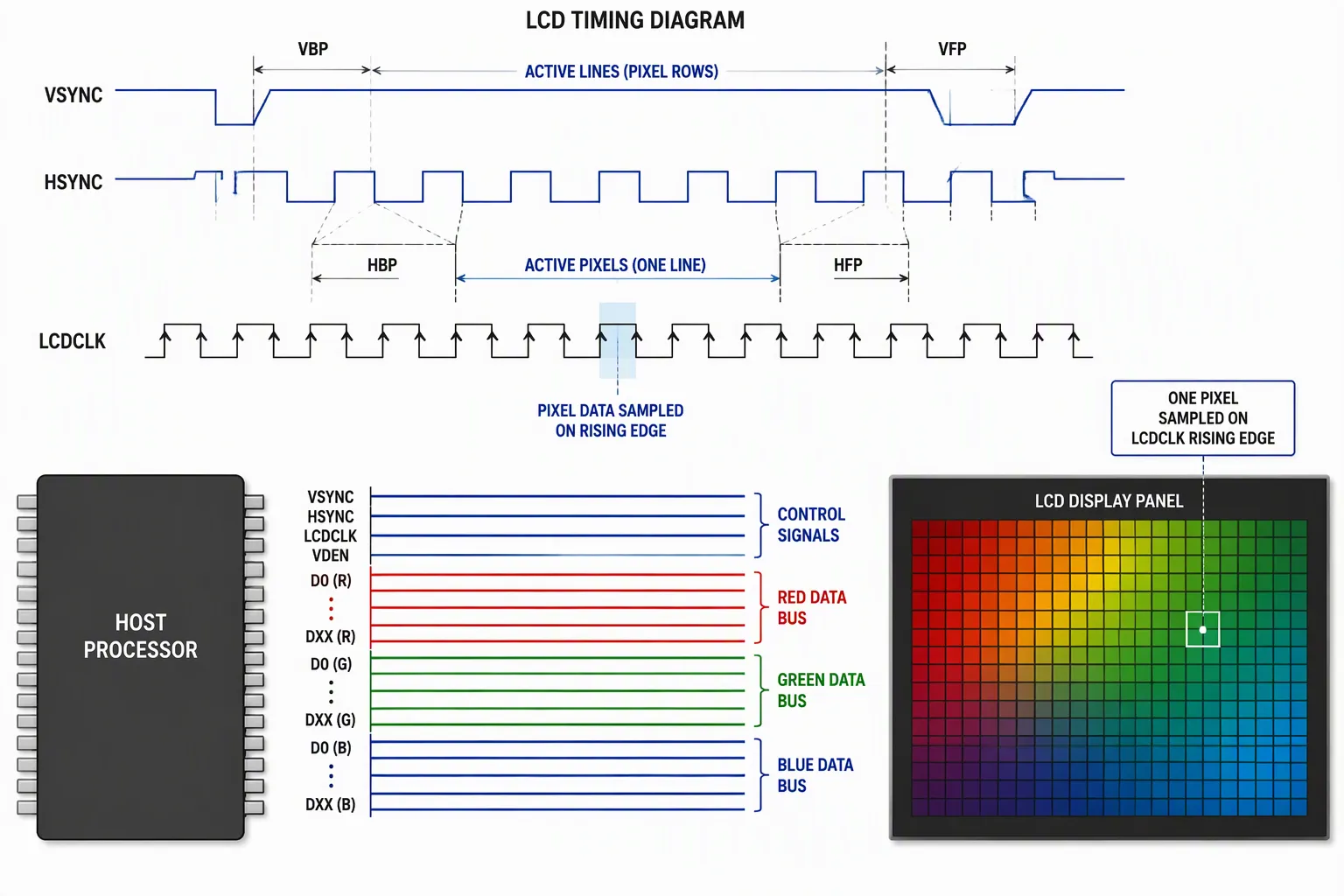
VSYNC, HSYNC, Àwọn Ìlà Dátà, àti LCDCLK
Àwọn ẹgbẹ́ àmì mẹ́rin ló gbé gbogbo férémù kọjá ọ̀nà ìsopọ̀ RGB kan. Each one has a distinct job, and the panel fails to lock if any of them drifts.
Signal | definition | ipa |
|---|---|---|
VSYNC | Vertical synchronization | Resets the start of a new frame; no image data travels during the VSYNC pulse |
HSYNC | Horizontal synchronization | Ó tún ìlà tó tẹ̀lé ṣe; dátà ìpele grẹy RGB fún ìlà kan gbọ́dọ̀ dé láàrín àwọn ìlù HSYNC méjì |
Data lines (D0…DXX) | Dáta RGB tí ó jọra, ìlà kan fún bit kan | Carry the gray-level color data for each pixel and row |
LCDCLK | Aago LCD, ìgbóhùnsáfẹ́fẹ́ pixel | Ó ń mú kí ìpele grẹ́y dọ́gba; TFT ń wakọ̀ píksẹ́lì kan fún aago kan, nítorí náà gígùn rẹ̀ tẹ̀lé iye ọ̀wọ̀n ti ìpinnu náà |
VDEN | Data enable | Tells the panel whether the RGB signals are valid |
Àwọn ìlà ìwífún náà pín sí àwọn ẹgbẹ́ mẹ́ta: blue LSB to MSB, green LSB to MSB, and red LSB to MSB. Each group carries the color depth for its channel. LCDCLK sets the pixel pace, and every data line is sampled on its edge. VSYNC and HSYNC act as reset pulses for the frame and the row. VDEN adds a validity flag, so the panel ignores data outside the active window. This handshake gives the host tight control over what the display module captures and when. The interface between the host and the panel depends on all four groups staying in step.
Àwọn Ìlà Àkókò Férémù àti Ìlà
Àwọn àkókò òfo yí gbogbo ìṣiṣẹ́pọ̀pọ̀ ká, àwọn àkókò wọ̀nyí sì ń ṣàlàyé ìnáwó àkókò. Ní orí ìlà ìlà, HBP (ìlà iwájú ẹ̀yìn tí ó wà ní ìpele) dúró lẹ́yìn ìlù HSYNC àti ṣáájú pixel tí ó wà ní ìpele àkọ́kọ́. HFP (ìlà iwájú iwájú tí ó wà ní ìpele) tẹ̀lé pixel tí ó wà ní ìpele ìkẹyìn ó sì ṣáájú ìlù HSYNC tí ó tẹ̀lé. Ìbú ìlù HSYNC fúnrarẹ̀ jẹ́ paramita ọ̀tọ̀. Ní orí ìlà ìlà ìlà, VBP (ìlà iwájú tí ó dúró ní ìpele) tẹ̀lé ìlù VSYNC kí ó tó di ìlà àkọ́kọ́ tí ó wà ní ìpele àkọ́kọ́, àti VFP (ìlà iwájú tí ó dúró ní ìpele) tẹ̀lé ìlà tí ó wà ní ìpele ìkẹyìn kí ó tó di ìlà VSYNC tí ó tẹ̀lé. A ṣètò ìwọ̀n ìlù VSYNC lọ́tọ̀. Ìlù tí ó wà ní ìpele kékeré lè má lè tún páànẹ́lì náà ṣe, ìlù tí ó sì gbòòrò jù sì ń jẹ àkókò tí ó wà ní ìpele àkọ́kọ́.
Àwọn pàrámítà wọ̀nyí fún ọ ní ìṣàkóso taara lórí ìdènà páànẹ́lì àti ibi tí àwòrán wà. Àkókò ìlà gbogbo dọ́gba pẹ̀lú àwọn píksẹ́lì tí ń ṣiṣẹ́ pẹ̀lú HBP, HFP, àti ìwọ̀n ìlù HSYNC. Àkókò àpapọ̀ fírẹ́mù dọ́gba pẹ̀lú àwọn ìlà tí ń ṣiṣẹ́ pẹ̀lú VBP, VFP, àti ìwọ̀n ìlù VSYNC. Ìwọ̀n ìtùnú tẹ̀lé láti àkókò àpapọ̀ fírẹ́mù: ìwọ̀n ìtùnú = 1 / àkókò àpapọ̀ fírẹ́mù. Gbàngàn gígùn ra àkókò ìtúsílẹ̀ páànẹ́lì sí i, àti gbọ̀ngàn kúkúrú ga ìwọ̀n ìtùnú ní aago kan náà. O gbọ́dọ̀ bá gbogbo ìní mu pẹ̀lú ìwé àkọsílẹ̀ páànẹ́lì, nítorí pé olùdarí ìfihàn àti awakọ̀ páànẹ́lì pín àdéhùn àkókò yìí. Jẹ́ kí gbọ̀ngàn kan ṣe àṣìṣe, àwòrán náà sì yípadà tàbí ya.
The control logic inside the driver counts pixels and lines against these parameters. Each HSYNC pulse resets the column counter, and each VSYNC pulse resets the row counter. That counting scheme keeps the signal path aligned frame after frame and gives the driver precise timing control. A stable timing set also protects the panel from partial-frame writes, which show up as flicker or banding. Log the timing values in your bring-up notes, and compare them against the datasheet on every board revision.
Timing Example: 480×272
Calculating Line and Frame Timing
ya kan 480 × 272 panel running at 16 bpp. The register set stores each display size as a value minus one, so HOZVAL holds 479 and LINEVAL holds 271. The porches and pulses come from the same register block: HBP = 2, HFP = 2, HSYNC pulse width = 41, VBP = 2, VFP = 2, and VSYNC pulse width = 10.
Add the horizontal terms to get the line length in pixel clocks: 480 active pixels + 2 + 2 + 41 = 525 clocks per line. Add the vertical terms to get the frame length in lines: 272 active lines + 2 + 2 + 10 = 286 lines per frame. Multiply the two totals, and one frame needs 150,150 pixel clocks. The pixel clock itself comes from the bus clock divided by twice the clock divider plus one, so the divider setting sets the pace for the whole signal chain.
Deriving the Refresh Rate
Ìwọ̀n ìtúnṣe náà tẹ̀lé láti aago pixel tí a pín pẹ̀lú àwọn aago nínú fírẹ́mù kan. Ní aago pixel ti 7.83 MHz, pín sí 150,150, o sì dé nítòsí 52.1 Hz.
Iye yẹn wà láàrín ìwọ̀n pánẹ́lì tó wọ́pọ̀, nítorí náà, ṣe é gẹ́gẹ́ bí àyẹ̀wò lórí ìṣirò ìforúkọsílẹ̀ rẹ. Jẹ́rìí aago pixel sí ìwé àkọsílẹ̀ pánẹ́lì kí o tó ṣe àkókò náà. Iye aago tí kò tọ́ máa ń yọ gbogbo gbọ̀ngàn àti ìlù jáde ní ìsàlẹ̀. Kọ iye ìlà náà sílẹ̀, àpapọ̀ fírẹ́mù náà, àti ìwọ̀n ìtúnṣe tó yọrí sí nínú àwọn àkọsílẹ̀ ìkọ́lé rẹ, lẹ́yìn náà, fi wọ́n wéra lórí àtúnṣe pánẹ́lì kọ̀ọ̀kan. Àṣà yìí máa ń jẹ́ kí ipa ọ̀nà ìṣàkóso jẹ́ òótọ́, ó sì máa ń mú kí àkókò máa lọ ní ìbẹ̀rẹ̀. Ìlànà ìṣàkóso inú awakọ̀ náà máa ń ka àwọn píksẹ́lì àti ìlà sí àwọn iye kan náà, nítorí náà, ìṣirò mímọ́ yóò fún ọ ní ìfihàn tó dúró ṣinṣin àti àmì tí pánẹ́lì náà lè ti.
LED Driving Control Workflow
The Data-to-Light Signal Chain
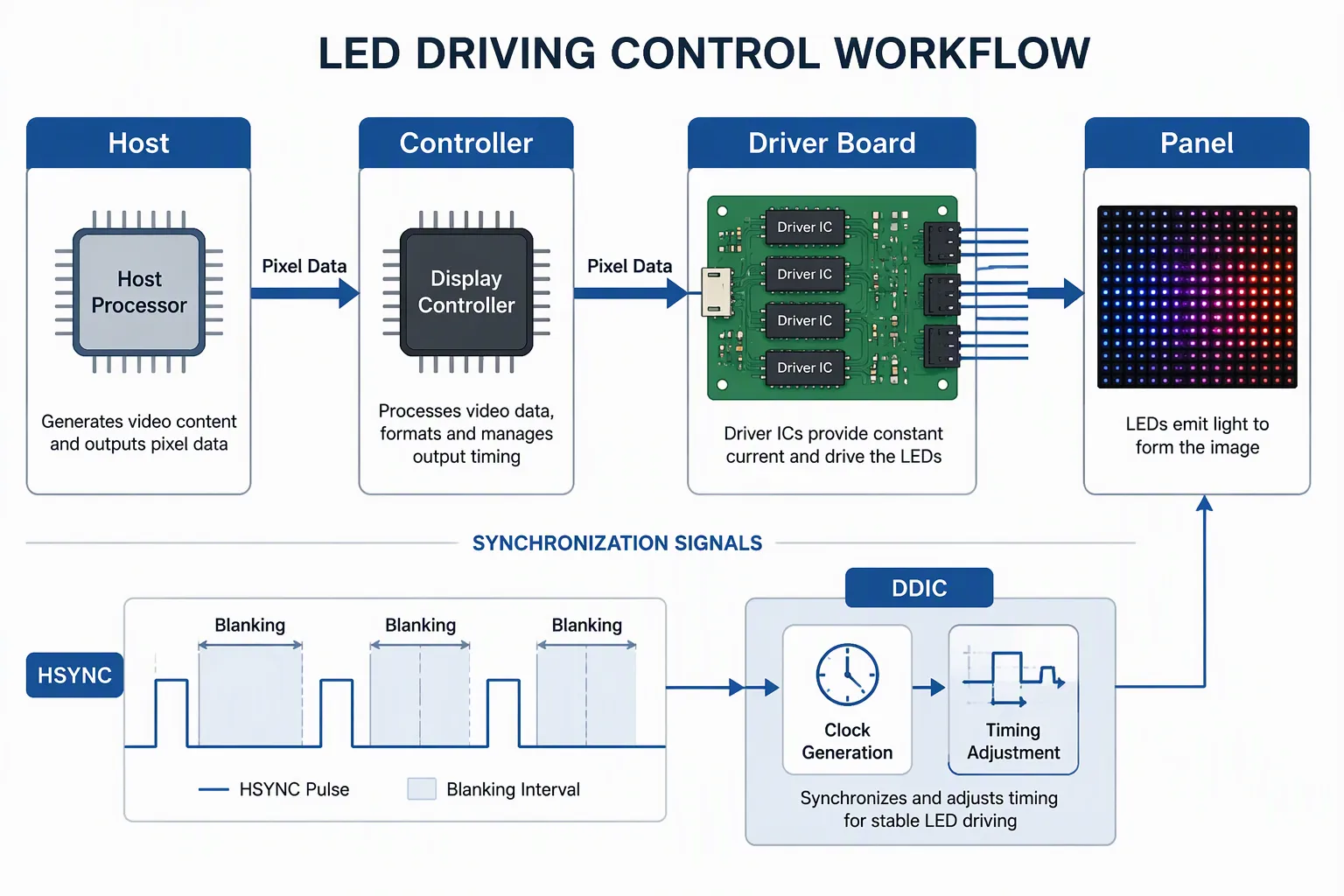
The led driving control workflow starts at the host processor. Your host renders a frame and hands it to the display controller. That controller formats the pixels and pushes them across the interface to the driver board. The driver board holds the driver ics that latch each pixel value. From there, the data moves to the panel, where each pixel electrode receives its analog voltage. Light follows.
Ẹ̀wọ̀n àmì ìfihàn yìí ní ìpele mẹ́rin: olùgbàlejò, olùdarí, pátákó ìwakọ̀, àti páànẹ́lì. Ìpele kọ̀ọ̀kan ń fi aago tirẹ̀ gba férémù náà síwájú. Olùgbàlejò náà ń ṣètò àkóónú àwòrán náà. Olùdarí náà ń ṣètò àkókò náà. Àwọn ẹ̀rọ ìwakọ̀ náà ń ṣètò fóltéèjì. Páànẹ́lì náà ń ṣètò ìmọ́lẹ̀ náà. Bíbọ́ ní ìpele èyíkéyìí dá gbogbo ètò ìfihàn LED dúró.
Brightness control adds one more layer. In a backlit LCD, led drivers set the light level behind the glass. In a true LED matrix, led drivers set each pixel directly. Either way, the driving principle of an led screen stays the same: current in, light out. Constant-current driver ics hold that current steady, and pwm dims it without color shift. The lcd/led display driver ties these stages into one path from bits to photons.
Synchronization Between Driver and Interface
Títìpá-sí-férémù da lórí ìṣàkóso àkókò pàtó àti ìṣiṣẹ́pọ̀ nínú DDIC. Àwọn àyíká ìṣẹ̀dá aago tó ti ní ìlọsíwájú máa ń so awakọ̀ pọ̀ mọ́ àkókò fírémù tó ń bọ̀. Àwọn ọ̀nà ìṣàtúnṣe àkókò lẹ́yìn náà máa ń san àwọn ìyàtọ̀ nínú ìwọ̀n ìfihàn àti ìpinnu, nítorí náà àwọn fírémù máa ń bá ara wọn mu. Olùdarí àkókò tó ṣọ̀kan máa ń ṣètò ìṣiṣẹ́ àti ìparẹ́ píksẹ́lì, èyí tó máa ń jẹ́ kí ìwọ̀n ìtúnṣe dúró ṣinṣin àti àwọn ìyípadà fírémù rọrùn.
Àwọn ìlù ìṣiṣẹ́pọ̀ àti àwọn àkókò ìfọ́mọ́ra ló ń ṣiṣẹ́ gidi . Ọ̀kọ̀ọ̀kan wọn fún DDIC ní ojú ìtọ́kasí tí a ti yàn tẹ́lẹ̀.
Ilana akoko | Ipa ninu Amuṣiṣẹpọ fireemu |
|---|---|
HSYNC (ìwọ̀n ìfọwọ́sowọ́pọ̀ ìpele) | Ó ṣe àmì sí ìbẹ̀rẹ̀ àti òpin ìlà petele kọ̀ọ̀kan kí DDIC lè ṣe àtúnṣe ìlà data pixel ní ìlà kọ̀ọ̀kan |
HBP (ìloro ẹ̀yìn petele) | Àárín ìfọ́mọ́ lẹ́yìn HSYNC tí ó gba ìṣiṣẹ́ inú láàyè kí àwọn píksẹ́lì tó ń ṣiṣẹ́ |
HFP (ìloro iwaju petele) | Blanking interval before the next HSYNC that completes the horizontal period |
VSYNC (ìwọ̀n ìṣiṣẹ́pọ̀ inaro) | Marks the start and end of each frame so the DDIC aligns frame by frame |
VBP (vertical back porch) | Àwọn ìlà ìbòmọ́lẹ̀ lẹ́yìn VSYNC fún ìṣiṣẹ́ inú kí àwọn ìlà tí ń ṣiṣẹ́ tó bẹ̀rẹ̀ |
VFP (vertical front porch) | Àwọn ìlà ìbòmọ́lẹ̀ ṣáájú VSYNC tó tẹ̀lé tí ó parí àkókò inaro |
Àwọn pàrámítà wọ̀nyí ń ṣàlàyé àpapọ̀ àwọn àkókò aago àti ìlà fún fírẹ́mù kọ̀ọ̀kan, kìí ṣe àwọn píksẹ́lì tí a lè rí nìkan. Aago píksẹ́lì náà wá láti inú àpapọ̀ àkókò àkókò petele àpapọ̀ gbogbo àkókò àkókò inaro. DDIC ń lo àwọn àkókò ìfọwọ́sowọ́pọ̀ àti ìfọ́mọ́lẹ̀ wọ̀nyí láti ti mọ́ fírẹ́mù ìfọwọ́sowọ́pọ̀ kọ̀ọ̀kan. Ètò ìṣàkóso rẹ gbọ́dọ̀ bá gbogbo ìní mu pẹ̀lú ìwé àkọsílẹ̀ pánẹ́lì náà. Gbàngàn kan tí kò tọ́ fọ́ ìdènà náà, àwòrán náà sì ya. Àwọn ics awakọ̀ ìsinsìnyí àti ìdè àkókò náà ń ṣiṣẹ́ gẹ́gẹ́ bí ẹyọ kan níbí. Ìyípadà ìwọ̀n pulse ń mú dídín, ọ̀nà ìfọwọ́sowọ́pọ̀ sì ń mú ìdúró. Jẹ́ kí méjèèjì wà ní ìpele, gbogbo fírẹ́mù sì ń bá ibi tí ó yẹ kí ó wà.
Apẹrẹ Awakọ ati Imọ-ẹrọ Awakọ LED
Àwọn Ohun Tí A Fi Ń Rí Nípa Apẹrẹ Awakọ Pataki
Ẹ̀rọ ìṣàfihàn IC kan wà láàrín MPU tàbí MCU rẹ àti gilasi náà. three roles: translation, interface, and controlNígbà tí a bá ń túmọ̀ rẹ̀, ìṣẹ́ náà yóò yí àwọn ìwífún àwòrán tí ń wọlé padà sí àwọn ìgbì iná mànàmáná tí a ṣe lẹ́sẹẹsẹ fún orísun, ẹnu ọ̀nà, ìpín, àti àwọn iṣẹ́ awakọ̀ tí ó wọ́pọ̀. Pátákó náà yóò yí àwọn ìgbì náà padà sí ìmọ́lẹ̀ àti àwọ̀. Iṣẹ́ yìí nílò ìdúróṣinṣin àmì tí ó lágbára lórí àwọn ipa ọ̀nà ìsopọ̀ gígùn àti ìwà tí ó dúró ṣinṣin lórí ìwọ̀n otútù àti àwọn àyè folti iṣiṣẹ́.
Lórí ìsopọ̀, ọ̀nà ìsopọ̀ pánẹ́lì náà ń ṣe àgbékalẹ̀ ìwakọ̀ rẹ. O yan lára àwọn ọ̀nà ìfipamọ́ mẹ́ta, gbogbo wọn sì ń pàṣípààrọ̀ iye owó tí a fi wé ìwọ̀n bezel.
Ọna apoti | Iṣagbesori ati afisona | Alupayida |
|---|---|---|
COG | Awakọ ti a gbe taara sori gilasi | Owó tó kéré jùlọ, àwòrán tó rọrùn jùlọ, ààlà tó tóbi tó sì hàn gbangba |
Cof | Driver on flexible film folded behind the panel | Iye owo ti o dọgbadọgba, eti iwaju kekere |
cop | Driver region hidden behind the active area on a flexible substrate | Fọ́ọ̀mù pàtàkì, ìjókòó tó kéré jùlọ |
Lórí ìṣàkóso, àwọn ètò píksẹ́lì tó dára jù nílò ìtòlẹ́sẹẹsẹ àkókò tó le koko. Àwọn ìyàtọ̀ kékeré máa ń fa àwọn ohun èlò tó hàn gbangba, ìmọ́lẹ̀ tó dúró ṣinṣin, tàbí ìdínkù nínú ìṣọ̀kan. Àwọn ẹ̀rọ ìwakọ̀ rẹ gbọ́dọ̀ ṣe àwọn àmì, tẹ̀lẹ́, àti mú àwọn iṣẹ́ ìṣàyẹ̀wò páànẹ́lì ṣiṣẹpọ. Agbára tó ń ṣiṣẹ́ dáadáa ṣe pàtàkì pẹ̀lú. Ìṣàkóso awakọ̀ tó gbọ́n máa ń dín agbára kù nígbà tí a bá ń ṣe àtúnṣe àti àwọn ìyípadà ìmọ́lẹ̀ láì ba dídára àmì jẹ́.
Yiyan Imọ-ẹrọ Awakọ fun Ohun elo naa
Iṣakoso piksẹli to peye n rii daju pe gbogbo piksẹli gba folti tabi ina to peye ni akoko to tọ. O gba imọlẹ to peye, awọn awọ to peye, ati išipopada ti o dan. Ipinnu giga ati awọn oṣuwọn isọdọtun jẹ ki iṣakoso to peye paapaa ṣe pataki. Awọn panẹli OLED nla n ṣafikun ẹru miiran: chip naa gbọdọ sanpada fun awọn ipa ọna ifihan agbara gigun, awọn iyipada akoko, ati awọn iyatọ abuda TFT nipa lilo data calibration ati isanpada folti.
Your choice of led driver technology follows the application. Backlit LCDs need led drivers that set overall light output, while true LED matrix panels need led drivers that set every pixel. Constant-current driver ics hold the set current steady, and their constant current accuracy stays under 0.1%. A pwm scheme dims the light without color shift. The same pwm path supports brightness control across the control system. Build your control logic around over-temperature and over-current shutdown, and the led driver protects itself. A well-chosen driver circuit and a matched control system keep the lcd/led display driver predictable from prototype to volume production.
Ìfọwọ́sowọ́pọ̀ náà ń pèsè dátà àti àkókò tí a ṣẹ̀dá. Àwọn awakọ̀ ics yí dátà náà padà sí àwọn folti analog fún-pixel. Àwọn pàrámítà àkókò, àpẹẹrẹ awakọ̀, àti ìmọ̀ ẹ̀rọ awakọ̀ LED para pọ̀ láti ṣe fírémù pípé kan. Àwọn awakọ̀ LED rẹ ń ṣètò ìṣàn, pwm ń ṣàkóso ìmọ́lẹ̀, àti ìwọ̀n ìtúnṣe tẹ̀lé láti àkókò gbogbo fírémù.
You now see why this partnership matters. A wrong porch breaks the signal lock. A weak led driver circuit adds flicker. Good control starts with the datasheet. Debug one stage at a time, and your display will lock frame after frame. Driver ics, pwm dimming, and led drivers all share one timing contract. Learn it well, and every future panel becomes easier to bring up.
FAQ
What does the driver IC do that the interface cannot?
Ìfọwọ́sowọ́pọ̀ náà kàn ń gbé àwọn ìṣùpọ̀ àti àkókò nìkan. Awakọ̀ IC náà máa ń di iye píksẹ́lì kọ̀ọ̀kan mú, ó sì máa ń yí i padà sí fólẹ́ẹ̀tì analog lórí píksẹ́lì elektrodu. Láìsí ìgbésẹ̀ ìtumọ̀ yẹn, dátà náà kò ní tàn. O nílò kí àwọn ìdajì méjèèjì máa ṣiṣẹ́ papọ̀ kí férémù èyíkéyìí tó bá fara hàn.
Kí ló dé tí àwọn awakọ̀ LED fi ń ṣe àkóso ìṣàn agbára dípò fóltéèjì?
Forward voltage falls as the junction heats up. A resistor circuit then lets current climb, and the extra heat repeats the loop. Constant-current driver ICs hold the set current steady, with accuracy under 0.1%. That stability protects the LED and keeps brightness repeatable across temperature and aging.
When should you choose MIPI DSI over parallel RGB?
Pick MIPI DSI when bandwidth and pin count matter. Four lanes at 2.5 Gbps each deliver roughly 10 Gbps, enough for 4K at 60 Hz. Parallel RGB suits medium panels with direct timing. Small instrument clusters and healthcare devices often run on I2C or SPI instead.
Kí ló máa ń ṣẹlẹ̀ tí ìloro tàbí ìbú pulse bá ṣe àṣìṣe?
Pánẹ́lì náà máa pàdánù ìdènà rẹ̀ lórí férémù tí ń bọ̀. Pílánẹ́ẹ̀lì ìṣọ̀kan tó ṣókùnkùn lè má lè tún pánẹ́lì náà ṣe, èyí tó gbòòrò sì máa ń jẹ àkókò tó ń ṣiṣẹ́. Lẹ́yìn náà, àwòrán náà yóò yípadà, yóò ya, tàbí yóò tàn. So gbogbo iye àkókò pọ̀ mọ́ ìwé àkọsílẹ̀ pánẹ́lì náà, kí o sì kọ wọ́n sílẹ̀ fún àtúnṣe pánẹ́lì kọ̀ọ̀kan.
How do you verify your timing math during bring-up?
Fi awọn piksẹli ti nṣiṣe lọwọ kun si HBP, HFP, ati iwọn pulse HSYNC lati gba awọn aago fun laini kan. Fi awọn ila ti nṣiṣe lọwọ kun si VBP, VFP, ati iwọn pulse VSYNC lati gba awọn laini fun fireemu kan. Ṣe isodipupo apapọ mejeeji, lẹhinna pin aago piksẹli naa pẹlu ọja yẹn lati ṣayẹwo oṣuwọn isọdọtun. Ṣiṣayẹwo iṣakoso yii mu awọn aṣiṣe iforukọsilẹ ni kutukutu.